This is default featured slide 1 title

Go to Blogger edit html and find these sentences.Now replace these sentences with your own descriptions.This theme is Bloggerized by Lasantha Bandara - Premiumbloggertemplates.com.

This is default featured slide 2 title

Go to Blogger edit html and find these sentences.Now replace these sentences with your own descriptions.This theme is Bloggerized by Lasantha Bandara - Premiumbloggertemplates.com.

This is default featured slide 3 title

Go to Blogger edit html and find these sentences.Now replace these sentences with your own descriptions.This theme is Bloggerized by Lasantha Bandara - Premiumbloggertemplates.com.

This is default featured slide 4 title

Go to Blogger edit html and find these sentences.Now replace these sentences with your own descriptions.This theme is Bloggerized by Lasantha Bandara - Premiumbloggertemplates.com.

This is default featured slide 5 title

Go to Blogger edit html and find these sentences.Now replace these sentences with your own descriptions.This theme is Bloggerized by Lasantha Bandara - Premiumbloggertemplates.com.

Friday, July 2, 2021

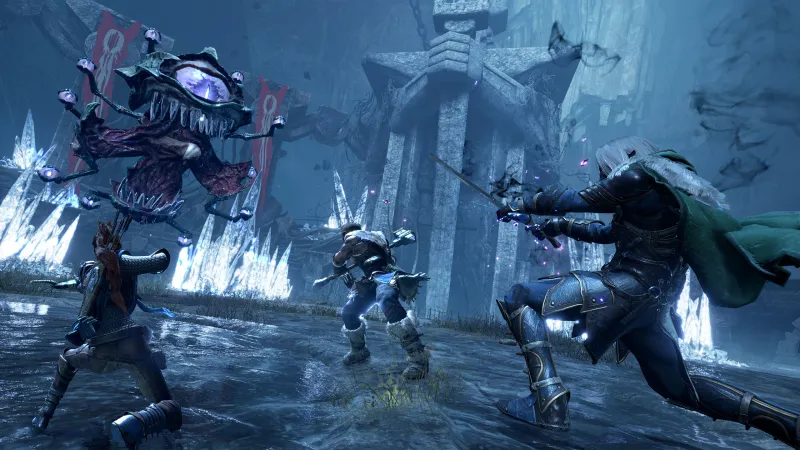
Dungeons & Dragons: Dark Alliance Review – Missing Ingredients

Publisher: Wizards of the Coast
Developer: Tuque Games
Rating: Mature
Reviewed on: Xbox Series X/S
Also on: PlayStation 5, PlayStation 4, Xbox One, PC

Wanting something to be good doesn’t make it so. I have a deep enthusiasm for the D&D tabletop game, fond memories of the R.A. Salvatore-penned novels that introduced these characters, and I was even excited about the revival of the cooperative Dark Alliance title from 20 years ago – I am the target audience for this fantasy action/RPG. Those preconditions are enough to make Dark Alliance a passable adventure in its early hours, especially when enjoyed with friends. But the deeper I played, the more the level design, character progression, cooperative elements, story, and combat mechanics began to fall apart, leaving the outline of an engaging adventure, but with few of the requisite features to fill in the middle.

The original Dark Alliance offered an isometric adventure in the vein of Diablo, but this new incarnation switches to a more engaged third-person perspective, with a big focus on stringing together combat moves, dodging out of danger, and even jumping and traversal elements. I like the emergent approach to attacks, which encourages players to combine light, heavy, and special moves to create their own favorite assaults. Unfortunately, the fundamentals of a tight melee exchange aren’t there. Hit detection is dicey, and bad physics lead to weird moments, and even insta-death for both you and enemy minions and bosses. Characters feel unwieldy and sluggish, refusing to break out of certain animations, and take too long to drink life-saving potions. Stagger mechanics regularly take away control, leading to a sense of frustration and powerlessness as the bad guys rail on your unresponsive hero.

Click here to watch embedded media

Levels are large and have lots of optional paths full of extra treasure, and I enjoy the variety of environments to discover over the course of play. But some sequences are meandering, with more than a little backtracking. And some are simply too long, especially since the game doesn’t allow for drop-in play during missions. The burden of these longer quests is at odds with the casual hack-and-slash feel of the broader game. The enjoyability of the levels is also held back by lackluster visual fidelity on most characters, environments, and monsters; everything lacks the coat of polish needed to compete in the current landscape of remarkably beautiful games

Multiple selectable difficulties before each mission allow for proportionately higher rewards in gold and equipment. And I quite like the “push your luck” mechanic during a mission, where you can forgo short rests to boost your gear rarity. However, all but the lowest challenge levels are effectively inaccessible to solo players, as the game is clearly balanced with cooperative play in mind. That’s well and good if you’ve consistently got a group of two or three friends at hand, but you’re in trouble if you don’t. The online matchmaking is a mess, frequently failing on a technical level to make a connection. When it does match, there are almost no options for how to cater the group to the challenge or level that each player needs, so potential squadmates are often rightfully dropping to try and find a group that matches their goals.

The matchmaking problems and failure to balance for solo play have a cascading negative effect on progression. The quality of your equipment eventually plateaus, since higher tiers of gear only show up in higher difficulties, and those difficulties offer constant one-hit kills from enemies, especially since your gear is too low to fight them. You can wait to find a team that happens to be doing a mission you want to do at the appropriate difficulty, or create a custom game at that level and hope you have players of an adequate level join from the random queue, but it’s all just a headache that encourages you instead to simply move on to a new game.

Click image thumbnails to view larger version


Developer Tuque Games has a clear affection for both the Forgotten Realms D&D setting, and the storied characters like Drizzt and Wulfgar who are the game’s leads. That affection manifests as a wealth of lore for faithful fans, and the developer has gone to great pains to slot this narrative into an appropriate place within the companions’ previously chronicled journeys. But the tales at hand all feel disjointed and lack cohesion, linking together to create a vague string of barely connected adventures, which never really go anywhere. From beholders to dragons, I had fun seeing some iconic creatures from the tabletop role-playing game make an appearance, but the potential for genuine storytelling or character development is lost in the ceaseless swing of scimitars and hammers.

With multiple collectible gear sets, magic-infused combat, and characters with distinct powers, building up a fun rhythm of play is possible, especially if you choose to tackle the entire game with a consistent group of players who stay in pace with each other’s progress. But even then, the cracks in the core experience are apparent. I wanted to have fun with Dark Alliance’s breezy adventures through a familiar fantasy world, but too many elements left me disappointed, and even the flashing weapons wielded by the Companions of the Hall weren’t enough to blind me to what was missing.
Score: 6

Summary: Affection for the brand and characters may maintain interest if playing with friends, but this by-the-numbers action/RPG has some big problems.

Concept: Team up as well-known D&D characters to take on goblins, giants, and dragons in a by-the-numbers looter

Graphics: Muddy environment textures and drab main character models add up to a game that simply doesn’t meet visual expectations

Sound: Voice acting is solid, and the music is familiar fantasy fare

Playability: Deep problems in control, hit detection, an over-reliance on stagger mechanics, and a poor approach to balancing all hold back the skeleton of a solid combat system

Entertainment: Hacking and slashing with friends is always fun, but Dark Alliance has too many problems to recommend when so many other cooperative experiences offer more

Replay: Moderately Low
Click to Purchase

Ender Lilies: Quietus of the Knights Review – Slaying In The Rain

Publisher: Binary Haze Interactive
Developer: Live Wire
Rating: Teen
Reviewed on: PC
Also on: PlayStation 5, PlayStation 4, Xbox One, Switch

Ender Lilies: Quietus of the Knights ticks all the boxes of a respectable Metroidvania. It delivers a colossal labyrinth that’s fun to explore, and you find cool new abilities to open inaccessible areas all while leveling up and enhancing your character with powers and equipment. I’m a sucker for the genre, so that bare minimum is usually enough to get me on board no matter how many games enter the space. But as I traversed Ender Lilies’ beautifully realized gothic kingdom, I found its challenging yet entertaining combat and myriad secrets helped set it a cut above several of its contemporaries. Ender Lilies likely won’t rope in anyone burned out on this style of game, but those looking to scratch that familiar itch will find plenty to love here.  

Lily is a young priestess who awakens to find her home of Land’s End in absolute ruin. A shower called the “Rain of Death” has not only devastated the land, but it has also transformed its citizens into undead abominations called the Blighted. Lily alone possesses the power to cleanse the afflicted of this disease, but she isn’t a trained fighter. Enter the Umbral Knight, an immortal protector who serves as Lily’s sword and guide.

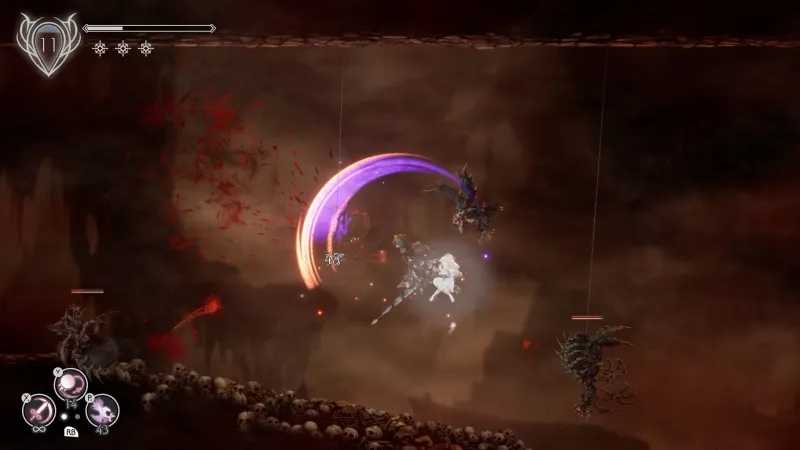
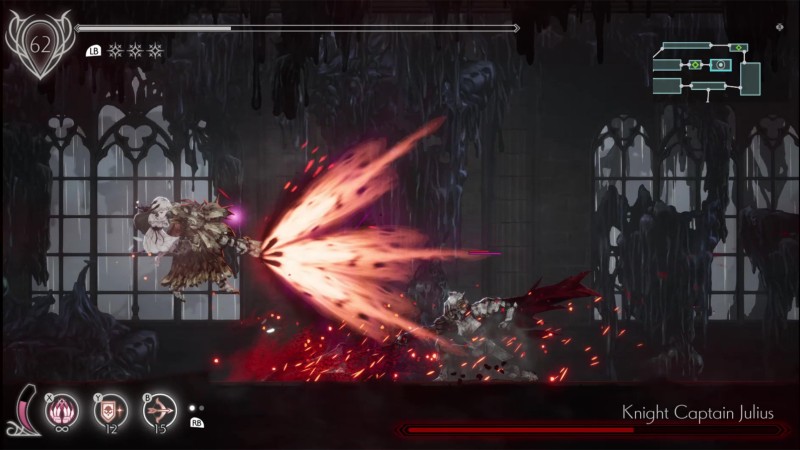
Whenever Lilly attacks, she summons the Knight, who eviscerates foes with simple yet satisfying hack n’ slash moves that can be upgraded to hit harder and perform longer combos. These attacks look slick, and watching the Knight handle the dirty work while Lily sheepishly cowers in the background is an endearing bonus. Lily’s roster of guardian spirits grows as she seeks out other cursed souls and engages them in exciting, white-knuckle boss battles. After defeating these monsters, Lily gains vital abilities used to access new areas of the map. These powers are nothing new if you’ve played enough of these types of games. Expect a double-jump, speed dash, and wall jump, for example. But I was always excited to gain more mobility and unlock access to a new area, thanks in part to the plethora of fun optional minibosses hiding within each zone. 

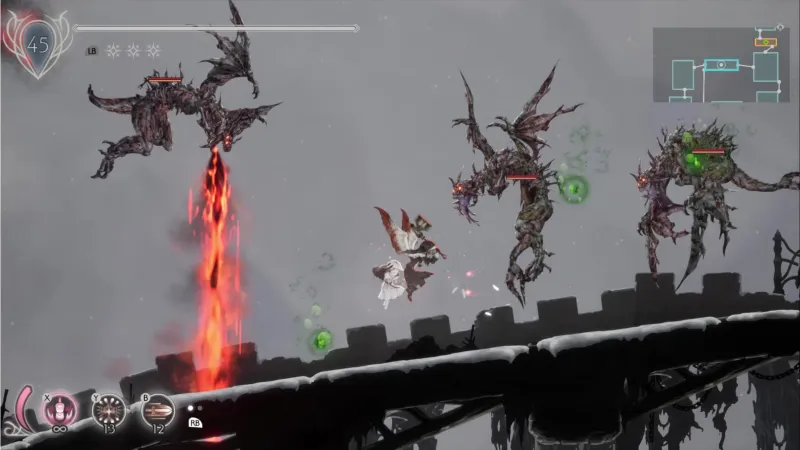
Smaller foes – from disease-ridden mages to undead paladins – may be weaker than the critical path bosses, but defeating these enemies often rewards Lily with powerful new attacks that can turn the tide in your favor. I love conjuring a powerful whirlwind to blow back enemies or summoning a fireball-shooting bird for a handy assist. These powers are invaluable because Ender Lilies is no joke in the difficulty department. Though the challenge is more entertaining than oppressive, the game demands an above-average level of finesse as even the most basic enemies can quickly annihilate lackadaisical players, and you’ll soon learn that you’re better off when you have more powers at your disposal. Some abilities are simply better tailored for certain enemies. For example, I found suffocating sluggish foes with a toxic cloud before they could reach me a great tactic.

Although you can beat any foe using any of your attacks, Ender Lilies rewards players who experiment with loadouts, and I enjoyed testing different strategies and reaping the results. Combining attacks works well too. It feels slick summoning a brute to launch foes skyward with his powerful downward strike, then impaling them in midair with a volley of arrows courtesy of a fallen archer. You can only equip a limited number of abilities and equipment, however, and it’s mildly annoying that you can only edit your loadout in save rooms. The excitement of gaining a new power diminishes when you have to drop everything to trek back to the nearest checkpoint. Despite this, acquiring as many tools in my belt as possible became a powerful motivator to search room after terror-filled room.  

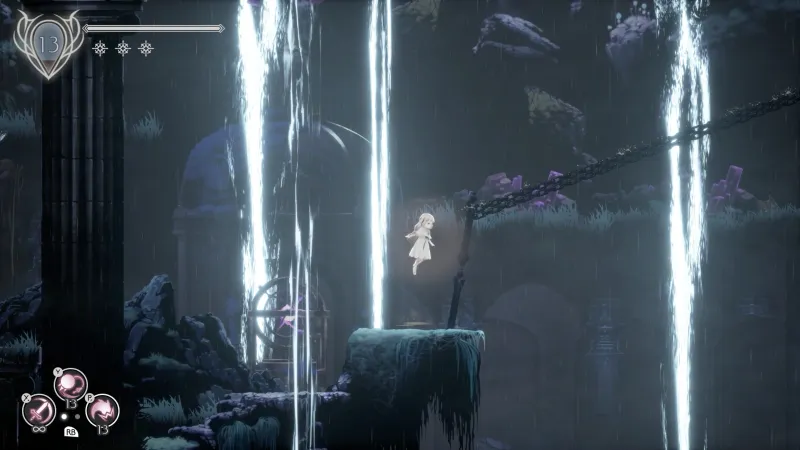
The map is a gigantic network of rooms that had me gleefully rubbing my hands in anticipation for each new expedition. Ender Lilies is divided into gorgeous, visually distinct biomes, from an underground laboratory run by mages to a fairytale-like forest. I had fun exploring most of these areas, save for one poison-filled swamp that was more stress-inducing than entertaining. A fantastic musical piece for each area further sets them apart; I looked forward to revisiting several zones just to hear my favorite songs again. 

Clearing a map of its secrets is one of the most appealing elements of the genre, and Ender Lilies litters its areas with enticing treasures to uncover. I was engrossed with finding worthwhile upgrades such as extra weapons slots, permanent health boosts, and blessings that improved the potency of my healing ability. Rooms also hide genuinely interesting notes and diary entries that flesh out the world while detailing the individual tragedies of its ill-fated occupants. Best of all, Ender Lilies’ color-coded map clearly communicates when you’ve emptied a room of its goodies, so you know exactly when to move on. That said, some items are a little too hidden and require an annoying degree of tiptoeing to see that faint white glow over a spot you walked over numerous times before. 

Ender Lilies doesn’t revolutionize Metroid’s decades-old template, but that’s okay. It’s a well-made experience, and I had a great time pouring over two dozen hours into this adventure. The presentation rocks, the action is more rewarding than punishing, and its gothic world and lore are alluring. Ender Lilies is a great meat and potatoes experience, demonstrating that simply executing a familiar formula at a high level can be just as welcomed as reinventing the wheel.

Score: 8.5

Summary: Ender Lilies doesn't break the mold for Metroidvanias, but its engrossing gameplay and eye-catching presentation serves a great example of how to execute them well.

Concept: A young priestess and her knight companion must cleanse a kingdom overtaken by a malevolent blight

Graphics: Ender Lilies immediately grabs attention thanks to its beautiful, animated sprites and detailed, varied environments

Sound: Although the game lacks voice-acting, a wonderful and varied soundtrack made me think twice about treating this as a podcast game

Playability: Tough-as-nails enemies present a fun challenge, and the large arsenal of abilities deepens your offensive strategy while providing a strong incentive to explore and find more of them

Entertainment: Ender Lilies may be standard Metroidvania through and through, but it rises above most of its peers with an engrossing sense of progression and entertaining combat, all presented in a beautiful package

Replay: Moderate

Click to Purchase

Thursday, June 24, 2021

Mario Golf: Super Rush Review – Teed For Speed

Click to watch embedded media
Publisher: Nintendo
Developer: Camelot Software
Rating: Everyone
Reviewed on: Switch

Mario Kart and Mario Tennis players understand that when Nintendo’s cast of characters infiltrate a sport, they take the spirit of the game and turn it on its head with power-ups, unique character abilities, and zany courses. The game of golf is a patient affair, but when Mario and company step up to the tee in Mario Golf: Super Rush, it’s hardly slow-paced, as the unique take on the sport injects foot races, battle modes, and special abilities to often chaotic results.

The core golf mechanics shine in Mario Golf: Super Rush. Lining up your shot, using the in-game measuring tools to judge the distance you need, and entering your backswing is easy for anyone to understand. Selecting the power on your shot is done with a single, timed button press, with each stroke giving you the opportunity to add subtle effects like spin and curve through intuitive commands. On multiple occasions, I found a tree standing in my path to the green, but through shaping my shot, I could choose to either wrap the ball around the tree or float it above and land on the other side. Nailing a perfect shot like that is a regular occurrence thanks to streamlined controls, but it doesn’t make it any less satisfying to see your ball curve around a tree and land perfectly where you were aiming.

Obviously, the goal is to get your ball on the fairway or green, but if you find yourself in other spots, whether that’s the rough, a sand trap, or something worse, you must take those elements, as well as any slope of the terrain, into account. Where your ball lies affects the distance, trajectory, and even how the ball curves off your club. Once on the green, putting is as simple as lining up your shot, again accounting for the slope of the surface, and timing the meter to apply the correct amount of power. The tools at your disposal make the core golf mechanics continuously enjoyable from moment to moment and lay a terrific foundation for the more over-the-top deviations from the traditional golf formula. While Mario Golf: Super Rush provides a strong take on the traditional sport, destination modes like Speed Golf and Battle Golf (both of which can be played online) provide unique and entertaining twists to the tried-and-true formula.

Click here to watch embedded media

In Speed Golf, you tee off alongside up to three opponents, then take part in a foot race to where your ball lands before taking another swing. The goal remains to get the ball in the hole, but rather than taking your time to line up the shot, you have the clock to worry about; each stroke adds 30 seconds to your course time, and the player with the lowest time takes the podium. As you sprint to your ball, you need to consider the best route, your stamina meter, and on-course obstacles. However, the most fun part of the mode is when special shots and dashes start messing with the characters. While golfers are typically among the most respectful and chivalrous athletes, that all goes out the window in these modes; blasting somebody with your special dash is simply too much fun to ignore. However, Speed Golf’s biggest weakness is that this element isn’t taken far enough; too often the running parts of this mode feel uneventful, and the action often feels like filler between your strokes. Thankfully, for those who like the more chaotic elements, there’s Battle Golf.

Battle Golf drops you into an arena with other players in a nonlinear, free-for-all mode with the mission to sink three holes first. The stadium is full of environmental traps and weapons for players to use on each other; blasting a nearby rival with a Bob-omb as they try to line up their putt is beyond satisfying. Since holes disappears after the first player sinks it, you need to be strategic about which flagsticks you target, as well as the path you take to each one. On top of dangers like Chain-Chomps, Thwomps, and Bob-ombs, players can also use special shots to electrocute other players, turn their balls into imprecise Yoshi eggs, and even haunt them with a Boo to cause their shots to veer off course. For every half-measure that Speed Golf takes, Battle Golf goes all in, delivering my favorite mode in the Mario Golf: Super Rush package.

Click image thumbnails to view larger version


Unfortunately, another main attraction to Mario Golf: Super Rush doesn’t live up to its potential. Serving as both a tutorial and a linear story mode with light RPG elements, the single-player Golf Adventure is an adequate place to start your Mario Golf journey if you’re wanting to learn the basics, but the shine wears off fast. The mode is skippable thanks to its tendency to spotlight different unexciting variants of Speed Golf, repetitive boss fights, and downright frustrating modes. One section drops you into a big open course with several nonlinear holes like Battle Golf, only it’s a solo version with stroke limits and tornados you use to reach higher areas; if you don’t hit these tornados at just the right angle or miss the tornado and instead land at the foot of it, your attempt is basically done for as you waste precious strokes returning to the correct angle. Add in a completely nonessential story as the backdrop, and you’re better off sticking with the standalone modes.

Despite the underwhelming nature of the story mode, Mario Golf: Super Rush delivers plenty of golfing greatness. With a strong foundation and multiple fun avenues of play, Mario Golf: Super Rush carries on the long-standing tradition of Nintendo sports games by being a good time regardless of your fandom of the actual sport.

Score: 8.25

Summary: Whether you're a fan of golf, a fan of Mario, or both, Mario Golf: Super Rush is a fun twist on the sport.

Concept: Take the traditionally slow-paced game of golf and inject a foot race into the middle of the competition

Graphics: The Mario gang looks snazzy in their finest golf apparel, and the courses are brought to life with vibrant visuals

Sound: Super Rush’s soundtrack has a couple of bangers, but I quickly grew tired of much of the music. My Mii character’s voice alone made me want to mute the game

Playability: The core game of golf is well represented in an approachable manner, and having your fundamentals down will serve you well as you try to get your putt off before an opponent drops a Bob-omb on you in Battle Golf

Entertainment: Whether you want to play 18 holes of traditional golf or blast your opponents into oblivion, Mario Golf: Super Rush is a fun package for both fans and non-fans of the real-life sport

Replay: Moderate

Click to Purchase