This is default featured slide 1 title

Go to Blogger edit html and find these sentences.Now replace these sentences with your own descriptions.This theme is Bloggerized by Lasantha Bandara - Premiumbloggertemplates.com.

This is default featured slide 2 title

Go to Blogger edit html and find these sentences.Now replace these sentences with your own descriptions.This theme is Bloggerized by Lasantha Bandara - Premiumbloggertemplates.com.

This is default featured slide 3 title

Go to Blogger edit html and find these sentences.Now replace these sentences with your own descriptions.This theme is Bloggerized by Lasantha Bandara - Premiumbloggertemplates.com.

This is default featured slide 4 title

Go to Blogger edit html and find these sentences.Now replace these sentences with your own descriptions.This theme is Bloggerized by Lasantha Bandara - Premiumbloggertemplates.com.

This is default featured slide 5 title

Go to Blogger edit html and find these sentences.Now replace these sentences with your own descriptions.This theme is Bloggerized by Lasantha Bandara - Premiumbloggertemplates.com.

Monday, March 1, 2021

Maquette Review – Put On Your Shrinking Cap

Publisher: Annapurna Interactive
Developer: Graceful Decay
Rating: Everyone 10+
Reviewed on: PlayStation 5
Also on: PlayStation 4, PC

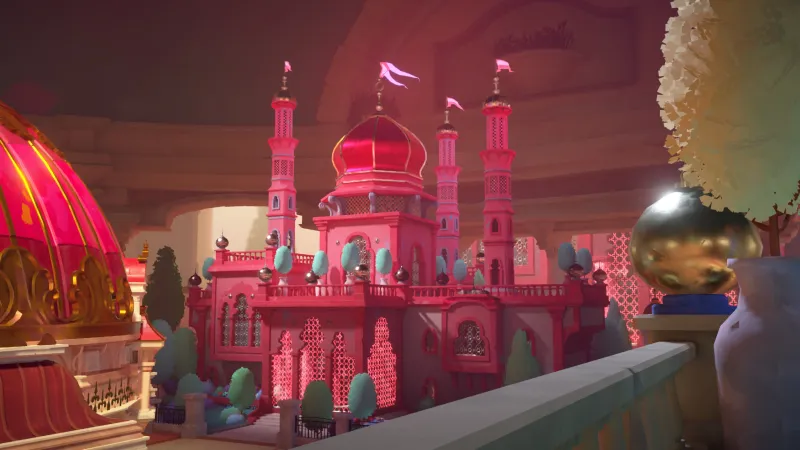
A good puzzle involves a delicate balance. The perfect brainteaser should leave players confused just long enough to feel clever once they reach a “eureka” moment, but the solution shouldn’t be so obtuse that players want to throw up their hands in frustration. Maquette fails to strike that balance. This gorgeous indie game explores the heady concept of recursive worlds while it tells a touching love story, but its puzzle design wavers too far between excitement and tedium. 

Maquette is a thoughtful meditation on worlds within worlds. Many of the early puzzles revolve around a maquette model, which resembles your environment. Whenever you manipulate objects inside the model, your actions also affect your surroundings. If you place a normal-sized key into the model, a giant-sized version will drop into view at the corresponding location in your environment. Using this mechanic, you can create ramps or bridges using everyday objects, or shrink larger items so they can slide through the cracks in a fence. I loved how Maquette challenged me to carefully explore my environment and think about how objects can be used in multiple ways. 

Click image thumbnails to view larger version


Throughout this journey, you’re treated to a somber love story about a young couple’s struggles to understand and live with each other. This story is told primarily through voiceover (you never actually see the characters), but they are well-performed, and listening to this couple’s cutesy banter regularly brought a smile to my face. Given the heady nature of the gameplay, Maquette’s narrative is surprisingly down to earth, but the characters and their struggles were so relatable that I sympathized with their plight. 

Unfortunately, the road to Maquette’s conclusion is bumpy. As much as I liked Maquette’s recursive world design, it offers a few uncomfortable player moments. Just as the model in front of you is a facsimile of your environment, your environment is also a model of the larger biomes that extend onto the horizon. Late in the game, you begin to explore those large spaces, which means you much walk across a variety of big, open areas. I loved the chilling vastness of these spaces, but solving some of these puzzles requires trial and error, which means you have to do a lot of walking. This quickly grows tedious, and I hated reaching my destination only to realize that I needed to adjust the model in the center of the world, which required a long march back. 

Click here to watch embedded media

In addition to Maquette’s tedious navigation, a handful of puzzle solutions are so obscure that I had to scour the environment many times before accidentally stumbling into an interactive element. I actually solved a couple of puzzles in ways that I don’t think the designers intended, and reaching these solutions didn't make me feel clever; it just felt like I had jury-rigged my way forward. One time I even worked myself into a corner; by the time I had calculated the puzzle's solution, it was clear that I could no longer achieve it. At that point, I was forced to reset the chapter, losing about 30 minutes of progress. 

When Maquette is firing on all cylinders, it is a beautiful journey through a series of ever-larger environments, and Maquette’s love story is poignant and a little heartbreaking. Sadly, my interactions with the puzzles were also full of heartbreak. While Maquette has some missteps, I look back fondly on my time with it. Much like a real-life romance, my affection for this game is complicated. — Ben Reeves

Score: 7.75

Summary: Explore recursive worlds within worlds. Change one thing in a model in front of you to affect the space around you.

Concept: Explore recursive worlds within worlds. Change one thing in a model in front of you to affect the space around you

Graphics: Maquette’s environments aren’t highly detailed, but the visuals are vibrant and colorful

Sound: Bryce Dallas Howard and Seth Gabel do a stellar job with the voice work, and a scattering of indie-rock ballads set a contemplative mood

Playability: The world is easy to navigate, but interactive elements are sometimes hard to spot

Entertainment: Many of Maquette’s puzzles offer a satisfying challenge, but some require abstract thinking to the point of frustration. The lengthy backtracking also gets old

Replay: Moderately Low
Click to Purchase

Thursday, February 25, 2021

Bravely Default II Review – Switching Up The Grind

Publisher: Square Enix
Developer: ClayTechWorks
Reviewed on: Switch

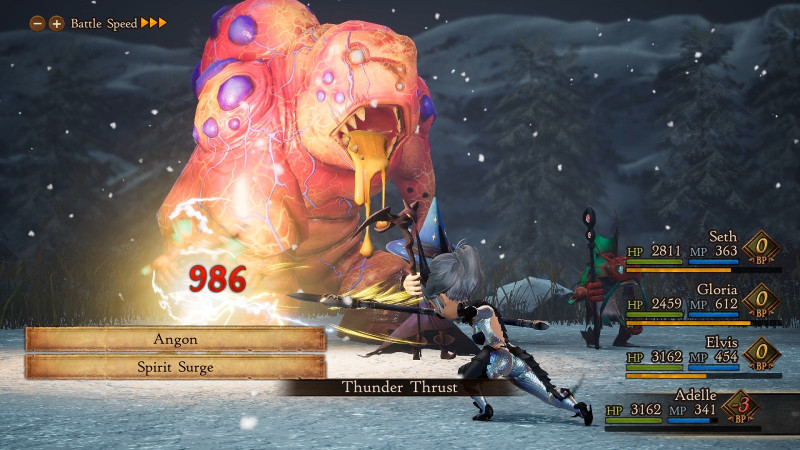
Bravely Default II hearkens back to another age of fantasy role-playing games, where players would find tiles to pace back and forth on, taking on random encounters to gain experience and resources before proceeding to the dungeon boss. Managing a team of four, players change jobs to access a wide variety of skills and abilities, combine them with gear choices, and craft their own satisfying builds to take on encounters. The overall experience is a nice trip for those looking to immerse themselves in job experiments, exploration, and monster-slaying, but the ride is firmly rooted in a formula that can drift toward dull at times.

Click here to watch embedded media

Environments are all over the place in terms of quality as you tackle myriad dungeons. A few are quite picturesque and memorable with visual trappings like flying bats or scrying clouds, but the majority are drab caves, earthy sprawls, and undercityscapes. Some neat lighting effects accompany some of the surroundings, but outside of a few exceptions, the world is a forgettable backdrop for monsters to crawl around in.

Epic signature fights at the end of each dungeon are often multi-phase affairs that can force you to craft a team designed to capitalize on its strengths and weaknesses, which may mean you’re going back to the grind. It feels good to “solve” a boss puzzle, but it also means you can’t rely on a single team with stacked abilities to get you through each encounter, as using the wrong sets of skills for a particular battle can have you annihilated in moments. The experience of crushing through a dungeon, collecting all the loot, and then getting the entire team slaughtered in a single attack by the area boss can be humbling (and definitely frustrating), but working out how to combine and craft a team to handle various challenges is satisfying as well.

Grinding is a big part of the game, so if you don’t enjoy doing it, this one probably isn’t for you. Luckily, Bravely Default II is cognizant of its own nature, and provides players the tools to fly through skirmishes once your setups get going. By taking advantage of ultra-fast combat speed and monster treats that allow you to stack up a bunch of battles into one for additional rewards, you can take the sting out of hours of grinding and turn it into a much more palatable pastime.

While grinding, it’s time to start thinking about job abilities in interesting and fun ways to forge lawnmower compositions that gobble up experience and loot in ridiculous quantities. For instance, I loved making my basic attacks hit all enemies with additional basic attack chances on top with stealing effects, allowing my crew to hit every target on screen with each attack and rob them at the same time. By combining skills and abilities, there’s no problem getting the job experience and gear needed to overcome the tough fights.

The “dungeon, savepoint, boss” template is slightly broken up by refreshing side quests and world exploration activities that include massively overpowered rare monsters that can be found in out-of-the-way areas on the world map. There’s even an entertaining Triple-Triad-style card game that you can dig into to break the standard routine. Still, killing reams of opponents loses its luster and feels monotonous from time to time, even with the alternative activities. On one occasion when I unloaded in town, I had approximately 80 of one axe drop to sell – a testament to just how many challengers I’d downed on that farm session.

Click image thumbnails to view larger version


While these side activities are most welcome, you’re still going to have to be comfortable with hours of monster mashing. As I harbor a good deal of nostalgia for old-school RPGs, this wasn’t a problem for me, but if you’re expecting a captivating story, interesting dialogue, or villains that don’t produce massive eyerolls, you won’t find those things here. The baddies have some of the hammiest quips I’ve ever seen, combined with lame responses from our heroic cast.

Fans of previous games may notice that the ability to turn off enemy encounters has been removed in this outing of Bravely, but don’t worry about it too much. Enemies that are weaker than the party will run quickly away, meaning they only need to be battled if you opt in to that fight. This allows you to turn your monster treats on for farming, and move through areas without a single battle when focused on progression.

Bravely Default II succeeds at delivering what it’s best at: offering a taste of the past with the emphasis on creative class combinations, hordes of foes, and big boss battles. Bravely Default II deftly harnesses some of the ancient enchantment of classic grind-and-go console RPGs – but don’t expect anything beyond that.

Score: 8

Summary: A love letter to a different time in role-playing history.

Concept: Turn-based battle your way through a world in peril with a highly customizable crew of adventurers

Graphics: While some of the dungeon environments are quite beautiful, many areas are nondescript. Plus, the chibi characters are sometimes strange situated against other backdrops

Sound: The soundtrack is solid and will have you humming along in dungeons

Playability: A casual difficulty mode is offered for players who don’t want to struggle with too much of a grind, but be aware some job combos must be experimented with even on the easier setting

Entertainment: If you enjoy the RPGs of eras long past, Bravely Default II captures some satisfying whimsy and nostalgia, but its formulaic structure can feel tedious

Replay: Low

Click to Purchase

Tuesday, February 23, 2021

Ghosts 'N Goblins: Resurrection Review – The Beauty Of Nostalgia

Publisher: Capcom
Developer: Capcom
Reviewed on: Switch

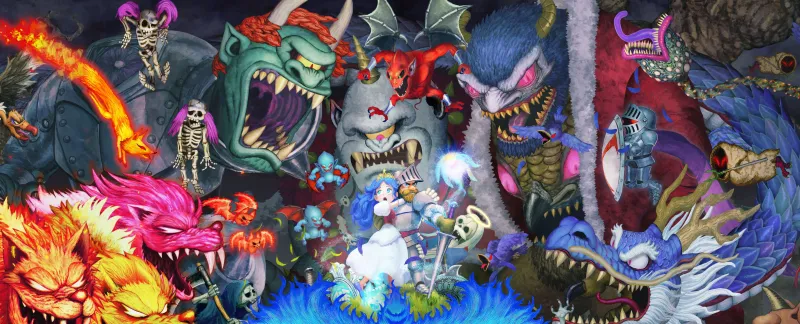
Ghost 'n Goblins: Resurrection is a game that time forgot, designed to transport players to the heyday of the Super Nintendo where visual beauty meets gameplay brutality, dazzling and pummeling in equal parts. The stack of corpses Resurrection piled up during my playthrough made me swear like a sailor, and yet I walked away singing its praises as one of the best throwbacks I’ve ever played.

Legendary hero Arthur and his more famous pair of boxer shorts return to be lit on fire, knocked into pits, and munched by a cave made of teeth, much to the chagrin of the player and delight of Capcom’s designers (which is spearheaded by Tokuro Fujiwara, who directed the original 1985 Ghost n’ Goblins game and SNES sequel). You can almost hear the latter group saying “Gotcha!” after each death that the player didn’t’ see coming. While nostalgic in its character movement and action dynamics, the level designs are wickedly clever and always changing, keeping you in a constant state of panic in fun and terrifying ways.

Skeletons rapidly rise from their graves as Arthur inches forward, and there’s always some kind of airborne threat positioned to knock him into a pit. The action demands split-second reflexes, but even more memorization of enemy patterns and placement, which is developed by dying. An edge can be obtained through Arthur’s weapon of choice, be it the quickly thrown daggers, the spreading fire of holy water, or a handful of other useful tools that can make short work of any foe. The action is simplistic in scope; you just jump and shoot in four directions, but it feels incredibly dynamic, making everything you do feel skillful.

All levels deliver wildly different challenges that make good use of the same moveset, yet players have some agency in how they progress through it. From the outset of the adventure, a choice between two levels is given, delivering either a shorter playthrough or the option to backtrack to missed stages to take on new horrors and earn more Umbral Bees. This oddly named collectible is a form of currency used to purchase useful spells, such as being able to turn every enemy onscreen into a frog or rain down lighting on them. The wealth of skills is worth the effort, as some can be game changers in specific stages, much like getting the right weapon for a boss in Mega Man.

Click image thumbnails to view larger version


The entire game can also be played cooperatively, with the second player controlling a trio of ghosts called the Three Wise Guys, who can be swapped on the fly. Each of the guys aid Arthur in different ways, like being able to create a protective shield or lift him across a gap. It’s a cool idea for co-op play that helps take some of the sting out of the game’s difficulty. While the second player isn’t experiencing the core gameplay, they can still have a significant role in the outcome.

Even with the aid of a friend, the game is quick to alert you that you can lower the difficulty if situations are too challenging. If that doesn’t produce results, you can activate a magic metronome to slow the game’s speed to a crawl, giving you a hell of an advantage to fill enemies full of lances, safely bound up crumbling staircases, and grab Umbral Bees that may zip past you otherwise. If you think the game is too easy, the metronome can also be used to speed it up and make it more challenging. If you just want to see the entire game without any cares in the world, the lowest difficulty setting lets you instantly respawn where you die, although some of the late-game surprises are removed when played like this.

Click here to watch embedded media

After the final boss is slain, players can restart their adventure to experience a slightly rearranged playthrough. This again holds true to the series’ roots, with transformed stages and new challenges within them. This is an awesome reason to play an amazing game again, and also gives the player a chance at earning every skill.

As much fun as I had getting my butt handed to me by Resurrection, one of the best parts of it is the visual design. It looks like a storybook drawn with pencils and colored to make every moving element pop. Yes, some of the classic enemy designs are fairly uninspired, and the worlds are fairly plain in details, but together they jump off of the screen and frame the action perfectly.

Ghost 'n Goblins: Resurrection is a game of try and try again, and should you not have the chops to make it, has built in solutions to allow you to keep making progress. I didn’t think I needed another Ghost n’ Goblins game, but Capcom proved me wrong, and now I want more.

Score: 9

Summary: This retro revival is challenging, fun, and worth playing twice.

Concept: A long-overdue sequel to the Super Nintendo game, Ghouls n’ Ghosts, that is wonderfully nostalgic and fantastically modern in its brutal action

Graphics: Basic enemy designs and backdrops are given flair with storybook-like details. Some of the animations almost look like they are made using stop-motion. It all adds up to a beautiful picture

Sound: Iconic retro melodies flow through the entire adventure

Playability: The simple acts of jumping and shooting are heightened by excellent scenario design and do-or-die moments

Entertainment: An incredible continuation that is a showcase of clever stages and pitch-perfect twitch reflexes

Replay: High

Click to Purchase