Pages

Thursday, October 29, 2020

The Dark Pictures Anthology: Little Hope Review – Inconsistent Magic

Publisher: Bandai Namco
Developer: Supermassive Games
Rating: Mature
Reviewed on: PlayStation 4
Also on: Xbox One, PC

Witchcraft. Doppelgangers. Cenobite-like demons. Evil children. Inescapable fog. Supermassive Games loves to combine horror tropes and create its own spin on them for one big, spine-tingling adventure. It’s part of the studio’s identity and what made Until Dawn such a hit. I always look forward to seeing how the team is going to subvert my expectations. Little Hope is the second standalone entry in Supermassive’s Dark Pictures Anthology, and though it is a step up from Man of Medan, it still falters as much as it succeeds. Little Hope tells a fascinating tale, but lackluster gameplay, predictable scares, and performance issues hold it back from greatness.

This story is completely self-contained, so you don’t need to play Man of Medan to understand it. This fresh break allows Supermassive to explore a new setting, characters, and horror subgenres. For Little Hope, you’re introduced to a New England town of the same name. It has an eerie past connected to the 17th-century witch trials, along with a family from the 1970s that experienced tragedy. When a bus carrying a professor and his group of college students crashes in Little Hope during a detour, you realize more is going on than meets the eye. Not only is a fog preventing you from leaving, but your group also appears connected to the town’s dark history. The new setting immediately pulled me in; not only is it creepy from the start, but the intrigue that holds the mystery together is powerful.

That being said, getting to the story’s best moments takes time and patience. Little Hope is a slow burn, meaning you have a lot of downtime just walking down a foggy path with few clues and boring dialogue. You occasionally go into the sewers, a church, or a factory, but the winding road is the main destination. The journey would probably be more enjoyable if I found the characters intriguing, but it was hard to care about any of them. The problem is they feel more like one-dimensional reactions to a situation rather than being unique people with needs and motivations. It was hard to get a sense of any of them beyond the few traits listed about them when you start the game.

Though the present-day ensemble is uninteresting, their doppelgangers from the past are a different story. They pull you back into their time period to experience the crazy accusations and fear of witchcraft that ran rampant. I loved the tension of these moments, as you see paranoia manifest you begin to question who is to blame for how things unfold (which becomes a big choice you make). It all culminates in a fantastic twist that I won’t spoil, but it is cleverly done and made me approach my second playthrough in a different and exciting way. Changing your decisions on subsequent runs also leads to new scenes and situations, like whether characters proudly show off their relationship, or what form a creature takes. 

Click image thumbnails to view larger version


I wish the overall gameplay of Little Hope provided the same excitement. Despite having some of the best creature design Supermassive has ever done, Little Hope still can’t capitalize on its terrors. The game tries to unnerve you, attempting its share of jump scares, but they are too predictable and over-the-top to work. Addressing complaints from Man of Medan, Supermassive made some improvements with better indicators for when QTEs are coming, and you can now press a button to walk faster through environments. However, item selection is still finicky, and I had to contend with technical issues like freezes and glitches, especially in co-op.

Speaking of co-op, I had a much better experience playing by myself than I did with someone else – the opposite of my experience with Man of Medan. The story lends itself better to solo play, as co-op allows only certain players to see specific scenes, which makes it difficult to piece together the whole story. Also, if your co-op buddy finishes up their area first when you’re split up, the story moves ahead without giving you time to inspect everything. I experienced crashes, dialogue cutting out, and disconnects, despite both my co-op buddy and I having solid connections. I hope this aspect of the game gets improved after launch, because it gets in the way of following and appreciating the narrative.  

Little Hope is inconsistent, like a witch-in-training still learning how to fully weave a spell. It sets up its story well and keeps you guessing, but the execution is lacking. It needs more variety and interesting things for your characters to do. The action comes too late, and by then, you’re already nodding off. However, seeing the fantastic ending makes putting up with those boring moments a little more bearable.

Score: 7.5

Summary: Little Hope tells a fascinating tale, but lackluster gameplay, predictable scares, and performance issues hold it back from greatness.

Concept: Keep your group alive as you explore a small fictional town with a horrific past connected to the 17th-century witch trials

Graphics: The creepy creature design is a highlight, but the character models look like wax figures, lacking realistic facial expressions and reactions

Sound: Outside of a few awkward deliveries, the voice acting is well-done, especially considering the New England accents required. The eerie sounds and tense music heighten moments, adding to the suspense

Playability: Some technical hiccups break immersion, especially while playing co-op. But having better indications for when QTEs are coming is a welcome change

Entertainment: Little Hope tells a hell of a story punctuated by a great twist. Too bad the overall gameplay and exploration don’t hold the same allure, bringing down the experience

Replay: Moderate
Click to Purchase

Pikmin 3 Deluxe Review – Sharing The Load Together

Publisher: Nintendo
Developer: Nintendo
Rating: Everyone 10+
Reviewed on: Switch

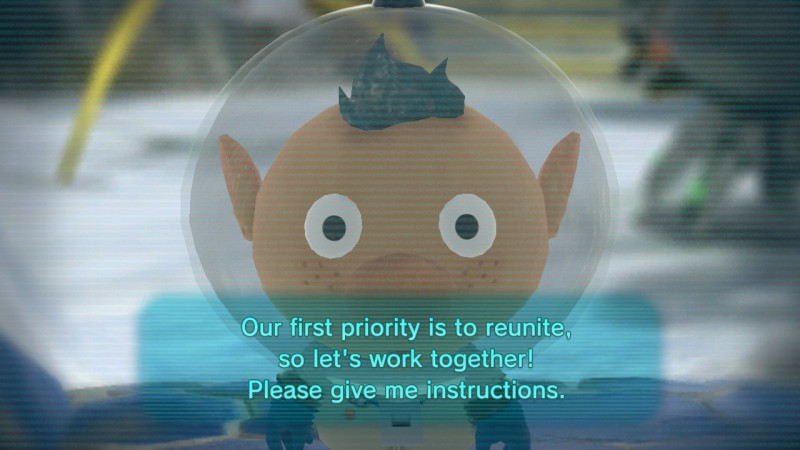
Words like “cute,” “adorable,” and “tiny” are conversational touchstones when it comes to Pikmin, but I offer an alternative: “Overwhelming.” The entire point of the series comes down to that concept. You defeat enemies by commanding swarms of the titular creatures who pummel giant bugs and other pests with their tiny fists until the foes are vanquished. You face multiple (and often competing) tasks, which must be prioritized and managed as the daylight relentlessly fades. Pikmin 3 added another juggling element when it first released on Wii U in 2013, giving players alternating control of three different diminutive astronauts. Leave one idle, and you’re wasting precious time and resources. Moving between all of these things competing for your attention can make you feel like every plate is just a few spins away from crashing to the floor – but it’s a good kind of overwhelming, to be clear. Pikmin 3 Deluxe doesn’t overhaul objectives or streamline tasks, but it gives you the opportunity to add a co-pilot along for the campaign, which lets you focus more on coordination and less on fussy micromanagement. 

If you didn’t play the original version, Pikmin 3 Deluxe is largely the same game when you tackle it solo. As a member of an alien crew, you’re responsible for saving your home planet by scouring the Earth-like planet PNF-404 for fruit and other edibles. Thanks to their diminutive size, an orange provides a bounty of juice that can sustain the trio for days. They’re so small, however, that moving that kind of prize back to their ship would be an impossible task, even if all three of them pitched in. That’s where the Pikmin come in. These friendly critters are happy to carry objects around, uncover shortcuts across the levels, and fight comparatively gargantuan beasts on your behalf. 

Click here to watch embedded media

Pikmin are split across a variety of colors, with each type providing special abilities. Pink ones can fly across streams and ponds, while blue ones can dive right in. Try that with one of the other varieties, such as the shockproof yellow ones, and you end up with a team of drowning victims. Fortunately, their numbers can be replaced by converting the corpses of defeated foes into new Pikmin seeds. It’s pretty grim stuff if you take the time to consider what’s happening, so the less you think about it all the better. You’re introduced to new types as you progress through the campaign, and you’re incentivized to revisit the handful of maps with Pikmin who can get you through previously impassible barriers.

The campaign was a lot of fun in its original form, thanks in no small measure to its frantic nature. Once you reunite your crew, successfully maneuvering through the day requires a fair measure of planning. Some areas can only be reached by tossing a crewmate across a gap or otherwise splitting up. The dedicated map (which was on the Wii U touchscreen) is gone from the deluxe edition, but the addition of co-op throughout the campaign is a worthy exchange. It breathes new life into the game, making some of the most strenuous challenges much more manageable.

Another player can jump in at any time via split-screen co-op. Each player has free rein (or whistle) to enlist Pikmin and explore the map for fruit and other elements. That cooperative framework was already in place originally, but through A.I. companions or multiplayer side missions. In Deluxe, it’s easier than ever to coordinate goals for an in-game day and find efficient ways to accomplish them. A bridge needs to be constructed? I can focus on that element with my little group as my teammate aims their attention on scouring the area for hidden fruit. Functionally, it is the same process before, but being able to simply talk to another person and come up with plans together or react on the fly is more engaging than I would have guessed.

Click image thumbnails to view larger version


In addition to the campaign, you can spend some time with a variety of different side missions. Most of those are from the original release or its DLC, but there’s also a new string of missions that show what a pair of other explorers, Olimar and Louie, got up to after the events of the story. It’s a pretty slight addition, but I enjoyed mastering each set of challenges (with a helper) to unlock platinum medals in each one. I also liked seeing a few twists on the mission types and even a small tweak or two to familiar maps. Seeing a stream I’ve crossed dozens of times drained wasn’t mind-blowing by any stretch, but it was a nice change of pace. 

Pikmin 3 was one of my favorite Wii U games, which isn’t meant to be faint praise it sounds like. Thanks to Pikmin 3 Deluxe, players who didn’t get around to checking it out in its original form have a chance to do so on the Switch. And better yet, they’re getting a version that lives up to its potential as a game to bring people together – even if it’s just to move tangerines and grapes around.

Score: 9

Summary: With the deluxe edition, Pikmin 3 lives up to its potential as a game to bring people together – even if it’s just to move tangerines and grapes around.

Concept: Revisit the 2013 Wii U action/strategy title, adding campaign co-op and a series of new follow-up missions

Graphics: The delightful blend of realistic environments and objects and cartoonish characters is great, whether you’re playing on your TV or in handheld mode

Sound: The pleasant tunes mostly hang around in the background, becoming more urgent when enemies are close by. The squeals of dying Pikmin haven’t lost their power to make me feel horrible

Playability: Losing the Wii U’s dedicated screen makes it less convenient to manage multiple characters playing solo, but the ability to bring another player along for the ride is a worthy tradeoff

Entertainment: Pikmin 3’s blend of strategic action and exploration is as captivating as ever, whether this is your maiden voyage or a return flight

Replay: Moderately High

Click to Purchase

Wednesday, October 28, 2020

Watch Dogs: Legion Review – A Successful Team-Building Exercise

Publisher: Ubisoft
Developer: Ubisoft Toronto
Release:
Reviewed on: Xbox One
Also on: PlayStation 5, PlayStation 4, Stadia, PC

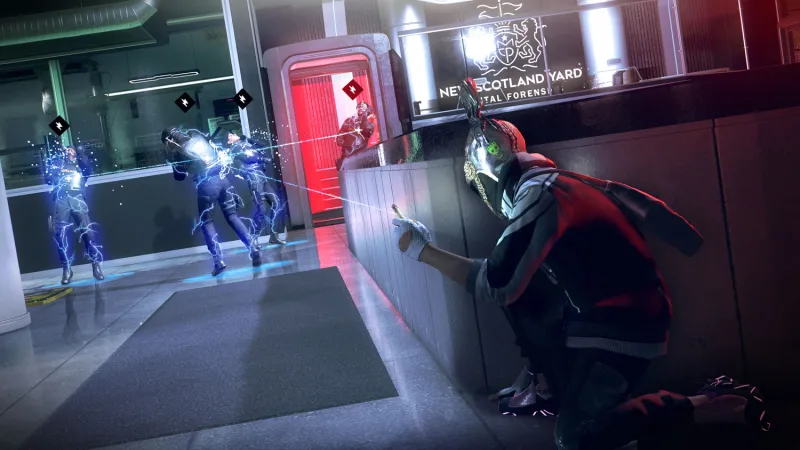
In near-future London, Dedsec is no more. Framed for a terrorist attack, the hacktivist group from previous Watch Dogs games has been purged, and the city has morphed into an authoritarian state policed by Albion, an evil mercenary company. However, the subjugated citizens carry the spark of resistance; it’s up to you to fan it into a wildfire of rebellion. Instead of putting you in control of a single protagonist, Watch Dogs: Legion gives you thousands of disgruntled Londoners, providing the freedom and flexibility to fight like never before. Despite a few bad apples, they don’t spoil what’s ultimately an entertaining fight for freedom.

Your objective is to retake London from its enemy kingpins. You explore and reclaim boroughs through a variety of activities, including sabotage, evidence gathering, and promoting your own propaganda. Where Watch Dogs: Legion sets itself apart from many open-world games is its city full of potential heroes.

Amassing your army of agents is a fulfilling and strategic (though occasionally flawed) endeavor. Anyone can be recruited, and I felt like a kid in a candy store scanning Londoners thanks to the cool combinations of skills each can bring. For example, one of my favorite members was a futuristic beekeeper who commanded swarms of robotic hornets. Techies hack devices faster, investors rake in more money, protesters can rally bystanders to fight, and spies bring gadgets and combat expertise. It’s delightfully silly to command a group resembling a tech-savvy Village People, and the game doesn’t take itself too seriously, making it fun to revel in the absurdity.

Click here to watch embedded media

I grew to cherish certain team members for their skillsets and zaniness (especially because I played with the optional permadeath turned on). Teams fill up quicker than you think, and I missed out on awesome prospects because I lacked the space for them. Because I wasn’t allowed to ditch recruits, I had to start throwing any dead weight off skyscrapers or into speeding buses. While this murderous take on spring cleaning is hilarious, being able to simply fire someone would be even better – especially since optimizing your team is such a central part of Watch Dogs: Legion’s appeal.

Most of the side content consists of satisfying the needs of potential recruits. They’re decently fun tasks, but start repeating themselves too soon. Borough uprisings offer better diversions thanks to their variety and the exciting final missions each neighborhood presents. Lesser activities like package deliveries and graffiti tagging provide lighter thrills, but they at least give an excuse to tour Legion’s beautiful, high-tech take on London.  

The main story missions are much more gratifying. Four genuinely despicable villains provide plenty of motivation to free London of their tyranny, and your tasks focused on taking them down regularly surprised me with their creativity. One of the best involves a surprisingly heartbreaking trek through the disturbing home of a scientist obsessed with digitizing human mind.

Smart level design forces players to consider the right person for the job while also allowing multiple approaches. Strutting into an Albion stronghold disguised as an employee is just as viable as sending combat drones to mow down threats ahead of time. I always had fun surveying a situation and deciding which combination of tools to employ. To that end, the game makes excellent use of its gadgets, like drones, cameras, and turrets. I especially like the spiderbots – arachnid-like drones that provide a satisfying way to circumvent heavily guarded areas. Plus, I also enjoyed the stealthy platforming segments dedicated to them. 

Commanding various robots is also fun in combat and for puzzle-solving. Riding atop large cargo drones like Spider-Man’s Green Goblin is particularly awesome. Not only can soaring overhead bypass a lot of obstacles, but raining hell from above is supremely entertaining. I love how Legion allows players to combine their tools for creative improvisation. I got a kick from attaching spider turrets atop cars or cargo drones to create mobile murder machines. Enemy A.I. can be boneheaded at times, but the gameplay is a blast that gets better with every upgrade and ability unlocked. 

While Watch Dogs: Legion mostly sells the fantasy of a wholly unique populous, hearing the same handful of voice samples or viewing similar character portraits with slight variations sullies that vision a bit. Another small but regular annoyance comes in the load time while switching agents (at least on current-gen hardware). While not egregiously long, it’s just enough of a delay to break your stride.

Legion feels like the realization of the hacker fantasy the first Watch Dogs tried to capture. Between the fun team-building, fantastic mission design, strong narrative, and a gorgeous world, everything comes together in a largely entertaining and cohesive package. Whether you’re controlling a trained super spy or a gassy grandmother, Watch Dogs: Legion is a ton of fun.

Score: 9

Summary: Whether you're controlling a trained super spy or a gassy grandmother, Watch Dogs: Legion is a ton of fun.

Concept: Take down an oppressive regime by recruiting an army of hackers across near-future London

Graphics: Holographic propaganda, omnipresent drones, and neon lights sell the city’s beauty and oppressive atmosphere

Sound: Hearing your crew spout the same voice samples gets old, but strong main character performances carry the slack. The licensed soundtrack rocks, too

Playability: Gameplay promotes flexibility and creativity while also rewarding the use of ideal agent types. More robust team-management options would be helpful, though

Entertainment: Legion offers a refreshing and fun change-up to the Watch Dogs formula that succeeds in letting players forge their own path like never before

Replay: Moderate

Click to Purchase

Tuesday, October 27, 2020

The Red Lantern Review | A Therapeutic And Immersive Adventure That Lets You Pet Dogs

Publisher: Timberline Studio
Developer: Timberline Studio
Reviewed on: Switch
Also on: Xbox One, PC

Picture inviting snow-packed mountains, a continuously evolving Alaskan skyline, and the best canine companions a person could ever hope for. That's exactly what Timberline Studio's The Red Lantern has to offer with its immersive, story-driven, roguelite survival game. Even if survival games don’t typically draw you in, The Red Lantern offers a magic that supersedes the genre. The art style and narrative flow in a way that isn’t constrained necessarily by its mechanics or the usual bindings that survival games typically come with.

In this dogsledding adventure, you play as a woman who has abandoned city life to chase her dogsledding dreams into the Alaskan mountaintops. Through the beginning parts of the story, she visits several dogs, each with different personalities and unique skills that help later on. As a dog lover, going through each area to meet the different canine companions is too pure for this world, especially when learning the personality of each pup. Whether you're looking for a hunter to track down squirrels or just want a cuddle-bug that knows how to navigate the wilderness, each animal is created to feel real, which helps to form a bond between you and each dog for the adventure ahead. 

The Red Lantern is a survival game, but you have less autonomy than you may expect. You have some agency in your dialogue choices and actions – choosing when to rest, when to feed your animals – but the game plays itself in a lot of ways. While you take to the slopes for sledding runs, you don't have direct control over your movement outside of base directional queues. Instead of feeling frustrating, this surrender of control makes the game feel therapeutic in a way that I find incredibly enjoyable. It allows you the freedom to enjoy the experience while taking in the beauty of the world at large without panicking or worrying about running your sled (and dogs) into a massive ditch somewhere. From the color palette changes to the subtle shifts in the passing scenery, this journey is aesthetically appealing right from the start, and the ability to sit back and enjoy it makes the limited movement worth it.

Click here to watch embedded media

The survival aspect comes from natural progression and resource management. Dogsledding is hard work, and each trail marker passed means less energy for your canine pals leading the charge. You can rest in established campsites to recoup energy and playfully interact with each dog, leaning into their personalities. Barkley, for instance, is an extremely loyal and protective animal, which means extra pets should always go to that little cutie when given a chance. 

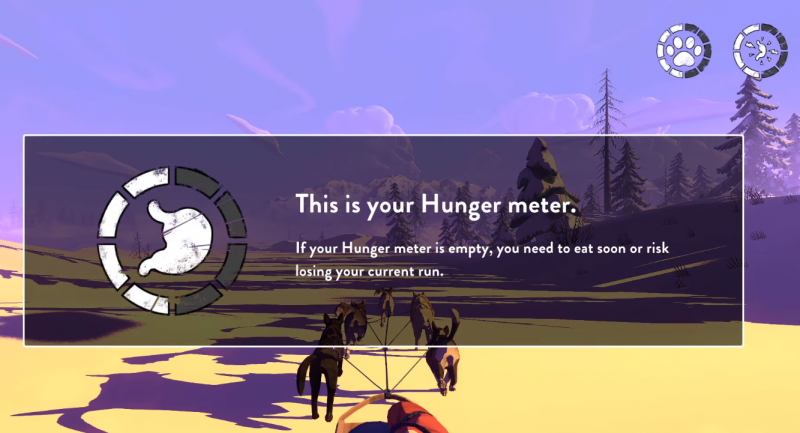
Keeping an eye out on how many bullets are left is key for hunting and protection against wildlife, while med kits are crucial for any unforeseen injuries that may occur. A run may present you with opportunities to claim a supply drop or hunt an animal, but engaging in those off-trail actions expends more energy. The more energy depleted, the higher the danger is for both you and your animal companions, so keep an eye on those gauges in the corner of your screen. 

The gauges for survival are easily accessible, and a constant reminder of your in-game mortality. While this new adventure into the Alaskan wilderness is beautiful, it’s far from safe, and not all of those dangers are external. The problem with this, however, is that sometimes it is easy to assume you have more time than you actually do, and that’s where the randomly generated content can either help or hurt the gameplay experience.  

A lot of the interactions you see on the trail come down to luck, which adds another layer of thrill to survival. Food is a valuable resource and supplies are scarce, so your success can hinge on when you are given the opportunity to stock up again.  My first failed run following that initial kick in the teeth was due to the fact that I tend to procrastinate. Much like I do in the real world with "I'll go to the next gas station to fill up my car," I often made this same choice in-game. That choice will sometimes pay off, but not always. And when it doesn't, that's another mission to flush down the drain. This aspect of The Red Lantern doesn't dominate the experience, but it does cause a lot of frustration, and the reliance on luck staunches the replayability potential. 

Item management becomes easier as time goes on, but one piece of advice: Don't be afraid to fail. The first time taking to a trail with your gathered pups will, more than likely, end in failure due to the low number of supplies allocated at the start. Don't worry, this is a deliberate attempt to show off just how important management is in the game, so think of that first run as a tutorial and less as a reflection of your skill. 

Click image thumbnails to view larger version


Another aspect of survival that is important to keep an eye on is the temperature. It's possible for you and the dogs to starve or even freeze to death. This makes awareness of any depletion absolutely vital for successful runs. At first, that thought overwhelmed me, and I found myself tracking each gauge obsessively in an effort to avoid any accidental deaths. Luckily, The Red Lantern does offer a feature in the main menu option that allows for the choice to make sure the dogs stay alive no matter what. This is a great addition from the studio for those like me that get a little squeamish with animal violence in games. 

Overall, The Red Lantern is a stunning game that offers a juxtaposition of being both a calming experience and one that can inspire a level of anxiety due to the more randomized nature of the mechanics. Watching that meter drop and feeling hope drop down with it can sometimes feel like a punch to the gut, but eventually a rhythm is found and relaxing around a campfire with a full belly, a warm fire, and adorable furry friends more than makes up for those dips in euphoria.

Score: 8

Summary: Abandon city life and immerse yourself in the wilds of Alaska with a team of dogs that become family and your key to survival.

Concept: A woman abandons city life to venture into the Alaskan wilderness to pursue her dog sledding dreams

Graphics: The art style and colors provide an escapists-like quality without breaking the immersion of survival and exploration

Sound: Moving through the wilderness has a muted quality that is both peaceful and unnerving when expecting danger

Playability: Due to RNG mechanics, much of this game's success relies on luck, which can be frustrating at times

Entertainment: The Red Lantern isn't for thrill seekers, but it is a phenomenal handheld experience that is easy to get lost in

Replay: Moderately low

Click to Purchase

Monday, October 19, 2020

Amnesia: Rebirth Review – The Fine Line Between Fear And Frustration

Publisher: Frictional Games
Developer: Frictional Games
Reviewed on: PlayStation 4
Also on: PC

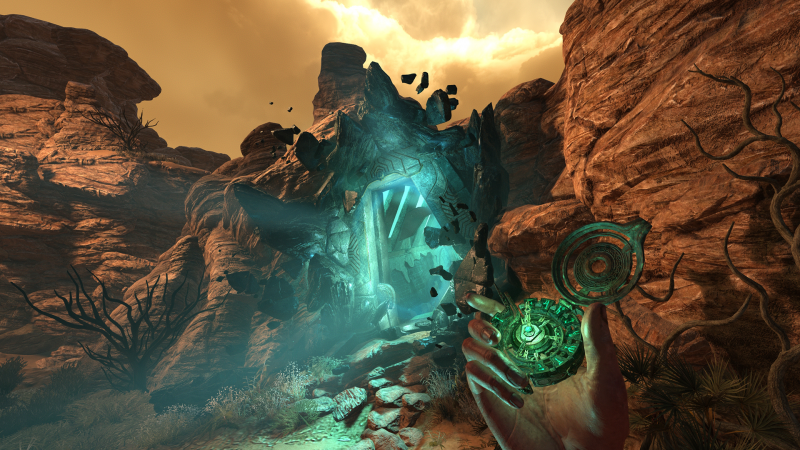
After archeologist Tasi Trianon’s plane crashes in the Algerian desert, she sets off on a journey across the sweltering sands in search of help. However, Tasi quickly discovers that there are holes in her memory. As she slowly uncovers the remains of her fellow party, she puts together the pieces of her fragmented past. Tasi’s suppressed memories are almost as horrifying as the ghoulish creatures that now stalk her from the shadows. Tasi’s journey is one of the most intense experiences I’ve had in a long time. Unfortunately, Amnesia: Rebirth’s puzzle design is equally as terrifying.

Much like in Amnesia: The Dark Descent, light is your greatest tool. As you help Tasi search for safety, you wander through desert caves, ancient burial tombs, and mysterious archeological sites. Light bounces around bizarre rock formations in unsettling ways and strange creatures skitter around inside the walls, which never fails to send a shiver up my spine. Almost all of the environments are dimly lit, so your tiny lantern and whatever dwindling supply of matches you scavenge from the environment are a constant comfort.

Click image thumbnails to view larger version


As you move through the darkness, Tasi’s fear levels rise. As they build, she begins to hear whispers in the dark. These voices are entirely fabricated, but they still make it hard to not run toward the light. When Tasi’s fear gets out of control, she begins to see flashes of grotesque images, which feel like cheap jump scares. Even so, they are incredibly effective at getting the heart racing. Whether I was exploring an abandoned oasis town or sneaking past a group of sleeping monsters, Amnesia: Rebirth continually produced one pulse-pounding sequence after the next. It doesn't help that Tasi has no way to fight back; when you see an enemy, your two choices are run or hide. This powerlessness sent my own fear levels through the roof.  

Praising Amnesia: Rebirth as a horror experience is easy. As a game, however, it comes up short in a lot of areas. One of the biggest problems is its puzzles, which shake up the pacing and reset the tension, though they falter as standalone diversions. As I explored Amnesia: Rebirth’s world, the game was often unclear about my goals or the steps I needed to take to progress. For example, one puzzle asks you to attach the wheels to a cannon and then push it down a ramp to smash through a rotted floor. The game never clearly communicated that goal, so I spent nearly an hour exploring a completely different floor of the building. The environments are also so dim and maze-like that you can easily miss your target, even when you know what you’re looking for. I regularly looped through environments four or five times before I would stumble across whatever I needed to progress. Feeling trapped and wondering if the game had bugged out on me filled me with nearly as much anxiety as the creatures hunting me.

Click here to watch embedded media

Amnesia: Rebirth’s frustrating puzzles undercut its horror, but bizarrely, so do its monster encounters. Amnesia: Rebirth features several otherworldly creatures who stalk Tasi through a series of dank caverns, and these creatures scamper through the shadows in increasingly unnerving ways. But the deeper I progressed into the story, the more I felt like these monstrosities were pulling their punches. Enemies often turn away from your position at the last moment, are incredibly easy to outrun, and lose interest in you quickly. Even when you do get caught, the repercussions aren’t steep; Tasi wrestles with the creatures and then you see a cutscene of her running back to a safe space, which is usually just a few rooms back. There are no game-over screens and Tasi seemingly can’t die. That’s nice from a convenience perspective, but it takes some of the teeth out of the horror.

Even after I felt like I’d seen behind the curtain and knew how the machinery worked, I still moved timidly through Amnesia: Rebirth's world, which is a testament to Frictional Games’ superb environmental design and sound work. Tasi Trianon’s journey is a surprisingly emotional rollercoaster, and I’m glad I saw that story to the end. The cave full of horrifying monsters I could deal with, but I never want to see those infuriating puzzles again.

Score: 7.5

Summary: Amnesia: Rebirth is incredibly intense, but its puzzle design is equally terrifying.

Concept: A woman crash-lands in the Algerian desert and has to outrun the monsters chasing her before she goes insane

Graphics: The eerie underground caves and otherworldly landscape are wonderfully realized, but the other humans and monsters you encounter could use a little more detail

Sound: Easily one of the best parts of the game; Rebirth’s haunting soundtrack and ambient effects do a spectacular job putting you on edge even when you’re clearly not in danger

Playability: Moving through the world is simple and easy, but interactive objects are sometimes obscured, and the puzzles can be obtuse

Entertainment: If you’re looking for a good scare, Amnesia: Rebirth delivers, but prepare to feel lost and confused along the way

Replay: Moderately Low

Click to Purchase

Friday, October 16, 2020

NHL 21 Review – A Playoff Hopeful

Publisher: EA Sports
Developer: EA Vancouver
Reviewed on: PlayStation 4
Also on: PlayStation 5, Xbox One

The game of hockey is always changing. And the last few years, we’ve seen the speed, skill, and creativity surge as a more physical, grindy game takes a backseat. Just like veteran players have had to adapt, so does EA’s NHL series. Two years ago, EA Vancouver upgraded the skating and physics engine adding a burst of agility, responsiveness, and satisfying impact to better reflect this. This year, it’s providing more inventive options to dazzle your opponents, trying to match skill-players dominating the game today. It’s a step the series has to take, but it comes with its share of stumbles, never capturing the grace and poise it’s trying to emulate.

The overall gameplay from last year remains intact. Don’t expect fundamental differences, but new skill moves give you some new options on the ice. My favorite is the slip deke, where you can chip the puck ahead to yourself and slip past a defender when coming up the boards. I also like doing self-passes off the net and banking them to myself off the board. You can also do a flip deke to create some space and fake-out opponents. It’s been interesting to see players use these to elevate their game on the ice and I appreciate that they add more strategy in how to get around defenders.

However, as someone who plays a simpler hockey game, the new super-star-inspired dekes weren’t as valuable to me. For instance, you can now do “The Michigan,” a lacrosse-style skill move, where you raise the puck from behind the net and just toss it in on an unsuspecting goalie. Good luck pulling it off, though; the timing is so precise I can’t imagine ever having the space and time to use it successfully in an actual game. The no-move deke modeled after Nikita Kucherov is easier to complete, but they are all such high-risk that only the most advanced players will master them.

Getting back to the basics, just like last year, checking is uneven. Sometimes players get a surge of momentum, allowing them to land hulking, unrealistic checks. It still amazes me that I can knock opponents to the ground with smaller players like Patrick Kane and sometimes a bigger power forward like Ryan Getzlaf can get pushed off the puck with ease. Poke checking is also very powerful in NHL 21. In single-player and online games, the puck felt like it was constantly changing hands due to this. This happens in a real hockey game, but it feels overpowered here; if you don’t master it and your ability to protect against it, you don’t have much of a chance to win, let alone a chance to have fun. Board battles still stand to be improved, but at least the A.I. is better at recognizing when to send someone over to help. I still hate how this aspect of real hockey is employed in the series, as I feel like even when I’m in a favorable position and poking the puck effectively, I still lose out more than win. 

The A.I. is also exceptionally good at poke checking and taking men off the puck. This is an improvement from last year, but they still struggle to recognize situations and take the effective action. I grew tired of their hesitation with getting the puck out of the defensive zone, or defensemen acting like they're forwards in EASHL. That being said, the goalie A.I. has made some strides, as I saw them come up with big saves more than in previous entries. However, players are already discovering that sharp-angle shots are likely to get them.


The mode that has received the biggest upgrade is Be A Pro, where you create your player, interact with teammates and coaches, and try to make a name for yourself in the NHL. This update is long overdue, but it is still rough around the edges. It feels low-budget, with boring static images and limited voice lines, but EA Vancouver brings it to life with the help of broadcasters James Cybulski and Ray Ferraro, who comment on your progress and big moments. They save the mode from feeling too stale, since all your interactions with management and players are dry and one-note.

You get dialogue options that usually fall into “star” or “team” categories, but they feel too extreme. To play the star role, you basically need to be a jerk. For instance, a teammate might ask you to attend his wedding and the star option has you saying you’ll go if there’s nothing better going on. The problem is picking the star options give you brand bonuses, which you want because it opens endorsements (the team option improves line chemistry). I see promise here and something for EA Vancouver to build off of in the new generation. It brought me back to a mode I had long abandoned, and it remains a mix of good ideas and poor execution. For instance, I thought it was cool when they gave my rookie forward a rival and told me I needed to outscore them in the upcoming game. The problem? My rival was goaltender Collin Delia. Of course, I outscored him.

The other big addition is HUT Rush, which offers fast, bite-sized games and rewards your prowess at pulling off fancy, stylish moves. When you score with a quick-drafted fantasy roster from Ultimate Team cards, you get multipliers up to 5x on the last three skills you used, so it’s all about finding the best combos to get the highest score. This mode feels more geared toward advanced players, who enjoy pulling off difficult dekes and can do so with ease. This is a clever way to get players into games quickly and draft a fantasy roster, but it heavily favors players who want to play fancy.

Smaller additions also came to other modes, such as Franchise getting a trade deadline minigame. Again, great idea, as it’s supposed to capture the frenzy of the day and you get to see the top players and the asking price from teams. But it never captures the chaos or intensity, since you just wait on the glacial clock to dwindle down without many events or trades coming through, even if you mark yourself as a seller with big names on the block. I like that World of CHEL added ranked seasons across all its modes, so you can get unique items based on your achievements. While it adds some new items to the mix, it still feels behind in terms of variety, expression of style, and amount of cosmetic items compared to other sports games.

NHL 21 is a playoff hopeful. It’s not gunning for the cup, but it’s making an effort. It’s trying to figure out if its pieces fit before an inevitable rebuild. As has been the story the last few years, the strategy and ideas are in place for EA Vancouver to take its game to the next level, but they need some work and fine tuning. As we move into the next generation, this will be essential to get right. For now, NHL 21 gets the job done, especially if you want to play a fancier, flashier game. I still had plenty of fun, and when you consider that it’s the only way to experience the NHL until the real league gets back on the ice in January, it’s not a bad way to get your hockey fix.

Click image thumbnails to view larger version


Score: 7.5

Summary: For now, NHL 21 gets the job done, especially if you want to play a fancier, flashier game.

Concept: Match the high skill and creativity of the sport with new moves and options on the ice. This year’s entry also adds long-requested enhancements and a few new features

Graphics: The series hasn’t taken a graphical leap in some time, and NHL 21 doesn’t change that. More accurate likenesses for star players would help add some variety and authenticity

Sound: Fantastic broadcasting from James Cybulski and Ray Ferraro returns, with new lines and reactions. The pair still has great energy, and their expanded role in Be A Pro mode is a welcome addition

Playability: This year's gameplay takes some steps forward and some steps back (especially with its A.I.). The single-player modes remain approachable for a general audience, but taking your game online requires high skill to truly get the most out of it

Entertainment: NHL 21 doesn’t feel like a huge leap from last year, but EA Vancouver makes strides in addressing long-known issues and sets a better foundation for the next generation

Replay: High

Click to Purchase

Tuesday, October 13, 2020

Torchlight III Review – Seamless Destruction

Publisher: Perfect World
Developer: Echtra Games
Reviewed on: PC
Also on: PlayStation 4, Xbox One, Switch

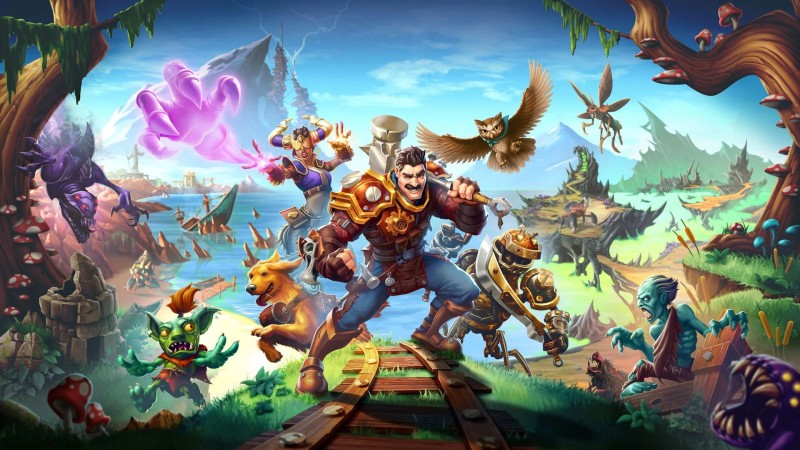
Torchlight III knows what it is, and embraces that identity. It’s not the biggest action/RPG on the market. It doesn’t have the most grim or mature setting, nor does it have the most complicated fictional backdrop. Instead, Echtra has crafted a buoyant adventure that joyfully hops players from one environment to the next, with barely a hitch of story or quest-tracking needed. The monsters are plentiful, the powers you wield are bombastic, and the unfolding battles fill the screen with colorful blasts and thunderous noise. The seamless nature of the action and leveling is just barely complex enough to demand your attention, making it a welcome fit for laid-back nights of escape, whether by yourself or with up to four friends working together.

Even as an enthusiast for gaming narrative, I skipped along the light storytelling of Torchlight III like a rock across water, vaguely capturing the gist of a tale set 100 years after the last game, with some bad guys from another dimension hoping to take over the world. The visual world-building is more robust, capturing a fun aesthetic mixing classic fantasy with clockwork/steampunk aesthetics. The result is a colorful setting filled with flashing elemental blasts and endless gears. The playful tone and art direction are a pleasant departures from the dark and gory norms of the genre, even if some spaces feel too similar. I was also frequently frustrated that large environmental objects occlude the view, which can sometimes just be annoying, but occasionally put your hero in a vulnerable spot.

In a mostly frictionless game, the one space Echtra has carved out depth is a rewarding character upgrade system. Four amusing classes each offer something enticing, from the dark and light balancing of the Dusk Mage to the borderline silly Railmaster, who literally builds a railway track and hauls a train behind him throughout the adventure. Each class is further enhanced through the selection of a relic subclass – a special elemental object that adds an additional tree of abilities. As such, your Sharpshooter class plays quite differently, depending on whether you’ve decided to freeze your enemies with the Coldheart relic or set the world ablaze with the Flaming Destroyer.

No matter your selection, it only takes a few levels to transform into a walking engine of destruction, encouraging that pleasant flow that comes from decimating dozens of enemies every minute in increasingly cathartic area-effect blasts and crushing weapon smashes. Multiple adjustable difficulty levels allow for efficient scaling to your experience or attention level; players who want a more dangerous adventure certainly have that option, though the game feels best when it moves at high speed, rather than slogging through a challenge your character isn’t ready for. No matter how hard you make it, you settle quickly into a mostly mindless rhythm of power rotation and satisfying loot bursts.

Click here to watch embedded media

Thanks to a pet who happily jets off to sell your gear, inventory management is a breeze, and I liked the variety of both cosmetic and functional features reflected in the many weapon and armor pieces I gathered. Players looking for an especially rich system of attribute optimization are likely to be disappointed. Like most things in the game, the focus is on quickly getting you back into the fray, not endless hand-wringing about which gloves to put on.

After you complete the campaign, Echtra has planted a number of wrinkles to maintain your interest, including an enchantment system, increased focus on crafting, and the ability to further customize your fort. I never warmed to fort development, which unfolds in a cramped space, and the changes I made rarely affected gameplay enough to be satisfying.

I enjoyed the post-game dungeon system, in which an enterprising djinni sets up shop to create endless “Dun’djinns” (get it?) for you to explore, each with increasingly challenging modifiers, and ever greater rewards. For players who fall in love with continued character development, there’s no shortage of additional battles on the horizon, though I was personally ready to try a new hero after a few hours of post-game. That end-game option is especially welcome if you’re playing with friends. Torchlight III supports up to four-player online cooperative options, and it’s borderline ridiculous to watch even more chaos unfold, even if the onscreen visual clutter can get especially hard to track.

Clever class design accepted, Torchlight III doesn’t offer tremendous innovation or nuance in its systems or gameplay. The gratuitous destruction is often great fun, right up until the hour marker when it’s not, and it all starts to feel a bit tedious. Thankfully, there’s always a new magic sword to collect, a respec to try out, a new character class to discover, or a dungeon to delve. Torchlight III is an approachable action/RPG that’s especially welcoming to newcomers, or simply players who don’t want to focus too hard on their evening’s entertainment. Repeat conquerors of heaven and hell may wish to look elsewhere, but if your desires for fantasy destruction are more about high-octane action, Torchlight III rarely disappoints.

Click image thumbnails to view larger version


Score: 8

Summary: Echtra has put together a no-frills action/RPG with plenty of fun monster smashing, even if the approachable gameplay is not incredibly deep or complex.

Concept: Hack, slash, and loot your way through a colorful clockwork world

Graphics: Attractive but lighthearted designs mostly defy the genre convention for dark settings, helping the visuals stand apart

Sound: How do you feel about explosions and spell effects? Those sounds tend to override everything else

Playability: The interlocking leveling and crafting systems are all sensibly presented and easy to navigate, and action feels smooth on controller or with mouse and keyboard

Entertainment: A simple and no-frills action/RPG that ticks all the boxes, so you can keep clicking the monsters.

Replay: Moderately High

Click to Purchase

Tuesday, October 6, 2020

FIFA 21 Review – Still Kicking

Publisher: EA Sports
Developer: EA Vancouver
Reviewed on: PlayStation 4
Also on: PlayStation 5, Xbox One, PC

For newcomers to the FIFA series, sprinting down the pitch and converting tight through-passes or high-arching lobs into game-winning scores is invigorating. Crowds go wild, the camera shakes to match the roaring intensity, and Paulo Dybala performs a backflip as his teammates whoop in excitement. Moments like this are fun and exhilarating, and you don’t need to follow the long-running series’ year-to-year adjustments to appreciate them – though seasoned veterans may be disappointed by the minor strides forward.

Instead of implementing revolutionary changes, EA Vancouver uses FIFA 21 as an opportunity to refine moment-to-moment gameplay. Keeping the ball feels intuitive, especially when you fake out aggressive defenders with skill moves like the bridge dribble or ball roll fake turn. Moreover, setting up fluid passes between multiple players with the flick of the right stick makes movement approachable for gamers of all skill levels. As a whole, the gameplay feels streamlined and entertaining – but the package is about more than the on-pitch action.

FIFA 21’s atmosphere and presentation are stellar. I always enjoyed seeing jerseys crease and crinkle at slight movements, or watching players flex their muscles after driving the ball into the opponent’s net. The animations are smooth and don’t have many collision issues. Nevertheless, I noticed some occasions where a celebrating scorer would slam into a net or run through a divider into the stands. These moments are immersion-breaking, but don’t occur often enough to drag the game down.

Click here to watch embedded media

FIFA 21 still has an array of classic modes. Ultimate Team lives up to its reputation for fierce competition, but skill-level disparities feel unfair since microtransactions lead to faster progression and better team builds. You have multiple offline and online options to earn Ultimate Team coins – run with friends and compete in Division Rivals and Squad Battles or dive into uniquely-themed event playlists by yourself – but don’t expect to earn a large sum of rewards. Laborious grinding is an integral mechanic of Ultimate Team. Other multiplayer modes are chaotic fun, like 11v11 Pro Clubs, but returning players will find that it’s a carbon copy of last year’s version.

Career mode makes it easy to manage your club’s development. You can set up group training sessions before big matches to increase your team’s sharpness – a new attribute that affects the likelihood of executing game-changing drives or making pivotal defensive stops. A clean interface also allows you to keep tabs on your team’s morale and fitness, so you can fine-tune your plans to prioritize high- and low-tier players. I enjoyed transforming my substitute players into all-stars, and the challenging A.I. made these off-the-pitch game plans more rewarding. If the heavy management and logistics of career mode are too monotonous, you can dive right into the action with pre-made tournaments including the UEFA Champions League and the Women’s International Cup.

My favorite mode is Volta, with small-scale matches (either 3v3, 4v4, or 5v5) similar to what I imagine organized street-football would look like. You start by creating an avatar, customizing your squadmates’ appearances, and deciding on a team logo/name. Volta’s quick-play matches take you around the world to wonderfully-realized locations – Rio de Janeiro’s favela-themed map is a standout – and are the fastest way to earn modest portions of skill points and currency which can be exchanged for new abilities and clothes respectively. Even though Volta’s wardrobe is extensive, it hosts an utterly lackluster collection of gear that ranges from generic jerseys to monochromatic sneakers. On the other hand, purchasing ability nodes on your avatar’s skill tree customizes the gameplay experience in satisfying ways. Do you prefer to make clutch passes and pad your assists or would you rather be a relentless scorer? Additionally, players from other Volta teams can be recruited, but if you want to play alongside famous footballers like cover athlete Kylian MbappĂ©, you have to grind against the A.I. and clear a list of monotonous challenges.


FIFA 21’s brief single-player story, The Debut, pits you against a number of amateur Volta teams in order to secure a spot in the Dubai Streets and Icons Championship. The Debut’s narrative and characters are forgettable, but it serves as a great way to earn a substantial amount of skill points and currency. Volta emerges as a nice break from the structure of professional football, but when you factor in the miniscule pitch and the lack of footballers on the field at any given time, it becomes evident that the game mode prioritizes one playstyle: speedy aggression. Because of this, matches teeter between being a breeze or downright punishing.

The graphics and gameplay of FIFA 21 deliver fun and functional football, but its ambitions don’t extend far beyond that. Over time, the grinding leads to burnout and boredom, and the gear and rewards you’re working so hard to obtain are rarely satisfying enough to make the chase worthwhile. Nailing the fundamentals is important, but it takes more than that to be a real winner.


Click image thumbnails to view larger version


Score: 7.75

Summary: FIFA 21 is entertaining, but the constant grind can make progression a slog.

Concept: Keep track of your favorite professional club with small quality-of-life changes or lead your own amateur street-football team in a new story-mode experience

Graphics: The faces and animations look great, but player models are stiff and robotic during pre- and post-game cinematics

Sound: Rapturous chants are a ceaseless reminder that you’re playing the most popular sport in the world

Playability: Skill dribbles are a challenge to execute, but when you outplay a goalkeeper to make a flashy score, you know you’re probably doing the right thing

Entertainment: The Volta and Career modes are fun and engrossing for a time, but they don’t add much substance for players familiar with last year’s installment

Replay: Moderately High

Click to Purchase

Friday, October 2, 2020

Genshin Impact Review — Into The Great Wide Open

Publisher: miHoYo
Developer: miHoYo
Reviewed on: PC
Also on: PlayStation 4, iOS, Android

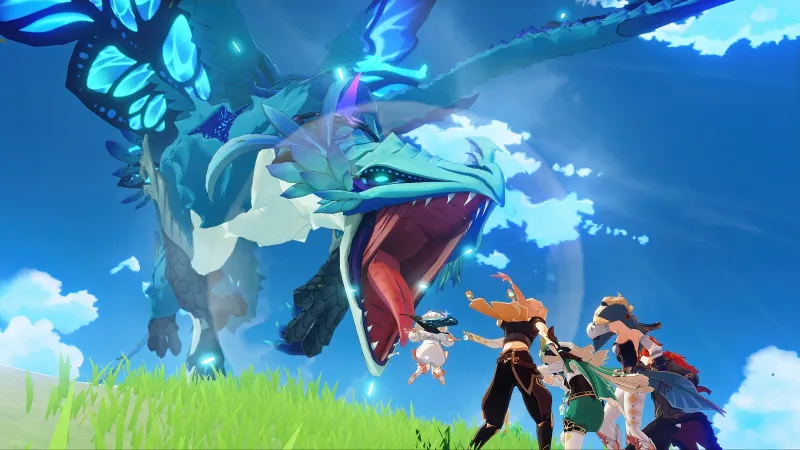
Genshin Impact is light on story and big on exploration, encouraging players to peek under every rock, glide from every precipice, and bash through every camp of goblins. This free-to-play, open-world action/RPG is an incredible amalgamation of stylish art and sound, easy-to-learn combat, and magical adventure around every corner. As you climb the highest peaks, take on titanic bosses, and spare moments of tranquility to take in the scenery, you are inundated with dozens of possibilities. Plenty of games serve up unending tasks, but Genshin Impact provides a sense of unyielding enchantment and desire that I rarely ever feel. 

Click here to watch embedded media

I'd put Genshin Impact down to head to bed, close my eyes, and find myself back playing moments later. The gameplay loop of collection, upgrading, and customization is captivating and compelling. Genshin Impact is an unending ball of adventurous yarn; pulling on any minute-long thread can lead you in unexpected directions for hours. Perhaps you’re on a major story quest but see a chest in the distance, which leads to following a mysterious spirit down a cliffside and unearthing a rare cooking recipe. By the time all is said and done, time has evaporated and you forgot why you were even in the area in the first place. That's okay, though, because you solved a crane puzzle that sent you soaring through the mountainous air, rescued some travelers trapped in amber, and fought a lumbering mech for some spiffy new loot. The main quest is always there, but it’s a struggle to stay focused on it as you run, glide, and climb. This world is an unparalleled beauty that hypnotizes and enthralls.

Click here to watch embedded media

Dialogue and story are the weakest parts of the experience. It’s completely okay to skip through most of the perfunctory conversation as you hit the core quest chains to unlock certain areas and boss encounters. The real story here is created by your journey as you move from area to area. From rummaging through a field of carrots for food to accidentally wandering into a high-level encounter because the surrounding environment looked interesting, I never felt that tasks became rote. The gameplay can get grindy around 30 hours in, but is it really a grind if it still feels great?

You control a party of four characters, with one on the field at a time. Combat begins simple, with each character having a few different attacks, an elemental skill, and an ultimate elemental attack. Swapping out characters is an instant push of a button, which creates a more dynamic and interesting combat system than basic button mashing. Using a water character to soak enemies and then quickly swapping to a lighting character to electrocute everyone is an effective use of elemental synergy, with more difficult encounters and time trials becoming hotbeds to try all sorts of elemental alchemy. In a fight with multiple minibosses present and a clock staring you down, it takes careful strategy to time your elements for maximum effect.

Elemental abilities aren’t just for combat. The open world is full of puzzles and chests to test your creativity. Simple tasks like burning the brambles off an entrenched chest or using wind to blow the seeds off a dandelion are available in the opening moments, but later tasks involve multiple elements to trigger a variety of environmental interactions. Find yourself running out of stamina trying to swim across a vast expanse of water? Use ice to create a walkway. Create matter to trigger a pressure plate. Even late in the game, I’m still discovering new ways to use abilities.

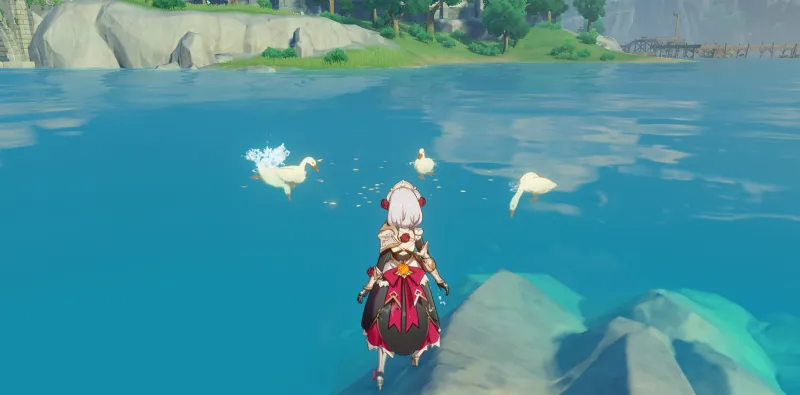
Up to four players can team up together, with cross-platform drop-in, drop-out gameplay. Co-op is easy to use, and a fun way to fight bosses and do mini-dungeon experiences. Or maybe you just want to hang out, watch some ducks, and take some screenshots. Co-op is a fun addition, but everything in the game can be done and enjoyed solo.

Click image thumbnails to view larger version


My biggest reservation about Genshin Impact is the monetization model, which is organized in a way that mobile gamers are intimately familiar with. In the West, we can liken the “gachapon” system to loot boxes. But these loot boxes aren’t merely for cosmetic hats; they’re for playable characters and awesome weapons. Yes, Genshin Impact features pay-for-power and pay-for-convenience. Genshin Impact has a battle pass that doesn’t even appear until around 20 hours into the game. The gambling for characters and weapons is further exacerbated by Genshin Impact's deliberate methods, like having the all-star heroes join your group for certain quests, which allows you to experience their awesome powers, thus creating a desire to spin the wheels for a shot at that power.

This is a monetization model that I cannot endorse or advocate, but I also have not spent any real money in my 40+ hours with the game. I do not feel like my progress has been throttled or my enjoyment dampened because I haven’t paid up. I have played many gacha games, and while Genshin Impact’s paywall is the least intrusive of all of them, I can’t pretend that the game wouldn’t be better without it.

Genshin Impact is a whimsical, wondrous land dripping with unbridled charm and appeal, combining a ridiculously compelling reward loop with unfettered, continuous discovery. In this world I felt like a child visiting theme park for the first time — dazzled, mesmerized, and completely swept away. I only wish the shimmering glow wasn’t marred by a ghoulish monetization model, but that’s something I’m willing to overlook for my ticket to this fascinating realm.

Score: 9.25

Summary: Genshin Impact delivers an enthralling world.

Concept: Explore a massive fantasy world while building a colorful cast of characters

Graphics: The aesthetic is so captivating, I often just got lost in the art and scenery

Sound: A stirring, powerful soundtrack accurately captures the sensation of sitting at a quiet pond or dueling a boss to the death

Playability: Genshin Impact drip-feeds its systems slowly and succinctly, as critical features and mechanics are spread out over the first 10 hours

Entertainment: This is an amazing smorgasbord of exploration, discovery, combat, and customization worthy of your attention – despite the presence of a predatory monetization model

Replay: High

Click to Purchase

Thursday, October 1, 2020

Crash Bandicoot 4: It’s About Time Review – Precision Platforming

Click here to watch embedded media
Publisher: Activision
Developer: Toys for Bob
Rating: Everyone 10+
Reviewed on: PlayStation 4
Also on: Xbox One

The early Crash Bandicoot games of the ‘90s were partially experiments in how to navigate 3D space. Crash didn’t freely traverse an open world; he marched down tightly designed digital tunnels. The camera zoomed in and out of the action and panned around the character, which seemed novel at the time. However, Crash’s movement was limited in ways that seem restrictive by today’s standards. In some sense, Crash Bandicoot’s gameplay was a product of those limits of technology as much as it was any single creative vision. And yet, those limitations helped produce one of 1996's most memorable platformers. Crash Bandicoot 4: It’s About Time proves the classic formula still works in 2020.

With Crash 4, developer Toys for Bob sends Crash and his sister Coco on an adventure through space and time. In one set of levels, I battled seahorse-like pirates while dodging cannon fire. In another, I bounced off dinosaur heads and over creeping lava flows. In yet another, I navigated a busy skyway, miles above a futuristic metropolis. Every level is full of wacky sights and sounds that made me smile, and I couldn’t wait to see where I was headed next.

Click here to watch embedded media

However, this experience is more about the journey than the destination, and Crash’s platforming remains faithful to his early adventures in ways both good and bad. On one hand, the controls are more responsive than ever, and I loved bounding from one precarious platform to the next while smashing crates full of Wumpa fruit. On the other hand, Crash 4's precise platforming sequences demand practice. The thrill of mastering Crash 4’s most challenging levels is rewarding, but some of the deadliest pitfalls come out of the blue, which means you have to replay sections over and over again to memorize each level's layout. A “modern” difficulty allows you to play with unlimited lives, which removes some of the sting, but distant checkpoints still tested my patience, as they forced me to routinely jumped through a familiar hoops in order to return to the platforming section that tripped me up.

While Crash’s platforming feels like it fell out of a time warp, this bandicoot does have a few new moves. Throughout his journey, Crash collects a handful of Quantum Masks that grant him new superpowered abilities. For example, one mask allows you to invert gravity so Crash can run along the ceiling, while another lets you transform into a spinning vortex that floats over large chasms. I especially liked the Kupuna-Wa mask, which slows time, so I could platform across falling objects and dodge fast-moving projectiles. These masks pop in and out of the game at predetermined times, so you can’t access them whenever you want, but I was always excited when one showed up. Even more, I'm impressed with how the Quantum Masks add new wrinkles to Crash’s classic gameplay in a way that feels true to the spirit of the franchise.

Click image thumbnails to view larger version


In addition to the Quantum Masks, Crash and Coco are joined by a few unlikely cohorts, such as Doctor Neo Cortex, Dingodile, and Tawna. These new characters have their own unique movesets, which they display in a handful of dedicated levels scattered across the game. These special levels offer a refreshing change of pace. For example, Cortex can’t double jump, so his levels center on using a gun to transform enemies into spongy platforms that launch him into the air. However, my favorite newcomer is Tawna, an alternate-reality version of Crash’s love interest from the first game. Tawna comes equipped with a grappling hook that allows her to zip across massive gaps and smash crates from a distance, and I always jumped into her special levels the second I unlocked them.

In many ways, Crash Bandicoot 4: It’s About Time feels like a game that shouldn’t work. Single-player, mascot-driven, hardcore platformers are few and far between these days. Moreover, most franchises born in the mid-‘90s have had to continually reboot themselves to match the tastes of an ever-changing market. At its core, Crash 4 remains rooted to the old way of doing things, but that’s not a bad thing. The visuals are cleaner now and Crash has a few new gimmicks, but if you squint, Crash 4 looks like the same old platformer you’ve always loved. 

Score: 8.5

Summary: A return to the unique brand of ‘90s platforming that put Crash Bandicoot on the map.

Concept: A return to the unique brand of ‘90s platforming that put Crash Bandicoot on the map

Graphics: The vibrant, colorful visuals really pop, and enemy designs are goofy in a charming way

Sound: This energetic soundtrack is fun and upbeat, which is good since you’ll be listening to some tracks on loop for a long time

Playability: Controls are tight and precise, which is necessary given the pinpoint maneuvering required in some levels

Entertainment: Mastering Crash’s aerial acrobatics is highly rewarding, but the journey to get there is occasionally frustrating

Replay: Moderately High

Click to Purchase

Star Wars: Squadrons Review – Roaring With Excitement

Publisher: Electronic Arts
Developer: Motive Studios
Reviewed on: PC
Also on: PlayStation 4, Xbox One

A hail of green laser fire rips dangerously close to my X-Wing’s cockpit as I rocket through the debris of a downed Star Destroyer. A TIE Fighter gives chase, and my astromech unit alerts me that a missile strike is imminent. I put my X-Wing into a spin and dive through a narrow gap in the wreckage, narrowing scraping a wall. In this moment, the Star Wars fantasy of piloting an X-Wing screams with excitement, showing how thrilling the dogfighting between the Rebellion and Empire can be. Developer Motive Studios has created a fantastic multiplayer experience that has the visual detail and edge-of-your-seat thrills of Star Wars’ epic space battles, but only fires direct hits in the online space, struggling to captivate with both its single-player content.

Star Wars: Squadrons is set after Return of the Jedi, with the second Death Star scattered to cosmos and the Empire retreating while looking for ways to strike back at the Rebels. This era gives us the cool ship designs from the original movie trilogy, but with more firepower than Luke Skywalker had at his fingertips. Whether I was in an A-Wing in a hunter role against a TIE Interceptor or a Y-Wing on a bombing run against an Imperial flagship, each craft feels distinct and is a blast to control. The movement is so smooth and precise that you can skip along the surface of an asteroid and safely snake through a space station’s interior without dinging the hull. And even if you do, the game is forgiving in damage, allowing you to quickly correct the flight path.

Unlike most space shooters, Squadrons is only playable from the first-person perspective. This is an odd design given just how iconic these ships are, but the locked viewpoint makes sense given how many systems the player has to monitor at any given time. Rather than littering the HUD with these meters, most of them are visible within the ship’s cockpit, and they all function admirably, allowing for quick reads on ammo, radar, and most importantly, how power is balanced throughout the ship. With a click of a button, the player can adjust the power to favor shields, weapons, or speed. I was constantly switching for various needs, and it always feels great to get that extra boost in the thrusters or to rattle off more laser blasts to down a TIE or A-Wing.

The loadouts of each of the eight ships can also be tweaked in a number of ways, such as switching a steady laser to burst fire or giving up hull integrity for shields. The number of components that can be swapped is fairly deep, allowing the player to tweak performance in a number of strategic and satisfying ways.

Click here to watch embedded media

No matter what ship I was piloting, the one-on-one battles against other player-controller ships are almost always intense. These duels can be quite long, as the targeted vessel can make a run for it, dance every which way through cluttered airspace to dodge laser fire, and perhaps get the upper hand and start firing back. If an opponent is shielded and at full health, you’re in for a good fight. Missiles will be dodged with countermeasures, and repair kits used to get health back. The maps are also nicely designed, providing surprisingly cluttered areas for the harrowing chases and open space that can be used to lure enemies into traps if you are coordinating with your teammates.

The online multiplayer in Squadrons is limited to just two avenues of play: Dogfight, which is wildly fun and is determined by kill count, and Fleet Battles, the heart and soul of this experience that delivers awesome wars of attrition. Fleet Battles flow to a moving front that forces you into offensive and defensive positions. Victory is achieved when your opponent’s flagship is destroyed, which takes time; victory can come down to barely visible slivers of health on both opposing flagships.

Both multiplayer modes are 5v5 conflicts. The small number works well for dogfighting, since the maps accommodate it. Fleet Battles could use more players, but the scale feels massive thanks to the healthy presence of A.I.-controlled ships, many of the larger variety. Both modes deliver plenty of exhilarating dogfighting moments, gorgeous backdrops to fly against, and iconic Star Wars music and sounds to set the tone.

After a match concludes, experience points are accumulated and currency is handed out to purchase new cosmetic items for both your ship and pilot, including goofy bobbleheads which are always viewable in the cockpit. The player can use a different earned currency to buy new ship components to add even more depth to the loadouts.

Click image thumbnails to view larger version


I love EA’s stance of not having microtransactions or DLC, but the well of unlockable cosmetics is surprisingly shallow, and relies too heavily on alternate colors for the same item. I only had my eye on around a dozen items, and the unlock time isn’t extensive. While multiplayer is great on its own and has depth in just being fun to play, not having that carrot dangled in front of you to get new stuff you care about hurts the drive to play more.

While Squadrons’ single-player campaign introduces a number of cool Star Wars characters, most of the story is told as they stand around in a hangar or at the briefing table. It doesn’t have much of a pulse, even though the narrative setup of a mysterious “Starhawk” project is quite good and remains an intriguing focus point for the entire arc. When plot is delivered mid-flight, the dialogue is rough and lacks impact, and certain moments could be framed more clearly.

Flying all of the ships in the single-player experience remains enjoyable, but the enemy A.I. doesn’t put up a good fight, and is the worst part of the entire game. The A.I. pathing is also a mess. Watching a TIE Fighter fly directly into an asteroid and then slowly spin on its axis to get free made me cringe. Some of the set pieces are good, but most of the campaign missions play out like mini tutorials, teaching new tactics even late into the game.

All of Squadrons’ content is fully playable in VR, and is a perfect fit for this medium. Through a headset, the battles feel like they are much larger in scale (even though they’re exactly the same as on TV), and I loved being able to sneak a quick glance at my astromech unit whenever it chirped. A variety of flight sticks are also supported, though I did not play with one for my review. EA included a full suite of accessibility options, and crossplay is supported for all systems, including VR.

Squadrons’ single-player may fizzle out frequently like a malfunctioning hyperdrive motivator, but the multiplayer continually impresses and is worth the price of entry alone. Flying in formation with a group of friends put a smile on my face, and that was just the calm before the storm. When the lasers start flying, Squadrons’ multiplayer can be nothing short of exhilarating and a great test of skill, pushing players to be clever in the cockpit to outthink and outmaneuver opponents. Given just how enjoyable it is to pilot an X-Wing or TIE Fighter, this is a multiplayer experience I will continually go back to, even if EA doesn’t support it with new content. It’s just fun to play, providing something different compared to most of today’s competitive games.

Score: 8.25

Summary: The multiplayer delivers huge thrills, while the single-player struggles to hit the target.

Concept: Set after the events of Return of the Jedi, this space-combat game tells a new story, and wows with its multiplayer

Graphics: Even though it’s all set in space, each map has plenty of variety in the backdrops and navigational spaces. The amount of detail in every object is excellent

Sound: The iconic soundtrack and effects cannot be beat and are in full force. Some of the voice acting is a little overblown, especially when trying to sell drama from the cockpit

Playability: Dogfighting with an enemy and lining up that perfect shot feels fantastic. The controls are excellently crafted, and the ships are all powerful in different ways

Entertainment: The single-player campaign teaches you the ropes, but achieves little else. Multiplayer is always fun and is exactly what it needs to be to wow Star Wars fans

Replay: Moderately High

Click to Purchase