Pages

Friday, August 27, 2021

Young Souls Review – Dungeon Brawling With The Best Of Them

Publisher: The Arcade Crew
Developer: 1P2P
Reviewed on: Stadia
Also on: PlayStation 4, Xbox One, Switch, PC

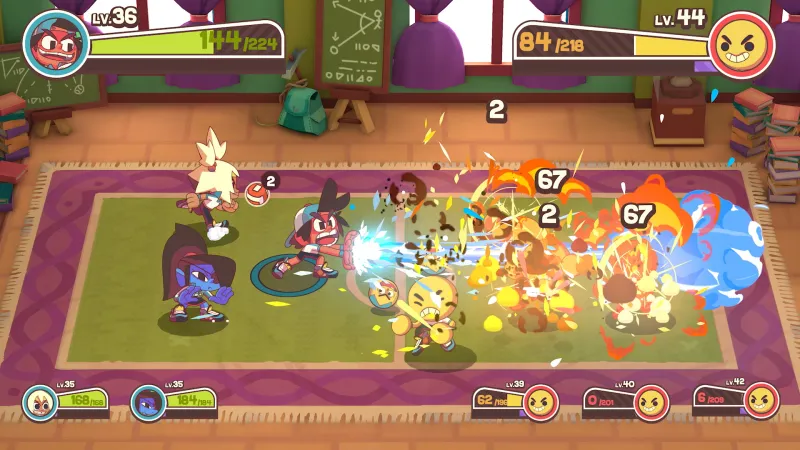
Young Souls stars two orphans who are used to being overlooked, but you shouldn’t ignore their adventure. This RPG brawler sports more depth than your run-of-the-mill beat ‘em up thanks to slick combat, enjoyable customization, and sharp writing. Whether you’re cutting down monsters alone or alongside a buddy, brawler connoisseurs should take notice. 

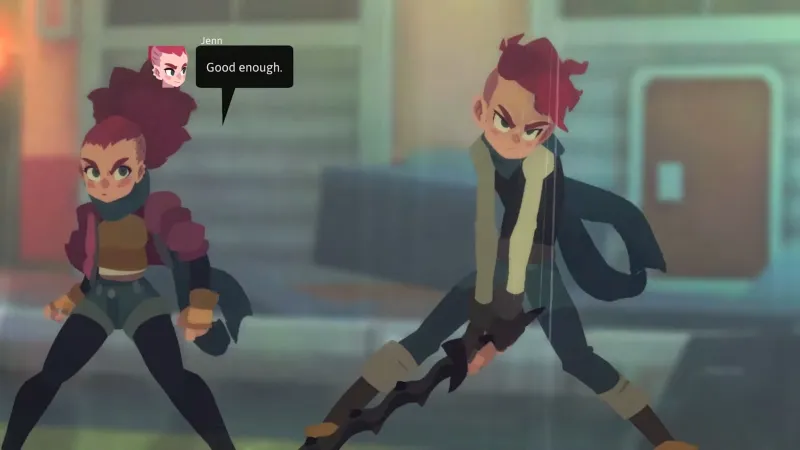
Orphaned twins Jenn and Tristan feel like they’re up against the world. The foul-mouthed, hot-headed teens are conditioned to fend for themselves, earning a reputation as troublemaking outcasts in their small town. The only person they respect is the Professor, their adoptive father who opened his home to them a year prior. The three enjoy a harmonious though emotionally awkward relationship, but things take a turn for the weird when the twins discover the Professor has been kidnapped. Even stranger, a portal in his laboratory reveals an underground world inhabited by goblins whose leader plans to assault their town. While that’s a problem, Jenn and Tristan’s primary concern is rescuing the Professor, and they are more than eager to pick up swords, shields, and other weapons to cut down goblin after goblin standing in their way.

Click here to watch embedded media

Young Souls’ solid writing treats players to a likable cast and a more emotionally charged story than expected. Seeing Jenn and Tristan ponder over their actions and discover that both sides of a conflict can commit atrocities with good intentions brings welcome self-awareness. I also found it refreshing to see a villain genuinely care that invaders are systemically murdering his subjects. The twins feel earnest and relatable instead of one-dimensional edgelords, especially when asking themselves if they’re ready to call the Professor “dad.”

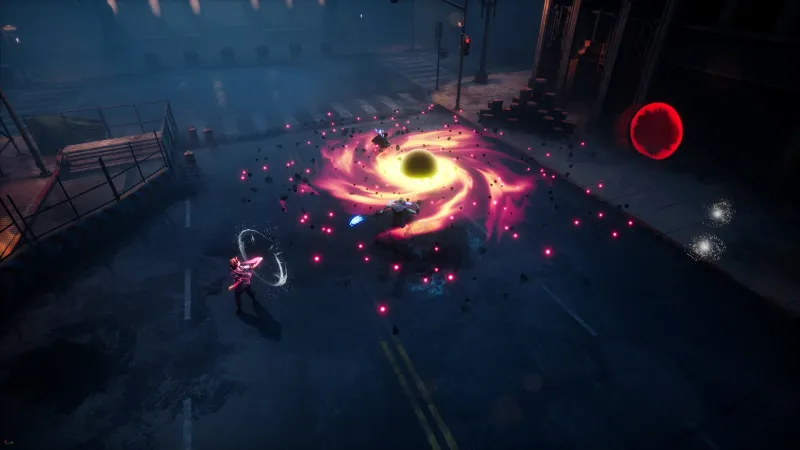
Kicking goblin butt rocks thanks to combat’s fluidity and the impactful feedback from landing blows. It doesn’t matter if you’re using daggers, swords, hammers, or heavy axes, stringing combos and air-juggling baddies feels great. The timing window for blocks and parries feels inconsistent, which is frustrating, but a successful parry triggers a satisfying slow-motion effect. Upgradable sub-weapons add further depth, such as a bow, a screen-hopping teleportation spell, mob-clearing bombs, and, my favorite, a chain that yanks enemies towards you or vice versa. Young Souls might not break the mold, but it’s an absolute blast to play. 

Goblins pose a more significant threat than the average beat ’em up fodder. They often evade, block, and parry, presenting an enjoyable challenge that kept me from mindlessly swinging my weapon. I was pleasantly surprised at how often I had to consider my offense instead of just mashing the attack button, especially against bosses. A few enemy types are annoying to deal with (shield-wielding spearmen block way too often), but Young Souls brings the fight in the best way. I encourage seasoned players to choose the developer’s recommended difficulty.
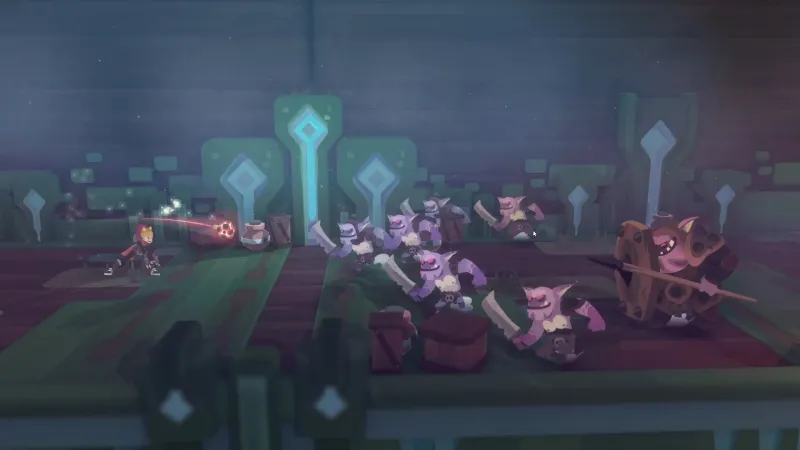
Playing alongside a buddy is probably ideal, but co-op is local only, unfortunately. Still, I’m impressed with how much fun Young Souls is to play alone. An awesome tag team system allows you to quickly swap between siblings at a button press which you can use to set up cool combo chains. This is great for making dramatic split-second saves since each sibling has their own health bar and a limited number of revives. I like the fighting game strategy behind constantly tagging in/out to allow the other twin recovery time while mixing up your offense. 

Jenn and Tristan initially play identically, but that changes in fun ways since each has their own loadout. Weapons and armor fundamentally alter their playstyles depending on their weight and type. For example, I had Jenn emphasize swift attacks and evasion while Tristan became my death-dealing tank. The game is at its best when you have two distinct twins to cover your bases against all threats, but having them both play similarly is a valid strategy, too. My Jenn’s speedier build fared better against a slow-moving boss, so doubling up on that strategy helped me take it down quicker. 

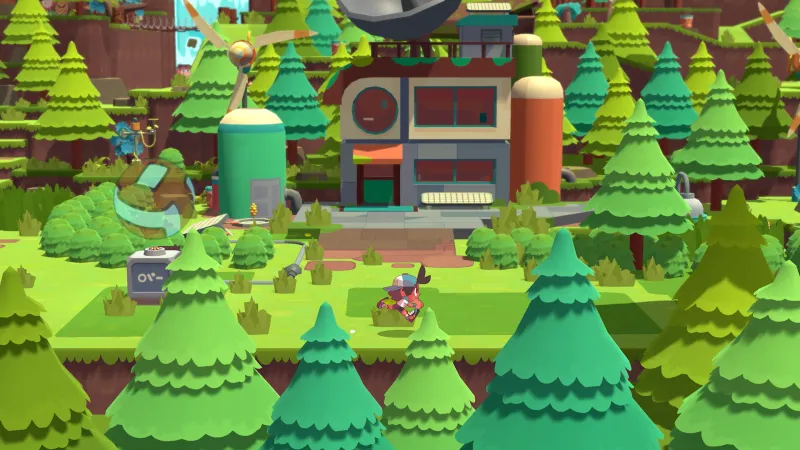
Young Souls’ structure resembles a condensed run-based dungeon crawler. You’ll battle your way through rooms of enemies to earn treasure, resources, and keys to unlock new zones and chests. Level design is largely straightforward to a fault. The game mixes things up with boss rush challenges and encounters against a legendary warrior who rewards a new weapon type each time she’s defeated. The most imaginative level pits players against ghosts that you can only kill using a particular weapon; however, the weapon renders you vulnerable to a one-hit kill. Young Souls can stand to shake up its exploration like this more often as most levels feel too mundane. On the plus side, backtracking to nab every item is a breeze thanks to a flexible fast-travel system, plentiful checkpoints, and the fact that the map marks locked chests. Young Souls may be the breeziest game to obtain 100 percent completion in some time. 

Click image thumbnails to view larger version


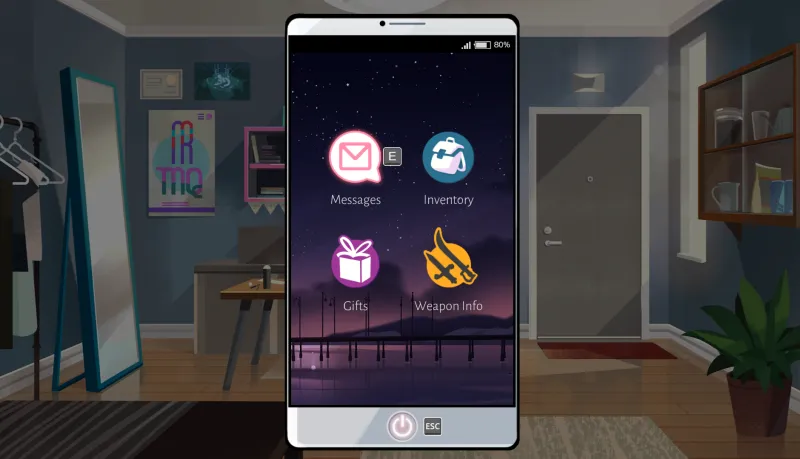
In between dungeon runs, you’ll zip around town on your moped to sell items and buy outfits, including buff-granting sneakers. You can even hit the gym to complete simple but enjoyable exercise mini-games to raise the twins’ physical attributes. However, warping home to level up is a tad annoying, as is the fact that you can’t equip battle gear in the human world. 

As the kind-hearted Professor learned, give Jenn and Tristan a chance, and they’ll impress you in more ways than one. Young Souls is an exceptional adventure you shouldn’t miss if you’re searching for the next great game to tackle with a friend, or just want a modern RPG brawler done right.

Score: 8.5

Summary: Young Souls may not shatter the mold for beat 'em ups, but its well-designed combat and impressive presentation make it a stand-out.

Concept: Wage a two-person war against an underground empire of monsters as a pair of rebellious teenagers

Graphics: Young Souls’ colorful art is sharp and oozes personality. It’s like playing a graphic novel for young adults

Sound: While the soundtrack doesn’t stand out as strongly as the art, solid tunes fit the spirit of adventure on and off the battlefield

Playability: The smooth combat has more depth than the average beat ’em up, and a varied loadout provides several entertaining approaches for laying the smackdown

Entertainment: Kicking butt in Young Souls is a blast and one of the rare co-op brawlers that is as enjoyable to play solo

Replay: Moderate
Click to Purchase

Thursday, August 26, 2021

No More Heroes 3 Review – Dead Or Alive

Publisher: Grasshopper Manufacture
Developer: Grasshopper Manufacture
Release: 2020
Reviewed on: Switch

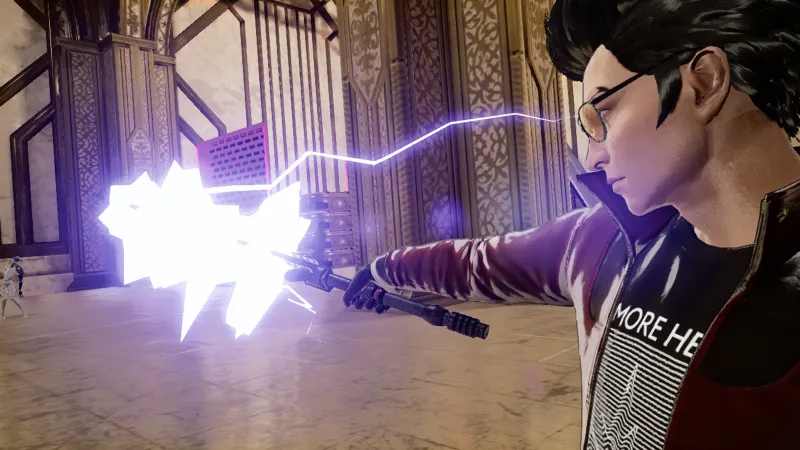
Suda 51 and Grasshopper Manufacture’s nerdy assassin Travis Touchdown returns in the first numbered No More Heroes in over a decade. Many of the series’ telltale features return, including stylish trimmings, Beam Katana battles, and completing mundane yard work to earn a buck. No More Heroes 3 is best when the action is heavy, and the absurdity in cutscenes is full-bore, but the open world padding between each thrilling melee arena or assassin duel hamstrings the experience.

No More Heroes 3 bleeds style, is full of fun references, and takes incredible pleasure in being weird and ostentatious. In the opening hour, the landscape of the cast changes in dramatic and violent ways. Also, I counted no less than four title cards in that timespan, one of which lingered onscreen longer than any in memory. I’m still chuckling about parts of this game’s presentation days later. Suda and his team at Grasshopper effortlessly plaster sound effects and visuals across the UI, menus, and cutscenes that bring countless retro games to mind. Few, if any, of the references feels corny; they’re all part of the game’s DNA.

Our hero, Travis Touchdown, has found himself fighting to become the top-ranked assassin on multiple occasions. After settling into his position at the peak of the global rankings, a gang of aliens arrive on Earth to challenge the otaku warrior. This group is led by a colorful leader and galactic prince named Jess Baptiste VI, better known as FU. A much younger and fluffier FU and his human companion Damon are introduced in the game’s opening moments in a beautifully animated Ghibli-inspired take on ET: The Extra-Terrestrial. FU was once an adorable pile of fluff looking to return home, but 20 years have passed since his last visit to Earth. Now, he’s transformed into a surly and violent kingpin, ready to kill at a moment’s notice.

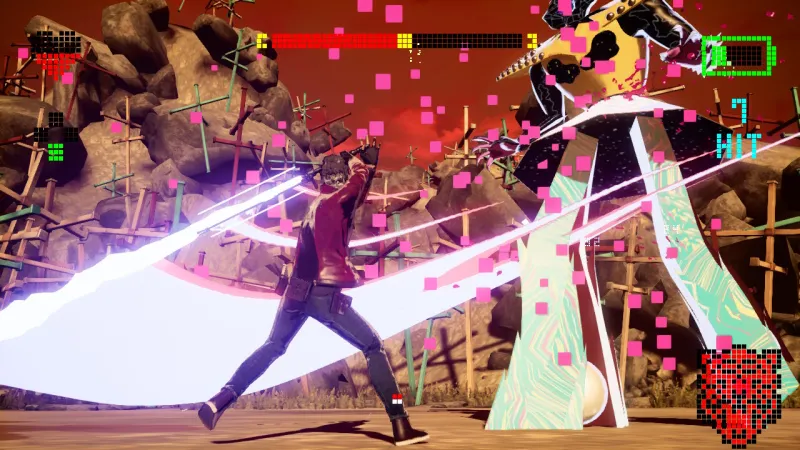
Boss battles are once again the heart and soul of the No More Heroes experience, and big setpiece battles against FU’s generals cap each episode. Players find themselves fighting among the stars in the depths of space or competing in a deadly game of musical chairs. Some encounters feature surprise moments and battles I won’t spoil, but I found it helpful to have previous series knowledge to get the most of it. Each climatic battle is unique and worth slogging through your mission tasks to complete. Even the final encounter was a blast, which breaks the fourth wall in ways that plastered a grin on my face through the credits.

No More Heroes 3 plays like TV episodes bookended with opening credits introducing the characters and features an ending credit animation reminiscent of ‘80s anime. I felt like I was seeing the world through Travis’ otaku mind, and the devs pull it off wonderfully. Episodes open with Travis hanging out with friends and discussing obscure topics like the production styles used throughout the career of director Takashi Miike. From there, you play with your talking cat Jeanne, pick out new clothes, or head to the basement to buy new skill points to power Travis up.

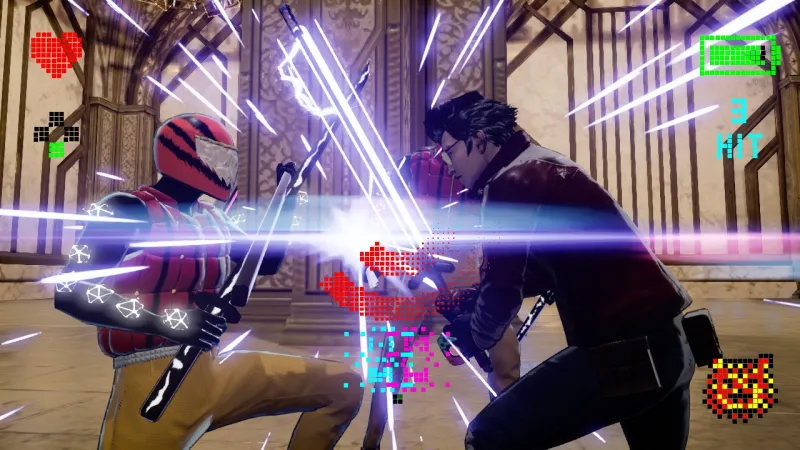
A relic of previous No More Heroes, Travis must complete a series of Designated Matches before each ranked assassin battle. These alternate between combat arenas against various aliens and mech conflicts in space against massive cosmic threats. Battles are quick and fun, where you’re presented with different enemies to fight with fantastic, diverse alien designs, each requiring a unique strategy. The arsenal at your disposal is limited but adequate. Travis can slash with light or heavy attacks using his trusty beam katana, and he uses a bevy of wrestling suplexes and throws when enemies are stunned. Early in the game, he also acquires Death powers, which allow him to slow time, do AOE damage, and toss aliens back, creating more breathing room. I never felt overwhelmed or underprepared when going into battle, but I continually hoped for more complexity and a greater sense of becoming stronger.

Once meeting the Designated Match requirements, Travis must cough up the registration fee for the United Assassins Association to sanction the match. Our mighty assassin earns money around town through Volunteer Missions, taking odd jobs to mow lawns or protect the oceanfront from invading kaiju alligators. These jobs aren’t as engaging as the combat missions, but they also aren’t a complete bore. Lawn mowing is a surprisingly strategic activity, challenging you to continually boost your engine without overloading. It features its own silliness, letting you be a showoff and ham it up while turning the machine to line up your next path to cut.

While I get this battle and chore loop is tied deeply to the series’ early installments, too much time is spent meandering between objectives in the dull, barren open world. Each chapter sends you to territories surrounding Travis’s home of Santa Destroy, and each one is devoid of interesting sights or activities in the world proper. Call of Battle is a bombed-out battlefield with a grainy sepia filter slapped on the screen. It’s the closest an environment comes to being attractive, though it is still empty and full of frustrating invisible walls. Scattered collectibles entice players to explore, but I felt minimal incentive to look around the eyesore of a world. Performance takes a massive hit in the open, bringing framerates down to near-single digits, which clashes with the more stable battle sequences.

Click image thumbnails to view larger version


While the journey to kill FU and his cohorts takes Travis Touchdown to some wild places, the narrative needle doesn’t move much in the end. There’s no natural arc for Travis, and the story merely serves as a setup for future series plans. Most character-building centers on FU and how he treats individual members of his team of space conquerors to their last meal before sending them to face Travis. Even these sequences are short and don’t matter much to the overall tale. I wish something more meaningful took place over the 15 hours I spent in Travis’ shoes.

My time with No More Heroes 3 jumped between the short highs from entertaining bosses and cutscenes to long, ugly stretches in the world. Much of the design is dated, and I wanted to drop it after a few bosses to avoid the mundanity, but I’m happy I saw it to completion. There are many fun moments, and I love how unafraid it is to be strange or referential. Those who are already invested in the tale of Travis Touchdown should be right at home in this new No More Heroes. Still, I’d insist newcomers try out previous entries before diving into this Garden of Insanity.

Score: 7.75

Summary: Travis Touchdown's return slays in action and presentation, while the world he inhabits is dead on arrival.

Concept: Travis Touchdown defends the Earth against ten ranked alien assassins who want to conquer the planet

Graphics: Battles are beautiful and fluid, but the open world is flat and drab with framerate woes. No More Heroes 3 suffers from performance issues, but is full of fun game references and stylish scenes

Sound: Retro game chimes and tones liven up menus and combat, while touches like the theme songs during the anime-like episodic credit sequences are a nice touch as well

Playability: Battles are easy to mash through, but those who want to be more meticulous won’t be disappointed. However, some side activities are frustrating and ask for more precision than the game allows

Entertainment: No More Heroes cutscenes and boss battles are worth the time investment alone. Its highs greatly outweigh the lows and provide plenty of fun for those who stick it out until the end

Replay: Moderately Low

Click to Purchase

Monday, August 23, 2021

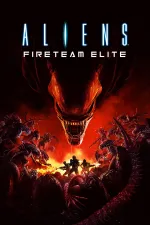
Aliens: Fireteam Elite Review – In Space, No One Can Hear You Snore

Publisher: Cold Iron Studios
Developer: Cold Iron Studios
Rating: Mature
Reviewed on: Xbox Series X/S
Also on: PlayStation 5, PlayStation 4, Xbox One, PC

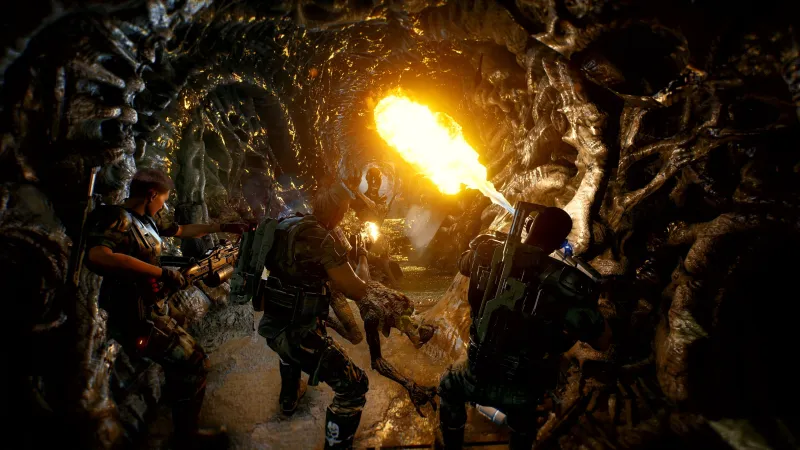
The acid-spewing Xenomorph has haunted the dreams of hardcore sci-fi lovers since its iconic first appearance in Ridley Scott’s Alien. Despite the skulking creature’s success on the silver screen, its video game adaptations have been less consistent. For instance, Colonial Marines’ tired shooting mechanics and bug-riddled environments created a lackluster experience, while Isolation emulated the gripping unease of the franchise’s best movies. Aliens: Fireteam Elite tries and often fails to establish itself in the middle ground. The environments – dimly lit corridors and abandoned caverns – sell the atmosphere, but uninspired A.I. and repetitive mission design ultimately do more harm than your average chestburster.

From the jump, you create an avatar, choose your favorite class, assemble an alien-slaying loadout, and set out alongside two players (or bots when playing solo) to take down some Xenomorph menaces. Fireteam Elite’s unremarkable plot takes place throughout four consecutive campaigns. Evil conglomerate Weyland-Yutani is unsurprisingly back at their nefarious antics, sacrificing innocent human lives for unethical alien research. Your task force is sent to the outer colonies to deal with the fallout. Sadly, there are no exciting twists or turns. If you’re a fan of the series, you’ve come across the illegal-experiment-gone-wrong trope more times than you’d care to remember.

In every firefight, numerous Xenomorphs or rogue synthetics fill the screen, clambering over one another – from pesky facehuggers and tool-wielding “working Joes” to 7-foot tall, bipedal Praetorians and heavy-infantry androids. Staff sergeant Herrera, the aggressive voice in your ear, oversees your progress through each campaign, but her directives and each mission’s overall level design, never change. Sure, you might traverse the awe-inspiring remnants of Prometheus’ ancient humanoid civilization (a nice break from the first mission’s dull storage bays and metallic hulls). However, your orders remain to advance upon a point of interest, activate a console or place a scanner, and hunker down amid incoming swarms while navigating linear maps. Rinse and repeat. Setting fortifications like sentry turrets and mines help alleviate the repetition, but Fireteam Elite has no intention of surprising its players or experimenting with its typical shoot-from-cover mechanics.

Click here to watch embedded media

Your marine’s personality is disappointingly nonexistent, and character customization is a cosmetic tag-on. Thankfully, classes add an important strategic component to the action. Each class comes equipped with two abilities and weapon specializations that can alter the flow of combat. Additionally, you can swap onto different roles during mission prep. The Doc’s “Trauma Station” heals the entire squad in a small radius and works like a charm in narrow passageways while the Demolisher’s assortment of heavy weapons, like the “smart gun” and flamethrower, dole out serious punishment and are helpful when things get dicey. I enjoyed leveling up my favorite classes to unlock rare perks like extended ability durations, which came in handy when selecting harder difficulties.

Managing abilities and securing different angles while also watching teammates’ backs created moments of thick tension. It’s too bad that those moments are few and far between. While enemies come from many different directions, each gunfight plays the same way. This is indicative of Fireteam Elite’s larger issue: monotony.

After reaching a checkpoint, you can return to your base of operations – an empty hangar, save for a smattering of forgettable, lore-dump NPCs – to purchase new weapons, attachments, perks, consumables (like elemental bullets), and other gear. You can also buy challenge cards that make missions harder for the added benefit of amassing a more significant fortune. When nearing the end of the campaign, I appreciated those challenge cards and used the funds to buy better mods and perks to meet the higher “combat rating” requirements of the final assault. On the other hand, this also meant that I spent time grinding through previously beaten sections. And with no variances in the gameplay, this got old quickly. There’s no avoiding this grind; you’ll have to backtrack more than once to complete the entire campaign since experience points and money don't grow on trees.


Weekly objectives called “Tactical Opportunities” dish out some extra currency for completing miscellaneous tasks like running a certain class or eliminating enemies with specific weapon types. Still, the payout isn’t worth replaying carbon-copy missions. What’s more, once the campaign is over, horde mode is finally unlocked, which – you guessed it! – reuses the locales and mission goals that you’ve already cycled through multiple times.

Aliens: Fireteam Elite occasionally fires on all cylinders, especially during battles. Xenomorph and synthetic limbs tear at you as you buffet them with high-energy bullets. The carnage produces pools of acid blood that deal extra damage if you don’t watch your step. Even Austin Wintory’s dissonant score and the array of nostalgic sound effects – particularly the whirring pulse rifle and thudding footsteps of approaching drones – help immerse you in the Alien universe. Unfortunately, there’s not enough interesting or entertaining content to parse through, and the grind gets tedious. Developer Cold Iron Studios promised a year of post-launch content, but unless substantial changes are made to the loop, you’re better off steering clear of this messy infestation.

Click image thumbnails to view larger version


Score: 6.5

Summary: Aliens: Fireteam Elite occasionally fires on all cylinders, but a monotonous gameplay loop bogs down the entire experience.

Concept: Shoot your way through a growing brood of Xenomorphs while unearthing the immoral schemes of a notorious megacorporation

Graphics: Character models are nothing to gawk at, although the scale and look of ancient archeological dig sites and alien spacecraft is impressive

Sound: Fans of the series should recognize the satisfying symphony of bullets and bone-chilling, guttural screeches from the films. Sometimes the low warble of the music can be mistaken for ambiance, but it more than rises to the occasion once the bullets start

Playability: Firing weapons remains at the core of Fireteam Elite’s combat, but class abilities, such as buffs and heavy ordinance, steal the show

Entertainment: The bland routine of traversing meandering hallways to arrive at wider combat zones brimming with seemingly unending hordes often leads to fatigue and frustration

Replay: Moderately Low

Click to Purchase

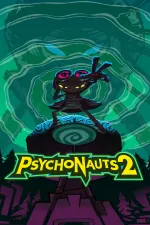
Psychonauts 2 Review – Well Worth The Wait

Click to watch embedded media
Publisher: Xbox Game Studios
Developer: Double Fine Productions
Release: 2020
Rating: Teen
Reviewed on: Xbox Series X/S
Also on: PlayStation 4, Xbox One, PC

Over 16 years have passed between Psychonauts games, but not much time has elapsed for protagonist Razputin “Raz” Aquato. His scratchy, high-pitched voice still screams of youthful inexperience, and his actions almost always show an eagerness to learn.

That’s precisely what developer Double Fine Productions has also done over the years. Time has allowed this arthouse studio to hone its platforming craft, sharpen its already hilarious wit, and create a sequel that shows off the tremendous complexity of the human brain and the thrill of unearthing its wonders. Psychonauts 2 invites players to explore colorful dreamscapes that melt into dangerous nightmares and quickly establishes the thought that almost every turn will lead to something unexpected and weird.

With summer camp behind him, Raz is now a talented intern for the Psychonauts, a psychic spy organization of superbeings that are dealing with a mole within their ranks. Raz wants to be involved in solving this mystery, yet his impulsiveness gets him into trouble early on, and he quickly needs to undo his mistakes. The story roars out of the gate with silly excitement and never slows thanks to clever jokes and a wonderfully realized cast of characters. Their banter is fantastic and usually offers deep insights into their motivations and personalities, especially when Raz is diving through their minds. Some thoughts are disturbing and explore serious mental health issues, but Double Fine handles them with care, often framing them in artistic ways.

Many of the dreamscapes Raz explores will likely elicit an audible “wow” thanks to their visualization and dynamic compositions. Colorful, loud, jagged, and almost always holding a claymation-like aesthetic, these worlds dazzle with their creativity and double as excellent playgrounds for the platforming experience at hand.

Click here to watch embedded media

Although there’s no shortage of animated story sequences to sit back and watch, Psychonauts 2 is a platformer at heart. Raz, who just happens to be the son of acrobatic parents, follows in their footsteps with a bit more grace and skill. His leaping prowess, and the controls bringing it to life, are improved, but he still isn’t moving with the precision and fluidity of Mario. A little uncertainty and guesswork comes with gauging jump distances and grab points. That said, no platforming sequence is ever as unfairly challenging as the first game’s death-dealing Meat Circus level. Psychonauts 2 consistently delivers solid platforming fun and encourages players to veer off the beaten path to find secret collectibles and upgrades galore. The most enjoyable collectibles to snatch up are the Figments, two-dimensional pieces of art scattered throughout the levels that often push the player to throw caution to the wind.

Raz’s newfound acrobatic status also transitions to combat, where dodge rolling and creating space are paramount. That distance is essential, as he doesn’t have to punch every enemy he comes across, and can now use a wide array of psychic powers to achieve victory from afar. He can start them on fire, riddle them full of holes with psi-blasts, or use other abilities to bring the censors and other enemies to their knees. Combat is vastly improved over the original game but is used sparsely, primarily within short arena-like conflicts or against bosses.

Click image thumbnails to view larger version


The spotlight isn’t solely on platforming, however. Even those sequences often feel truncated given just how often Double Fine transitions to different gameplay sequences or story moments. The flow works, as it keeps the player off-kilter and unsure of what could happen next. In one moment, I chopped up an adorable bacon character to fry up and feed to a goat puppet, and in another, I was balancing precariously on top of a giant bowling ball. Most of the gameplay sequences are enjoyable and blend nicely with the platforming action. The constant shifting of gameplay types creates a problem in that the player frequently must pause to assign specific abilities to the action buttons. Some of the powers are quite ingenious; one even bringing a wildly different version of Raz into play.

Psychonauts 2 is mainly about Raz’s psychic development but also focuses intently on the life of Ford Cruller, a character who appeared in the first game and is born again in a truly fascinating way. For the sake of spoilers, I won’t go into Ford’s involvement too deeply, but satisfying (and shocking) payoffs come from it, and the worlds he introduces to Raz are alarming in the best possible ways for a gaming experience.

I adored almost every second of Psychonauts 2. It achieves something I don’t often see in games – a continual sense of awe as each of its worlds unfold. It took 16 years to reach release, but Double Fine has delivered an incredible sequel. I hope we get a third installment that doesn’t take nearly as long to create.

Score: 9

Summary: Double Fine has crafted an artistic journey that impresses at almost every turn in unexpected ways.

Concept: A long-overdue sequel that pumps out psychic excitement in both its platforming and twisting narrative yarn

Graphics: Each world leaps off the screen with colorful designs worth studying up close to see all the little artistic touches. Some of the texture work is a bit dated, however

Sound: The wild dreamscapes come to life with melodies that bounce between peaceful and haunting. Voicework doesn’t get much better than this ensemble

Playability: Improved in almost every way over the original game. Having to manually map highly used gameplay abilities highly used gameplay abilities manually is annoying

Entertainment: Well worth the wait and better than the original, Psychonauts 2 hits its stride early and never loses steam

Replay: Moderate

Click to Purchase

Thursday, August 19, 2021

Madden NFL 22 Review – Short Of The First Down

Madden NFL 22

Publisher: EA Sports
Developer: EA Tiburon
Rating: Everyone
Reviewed on: Xbox Series X/S
Also on: PlayStation 5, PlayStation 4, Xbox One, Stadia, PC

Following vocal community backlash against last year's game, developer EA Tiburon looked to turn things around through an increased emphasis on Franchise and more noticeable improvements to gameplay. Madden NFL 22 takes the field with tons of potential, but its inability to differentiate from its predecessor, plus its many fumbles, wipe away much of the goodwill it garners.

Franchise mode remains a focus following EA Tiburon's shift to add to last year's mode post-launch. In addition to the post-release updates implemented by Madden NFL 21, this year's mode simplifies its user interface, giving you easy access to league news or information about your upcoming opponent. I like the new coach progression system, which lets you unlock perks like attribute boosts, better negotiation skills, and extra experience points for players.

However, my favorite Franchise addition this year comes in the form of the improved weekly strategy tools. Here, you plan for the specific team you're facing on both sides of the ball, plus dictate the intensity of your practices. While full practices grant stat boosts, they have a chance to leave your players banged up going into the game. I found it helpful to scope out your opponent's strengths and then apply temporary boosts to counter them.

Click here to watch embedded media

When you finally step onto the field, the football action is solid but familiar. While I still noticed snapped-to animations, dumb mistakes from the A.I., and players running into each other post-play, better blocking and tackling make the trench battles more realistic. The feeling of a pocket closing around your QB is almost palpable, and I'm happy it's easier to blast through running lanes as a halfback. These incremental improvements add to the experience in tiny ways, but they still don't take the game forward enough to differentiate it from last year's title. However, my favorite additions come in the new atmosphere and momentum mechanics.

I love watching the new momentum meter react to the on-field action, unlocking advantages for the side in control. These modifiers often come in the form of hindrances for your opponent, like knocks to their stamina or hiding their receiver icons. Whenever my opponent stole the momentum, I always did whatever I could to chip away at their advantage. When the meter is heavily on one side's favor, the camera even shakes pre-snap, replicating the unease your on-screen players feel.

These mechanics carry over into Face of the Franchise, the series' single-player career mode. This year, you can play on the defensive side as a middle linebacker. I've always enjoyed Madden's offense more, but I liked stepping into the shoes of the field general of the defense with a new camera angle and more instructive play art. Even though you're right in the middle of the action, not every play comes your way, meaning your play calls are more important to your team's success than when you play quarterback where you touch every snap.

I like role-playing a hotshot rookie entering the league, trying to turn around a struggling franchise through weekly play and unique scenarios. As you go from week to week, you're presented with special situations like a big rivalry game, a weather-delayed match-up, or a game where the opposition trash talks your offensive coordinator, so you run up the score to defend his honor. I found it rewarding to progress my player by making decisions about how to spend their free time, even if the story is largely forgettable. Once you're through the beginning, most narrative beats are awkward cutscenes where voicemails play over an animation of my character on his phone or through uninteresting text conversations. In the lead-up to a big rivalry game, I even had to play through a puzzling scene where a coach asked me multiple-choice questions about the history of the New York Jets. While I love single-player career-centric modes in sports games, sequences like that leave me scratching my head.

Click image thumbnails to view larger version


Though I appreciate the new ability to play on defense, I found the most enjoyment in the mode lining up under center as a quarterback. Nothing beats the excitement of calling the right plays, driving down the field, and completing important passes at crucial junctures of the game. While the core experience is enjoyable, Face of the Franchise fumbles due to glaring technical problems. Seemingly broken cutscenes leave characters awkwardly staring after dialogue stops, and some practice minigames fell apart when players didn't appear on the field. However, the worst glitch came in my first game as a linebacker for the Chargers. The Washington Football Team didn't spawn, and instead, I played against a duplicate Chargers team. Glitches are present in other modes but are especially noticeable in Face of the Franchise.

Those looking for more quick-hit experiences still have The Yard, Superstar K.O., and the standard online suite. The Yard adds more challenges to complete thanks to beefed-up campaign missions, plus cross-progression for your Face of the Franchise avatar adds incentive to continue your career in this side-dish mode. While I appreciate the freedom to pour hours into The Yard or Ultimate Team, this year's tweaks do little to entice me to spend more time in these modes.

Despite its several technical issues, the on-the-field action of Madden NFL 22 continues to improve in small ways. However, the upgrades and improvements are largely overshadowed by the game's problems and the series' overall stagnation, making it difficult to recommend for week one.

Score: 7

Summary: Though Madden NFL 22 delivers solid yet familiar action, the yardage gained is squandered by its fumbles.

Concept: Step onto the field once again as your favorite NFL team, but crowds and momentum play a more significant role this time around

Graphics: When the many technical errors aren't ripping you out of the immersion, Madden NFL 22 looks good. Spectators feel less mechanical thanks to new crowd animations

Sound: The commentary gets repetitive fast, but the remastered crowds sound great when the momentum is in the home team's favor

Playability: The core experience is extremely familiar, but gameplay enhancements both subtle and apparent improve the play-by-play action

Entertainment: The atmosphere enhancements are welcome additions, and the on-the-field action is largely sound, but Madden NFL 22 suffers from technical issues that hold it back

Replay: Moderately high

Click to Purchase

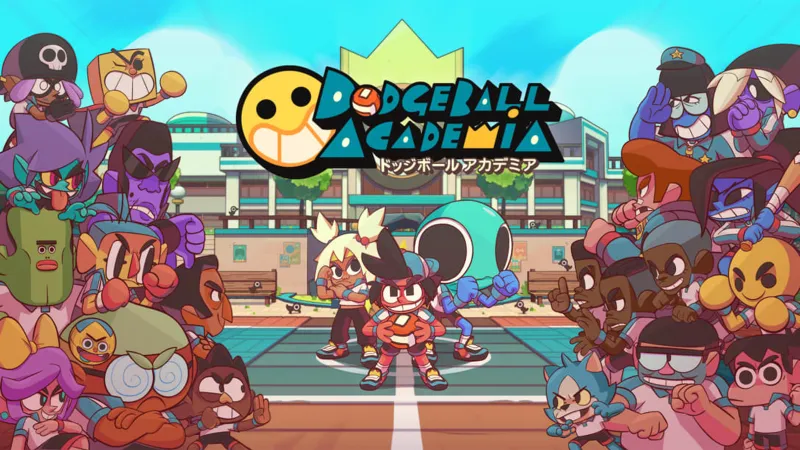
Dodgeball Academia Review – Head Of The Class

Publisher: Humble Games
Developer: Pocket Trap
Rating: Everyone 10+
Reviewed on: Xbox Series X/S
Also on: PlayStation 4, Xbox One, Switch, PC

Story-driven sports RPGs such as the early Mario Golf and Tennis games, or most recently Golf Story, have slowly come back in vogue. Brought to life with the art of veteran animator Ivan Friere and Brazilian studio Pocket Trap, Dodgeball Academia is a confident combination of Shonen anime, sports games, and Saturday morning cartoons, creating a thrilling experience to the very last match.

After ditching his old school and breaking free from his controlling parents, Otto wants to prove he has what it takes to thrive at Dodgeball Academia, the premier school for the sport. Professors of the academy initiate the new students by unlocking their extraordinary latent power. These abilities manifest after touching a magical ball, an artifact from the “Great Dodgeball War,” an event that illustrates how ingrained the sport is to this world. Think of this introductory ceremony like X-Men getting their abilities from the Sorting Hat. This amalgamation of some of the most popular tropes in modern media works well and allows the narrative to stretch its ingenuity ideas where it counts the most: on the court.

Dodgeball games play out in real-time, but these games aren’t the one-hit elimination matches you might be used to from gym class. Your primary goal is to reduce the opponent’s health by pelting them with balls, a simple objective, but things get a lot more explosive thanks to the aforementioned special abilities. Over time you’ll level up characters and gain stat boosts and more augments that change how each character plays.

Some students, like Otto, imbue their attacks with elemental effects, others heal their team or teammates, and some cause the ball to boomerang or curve. I’m delighted by the sense of individuality this brings to each athlete on my team and among my opponents. These differences are factors in deciding on your team of three based on their abilities and playstyles. I enjoyed and found success with a balanced group of an attacker, skilled defender, and support player capable of replenishing HP. One of my favorite characters can’t catch balls thrown her way and relies on a more creative method of defense. Instead, you hold the catch button and release it at the right time, and she rockets the ball back at the opponent using a baseball bat.

After charging a meter throughout the match, characters can unleash their Balltimate move, a super technique that can turn the game’s tide. Otto’s Balltimate is a standard Hadoken-like fireball, support character Ballooney puts down a healing puddle, and Mina strikes opponents with deadly lightning bolts. Balltimates are unique to each character and are a significant factor in how I build my three-person team. Balltimates can be used to spam your way through matches, and I did that a few times, but I never felt like I was cheating. Any given match can go south no matter how you try to cheese the game.

Matches in Dodgeball Academia offer a refreshing, if subtle, variety, which keeps the action fresh. Opposing teams have various makeups, and even the court and obstacles change from match to match. Some courts are bigger. Some have oncoming traffic you have to dodge along with enemy attacks. Even the balls vary from battle to battle, sporting different elemental properties and shapes. I wasn’t pleased with the forest court, which obscures the view of the action by covering everything with tall blades of grass. This recurring match-type is annoying; thankfully, they only take up a small percentage of the games you’ll play.

I enjoyed the day-to-day life at the academy. Some days you go to class to train in subjects such as dodging or catching through timed survival minigames; other days, you’re sent on quests by the professors. Peppered in between are matches in a schoolwide tournament to decide the best team on campus. Each day brings a fun self-contained story, with pieces that nicely culminate on the final day of the competition. Along the way, Otto and his ever-growing slate of misfit teammates have to contend with rampaging training robots, scheming classmates, and a cult of students who deeply believe dodgeballs are square-shaped. Each student in Otto’s class has their quirks and personalities you learn throughout the game’s eight chapters, and while most are antagonistic, all are enjoyable.

Click here to watch embedded media

Unfortunately, the action never strays far from school, its parking lot, and a nearby forest. A brief stint to an icy mountain brought some enjoyable platforming not seen in the rest of the game that I wish was more prevalent. Running through the same three areas over again, seeking the next objective is repetitive. While I enjoyed what’s there, the world’s mundanity compared to the absurdity of the characters and their powers was a letdown.

Fortunately, an incredible soundtrack kept me trotting happily back and forth around the school. With tunes like the jaunty and hopeful dormitory and leisure area themes or the energetic wailing electric guitar-driven song heard on the school grounds, Dodgeball Academia has my favorite game soundtrack of the year so far. It also doesn’t hurt that the battle intro music seems heavily inspired by the Pokémon games and features a similar alarming intro and triumphant victory fanfare. I haven’t woken up a day this week without something from this soundtrack playing on loop in my head, and I wouldn’t have it any other way.


The art and character animation are equal to the music. Pocket Trap did a great job giving each sprite a big personality, even in their standard idle animations. Ballooney’s deflating head, the Principle’s gleaming badge flick, and Vampy’s animalistic movements are noticeable minor touches to some spectacular character work. These characters look plucked from a Cartoon Network series. While I expect that quality in cutscenes, the art and animation even shine in the dodgeball matches. Whether it’s the main characters and their attacks, or standard nameless enemies, everything has an excellent way of moving and interacting on the court.

I may have some minor quibbles here and there about certain courts or reused environments, but at the end of the day, Dodgeball Academia is a champion in its field. It provides the best parts of sports RPGs with cheeky characters, flashy special moves, and gameplay that’s fun to master. Better yet, the package is enhanced by a killer soundtrack. Look no further than this gem if you want to have a great time for a dozen hours.

Click image thumbnails to view larger version


Score: 9

Summary: This goofy and energetic sports RPG with the soul of a Shonen anime passes with flying colors.

Concept: Take an excitable dodgeball prodigy through fantastical classes at the world’s premier academy for the sport

Graphics: With character designs on the level of the best cartoons running, Dodgeball Academia is plenty of fun to look at

Sound: This peppy soundtrack is full of earworms that should stick with you on and off the virtual dodgeball court

Playability: Easy to pick up with plenty of abilities and characters to learn and juggle throughout the adventure

Entertainment: Boredom is never allowed thanks to entertaining characters, diverse team compositions, and a steady difficulty curve

Replay: Moderately Low

Click to Purchase

Wednesday, August 18, 2021

Boyfriend Dungeon Review | To Woo Or Not To Woo, That Is the Question

Publisher: Kitfox Games
Developer: Kitfox Games
Rating: Teen
Reviewed on: PC
Also on: Switch

Visual novels are nothing new, but they flourished in the late nineties as an offshoot of Japanese adventure games. More of an interactive experience than the usual gameplay, these titles center around a journey where the player chooses between several story routes, effectively shaping the narrative. This genre is also known for its bursting romance simulators, though in recent years the medium has started to cater to a wider player base beyond the usual target audience. Boyfriend Dungeon puts a roguelike spin on the genre and weaves a compelling storyline with a comedic twist reminiscent of games like Dream Daddy.

In the latest Kitfox Games adventure, you craft your character by choosing your hairstyles, clothing, pronouns, and other basic tweaks with a limited character creation tool. Once done, players travel to Verona Beach to get a fresh start on life with the support of the player’s mom and their cousin Jesse. Your room inside your cousin’s old digs opens up a new world of possibilities, a world that happens to be filled with people that can turn into weapons. The visual novel twist? They are all ridiculously hot.

The story is more than its romantic ties. It’s about facing personal fears and learning more about yourself and opening up to those around you, even when looking for simple friendship. I felt like I had more to do within Boyfriend Dungeon than the usual visual novel niche, particularly with player choice regarding the cast of characters and the dungeon-crawling gameplay style. Boyfriend Dungeon mixes in roguelike gameplay, making it more than just an interactive novel. As far as roguelikes go, this is pretty forgiving. The action is simple and repetitive. Dying has no real penalty, you simply leave the Dunj (which is a mall crawling with monsters in the form of old cell phones and VHS tapes) and wake up back in your apartment. There is also the additional option of the Shield in the menu settings, allowing a defensive buff when in the heat of battle, which should help players looking for an easier time. 

Throughout this journey, you choose your weapon ally, discover hidden locations, find tucked-away safes full of loot, and take moments between rounds to squeeze in a little extra one-on-one time with your love interest. The setup is cute, but limited in variety. Until you reach the bottom depths, each level looks exactly the same and the enemy types are repetitive. To counter this redundancy, you can swap out your weapon before each level, allowing for new conversations and combat strategies. For instance, running with a dagger is pretty fun for the upper floors while the enemies are still at an average level and not too overwhelming. On the other hand, something more powerful like Jonah’s axe is a good pick when you’re going down into the deeper levels where meatier enemies lurk. My favorite weapon was Leah, who is a hammer, because we share a love of karaoke but she also just kicks a ton of butt when it comes to getting cornered mid-fight. As you progress, there are more instances of enemy encounters that switch up the enemy types.

The true Boyfriend Dungeon experience lies within the game’s characters. The mainstay romance options include Sunder, the bad boy with a secret, and Valeria, a woman with a free spirit and a checkered past. There are also splintering flirt options, those met throughout the course of the game but not included in the “main cast” of love interests. There are men, women, and non-binary potential romance options to get to know without the pressure of getting lovey-dovey. Unlike many games in this space, Boyfriend Dungeon won’t punish you for favoring one character over another, you can choose them all or none at all! And if romance is not your thing, Boyfriend Dungeon allows players to remain friends with the characters they meet, alleviating any pressure to make the “right choice.”

Each character has their own deeper story to uncover. Some storylines are light-hearted, while others tackle “real” subjects such as betrayal, the longing to belong, and the continued process of growing as a human. Not every storyline hit a home run, but each character is unique and easily relatable. I instantly connected with characters like Valeria, and I enjoyed watching her journey of re-learning how to trust again, both platonically and romantically. Kitfox does a great job keeping that relatability believable despite the game’s premise.You can give gifts to the characters you treasure the most, listen to one another’s stories, and get to know each other in true visual novel style through dates and battling out those Dunj monsters. 
 

Overall, Boyfriend Dungeon is an enjoyable experience for fans of both roguelikes and visual novels. I like that it gives you the option to make the adventure live up to the romance simulator hype, or just meet some great characters to become friends. Boyfriend Dungeon offers a charming gameplay experience despite its simplistic mechanics and redundant enemies. With more characters teased for the future, I can’t wait to dive in to see what’s next.


If comments are still showing as disabled, a site update is happening on our side that has caused a temporary takedown. We hope to have them back up and running soon so our community can go back to sharing their thoughts with us about everything gaming-related! 

Score: 7

Summary: Fight some monsters, woo some swords, and embark on an adventure of self-discovery and fun.

Concept: Fight off monsters in roguelite arenas with weapons that turn into people, and find love in romance and friendship

Graphics: The character designs and art style are simplistic but colorful, filled with calming pastels and vibrant neons to bring the adventure to life, whereas in combat it takes on a more chibi-like look

Sound: A playful soundtrack filled with indie artists beautifully contrasts the low-key sounds and narration of the characters

Playability: The combat mechanics are obviously designed with controllers in mind, but exploring the surrounding area is easy

Entertainment: The story pairs real human experience with comedic levity, offering depth to the game that should appeal to story lovers and roguelike fans

Replay: High

Click to Purchase

Twelve Minutes Review – Stuck In Hell

Click to watch embedded media
Publisher: Annapurna Interactive
Developer: Luis Antonio
Release: 2020
Rating: Mature
Reviewed on: PC
Also on: Xbox One

Getting stuck in a narrative time loop game is a unique sort of hell. On the one hand, being stuck creates a connection between mechanics, story, and player engagement rarely possible in video games; like your protagonist, you’re trapped, both caught in a never-ending cycle you are unable to break. On the other hand, the experience can be frustrating when you want nothing more than some shred of progress. So goes Twelve Minutes, a fascinating game that unravels its story 12 minutes at a time.

The beginning of Twelve Minutes is immediately captivating. Arriving home to your small apartment, your wife has made your favorite dessert. It’s a special night because, as you sit down to eat, she reveals she’s pregnant. You’re going to be a father. But then comes a knock at the door. A man claiming to be a police officer accuses your wife of murdering her father eight years ago. He says he’s looking for a pocket watch belonging to her father. She insists she didn’t do it, but the cop wrestles both of you to the ground. In an act of utter police brutality, he begins choking you, but at the moment of death, you wake up at your front door just a few minutes earlier. The evening continues to repeat itself. What do you do next?

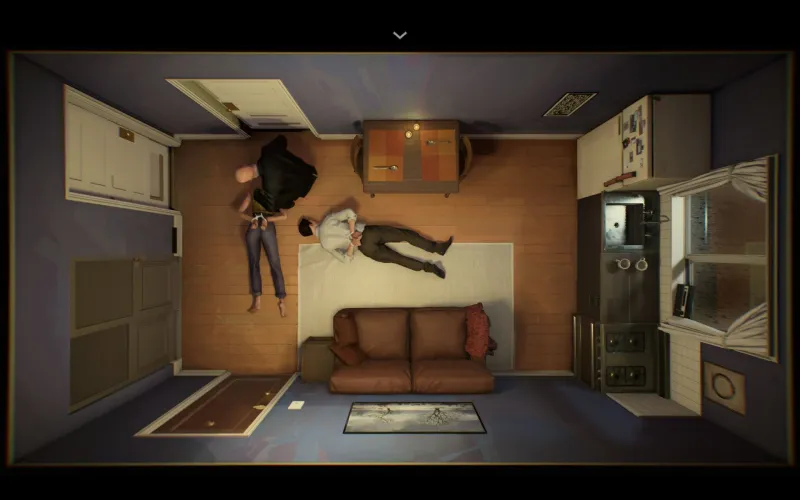
Twelve Minutes is a point-and-click adventure game, and so you point and click your way around the three-room apartment, trying to convince your wife of the time loop, stop the police officer from killing you, and unravel the mystery at your front door. Solid writing and great performances by James McAvoy, Daisy Ridley, and Willem Dafoe carry the game for its roughly six-hour runtime. Dafoe, in particular, plays an excellent and scary villain who’s both deadly and aggressive, amplifying your sense of urgency through each loop.

Click here to watch embedded media

Progress comes down to memorization and experimentation. Memorization works better in the long run. If you can remember the location of each key item in the apartment and the core questions that need answering, you can make solid progress through each run, discovering new revelations as you get better at the puzzle. However, mechanically, the game never goes quite as far as I wanted. My hair-brained schemes and experiments – such as trying to pour a glass of water on the hardwood floor inside the front door to trip the cop – were not recognized by the game. There are very exact solutions to each puzzle, such as show this photograph to this character, and only then can you unlock the dialogue tree you need. The game expects you to figure out these solutions exactly as it wants you to, which can feel limiting when you want to experiment with the environment.

In and of itself, this isn’t a bad thing, but when you get stuck, you feel trapped in your own time loop. Each run through the game lasts just over 10 minutes, which feels like a harsh time restriction when you can’t decipher your next move. The time limit can be frustrating, and each cycle’s repeating dialogue becomes very grating. At one point, I spent over an hour repeatedly going through the loop, trying desperately to find the one thing I missed. Every time I tried to be creative with the game, nothing I did gave me any progress. The whole process was infuriating.

Click image thumbnails to view larger version


                                                                                                           The flip side of this experience is that once I found a solution – almost always through experimenting the way the game wants you to, not the other way around – the payoffs were satisfying. At the root of Twelve Minutes is the question: Can you ever really know someone? No matter how close you are, do you know everything there is to know about a person and their past? It’s not the most unique story in the world, but by the time I reached the game’s finale, I was hooked. When I saw the last shocking and grotesque twist, I felt like the game had earned its narrative payoffs – despite a few plot holes, such as one character’s odd gaps in memory. I’m still not sure where I land on the final revelation, but I commend creator Luis Antonio for genuinely going for it and pulling no punches. I think the ending could potentially rub some players the wrong way, so if you can find necessary trigger warnings without spoiling yourself on the story, it’s a good idea.


Twelve Minutes is ambitious, both in its narrative and gameplay. It restricts players to its brutal rules, and its tragedies truly horrified me. And while its gameplay never let me experiment as much as I wanted it to – I still wish my cup of water plan had worked – I can’t stop thinking about the experience. I don’t want to be trapped in the game’s time loop any longer, but the entire adventure will stick with me. Twelve Minutes is a case study on a game thinking outside the box, playing by its own rules, and it’s a worthwhile experience for that alone.

Score: 8

Summary: Twelve Minutes is a captivating, horrifying journey that left us hooked despite some frustrations.

Concept: Fight your way through a time loop, trying to figure out why a man is at your apartment accusing your wife of murder

Graphics: The top-down perspective and one-apartment setting gives the game a live-stage feel that amplifies the story

Sound: Great performances by Willem Dafoe, Daisy Ridley, and James McAvoy sell the story’s stakes

Playability: Pointing and clicking around your apartment makes up the majority of Twelve Minutes. It’s fun mixing and matching different items to find new results

Entertainment: Twelve Minutes sinks its claws in from the get-go and doesn’t let go until the final, brutal revelation

Replay: Moderate

Click to Purchase

Friday, August 13, 2021

Dreamscaper Review - Ethereal Enchantment

Developer: Afterburner Studios
Reviewed on: PC
Also on: Switch

As Cassidy, your goal is to conquer the nightmares that plague your dreams. To this end, you employ everything from pool cues, yo-yos, finger guns, and magic bows to complete your adventure against strange nightmares and ghoulish bosses. An excellent combat system creates a flow that has you zipping from monster to monster. Secrets and unlocks await around every corner. Some smart choices – like letting players teleport to rooms they have already discovered instead of walking – add some welcome convenience to the roguelike dungeon crawl.

Click here to watch embedded media

Combat is crisp, responsive, and the highlight of Dreamscaper. While I found it possible to get through a run with some incredible gear and big buffs without engaging with the battle mechanics, it is incredibly satisfying to learn how to perfect dodge, block, parry, and time your attacks. You can even deflect projectiles back at foes as you master the timing. Boss fights are skill-oriented, and you must learn each of their abilities and how to counter them. My first battle with each boss was intimidating, and I often failed early attempts. Later, I was running circles around these monsters and finishing them off without getting touched. Mastering and engaging the mechanics is a true joy, and the combat kept me coming back even after I’d completed an entire run of the dreamscape.

Click image thumbnails to view larger version


Each dungeon runs yields various resources that you can spend in the waking world between runs. Eventually, you unlock new items to find during runs and permanent power boosts, including health, potent companions, and more. In addition, you can spend resources to alter the room configurations and logic. Spending resources allows you to add rooms, change how rooms work, and add considerable options to each run, and this adds another valuable foible to play with as you work on other stats and skills. Being able to add challenge rooms for more items, health fountains, and item enhancing blacksmiths makes a huge difference and is a cool roguelike feature on top of the other progression methods.

As your relationships with the various residents of the town grow, you gain influences you can bring into the dungeon, which can make you an offensive or defensive powerhouse. While the game attempts to turn these relationship-building encounters into a narrative, these efforts fall flat compared to the rest of the game, and I found myself skipping the little vignettes to get back to the action. While the small-town chat and look into lives might be suited for a more laid-back game, I had little interest in the rather uninspiring stories of the townspeople who attempted to regale me about their lives at the record store or journey as historians. The soundtrack is on point – soothing and calming as you walk the cozy land of the living but appropriately tuned up and raucous within the nightmare.

A notable lack of enemy variety is apparent as you dig deeper into the dreams, but this didn’t diminish my experience. Even though the game involves repeatedly plowing through many of the same creatures, the variety of tools on hand to do so keeps things fresh until the very end. The continual drip-feed of upgrades makes every run a joy, even if you meet an untimely end. A lucid dreaming option is great for players who want to make significant progress every run regardless of other factors. Lucid dreaming gives players additional defense with every run, making success a sure thing in the long term. This option is essentially a way to add a difficulty slider to the core roguelike formula and is an excellent choice for those looking for a far more forgiving entry point.

If you’re an old-time lover of roguelikes that’s into things like Binding of Isaac or Dungeons of Dredmor, Dreamscaper is for you. If you’re a newer addition to the ranks of procedurally-generated dungeon crawls with the new era of roguelites like Rogue Legacy or Hades, Dreamscaper is for you. Either way, smart design decisions and surreal vibes surround the experience, making this an excellent summer surprise.

Score: 8.5

Summary: Explore the depths of your dreams in this engaging roguelike.

Concept: Explore dreams and nightmares in a fast-paced action RPG roguelike

Graphics: The visuals expertly convey a surreal dream state that fits the concept wonderfully, creating a whimisical world to explore

Sound: A stirring soundtrack keeps boss fights intense while the quieter moments are seren

Playability: If you don’t master the combat, you can engage with plenty of powerful permanent progression hooks. A lucid dreaming option allows anyone to conquer the nightmares

Entertainment: Dreamscaper is a subtle, surreal ARPG that features compelling combat, engaging progression systems, and enchanting environments. If you enjoy roguelikes, don’t miss it

Replay: High

Click to Purchase

Wednesday, August 11, 2021

Axiom Verge 2 Review – Lost In Another World

Publisher: Thomas Happ Games
Developer: Thomas Happ Games
Reviewed on: PC
Also on: PlayStation 5, PlayStation 4, Switch

Thomas Happ’s 2015 Axiom Verge is a triumph of both singular vision and nostalgia. The scope of that project was astounding, as it was accomplished almost entirely by a single person. That release also earned its reputation as the most Metroid-like game ever released that didn’t actually bear the name. Years later, the sequel is more confident in its strides away from that core inspiration, but it remains no less impressive in size and breadth. Players can anticipate a lengthy and thoughtfully crafted adventure through gear-gated paths and an elaborate science fiction narrative. But, Axiom Verge 2 is also a game that skirts the line between demanding patience and inducing frustration. The pacing lacks some of the big moments that might lend structure and excitement, and the many interconnected corridors begin to blend into a long and confusing blur.

Protagonist Indra Chaudhari is an eccentric billionaire hoping to track down her missing and estranged daughter. Her search takes her to an abandoned Antarctic research station and a cargo elevator that opens into an entirely different world governed by bizarre physics, technology, and history. Only the most fervent followers of Axiom Verge lore will detect the connective tissue to the first game. Still, alternate universes and the nature of consciousness are concepts very much at play. The story flirts with themes of identity and the question of what makes us human, but even with some sophisticated ideas, I was a bit let down by the story. One significant beat early in the plot offers a surprising shift in the narrative and gameplay direction, but much of what follows lacks the revelatory follow-through I hoped to find.

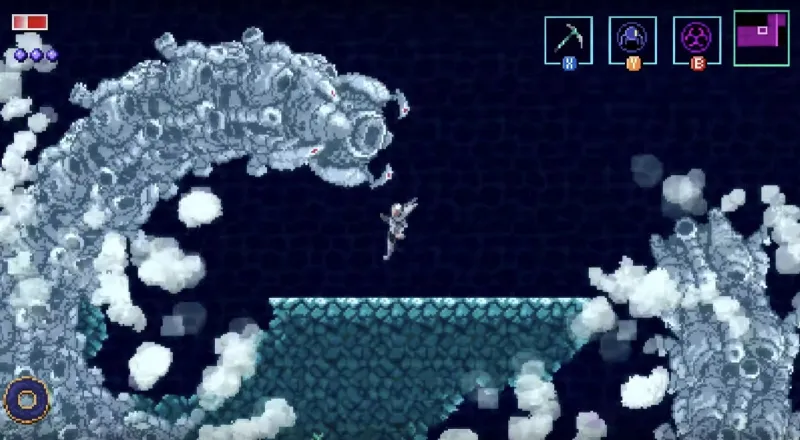
If there’s a reason to play, it’s to marvel at the immaculate level design and the clever upgrades that open up new paths for exploration. The character improvements are intriguing, from navigating a remote drone through tiny openings to exploding into a swarm of nanites to knock down a boulder. The most exciting aspect to exploring is the overlay of an entire second world on top of the first, and both have slightly different geometries and upgrades to track down. Puzzles often take advantage of this dual-world dynamic, demanding you think in multiple dimensions. The experience is trippy and often satisfying in its challenge.

New ranged and melee weapons are upgradable for some added kick, and a skills progression system allows further arsenal improvement, health expansion, and more. There’s even a hacking tool to upgrade, providing the chance to open particular locked doors or turn aggressive enemy technologies into allies. Even though the upgrades and weapons are fun, the combat never takes off. Individual enemies often feel like nuisances rather than a challenge. Several large optional monsters are scattered across the map, but overcoming them rarely demands great skill. And in an unusual twist, given the genre, the game has only a couple of encounters that you might term as bosses, and even those lack depth.

Click image thumbnails to view larger version


The gradual unlocking of the Axiom Verge 2 map leads to several enjoyable moments of discovery. Many of the hidden paths and locked-away improvements made me smile.  Unfortunately, I found those moments of progress and discovery unevenly paced. Just as I began to get in the flow of exploration and the map opening up, I would hit a wall. The massive size of the map, usually a thing I’d celebrate, suddenly became a barrier to my enjoyment as I slowly backtracked through dozens of rooms, looking for a newly opened space. The map is hard to read and contains few clear indicators for blocked paths or the location of unreachable items.

Along with the odd absence of meaningful boss encounters or story beats, the sprawling map gave me a sense of aimlessness and consistent confusion. Without a doubt, some of that vibe is inherent to any game inspired by the likes of Metroid. But here, I found the sensation overwhelming, sometimes taking me out of the otherwise pleasant rhythm of discovery and exploration.

Nonetheless, even when Axiom Verge 2 left me frustrated, I never lost the sense of its intelligent design and mind-bending premise. With these first two games, Happ has laid the groundwork for a particularly weird and captivating fiction, and we’ve only just scratched the surface of its secrets. While I hope I don’t have to wait another six years to play Axiom Verge 3, I’m fascinated enough to have a controller at the ready for its inevitable return.

Click here to watch embedded media


Score: 7.75

Summary: Striding more confidently free of its Metroid inspirations, Axiom Verge 2 is a worthy successor, but it takes patience to fully enjoy.

Concept: Explore an alternate dimension of winding corridors and forgotten technology in this mostly standalone follow-up

Graphics: The pixel graphics are evocative and colorful, but that stylistic choice has a cost, especially when trying to read the map

Sound: The novel soundtrack draws harmonies from various world music traditions while mixing in a healthy dose of punchy synth sounds

Playability: The ramp-up of new abilities and gear is steady, but a game this focused on exploration needs more tools to manage navigation

Entertainment: Clever level design and consummate world-building are great fun, even if the pacing and exploration sometimes lead to frustration

Replay: Moderately High

Click to Purchase