Pages

Wednesday, January 26, 2022

Uncharted: The Lost Legacy Review – The Heart Of Adventure Is Bigger Than One Hero

Publisher: Sony Interactive Entertainment
Developer: Naughty Dog
Release:
Rating: Teen
Reviewed on: PlayStation 4

Nathan Drake’s days of adventuring are over. As we watched him hang up his holster and rope to begin a new chapter in his life, Naughty Dog’s scribes doubled down on the message of “it’s over.” Video game protagonists rarely walk off into the sunset, but Drake’s farewell is as definitive as they come. Naughty Dog wrote Uncharted 4: A Thief’s End as a conclusion to Drake’s story, and it ended on a poetic and satisfying note. To bring him back in starring role would be foolish. It really is over. Is Drake’s name synonymous with Uncharted? He’s wonderfully charismatic and endearing, but we now know he isn’t the lifeblood of it.

The Lost Legacy is every bit as riveting and accomplished as any Uncharted title. We learn that the heart of the adventure trumps everything else, and can extend to any character.

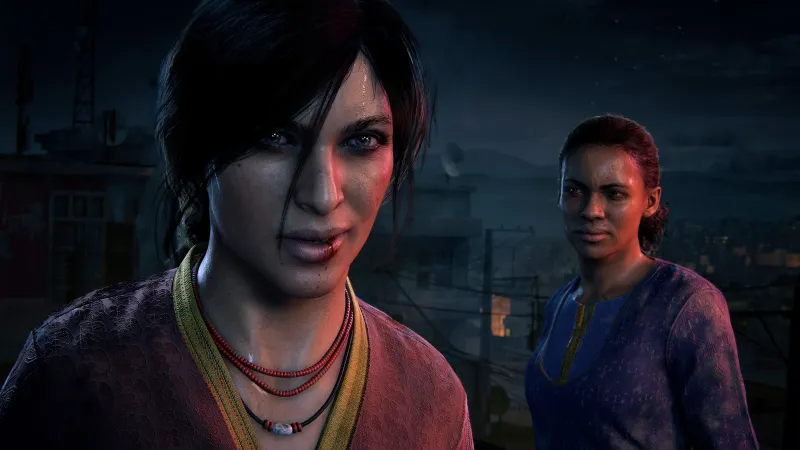
Chloe Frazer fits into the starring role admirably, but never once is written in a way where you feel she is replacing or replicating Drake. She’s just as playful, but she’s wired differently; she’s more than the untrustworthy hustler we briefly got acquainted with in Uncharted 2: Among Thieves. Figuring out who she is takes time in The Lost Legacy, partially because she’s incredibly guarded, but also because you are getting to know her in the midst of an adventure.

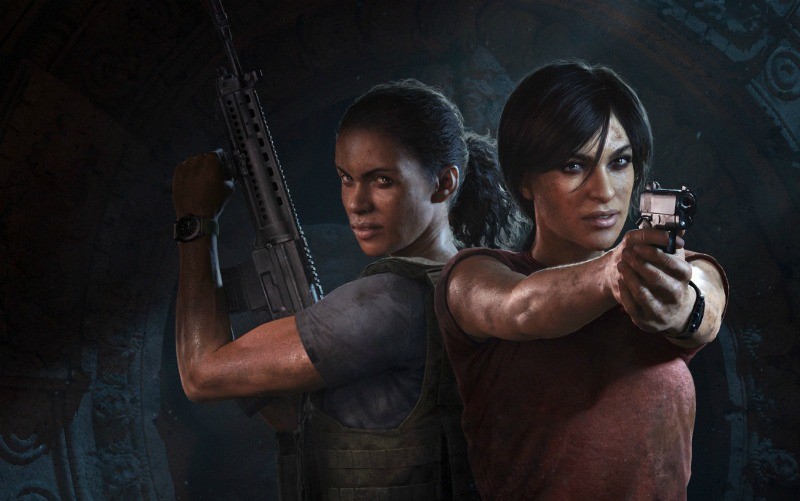
Chloe is nearing the end of a heist she organized with Nadine Ross, the former paramilitary boss turned treasure seeker from Uncharted 4, who is in many ways the polar opposite of Chloe, pragmatic and fixated on results.  We are left wondering why they are together for a little too long, but satisfying answers eventually arrive. As the confusion melts away, Chloe and Nadine settle into a nice (yet somewhat turbulent) groove, and end up being a fascinating duo to track. They’re funny, terse, and wonderfully unpredictable in both their actions and words – their chemistry works even as they frequently butt heads.

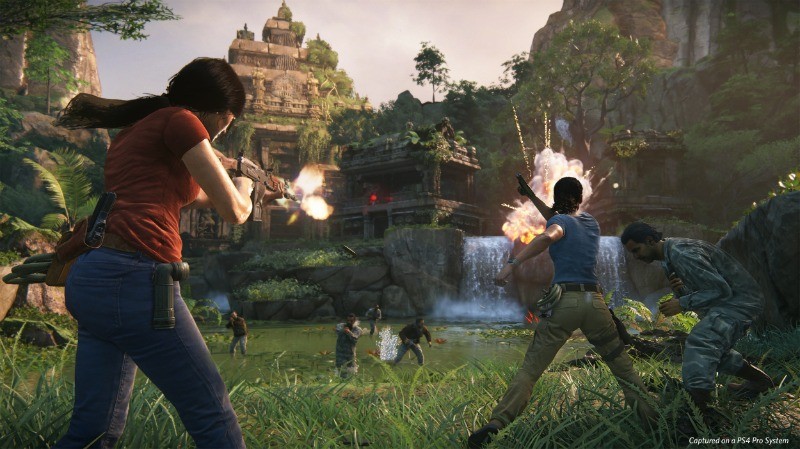
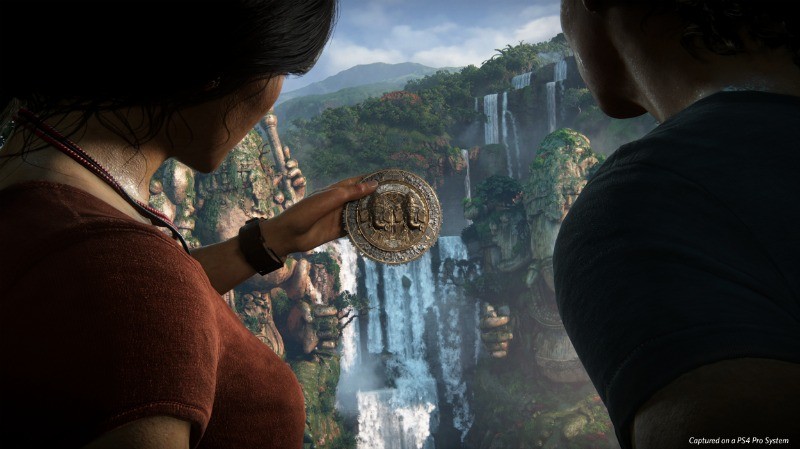
Chloe and Nadine are in hot pursuit of the Golden Tusk of Ganesh, which they believe is located in the long-lost ruins of the Hoysala Empire located in India’s Western Ghats, another part of the world Naughty Dog turns into a scenic work of art for players to explore. The duo are soon at odds with an insurgent rebel leader named Asav, who initially appears to be just another madman who loves treasure, but is later revealed to be far more dangerous and cunning than anticipated. Asav moves the narrative needle just as much as the heroes, and the story soars from the uncertainty of his actions.

I just wish Naughty Dog wouldn’t have felt the need to reference the Drakes so often – a distraction that frequently entertains and can be interesting, but is placed more in the spotlight than is needed and diminishes Chloe and Nadine’s ownership of the adventure.

The Lost Legacy was originally intended to be a bonus episode for Uncharted 4, but ends up being a legitimate sequel that is every bit as fully featured as any of Drake’s adventures – it’s just a little shorter. I would never say any of the Uncharted games are too long – they always leave me wanting more – but this new entry demonstrates brevity works just as well, as the journey feels more urgent and streamlined.

The Lost Legacy’s gameplay is a direct continuation of Uncharted 4, hanging its hat firmly on the same grapple hook, stealth, and open-world exploration Drake used. Outside of a lock-pick mechanic – which can deliver high intensity when used in areas where enemies are on patrol – Naughty Dog doesn’t introduce much that can be classified as “new.” As I worked my way across India’s lost ruins and gorgeous jungles, I never felt the gameplay needed a shot of something different. The spectacle is always so huge, and the next discovery is always so enticing that I didn’t think about the actions that got me there – other than they are fun and reliable.

Although the gameplay mechanics fit like a well-worn glove, Naughty Dog still has a few tricks up its sleeves. The puzzle contraptions that were invented to hide the Golden Tusk of Ganesh are challenging, clever, and again all about spectacle. Two of these puzzles rank among my favorites in the series – one dealing with platforms and swinging axes, and another that uses silhouettes in a fascinating way. I’d even say these slower gameplay moments are more impressive than the series’ signature setpieces, where everything explodes and collapses. Yes, Lost Legacy has plenty of that, but it’s nothing you haven’t seen before.

Given just how fully featured this adventure is, Lost Legacy could have easily been Uncharted 5. Where Naughty Dog goes next is anyone’s guess, but I would love to see Chloe and Nadine return for another hunt, as they’re every bit as engaging as the Drake family. They make a hell of a team.

Score: 9

Summary: Naughty Dog delivers another must-play adventure.

Concept: Chloe Frazer shines in the leading role with a story that is equally as personal as it is about the hunt for a mysterious artifact

Graphics: Every bit as jaw-dropping as Uncharted 4. The scenic landscapes are ridiculously detailed and beautiful, often consisting of skyscraper-sized statues and rolling jungles

Sound: Claudia Black and Laura Bailey are wonderful together, but too much focus is placed on jokes. The two shine brightest in one of the series’ slowest moments. Usman Ally is also fantastic as an unwavering threat

Playability: Scaling perilous cliffs is just as much fun as ever, but don’t expect any new wrinkles in the adventuring outside of a few puzzles

Entertainment: Shorter than any other Uncharted game, yet just as powerful and memorable

Replay: Moderately High
Click to Purchase

Uncharted: The Lost Legacy Review – The Heart Of Adventure Is Bigger Than One Hero

Publisher: Sony Interactive Entertainment
Developer: Naughty Dog
Release:
Rating: Teen
Reviewed on: PlayStation 4

Nathan Drake’s days of adventuring are over. As we watched him hang up his holster and rope to begin a new chapter in his life, Naughty Dog’s scribes doubled down on the message of “it’s over.” Video game protagonists rarely walk off into the sunset, but Drake’s farewell is as definitive as they come. Naughty Dog wrote Uncharted 4: A Thief’s End as a conclusion to Drake’s story, and it ended on a poetic and satisfying note. To bring him back in starring role would be foolish. It really is over. Is Drake’s name synonymous with Uncharted? He’s wonderfully charismatic and endearing, but we now know he isn’t the lifeblood of it.

The Lost Legacy is every bit as riveting and accomplished as any Uncharted title. We learn that the heart of the adventure trumps everything else, and can extend to any character.

Chloe Frazer fits into the starring role admirably, but never once is written in a way where you feel she is replacing or replicating Drake. She’s just as playful, but she’s wired differently; she’s more than the untrustworthy hustler we briefly got acquainted with in Uncharted 2: Among Thieves. Figuring out who she is takes time in The Lost Legacy, partially because she’s incredibly guarded, but also because you are getting to know her in the midst of an adventure.

Chloe is nearing the end of a heist she organized with Nadine Ross, the former paramilitary boss turned treasure seeker from Uncharted 4, who is in many ways the polar opposite of Chloe, pragmatic and fixated on results.  We are left wondering why they are together for a little too long, but satisfying answers eventually arrive. As the confusion melts away, Chloe and Nadine settle into a nice (yet somewhat turbulent) groove, and end up being a fascinating duo to track. They’re funny, terse, and wonderfully unpredictable in both their actions and words – their chemistry works even as they frequently butt heads.  

Chloe and Nadine are in hot pursuit of the Golden Tusk of Ganesh, which they believe is located in the long-lost ruins of the Hoysala Empire located in India’s Western Ghats, another part of the world Naughty Dog turns into a scenic work of art for players to explore. The duo are soon at odds with an insurgent rebel leader named Asav, who initially appears to be just another madman who loves treasure, but is later revealed to be far more dangerous and cunning than anticipated. Asav moves the narrative needle just as much as the heroes, and the story soars from the uncertainty of his actions.

I just wish Naughty Dog wouldn’t have felt the need to reference the Drakes so often – a distraction that frequently entertains and can be interesting, but is placed more in the spotlight than is needed and diminishes Chloe and Nadine’s ownership of the adventure.

The Lost Legacy was originally intended to be a bonus episode for Uncharted 4, but ends up being a legitimate sequel that is every bit as fully featured as any of Drake’s adventures – it’s just a little shorter. I would never say any of the Uncharted games are too long – they always leave me wanting more – but this new entry demonstrates brevity works just as well, as the journey feels more urgent and streamlined.

The Lost Legacy’s gameplay is a direct continuation of Uncharted 4, hanging its hat firmly on the same grapple hook, stealth, and open-world exploration Drake used. Outside of a lock-pick mechanic – which can deliver high intensity when used in areas where enemies are on patrol – Naughty Dog doesn’t introduce much that can be classified as “new.” As I worked my way across India’s lost ruins and gorgeous jungles, I never felt the gameplay needed a shot of something different. The spectacle is always so huge, and the next discovery is always so enticing that I didn’t think about the actions that got me there – other than they are fun and reliable.

Click here to watch embedded media

Although the gameplay mechanics fit like a well-worn glove, Naughty Dog still has a few tricks up its sleeves. The puzzle contraptions that were invented to hide the Golden Tusk of Ganesh are challenging, clever, and again all about spectacle. Two of these puzzles rank among my favorites in the series – one dealing with platforms and swinging axes, and another that uses silhouettes in a fascinating way. I’d even say these slower gameplay moments are more impressive than the series’ signature setpieces, where everything explodes and collapses. Yes, Lost Legacy has plenty of that, but it’s nothing you haven’t seen before.

Given just how fully featured this adventure is, Lost Legacy could have easily been Uncharted 5. Where Naughty Dog goes next is anyone’s guess, but I would love to see Chloe and Nadine return for another hunt, as they’re every bit as engaging as the Drake family. They make a hell of a team. Multiplayer Worth Your Time The Lost Legacy comes packaged with all of Uncharted 4’s multiplayer content, along with a fun cooperative Survival mode for up to three players. People jumping into The Lost Legacy’s multiplayer join the existing base of Uncharted 4 players. The release of Lost Legacy brings a few additions, including a new Survival Arena mode, featuring 10 waves of combat, some ending with warlord boss fights. You’ll also find Asav as a playable character. New skins are included for Lost Legacy’s notable players. I enjoyed Uncharted 4’s multiplayer thoroughly for its combination of run-and-gun and traversal mechanics. This is yet another chance to see just how fun it can be.

Click image thumbnails to view larger version


Score: 9

Summary: Naughty Dog delivers another must-play adventure.

Concept: Chloe Frazer shines in the leading role with a story that is equally as personal as it is about the hunt for a mysterious artifact

Graphics: Every bit as jaw-dropping as Uncharted 4. The scenic landscapes are ridiculously detailed and beautiful, often consisting of skyscraper-sized statues and rolling jungles

Sound: Claudia Black and Laura Bailey are wonderful together, but too much focus is placed on jokes. The two shine brightest in one of the series’ slowest moments. Usman Ally is also fantastic as an unwavering threat

Playability: Scaling perilous cliffs is just as much fun as ever, but don’t expect any new wrinkles in the adventuring outside of a few puzzles

Entertainment: Shorter than any other Uncharted game, yet just as powerful and memorable

Replay: Moderately High
Click to Purchase

Uncharted 4 Review – One Last Grand Adventure

Publisher: Sony Computer Entertainment
Developer: Naughty Dog
Release:
Rating: Teen
Reviewed on: PlayStation 4

The Grim Reaper’s scythe rarely falls upon treasure hunters. The earth collapses beneath their feet, arrows fly from walls, and giant boulders give chase, but these adventurous souls cannot be stopped until they locate an ancient secret. Their expeditions are brimming with rollicking fun, but their stories always end the same way: They live another day, and one less treasure is lost to the world. We know what we’re getting from these serialized stories, and we love them for it. But unlike Indiana Jones (who is still chasing myths and legends at age 73) and Lara Croft (who is turning back the clock), Naughty Dog has said Uncharted 4: A Thief’s End is Nathan Drake’s final chapter. The subtitle alone paints an ominous picture for the famed hero, but what is it hinting at? Does he die? Disappear without a trace? Retire atop a mountain of gold?

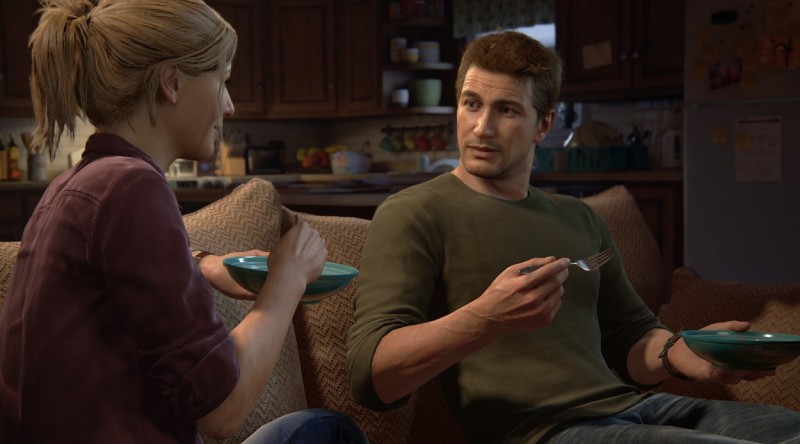
That question turns A Thief’s End into a ticking time bomb of a narrative. As this story unfolds, we see Drake’s entire life come into frame – from key moments in his childhood that helped shape him to the ordinary days he spends at home with his wife, Elena. We get to know Drake intimately; we know what he’s sacrificing and what drives him.


Drake has settled down and appears to be content living out the rest of his days working nine to five and heading home to see Elena. The unexpected arrival of his older brother Sam, who was believed to be dead, pulls Drake back into the treasure hunting game. He is reluctant at first, but Sam’s life hangs in the balance, so Drake has no choice.

Naughty Dog paints Drake in a fascinating light, giving you enough narrative rope to want to save or strangle him – and I wanted to do both at various times in this adventure, given the choices he makes. Though we’re just starting to explore new sides of Drake, and we are just meeting Sam, a sense of finality is sewn into all of the character-building.

On one hand, it feels like the start of something new, with Drake rediscovering life and the thrill of the hunt with his brother. On the other, it feels like an end, with Drake recklessly throwing everything away to hastily answer the call for adventure. The scale is constantly shifting between the two, and the emotional tension tied to these moments is one of Uncharted 4’s most powerful elements. It’s a hell of a story that shifts between Uncharted’s patented “everything is suddenly exploding and everyone is yelling” design to the slow and heavy emotional tone of The Last of Us. There’s clear inspiration from The Last of Us in Uncharted 4, and it’s a better game because of it.


While Nathan and Sam are front and center for most of this journey, one of the most interesting characters to follow is Captain Henry Avery, a dead pirate who we only learn about on pieces of paper and riddles scrawled on cave walls. He's written remarkably well by Naughty Dog, turning most secrets into tantalizing story material. Avery has concocted the mother of all treasure hunts, which ends up being a fascinating reflection of a pirate in his prime, and a fun breadcrumb trail to follow.

This hunt takes Drake to hidden corners of the world, often holding elaborate puzzle contraptions that produce legitimately fun and challenging gameplay moments. The adventuring spirit is alive and well in this installment, and the revelations at the end of it all are fantastic, as they show the great lengths Avery went to protect his treasure. It wouldn’t be fair of me to list the locations Naughty Dog brings to life, but they all have grandeur and spectacle, from the scale of a scenic landscape to the wealth of detail included in a house that players don’t even need to enter.

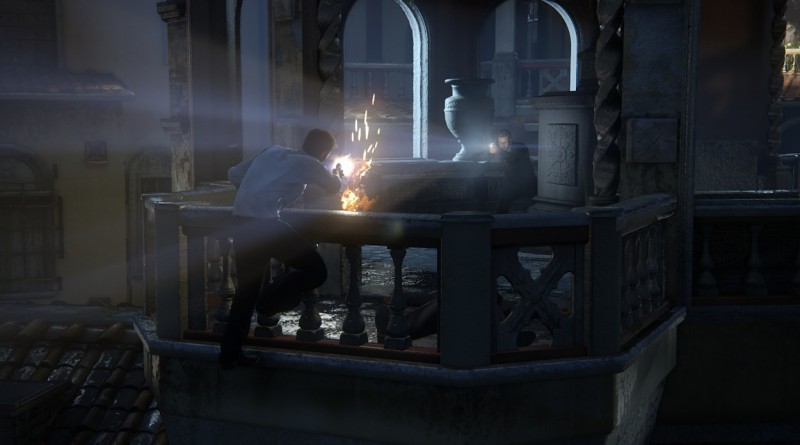
A Thief’s End doesn’t have that big, iconic set piece moment like the previous Uncharted games did (i.e. the train on the cliff, the boat capsizing, and the cargo falling out of the plane), but succeeds as a collection of smaller “I can’t believe we survived that” sequences with houses crumbling, armored vehicles exploding, motorcycles racing dangerously, and Naughty Dog’s artists pulling out all of the stops to make every second of action look as chaotic and beautiful as possible. As visually stunning as many of these moments are, the excitement they deliver has diminished over the years. The thrill of a platform falling apart as soon as Drake lands on it doesn’t get the blood racing anymore – it’s an expected element that, by the fourth installment, seems fairly commonplace. Naughty Dog finds new ways to make things go boom – there's plenty of fun in that – but I was never hit with the that one defining moment I had to tell everyone about like I did in Uncharted 2 and 3.


The action may feel somewhat routine at times, but the feeling of exploring lost worlds is heightened in this chapter. The environments are much wider, sometimes offering multiple traversal solutions and optional areas. In past Uncharted games, I just ran forward, following the linear path laid out before me. In this game, many of the environments made me pause, analyze my surroundings, and figure out how I could navigate them. They offer a satisfying puzzle element we rarely saw in the past. The player now has some ownership over how a destination is reached, and the paths aren’t always easy to pinpoint (although some object coloring is used to lead players along).

Drake’s new grappling hook enhances the exploration, and is often the tied to harrowing platforming sequences. It's also flat out fun to use. The grapple is put to good use in combat and puzzle solving. As forward-thinking as Uncharted 4 is with the new grapple mechanics, the levels offer an odd abundance of old school box-pushing puzzles, which sometimes feel like they are there just to slow player progression. The platforming is as briskly paced as it's been in the past, and is often done with the world exploding around Drake. But again, this element has lost some of its magic with time.

Some of the environments are so vast that they take on the illusion of open worlds, giving the player even more freedom to explore, often with a vehicle. These areas change up the pacing nicely and embrace the essence of adventure in a slightly different way. Since Drake is often with Sam (or other characters), light team-based gameplay is periodically thrown in (think The Last of Us). Sam helps you reach ladders and boxes, lends verbal feedback for navigation and riddles, but his greatest contribution is assisting in combat.


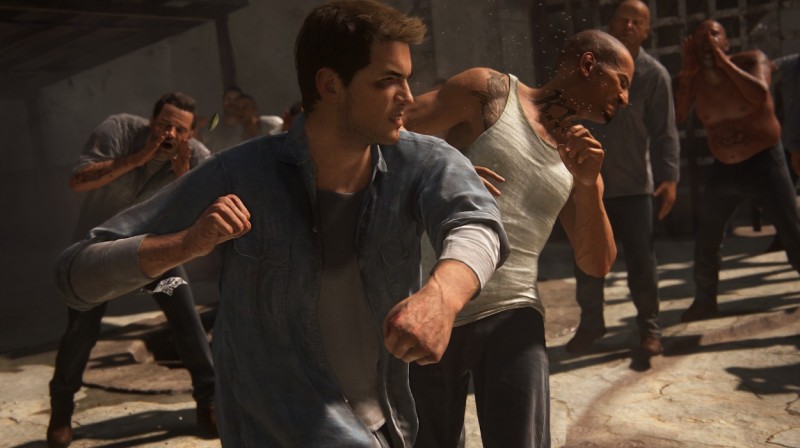
He can tag and grab enemies, provide covering fire, perform double-team melee moves, and is lethal with a gun. The hand-to-hand fighting is greatly improved, giving each punch a cringe-inducing (but satisfying) smack. The gunplay is still a little loose, but the enemies are smarter now, which means Drake either has to rely on stealth more (which works well and is immensely satisfying when entire zones are cleared silently), or strategically pick off targets before they advance or flank. Combat never feels like a thrown in chore. I enjoyed all of the encounters and found them surprisingly empowering, especially when the grapple swing is used to effectively launch Drake onto a foe.

A Thief End’s is the best Uncharted yet, delivering a story I didn’t want to end, and an adventure that concludes with a hell of a payoff. The “wow” factor of the world exploding under Drake’s feet has diminished in the years following Uncharted 2, but those moments are still effective, and a true showpiece of the developer’s exquisite craftsmanship for world and gameplay design. All four of Naughty Dog’s games culminate in A Thief's End in a fitting and cohesive way that fans should appreciate. I hate seeing Drake go (especially when he’s in his prime), but I’d rather see him go out on top like he is here than be tasked to find a crystal skull or some other poorly fabricated MacGuffin decades from now.


Click image thumbnails to view larger version


Score: 9.5

Summary: Nathan Drake's final adventure is his finest yet.

Concept: Nathan Drake’s final adventure is as emotional as it is exciting, a true testament to Naughty Dog’s storytelling and gameplay skills

Graphics: A work of art. Few details are spared in making the characters and world come to life

Sound: Nolan North and Troy Baker make a great team, and are almost always cracking wise. The score is also used expertly for tension and drama, sometimes drowning out all sound to heighten a moment

Playability: The awe factor of the world blowing up around Nathan Drake isn’t what it once was, but the combat is better, and the exploration offers more gameplay and discovery

Entertainment: The best Uncharted yet. It hooks you emotionally early on and keeps you locked in place as the thrill of the hunt for a lost treasure takes shape

Replay: Moderately High
Click to Purchase

Pokémon Legends: Arceus Review – Learning Some New Moves

Click to watch embedded media
Publisher: Nintendo
Developer: Game Freak
Rating: Everyone
Reviewed on: Switch

Catching as many Pokémon as you can, learning more about them, and training them to be stronger in battle are the very foundations of Game Freak’s iconic RPG series, but few titles exemplify those core concepts as powerfully as this latest outing. Pokémon Legends: Arceus tasks you with exploring a bygone era of the Sinnoh region, then known as Hisui, and gives you more ways than ever to complete your Pokédex. While some elements don’t feel like their final forms, I love where this new direction takes the Pokémon series.

Pokémon Legends: Arceus’ early hours are full of exposition and long, dialogue-filled scenes. You learn most people are afraid of Pokémon, but a new invention – the Poké Ball – hopes to bring people and Pokémon closer than ever before. The beginning was slow, but once I was finally set free into the Hisui region, the gameplay loop sunk its hooks into me. With Poké Balls in tow, your primary task is to fill your Pokédex with as many unique species as possible. However, en route to completing that task, you uncover various mysteries surrounding anomalies happening around the region. Some narrative beats and character arcs did not land for me, but the story is a step up from previous entries in the series, particularly later in the game.

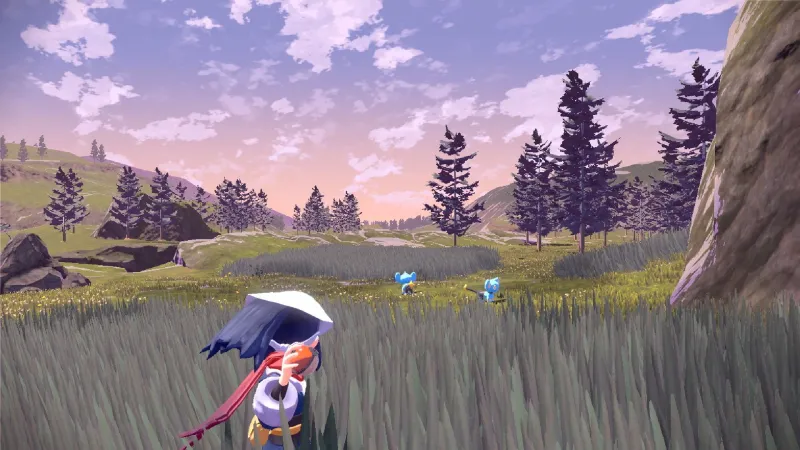
Running around vast, open areas in search of new creatures to add to your Pokédex is enthralling. I love how simply catching a Pokémon doesn’t immediately complete your entry for that monster. Instead, you need to perform mini-tasks to earn points towards completion; these include seeing them do specific moves, defeating them, and even using certain moves against them. The objectives can be too cookie-cutter, but I like how the system made me feel like I was actually studying the Pokémon I encountered rather than mindlessly collecting them.

Click here to watch embedded media

You can opt to sneak up on a wild Pokémon instead of battling them, which I applaud for how it improves the flow of moving through an area. The game’s streamlined U.I. lets you easily select if you want to throw an empty Poké Ball to try and catch them, a piece of food to distract them, or a Pokémon of your own to battle them. The wild Pokémon might run if you’re spotted, but it may also attack you. You can try to escape, even utilizing dodge-rolls to evade attacks, but your best bet is to toss one of your own Pokémon out to take it out. While much of the game focused on action and exploration, I appreciate how encounters seamlessly transition you from the real-time exploration to an improved iteration on the series’ simple turn-based battle system.

Battle menus also receive a streamlined interface, allowing you to select whether you want to send out a new Pokémon or throw a Poké Ball without leaving the battle screen. Additionally, Pokémon can learn new moves or master their existing ones by leveling up. I like how the mastery system lets me be more strategic. You can choose to execute strong attacks to add some oomph and accuracy at the cost of speed or agile versions that might give you an extra turn at the expense of power. I loved watching the enemy’s life bar drain after landing a strong attack, knowing that my gamble paid off.

Hisui is full of diverse biomes, which play host to a wide array of Pokémon. These segmented areas all have linear routes that lead to destinations and points of interest. However, wandering off the beaten path to scavenge resources to use in the game’s rudimentary crafting system, discovering tucked-away areas, and finding new creatures to catch were my favorite moments with the game.

Pokémon Legends: Arceus

Whenever I wanted a break from the main story, I could quickly lose a couple of hours trying to further my Pokédex progress on side activities. A day/night cycle further enhances the rewards, as different monsters come out at night, giving you a reason to return when the sun sets. Hisui is full of rewarding activities that include stronger Alpha Pokémon to fight and catch, side-missions that involve collecting resources and specific creatures, and special limited-time events to help you further round out your Pokédex.

As you progress the story, you face off against a handful of frenzied noble Pokémon. Rather than engaging in Pokémon battles, you control your trainer for most of the sequence. You have to throw special balms at the noble Pokémon to drain their health bar as you dodge various attacks. At specific points in each encounter, you can use your Pokémon to try and defeat them in battle; if you’re successful, you stun them and open them up to more balm tosses. These boss battles are sometimes tricky as the attacks become more intense, but the option to restart failed battles without losing progress removes some of the sting of defeat. These fights are fun twists on the boss battles in the Pokémon universe, but imprecise controls sometimes caused me to take unnecessary damage.

A prominent criticism of the Pokémon series has long been about how the production values don’t match the standards set by other triple-A titles. Pokémon Legends: Arceus is a beautiful adventure thanks mainly to its colorful art style. However, while character and Pokémon animations are a step up from previous mainline entries, they still lag woefully behind other games in the genre. Cutscenes set up action moments, only for the screen to fade to black when a character needs to perform a unique action that would require a new animation, leaving the player to fill in the blanks with their imagination.

Click image thumbnails to view larger version


Additionally, the series’ lack of voice acting hasn’t been a sore spot to this point for me, but Arceus has several dialogue-heavy scenes. The prominence of these scenes makes the silence feel like an antiquated relic of the late ‘90s, alongside the digitized Pokémon cries that persist in this title. Top it all off with lackluster technical performance, full of object pop-in, frame rate drops, and low-resolution textures, and Pokémon Legends: Arceus is hardly a technological marvel.

Despite these shortcomings, Pokémon Legends: Arceus is a worthwhile spin-off adventure, even if some of the concepts aren’t fully developed. With an enticing gameplay loop, fun side activities, and a story I’m glad I saw through to the end, Pokémon Legends: Arceus sets a solid foundation for what I hope is the next evolution for the series.

Score: 8.75

Summary: Pokémon Legends: Arceus charts an exciting new direction for the series, while still maintaining many of the core tenants that made Game Freak's franchise so beloved in the first place.

Concept:

Graphics:

Sound:

Playability:

Entertainment:

Replay:

Click to Purchase

Friday, January 21, 2022

Windjammers 2 Review – A Fading Adrenaline Rush

Publisher: Dotemu
Developer: Dotemu
Rating: Everyone
Reviewed on: PlayStation 4
Also on: PlayStation 5, Xbox One, Switch, Stadia, PC

Windjammers 2 gives fans of the popular arcade game exactly what they want: more Windjammers. Outside of a sharp graphical facelift and some new competitors and arenas, don’t expect to find much to gnaw on after you’ve batted around the disc a few times. The sport remains a reflex-demanding delight, but the fun wanes after a few rounds on the court. 

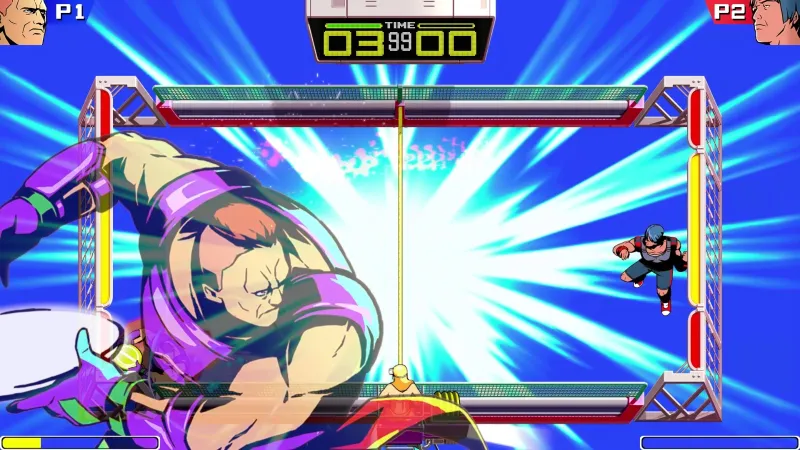
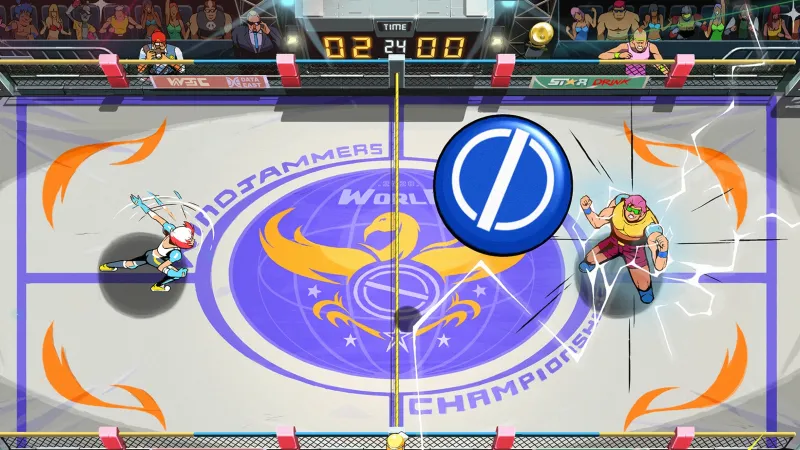
Windjammers pits two players against each other in an over-the-top frisbee version of air hockey. You shoot the disc at each other, attempting to nail it through the goal on your opponent’s side; you can also earn points if the disc touches the ground on their court, as in tennis. Getting the disc past your opponent involves executing a variety of wildly implausible shots that ricochet off walls or wrap around the court in flaming loop de loops. Windjammers 2 controls well, and I love using curved shots and other tricks to fool my opponents to zig where they should have zagged. 

Click here to watch embedded media

The game possesses a fighting-game level of depth despite its simple veneer, so I wish it had a more fleshed-out tutorial. Windjammers 2 has a lot of moves and nuance that the tutorial mode plainly explains through static slides. Committing pages of button commands to memory before starting a match is neither fun nor effective, and there’s no way to access the move list in the pause menu. I forgot how to execute a useful maneuver several times and had to decide whether to quit the arcade ladder to refresh my memory or continue flying blind. Modern fighting games have come a long way to onboard players, providing instruction as well as context for how and why a move should be executed. Windjammers 2 needs something similar because getting annihilated for matches and feeling like I didn’t have a great resource to turn to wore on me in the early goings.

The roster features returning names and newcomers, each with speed/strength differences and dedicated special moves. My favorites include Sammy Ho, who fires a teleporting disc that disorients opponents, and Jao Raposa, whose pure speed makes him a mobility machine. Matches are largely balanced no matter which pairing of competitors faces off, but taking on the CPU in the short arcade mode is challenging to the point of frustration, even on Easy mode. Even when I pinpointed a clear opening, the AI often blocked my shots, no matter how fancy or mind-bending they were. That’s not entirely new for Windjammers, but at times I gave up on strategically lining up shots and resorted to serving any which way until I scored a lucky goal. Still, it’s hard to deny the fun, sweat-inducing intensity of a long back-and-forth volley and the triumph of tripping up your adversary for a score. 

The arenas aren’t vastly different from each other beyond the visuals, but a few sport notable gimmicks. I like the casino stage the most, which regularly changes a goal’s point value roulette-style, adding a devious layer of luck and unpredictability. I appreciate the vibrant ’90s-inspired presentation and upbeat soundtrack as well. 

Though enjoyable, Windjammers 2 is a bare package. The basic arcade, online, and versus modes didn’t engage me for the long haul. And there is a noticeable lack of unlockable rewards, characters, or cosmetics to work towards. Bragging rights and leaderboard dominance are your only incentives. The action is best enjoyed in short bursts, preferably against a friend in local versus or a stranger online. I respect this old-school approach as an older player, but I found it hard to stay motivated when all I could expect from winning a grueling round was a pat on the back and a “good job!”

Windjammers 2 is an enjoyable throwback that proves its unique sport is still a blast, but the thrill is fleeting. I’m happy to see it return; I just wish it gave me more reasons to step on its court more often.

Score: 6.75

Summary: Windjammers 2 gives existing fans more of the wacky disc hockey they love but not much else.

Concept:

Graphics:

Sound:

Playability:

Entertainment:

Replay:

Click to Purchase

Thursday, January 20, 2022

Final Fantasy XIV: Endwalker Review – A Grand Finale

Publisher: Square Enix
Developer: Square Enix
Reviewed on: PC
Also on: PlayStation 5, PlayStation 4, Mac

Following a reboot and three exceptional expansions, Final Fantasy XIV’s fourth add-on, Endwalker, has a lot to live up to, especially as it’s billed as the conclusion to the storyline that’s been brewing since the defunct 1.0 release. I’m happy to report Endwalker masterfully delivers a dense narrative full of exciting twists, wonderful character moments, and well-designed battles. Its culmination offers a satisfying conclusion to the conflict between deities Hydaelyn and Zodiark and other threads that have been unfolding for well over a decade.

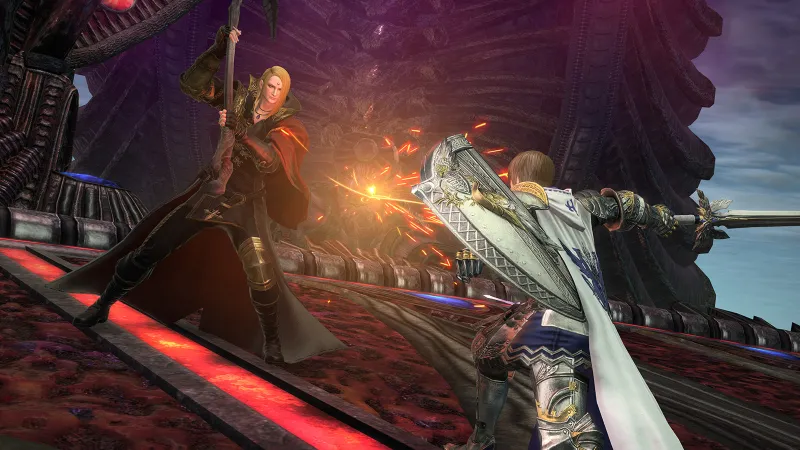
Endwalker not only reminisces on its prior expansions, but revels in nostalgia for previous Final Fantasy games that mold its memorable scenarios and incredible soundtrack. Dungeon bosses like the Magus sisters, and a fateful trip to the moon, harken back to Final Fantasy IV. While more recent additions like the tortured FFX summon Anima get a spotlight elsewhere. Those with knowledge of the Final Fantasy series will enjoy various throwbacks, but you’ll definitely want to go into Endwalker with a good understanding of XIV’s story thus far. This final chapter relies heavily on the machinations, stories, and characters from the expansions that came before, and unlike the previous expansion Shadowbringers, it doesn’t work well as a standalone adventure.

Click here to watch embedded media

The action in this expansion is slow to start, with much of the opening hours filled with cutscenes as you run from quest giver to destination in typical MMO fashion. But once the narrative setup is done, the excitement rarely stops until the credits roll. You’ll travel to the nation of scholars for a diplomatic mission in Old Sharlayan, the colorful, Indian-inspired Radz-at-han and Thavanir, and even to the moon and beyond. Each environment being a key to the evolving story centered around a world-ending cataclysm.

I’m impressed by the story’s dark tones and how it smartly handles complicated themes. The initial visit to enemy territory in Garlemald stands out, as it deals with neglected, malnourished, and distrusting communities wrapped in a civil war as you, an invading force, attempt to assist them. Another questline about the loyalties of soldiers sworn to a nation that’s crumbling around them also made a big impact. Despair and hopelessness are central to much of the expansion’s plot and manifest in surprising ways.

Some quests require you include various characters in your company, adding the sense of adventuring with a party that’s often missing in MMORPGs. In these instances, I’d take the opportunity to seek out specially marked points of interest that let me speak with my companions about their thoughts and feelings on the situation at hand. This storytelling isn’t flashy, but I appreciate the little ways FFXIV makes the game more intimate.


The two new Jobs available are stylish and fun. The Reaper, a new melee-DPS role, utilizes a killer scythe and void creatures in combat, relying on kinetic positional attacks to deal maximum damage. The Sage, on the other hand, is a new shield-deploying healing class that uses laser drones that zip around in cool formations as they blast your allies with protective spells and restore their life. Both have proven very useful in groups and offer vastly different aesthetics and gameplay from similar Job archetypes.

Endwalker pulls off a spectacular ending to a complicated ongoing narrative, a testament to how far it has come since its revival in A Realm Reborn. Luckily this isn’t the end, but the beginning of a new story that I can’t wait to experience in future patches and expansions. Having spent hundreds of hours with Final Fantasy XIV, it’s easily one of the best MMO experiences out there, and Endwalker has solidified it as my favorite Final Fantasy to date.

Click image thumbnails to view larger version


Score: 9.25

Summary: Endwalker caps off a story over a decade in the making in spectacular fashion and cements it as one of the series' best entries.

Concept:

Graphics:

Sound:

Playability:

Entertainment:

Replay:

Click to Purchase

Pupperazzi Review – A Short But Sweet Photography Treat

Pupperazzi review

Publisher: Kitfox Games
Developer: Sundae Month
Reviewed on: Xbox Series X/S
Also on: Xbox One, PC

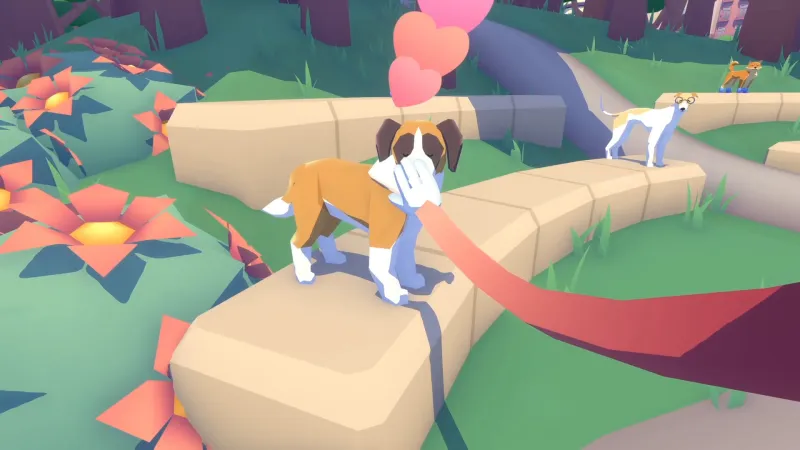
Pupperazzi is the gaming equivalent of cotton candy. It’s sweet and makes the day feel more festive, but it’s not going to tide you over if you’re looking for something with real substance. Smartly, the game doesn’t take itself too seriously, leaning into the playfully absurd concept of becoming a leading member of the puppy paparazzi with chuckle-inducing tasks, lively levels, and plenty of chances to pet virtual pooches.

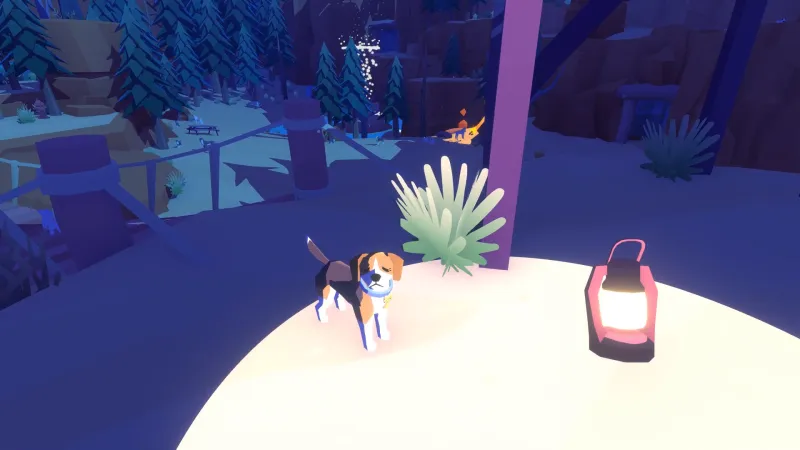
Developer Sundae Month doesn’t try to explain Pupperazzi’s conceit. You are a humanoid camera (whose stretchy arms and ungainly shadow are either silly or the stuff of nightmares depending on how you look at it). From the start, your goal is to become the best dog photographer you can be in a world dominated by frolicking puppies. It’s that simple. Pupperazzi knows what it is, and instead of being bogged down by an exposition-heavy beginning, the game lets me jump right into the fun, photo-taking action.  

My first job, as explained by an authoritative canine in rain gear, is to build my notoriety by completing objectives. Rather than getting tasks from NPCs, you find a log of photo-centric to-dos in the menu. Many requests are breezy and humorous, like one from a game dev requesting a picture of a dog on a bike with a pixel lens because they don’t know how to draw a bike and need it for reference.

Completing objectives nets rewards, like bone-shaped currency to buy better equipment and more followers – which marks your progress like experience points might in another game. Gaining followers also means opening up more areas to explore. These challenges did a good job pointing me towards things to see or do in each level and motivated me to upgrade my gear. Pupperazzi’s menu-based objectives are important because there isn’t a lot of direction in the gameplay. There are no characters or overarching narratives to move you along, which might have been more engaging, but the requests give players an adequate reason to explore the landscape and get snapshots of adorable puppies.

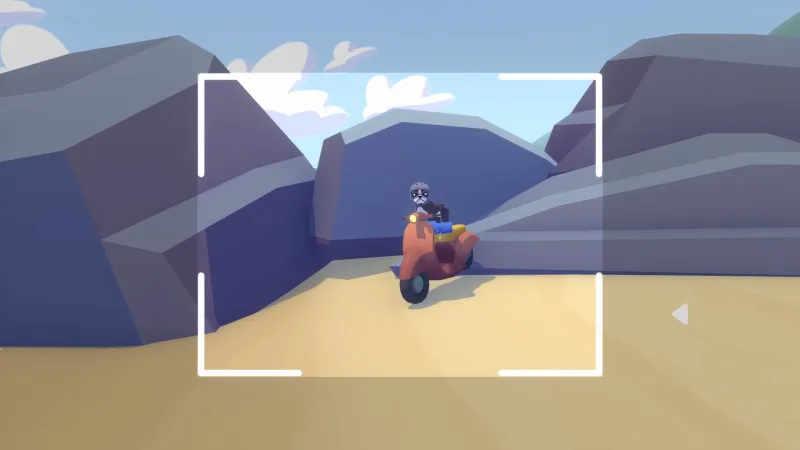
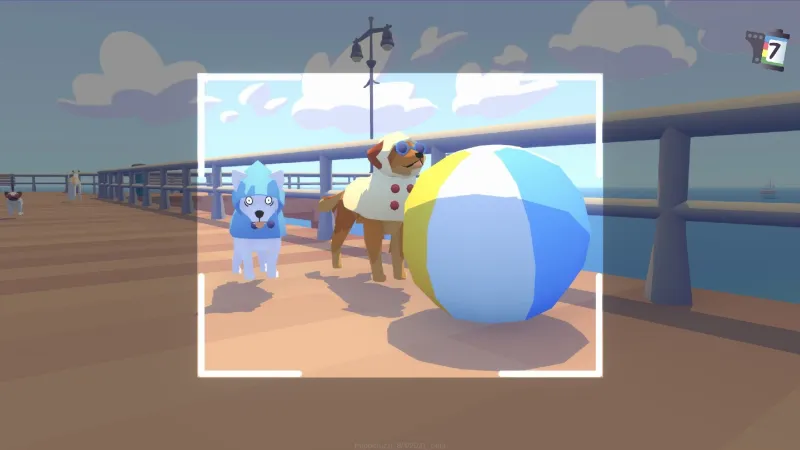
The photography controls are intuitive; simply hit the left trigger to bring up the camera and the right trigger to snap a photo. Once I captured that perfect moody, black-and-white shot of a dalmatian sporting a dramatic collar in my objectives list, I checked to see if it satisfied my client to claim my prize. I also picked up more followers by posting my picture to the game’s social media site, dogNET. NPCs share feedback and may follow you if they enjoy the subject, helping unlock new levels. Attempting to appease the whim of these armchair photographers adds a much-needed layer to the game, which might otherwise feel boring with how little happens from moment to moment.

Pupperazzi doesn’t completely avoid pitfalls. I spent a lot of time in menus, and the game doesn't always clearly convey things. For example, the game doesn’t indicate when a photo meets the requirements for your current goals. I had to constantly bring up the menu after every shot to see if I could claim a reward.

On top of that, I need to check the menu just to see what my objectives were for each area or if I want to access dogNET. This all leads to a lot of flipping through tabs rather than photographing fuzzy creatures. I also found it a little off-putting that a message popped up warning me my photos might not be saved every time I want to move to the next zone. This left me confused and hesitant about what to do the first time I tried to leave the beginning level. However, after waiting longer than I’m prepared to admit, I took the risk, left the level, and discovered my photos were just fine as I moved on to a new locale.

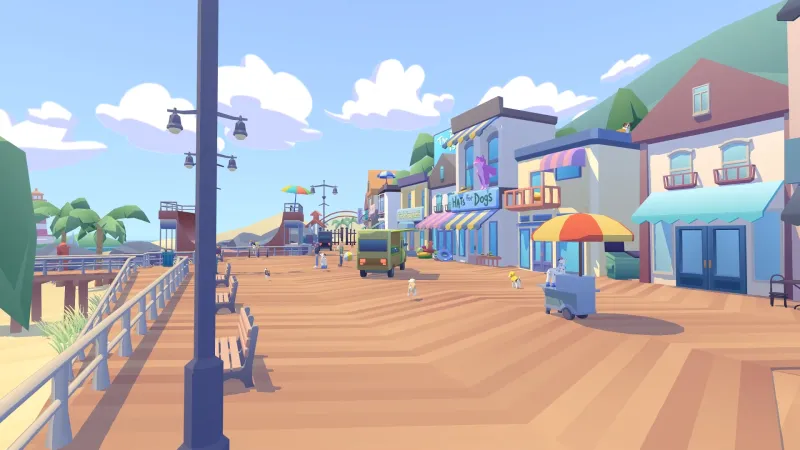
Getting to explore the vibrant and uniquely themed sandbox levels made up for the inconvenience. From Bubby Boardwalk, which boasts a skatepark and shuttered arcade, to the nature-filled paths of Mellowstone, each zone is a treat to explore. Different worlds have fresh objectives, hidden objects you can use to interact with your furry subjects, secret currency stashes, and vending machines to purchase equipment or items. I was also pleasantly surprised to discover a handful of optional platforming opportunities in various levels, like using awnings as trampolines to hop onto rooftops where more dogs were hanging out.

I rolled credits on Pupperazzi after a few hours, having completed almost all of the objectives in that time, and I have little reason to go back. However, my brief time was stuffed with lighthearted amusement, marred only slightly by a few annoyances. Its animated levels, playful attitude, and pleasing premise make Pupperazzi a wonderful game to jump into when you just want to escape and play with pretend puppies for a while.

Score: 7.25

Summary: Pupperazzi isn't a substantial adventure, but its absurd, playful, and dog-filled world serves as a lighthearted retreat.

Concept:

Graphics:

Sound:

Playability:

Entertainment:

Replay:

Click to Purchase

Wednesday, January 19, 2022

Rainbow Six Extraction Review – A Strange Encounter

rainbow six extraction review

Publisher: Ubisoft
Developer: Ubisoft Montreal
Release: 2020
Rating: Mature
Reviewed on: Xbox Series X/S
Also on: PlayStation 5, PlayStation 4, Xbox One, Stadia, PC

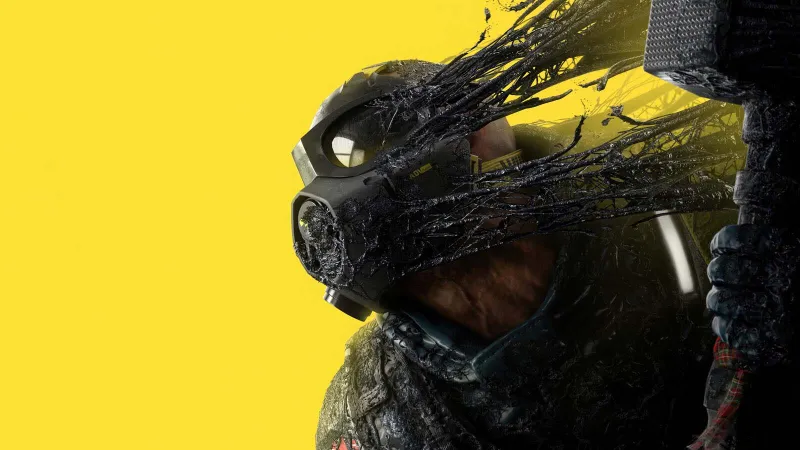
Rainbow Six Extraction is a spin-off of Ubisoft’s flagship competitive multiplayer hit, Rainbow Six Siege, set in an alien-infested depiction of the United States. This three-player cooperative shooter borrows its predecessor’s roster of operators and weapons and recontextualizes them inside a more approachable player-versus-environment setting – often to fun results. The operator advancements offer exciting rewards for players willing to invest the time, though the climb to unlock the best rewards is steep. Additionally, a persistent health system creates meaningful consequences for players who fail to best Extraction’s many challenges by carrying over operators’ injuries from match to match. However, Rainbow Six Siege casts a substantial shadow, and despite its best efforts, Ubisoft’s latest shooter struggles to fully emerge from beneath it. 

Extraction is technically well-crafted. It’s polished and enjoyable. Though, I don’t find it nearly as compelling as the shooter it spins off from. Even during the most exciting scenarios, I couldn’t help but wish I was playing Rainbow Six Siege. Each incursion in Extraction begins like a match in Siege. Your team picks their operators and equipment load-outs and then prepares to fight an onslaught of AI enemies across four brand new locations: New York City, San Francisco, Alaska, or Truth And Consequences — which is a real town in New Mexico. These maps are divided into multiple sub-maps that offer ample cover and verticality, though none of them are particularly memorable outside of a few exceptions. More interesting locations, like a UFO-themed diorama or an abandoned casino, are covered in parasite nests and dark slime textures, making them difficult to memorize.

rainbow six extraction review

You and your crew complete a random selection of goals in each area. These range from stealth-based challenges like Biopsy, which requires you to obtain alien tissue samples with a knife, to attack-oriented objectives like Hunt and Decontamination, which serve as standard-fare kill quests that remain somewhat satisfying. Siege fans may recognize missions like Sabotage and Rescue, which mirror the Bomb and Hostage modes featured in Siege. My favorite objective type is Specimen, which requires your team to lure one of the powerful Archaeans – the parasitic antagonists tormenting the darkened hallways of every environment – into a trap to capture it alive. This objective is hilarious, and my teammates and I often laughed as one unlucky person had to serve as bait.

Airlocks separate each city’s three sub-maps, serving as safehouses filled with supplies like med-kits and (hopefully) ammunition. The deeper your squad ventures into the incursion, the harder it is to successfully extract as enemies increase in difficulty and variety, ranging from low-level grunts to terrifying behemoths capable of smashing through walls. I enjoy the variety, but you’ll have to increase the difficulty level to encounter the best ones. If you manage to fight your way through all three areas, you earn extra experience points, unlocking perks like increased movement speed or new abilities like Sledge’s charged hammer swing. These operator advancements are the highlight of Extraction’s progression loop, and I wanted to keep playing to obtain them. You also receive new operators, equipment, and cosmetics through advancing your player level by completing matches and level-specific challenges. While there are exciting rewards to unlock, and I appreciate the operator-specific upgrades, in particular, progression feels unnecessarily slow overall. 

Every weapon handles differently, but I enjoyed using them all equally. Silenced rifles are my go-to weapon type. They trade raw stopping power for the ability to execute discrete kill-shots on all kinds of Archaeans. Shotguns reliably blow enemies – and walls – to pieces but attract lots of attention. Extraction also introduces stealth takedowns, offering a discrete method to complete your objectives when ammo and health are scarce. Nothing feels better than quietly clearing a perimeter with your team. However, the game fails to adequately convey when you’re at risk of being detected, so my attempts at subtlety often devolved into panicked shoot-outs. 

Click image thumbnails to view larger version


While Extraction borrows a lot from Siege, it introduces a new feature I love: persistent operator health. Suppose you previously played as Vigil and exited the mission with only four health. In that case, he’ll start the next game injured unless you let him recover by completing incursions as other characters. Depending on your performance, several operators could have an injured status, or even worse, be missing in action until you rescue them during another mission. This system encouraged me to experiment with operators across the roster, resulting in white-knuckle encounters.

Rainbow Six Extraction converts much of Siege’s content library into an approachable co-op shooter, providing a tense environment for players of all skill levels. However, in a series of industry-defining hits, this installment feels incredibly safe and markedly less gripping than its predecessor.

Score: 7.25

Summary: An approachable spin-off of a competitive multiplayer hit, this co-op shooter struggles to emerge from beneath its predecessor's shadow.

Concept:

Graphics:

Sound:

Playability:

Entertainment:

Replay:

Click to Purchase

Tuesday, January 18, 2022

Nobody Saves The World – Form And Function

Click to watch embedded media
Publisher: DrinkBox Studios
Developer: DrinkBox Studios
Rating: Teen
Reviewed on: PC
Also on: Xbox One

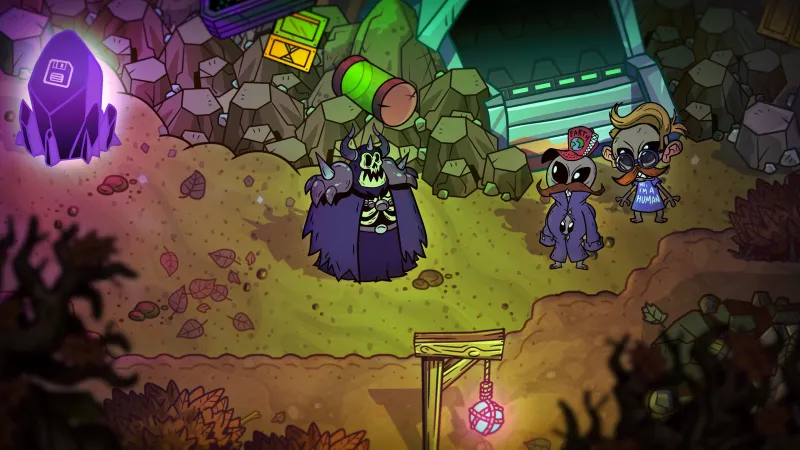
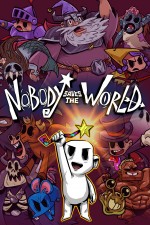
Nobody Saves the World is as charming and funny as Drinkbox Studios’ Guacamelee series. Bolstered by wonderfully challenging dungeons, Nobody’s core pillars of body swapping and ability customization go a long way to making this a memorable adventure, though a paper-thin world and underwhelming rewards keep this Nobody from being the best Somebody possible.

Within the amusing story, only one wizard has the power to shut down the disgusting fungal calamity that’s devastating the kingdom. Unfortunately, that guy is nowhere to be found. Instead, a pale, featureless wimp takes up that mage’s powerful wand. With it, this Nobody can shapeshift into useful forms like a bodybuilder, robot, or rat; each comes equipped with a special attack and passive ability, with more to be unlocked. I found the process of leveling up forms and gaining new ones to be a blast. Completing skin-specific challenges levels up that form, revealing more to unlock and becoming available as certain ranks are achieved.

Nobody Saves the World’s progression hinges on the constant loop of completing these quests. Every quest grants precious experience along with stars, a currency used only to unlock the five legendary dungeons. Unfortunately, those rewards are the same for any side missions I picked up from NPCs, making most quests feel like just another drop in the XP bucket. While constantly filling progress bars feeds a primal dopamine drip, I wish there were additional passive abilities or stat boosts as rewards to some of these activities. However, those are relegated to unsatisfying gold sinks from vendors.

Nobody’s top-down, hack-and-slash gameplay reminds me of an amalgamation of a classic 2D The Legend of Zelda and The Binding of Isaac. Some character forms at Nobody’s disposal wield more traditional weapons like swords and bows, while others use streams of lighting, tears from a slug, or a swift kick from a horse. It’s not afraid to tread well into goofy and mildly disturbing territory. Abilities from any form can be slotted in to be used by another, enabling an enjoyably deep system of mixing skills to mold the perfect dungeon slaying creature. I love how many quests rely on equipping non-native abilities. It forces me to switch up my strategy, sometimes at the cost of combat effectiveness, though it always teaches me a neat combo to use down the road. One of my favorite concoctions involves the Magician, who already swarms baddies with rabbits and tigers, and equipping him with an attack that infects enemies who join my army as zombies upon death.

The most fun and challenging action unfolds within the dungeons. These castles, beached sea creatures, UFOs, and corporate office buildings each house a few floors of monsters to slay. However, there’s a catch—every dungeon sports a dangerous modifier, which often upset my preferred loadout. You’ll usually be forced to build something special to clear them. For instance, one dungeon modifies damage from any attack to deal 9,999. Puzzling out solutions to survive through trial and error was fun since I had the right tools at my disposal; I just had to find which ones to use. The various modifiers made me appreciate the breadth of customization and experimentation for every form. Figuring out which build will work best is incredibly satisfying.


The world outside the dungeons, while beautifully drawn and visually diverse, lacks an exploratory pulse. The overworld rarely provides the same complexity or challenge I enjoy in the dungeons, save for a couple of guild quests scattered about. The world feels flat and uninteresting as a result. Traversal only gets as deep as using certain forms to swim through bodies of water or fit into some tight corridors. The excellent Jim Guthrie soundtrack does make everything more bearable, though.

Despite its minor shortcomings, Nobody Saves the World kept me enthralled from start to finish as I leveled my way through form ranks for the next body or ability to work with. It's most fun when unleashing devious yet approachable combat scenarios, keeping me on my toes to find the best solution to survive. Thankfully, it gave me plenty of those unrelenting loops throughout, justifying the time to save this funny little world.

Click image thumbnails to view larger version


Score: 8.25

Summary: Drinkbox Studios delivers a funny and challenging adventure that's not afraid to get weird and encourages clever customization.

Concept:

Graphics:

Sound:

Playability:

Entertainment:

Replay:

Click to Purchase

Monday, January 17, 2022

GTFO Review – The Great Escape

Publisher: 10 Chambers Collective
Developer: 10 Chambers Collective
Release: 2019
Rating: Mature
Reviewed on: PC

Turtle Rock Studios helped define the cooperative squad-based genre with Left 4 Dead and its recently released spiritual successor, Back 4 Blood. 10 Chamber Collective, a small group of ex-Payday developers, was undoubtedly inspired by the acclaimed zombie-slaying franchise. In truth, the studio’s debut project, GTFO, is Payday meets Left 4 Dead, but with a deliciously dangerous learning curve. GTFO’s satisfying mix of tactical action and all-encompassing uneasiness will likely appeal to FPS fanatics yearning for an electrifying challenge. And now that its two-year Early Access period has ended, 10 Chamber Collective’s survival horror shooter might reach a wider audience. So, how does the full version of the game hold up? Despite a repetitive loop, GTFO smartly differentiates itself from its predecessors while still being an approachable thrill ride.

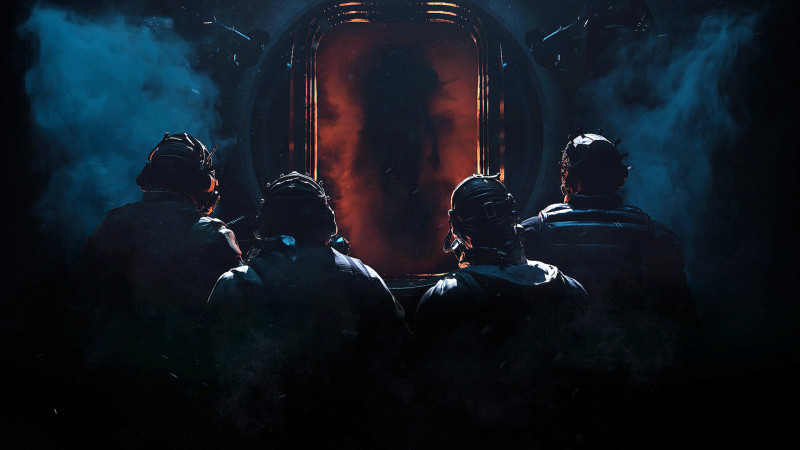
My four-player crew is held captive by an entity called “The Warden,” who forces us into an underground facility known as “The Complex” to retrieve miscellaneous items that help uncover the truth behind a devastating virus consuming the Earth. It’s immediately apparent that GTFO’s best quality is its oppressive tone. Rundown 6.0, the latest series of available expeditions, is an all-out assault on the senses. From the claustrophobic plummet at the start of each mission to The Complex’s discombobulating layout of laboratories and dig sites, every component of GTFO’s gameplay is inundated with high-stakes tension. Early expeditions (listed in increasing difficulty by the lettered tiers A-D) offer vague tutorial details – locate the objective, proceed to the specified zone, survive an alarm-raising door scan. These tutorials become virtually nonexistent as I press deeper into The Complex. Fleshy, grotesque humanoids, sensitive to light and sound, sleep in the darkness. Any sudden movements or flashlight misclicks can lead to doomsday scenarios. I appreciate these severe constraints. Clear communication and kit experimentation feels more gratifying this way, especially when extraction becomes harder on higher rundown levels.

Click here to watch embedded media

I spent copious amounts of game time preparing for upcoming expeditions. Loadout balancing is essential in GTFO, and it’s a good thing that each prisoner can come equipped with two firearms, a melee weapon, a heavy-duty tool, and double-edged buffs called “boosters.” GTFO rewards stealthy approaches and meticulous planning, so I usually bring a knife to silently take down unaware “sleepers” while also referring to my bio tracker tool to record enemy positions. Other gear includes blunt weapons and cool gadgets like foam launchers for slowing rampaging targets/gluing doors shut or auto sentries for buffeting pesky flankers with tungsten rounds. Booster effects, such as increased damage and specified resistances, make each prisoner feel like a one-person army. Vanquishing monsters with synchronized melee attacks to establish fortified defenses for mowing down incoming adversaries is never easy. Even so, when each player is attentive and utilizing equipment effectively, GTFO’s squadrons of disparate parts suddenly feel like well-oiled machines.

Launching expeditions with friends is the best way to experience the terrifying mayhem, and GTFO’s team-centric exploration mechanics are proof of this. I’d share medical packs and munitions sprinkled throughout the map with less fortunate companions – that one shotgunner always taking hits on the frontlines or the distant sniper consistently low on ammo. Moreover, tools satisfyingly pay off when paired together. Mines deployed on foamed gateways would exterminate entire armies, allowing the team to save resources for creatures with bigger health pools. Hollering in unison as swarms clamber into a once-empty room and breathing a sigh of relief when the team somehow emerges unscathed rank among my favorite moments in GTFO.


I only wish there was more to do. Scouring predominantly pitch-black settings to collect artifacts (boosters) or locate far-off terminals and other bland objectives grows tiresome. An array of enemy types with wormlike appendages, energy blasts, and tentacled wings keeps the action fresh early on. Still, after you memorize important coordinates, most of that terrifying magic is stripped away. Some interesting environmental puzzles emerge in command consoles (interactive parsers) which let me search for and ping vital items like key cards. But experienced players often ignore these computers, rendering them useless in most cases. And when matchmaking, trolls and/or quitters make playing through hours-long expeditions infuriating. Rundown 6.0 implements competent bots that can be given orders and merciful checkpoints to help remedy these issues. However, there’s nothing more disheartening than watching a trigger-happy stranger queue into a D-level mission with the intent of getting their whole team killed. Finding success is downright punishing if you don’t have a dedicated group.

GTFO might grow stale the more hours I pour into it, but 10 Chamber Collective’s rundown updates function like seasons and are guaranteed to introduce new levels and primary/secondary goals to complete in the coming months. The gunplay leaves a lot to be desired as the catalog of assault rifles, SMGs, pistols, and shotguns feel the same, but stealth runs are satisfying to plan out with others. Guttural screeches of enemies are bloodcurdling during engagements, while dark and complicated backdrops limit sightlines and keep me on my toes. GTFO isn’t for the faint of heart. Nevertheless, the fear of death means that re-strategizing and improvising are commonplace, which is a metagame that feels disappointingly absent in most cooperative shooters as of late. If you’ve been craving an FPS that tests your critical thinking and mechanical skills, then GTFO might just be the perfect hidden gem to satiate that ravenous hunger.

Click image thumbnails to view larger version


Score: 8

Summary: Despite a repetitive loop, GTFO smartly differentiates itself from its cooperative shooter influences while still being an approachable thrill ride.

Concept:

Graphics:

Sound:

Playability:

Entertainment:

Replay:

Click to Purchase

Friday, January 14, 2022

God Of War Review – Reaching A Higher Summit

Publisher: Sony Interactive Entertainment
Developer: Santa Monica Studio
Release:
Rating: Mature
Reviewed on: PlayStation 4
Also on: PlayStation 5, PC

In gruff moments of fatherly instruction, Kratos repeats the phrase “be better” to his son, Atreus. This happens in different contexts, but the lesson remains consistent: Your decisions are not bound by precedent, and the choices of others are not examples to follow – they only set standards you can strive to exceed. In developing the latest God of War, Sony’s Santa Monica studio apparently took this message to heart. While previous games in this series established a successful formula of stylish action and epic setpieces, the team used this opportunity to be better; with surprising changes on every front, God of War forges a new identity and surpasses even its most acclaimed predecessors.

As a longtime fan of the series, this entry captivated me for completely different reasons. The narrative is one of them, despite its simple premise: Kratos and Atreus need to reach the top of the highest mountain in the Norse domain. They encounter detours and surprises along the way, but the precise story beats are less important than how they are conveyed. God of War brilliantly presents a desolate journey in a gorgeous world, all through the lens of the relationship between a distant father and his eager son.

The interactions of Kratos and Atreus range from adversarial to compassionate, and these exchanges have ample room to breathe and draw players in. Atreus wonders what he might say to his departed mother if given the chance – an exercise Kratos finds pointless. When Kratos artlessly paraphrases the fable of the tortoise and the hare, Atreus mocks his lack of storytelling prowess. These quiet moments are interesting, slowly and believably closing the distance between two characters – a focus that contrasts sharply with previous games. In terse responses and long silences, Kratos conveys more than he ever did cursing Olympus at the top of his lungs.


That isn’t to say God of War has sacrificed its ability to deliver incredible spectacle. An early encounter (against a mysterious enemy called the Stranger) sets the bar absurdly high, and a cathartic sequence later on stands out as my favorite moment in the series to date. Between those points and beyond, the adventure is punctuated by a steady flow of enormous beasts, ancient architecture, and intense boss fights. The environments and characters look fantastic, and a new cinematic camera angle brings you close the action and never cuts away – a decision that proves immensely rewarding during big moments by giving you an intimate view. Despite this more grounded approach to presentation, the action’s scope and ambition is stunning in cutscenes and combat alike.

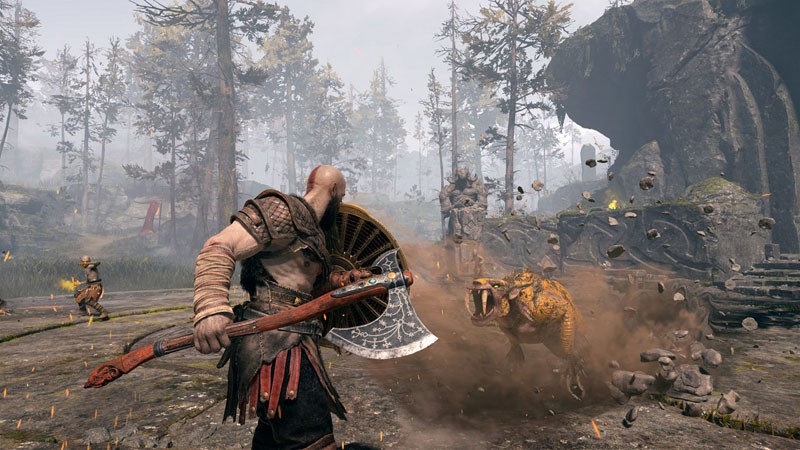
The Greek world may be gone, but Kratos is still a god of war, and his skill on the battlefield is appropriately divine. He fires off magic attacks and performs brutal executions in his attempts to defeat a clever assortment of foes from Norse myth. The ice-infused axe Leviathan is a drastic departure from the iconic Blades of Chaos Kratos once wielded, but it is a well-balanced and entertaining tool of destruction. I like how it emphasizes a more calculated style of combat; instead of zoomed-out, combo-driven encounters, Leviathan makes you a tactician. You can’t cut through huge swaths of enemies with it, so you need to consider how to manage your foes. You can freeze one from afar by throwing your axe, then use your fists to stun and grab another, then recall Leviathan for an area-of-effect ice burst. This kind of strategy gives many fights – especially one-on-one bosses – an engaging duel-like quality. Plus, the “thunk” of Leviathan magically flying back into Kratos’ hand is satisfying every time.

During the first few hours, I had doubts about the axe-and-shield emphasis. In those opening segments, crowded melees are difficult to navigate due to off-screen attacks, which encouraged me to keep my distance – at least until I got more comfortable with key mechanics like parrying. After that, I quickly came around; the combat system’s gradual unfolding in God of War is a joy. Though it may feel restrictive at first, before long you are rapidly alternating between all the tools and skills at your disposal, including your fists, Spartan Rage, Leviathan, and more. Cooldown-regulated runic attacks provide a diverse and unique array of special moves, like a freezing beam or a stunning blast, and I had fun experimenting with them and seeing which ones I wanted to cycle into my regular rotation.

You spend experience to unlock cool new techniques, and they aren’t just damage or range improvements; several have a significant impact on your options, like Kratos assuming a secondary stance from which additional attacks are possible. I also leaned on Atreus for assistance, since his arrows are crucial for incapacitating many creatures. Some of these concepts are introduced too slowly, but on the other hand, I relished how God of War’s battles avoid stagnation through constant evolution.

Underlying all of your combat endeavors is a surprisingly involved gear system that gives you an avenue to customize your arsenal, but also dangles aspirational goals in front of you. Many of your deeds provide materials and equipment as rewards, and like an RPG, you see the numbers next to your stats increase as you build and equip new items. You also see materials you don’t have for pieces of gear you want to craft, which adds to the excitement when that item finally drops after finishing a sidequest or beating a tough foe. This layer of upgrading may be less exciting than learning new moves to chop up monsters, but it still provides a powerful incentive to explore.

While not strictly open-world, the game has a large lake with various shores and islands available for free exploration. I loved systematically checking out new locations and acquiring crafting materials, enchantments, and other rewards. These excursions are largely optional, but they are the best way to ensure that you have everything you need for equipment upkeep. As a bonus, these diversions flesh out the world with some interesting NPCs, in addition to offering some fun (but not too challenging) puzzle-like scenarios. They can provide a nice break from the main story, but they’re always available, so you don’t need to invest in them at the expense of the narrative pacing.

God of War’s momentum rarely falters, and when it does, the inconvenience is brief. For example, you have the freedom to explore, but the map isn’t especially helpful for tracking your position relative to the things you are interested in, and the fast-travel system is weirdly cumbersome and opens up too late. This is more frustrating if you plan on being thorough with collectibles and post-game objectives (no new game+ this time around), but that didn’t dampen my enthusiasm for climbing cliffs and delving into ruins long after the 30 hours I spent finishing the main story.

Years ago, Kratos killed the deities of Mount Olympus in a gory rampage. Now, in the Norse realm, he has remade himself into a different kind of god. He is quieter and more deliberate, affected by his history but not constrained by it. Kratos’ reinvention serves as a narrative hook, but it also parallels the series’ evolution as a whole; where God of War once relied on bombast and bloodlust, now it leaves space for strategy and nuance. It still has superb action and plenty of jaw-dropping moments, but it supports them with a new level of depth and maturity. God of War learns from its past while clearing an exciting path for the future, and emerges as one of the best games of this generation.

Click image thumbnails to view larger version


Score: 9.75

Summary: God of War forges a new identity and surpasses even its most acclaimed predecessors.

Concept: A sublime reinvention of the God of War series that adds new layers of depth in gameplay and storytelling without sacrificing epic moments

Graphics: The world and characters come alive with fantastic design and gorgeous visuals. A more intimate camera ups the intensity of moments big and small

Sound: From the quiet tracks to the thunderous climaxes, Bear McCreary’s score supports the action and establishes an interesting tone

Playability: Despite a variety of different attacks, the controls make it easy to strategize in combat and use your full array of abilities

Entertainment: An enthralling experience from beginning to end, with a mixture of great narrative moments and engaging encounters. God of War is a well-paced adventure that knows when to let the action simmer and when to make it boil over

Replay: Moderately High
Click to Purchase