Pages

Wednesday, August 24, 2022

Blossom Tales II: The Minotaur Prince Review - Another Blooming Adventure

Blossom Tales II: The Minotaur Prince

Reviewed on: Switch
Platform: Switch, PC
Publisher: Playtonic Friends
Developer: Castle Pixel

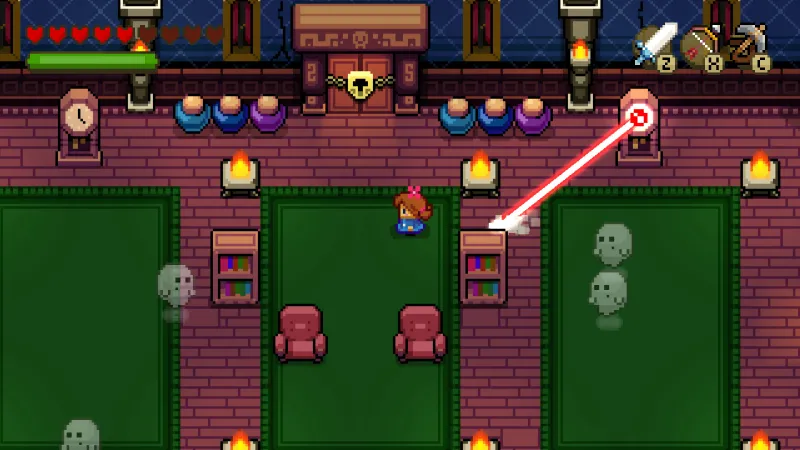
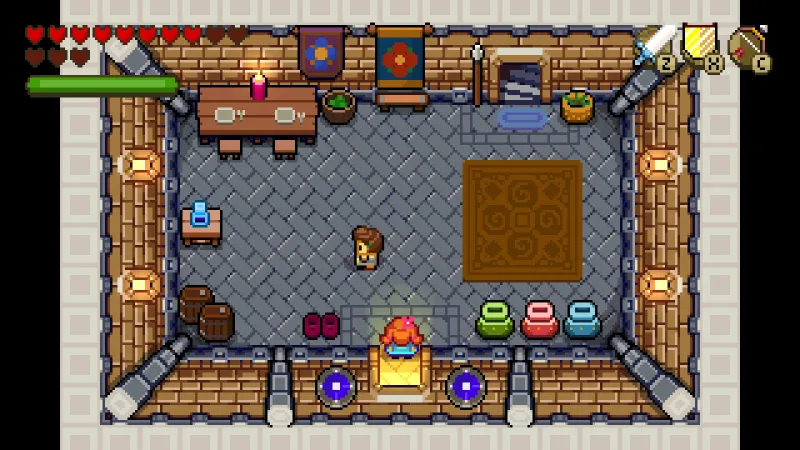
Modern homages to classic video games often go one of two ways: They either stick close to the gameplay conventions to which they are paying tribute, or they expand the original games’ styles in meaningful and innovative ways. Blossom Tales II: The Minotaur Prince, like its 2017 predecessor, is more the former than the latter, adhering closely to the classic Legend of Zelda blueprint, most notably that of A Link to the Past. Despite this lack of innovation, Blossom Tales II still manages to capture many of the acclaimed elements of what many consider to be one of the greatest video games of all time, and in the process, delivers a fun, retro-facing adventure worth embarking on.

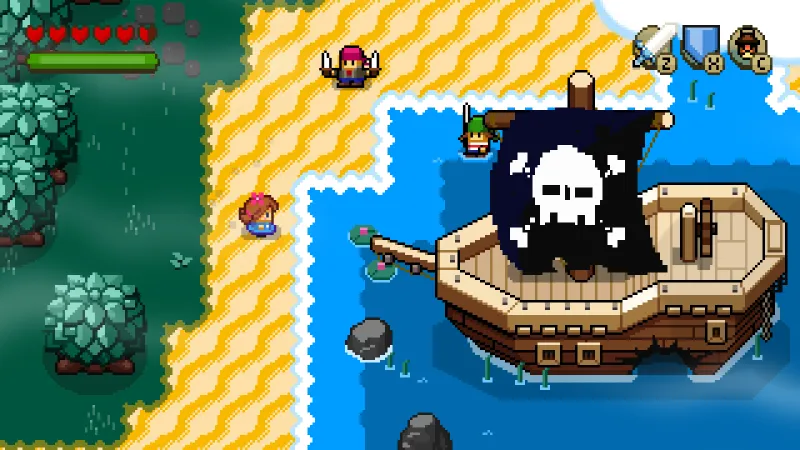
After player-character Lily accidentally unleashes the Minotaur King, who swiftly kidnaps her brother, a new dark age looms unless she can put a stop to the monstrous mythological monarch. To do so, she must leave the comfort of Blossomdale to trek through pirate-infested swamplands, ghost-haunted mansions, and a monster-filled desert. I love how each biome presents different challenges and enemies to overcome, and the exploration often feels natural and intuitive, leading you from one screen to the next. I rarely felt lost during my playthrough, which is a testament to the design of the open world and the dungeons therein.

Unfortunately, despite my enjoyment of the exploration, I rarely felt adequately rewarded for poking around each nook and cranny. Treasure offered for completing even the most difficult caverns is often gold coins, of which I already had more than I could spend. On rare occasions, I received a heart piece to help me earn more health, but those were so rare (and you need four of them to add to your max health) that it was minimally exciting. Still, that didn’t stop me from bombing every cracked wall, collecting every item, and fishing every pond.

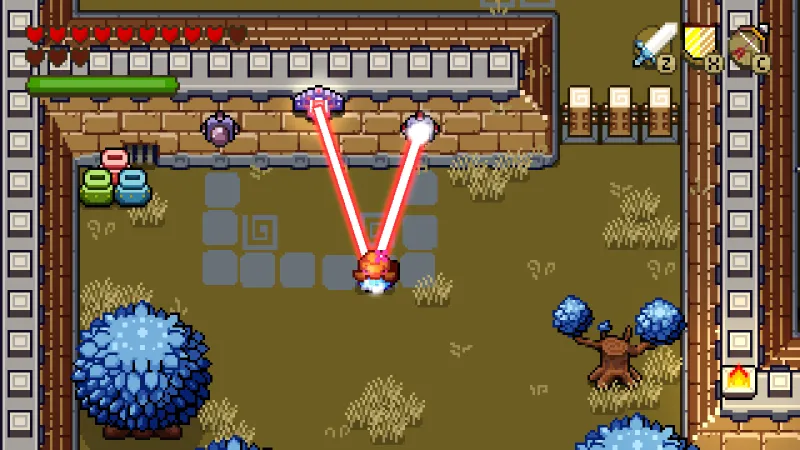
Blossom Tales II carries on the series’ hallmark of well-crafted dungeon experiences. Much like the world, the game’s dungeons flow well from room to room, and give you the right number of clues to progress without much frustration. While a late labyrinth is perhaps my favorite thanks to its strong mix of challenging combat and head-scratching puzzles, the dungeons feature terrific design involving minecart tracks, changing water levels, and more.

Blossom Tales II’s simple combat lacks the sophistication and smoothness of other top-down action games, but it makes up for it by giving you a wealth of items and powerups. Genre mainstays like a bow, boomerang, and bombs appear in your inventory early on, while a yo-yo that acts like a hookshot and a guitar on which you play spell-inducing songs do more than nod at the Zelda series. These items are used in interesting and satisfying ways, though I was less excited about how often I needed to pause the action and map a different item to the face buttons.
 

The story uses an unreliable narrator convention as it’s told to children Lily and Chrys, who also serve as the two main characters of the adventure. On occasion, the kids will fight over what they want to happen, and it’s up to you to decide what to do. Though I enjoy being able to choose what kind of enemies I needed to fight or puzzle I needed to solve on occasion, the unique storytelling model is underutilized and relegated to only minor decisions.

Blossom Tales II does little to hide its Zelda inspiration from the player. While it doesn’t reach the heights of Nintendo’s legendary franchise, it does smooth over many of the early-‘90s design conventions present in games like A Link to the Past to deliver an adventure able to be enjoyed by players of all ages and experience levels. Blossom Tales II is a better game than its predecessor, and I hope we continue to get more adventures from Lily, Chrys, and their grandpa in the future.
Score: 8.25

About Game Informer's review system

Purchase

Monday, August 22, 2022

Madden NFL 23 Review - A Short Gain To Start A New Drive

Madden NFL 23

Reviewed on: PlayStation 5
Platform: PlayStation 5, Xbox Series X/S, PlayStation 4, Xbox One, PC
Publisher: EA Sports
Developer: EA Tiburon

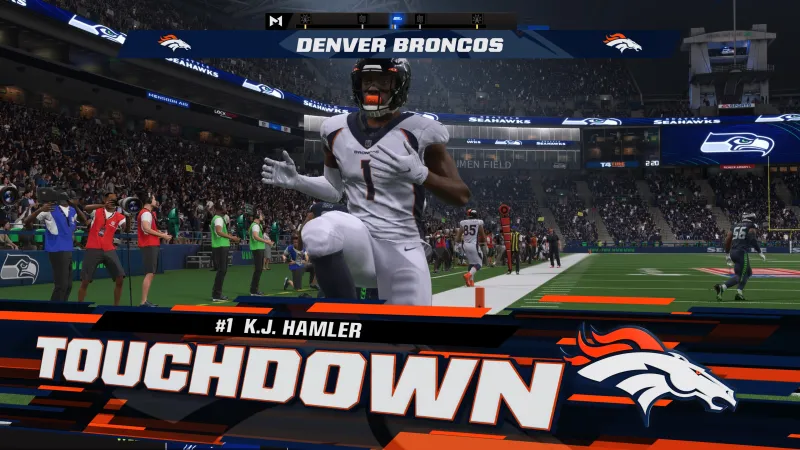
In Madden NFL 23, developer EA Tiburon focused on the fundamentals: authentic 11v11 football and cleaning up many of the bugs that plagued previous Madden iterations. The result is a small step forward for the franchise and a strong foundation to build on.

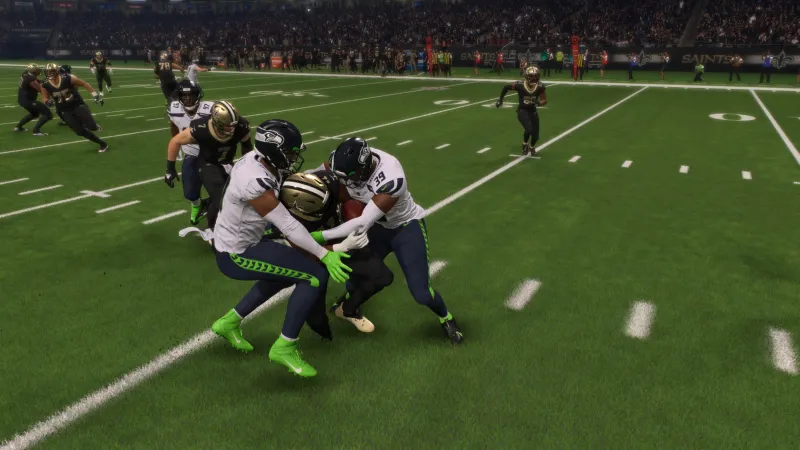
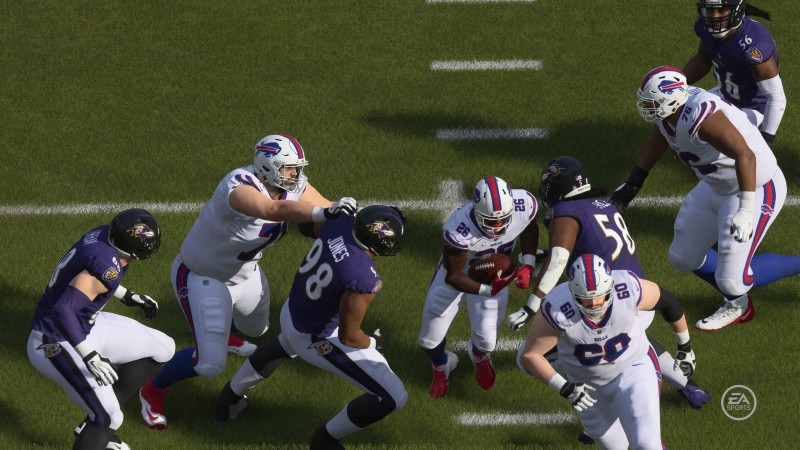
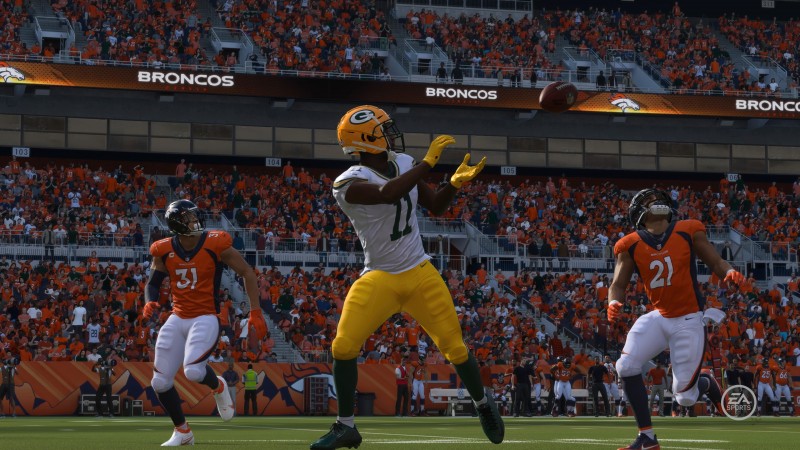
The most significant changes in Madden NFL 23 are under the surface. The team at EA calls it FieldSense, a shift to more physics-based interactions on the field. In practice, it’s a mostly positive change. Running the ball between bodies is chaotic and violent, true to the real-world game. There are occasional issues; would-be tacklers tend to slide off whoever is running the ball like they are coated in Teflon, for example. The way defenses wrap up opponents and how ball carriers fight for extra yards feels authentic, but the high frequency of fumbles on these plays needs adjustment. It’s imperfect but a solid first implementation of a system that should improve in future iterations.


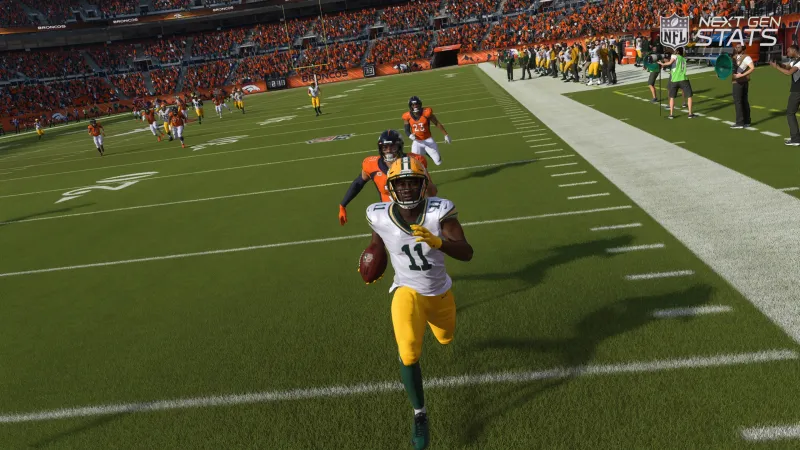
The overall presentation is a noticeable step forward. From boot up, everything is awash with the legacy of the late John Madden – a fitting tribute to the man behind the name. Updated scans of equipment and players look excellent, and the gameday presentation features more vibrant graphical overlays and cinematic camera work that feel more like an NFL broadcast. The authenticity is appealing; I skipped fewer transitions during games to enjoy the presentation.

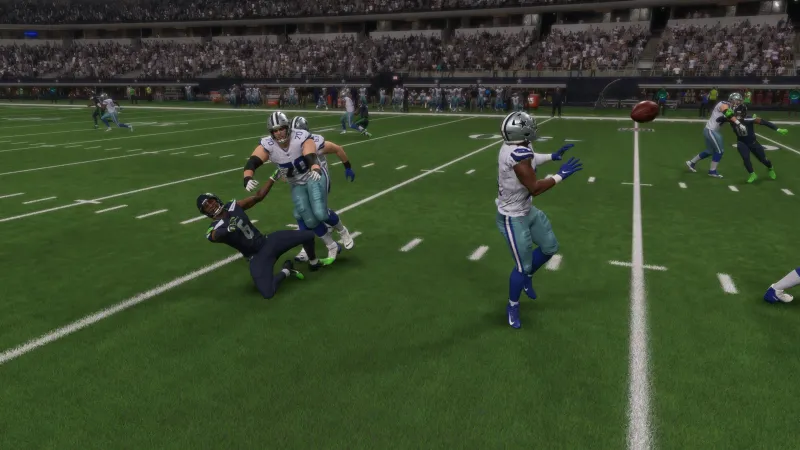
The much-ballyhooed Skill-Based Passing adds an interesting (and optional) wrinkle to throwing the football. Having a target area and aiming reticle takes a bit of getting used to, but the additional control over ball location does make a difference, especially for avoiding defenders while throwing over the middle of the field. It quickly became second nature, and I sorely missed the fine aiming controls when I went back to play a game in Madden 22. The passing meter, on the other hand, is a non-factor. Generally, my muscle memory for how long to hold a pass button lined up with perfect passes and turning the feature off or on didn’t make a noticeable impact on the field.

Connected Franchise evolved in Madden 22 with an updated scouting system and an overhauled interface. This year it’s more of a refinement. The addition of Motivations and Tags adds a nice sense of humanity to the players in the league. Motivations include the desire to play with a franchise quarterback or in a fair-weather stadium. If you have what a free agent is looking for, you may be able to attract them with a team-friendly deal. Otherwise, you may need to overpay to land your man. I worry how that will play out in competitive leagues; it won’t be clear if it creates a significant imbalance immediately, but the potential is there.

Tags are rarer and reflect a player's role and how they affect the team's dynamic as a whole. A player with a Mentor tag may not be the best on the field, but they'll accelerate the development of younger players at their position. It’s the sort of off-the-field factor that NFL GMs consider, and I enjoyed the added element when I constructed my team. When I drafted a star safety, I was immediately motivated to seek out a veteran for them to learn from, in a fun bit of roleplaying that Connected Franchise often lacks.

Face of the Franchise remains a mixed result. Playing exclusively as a quarterback, running back, or linebacker can be fun, as you are involved in every play. This year, corner, a new position for Face of the Franchise, is a worse experience. I went entire drives without having any impact on the game, and it was frustrating to miss out on goals for tackles or stopping drives because of things outside of my control.

The Madden NFL series has long had a solid gameplay foundation, maintained by small improvements year over year. Madden NFL 23 is the first iteration in a long time that rebuilds that foundation, and that’s where this year's greatest success lies. Some slippery collisions aside, the more physics-based action is a good change, and the control over ball placement from Skill-Based passing is a welcome addition. This comes at the cost of only minor updates to the core gameplay modes, but it was ultimately the right call to make, and Madden is a better game for it.

Score: 7.5

About Game Informer's review system

Purchase

Saints Row Review – Captivating Chaos

Reviewed on: Xbox Series X/S
Platform: PlayStation 5, Xbox Series X/S, PlayStation 4, Xbox One, PC
Publisher: Deep Silver
Developer: Volition
Rating: Mature

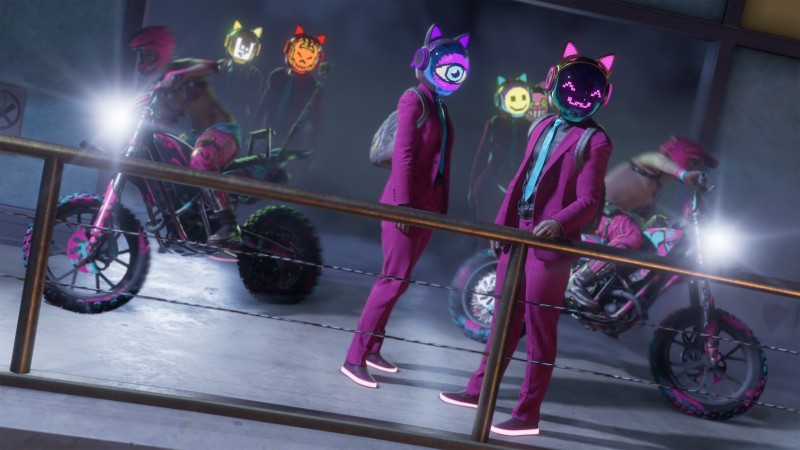
The Saints Row reboot features a new cast of characters and a different location to explore, but its heart and soul haven’t changed: Players can once again expect an exciting crime fest, giggle-worthy humor, purple splattered everywhere, and an open-world chock full of things to do and secrets to unearth. The game also has a knack for blowing everything up. In other words, it is great fun in that traditional Saints Row way and even better when experienced with a friend.

Saints Row establishes an exciting pulse from the outset of play that periodically palpitates with graphical glitches or can outright flatline when gameplay bugs halt progress. The rough edges are noticeable yet are minor nuisances in an otherwise outstanding game. Saints Row has never been better, but I wouldn’t call it the next evolution in the series – it feels like an alternate sequel to Saints Row 3. Take that as both a compliment and a minor complaint. The mission designs and co-op play creatively build off that formula, while the gunplay and animations haven’t shown much improvement and are well behind what we expect in games today.

This entry hits with silliness within minutes of play, with the lead character delivering what is likely the longest string of f-bombs in all of entertainment. This moment cements the game’s silly (and low brow) vibe, which hits more than it misses, and shows the protagonist can be a bit of a wild card. The player designs this character, determining their sex, voice, facial features, and even the size of their genitalia. This lead is nicely penned and blends seamlessly with a fantastic supporting cast that gives the game a legitimate team dynamic, both in the story and mission flow. Eli is the brains of the operation, and his love of LARPing rubs off on you. Neenah’s obsession with cars and art is contagious and represented in play. And then there’s Kev, who is always shirtless, loves tacos, and is one of the fathers to a fantastic cat (that actually plays a significant role in the plot).

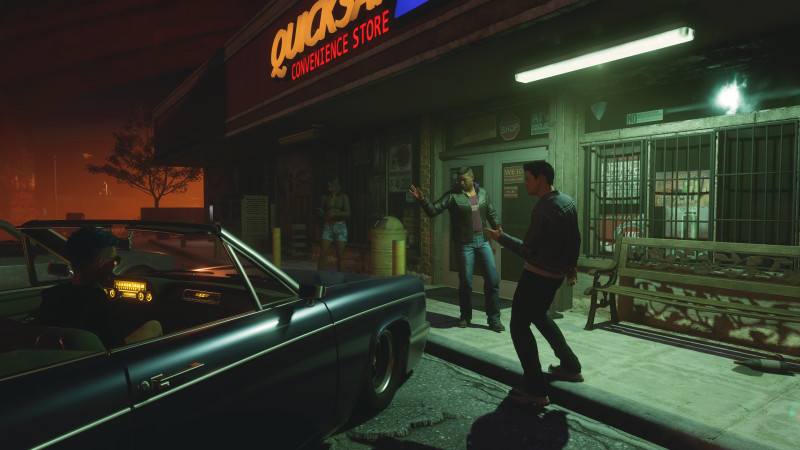
The fictional world of Santa Ileso is just as colorful as this cast, stealing the eye with creative architectural designs like dinosaur statues and state-of-the-art skyscrapers backed by scenic deserts and mountains. I like how developer Deep Silver Volition encourages the player to stop to admire the architectural craftsmanship with photo opportunities. When photographed, some of these wonders transform into decorations for the Saints’ base. I don’t know how many hours I sunk trying to track these collectibles down. They reward you well for taking the time to explore.

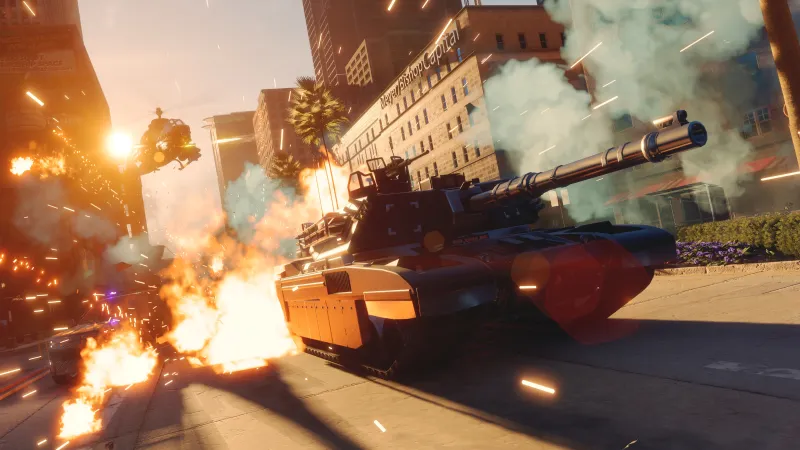
Getting around Santa Ileso is rarely a bore, even if stretches of it are remarkably flat. From hoverbikes to battery-powered tanks, vehicle variety is high and surprisingly powerful. A basic rusted-out car doubles as a weapon that can knock other vehicles off the road and break the laws of physics to turn corners on a dime. Most of these rides offer extensive tuner customization, allowing their looks to transform through deep wells of body mod parts, tires, paint, and more. Additional customization parts are tucked off to the side as hidden collectibles, giving yet another reason to explore.

I enjoyed every mission in the game. The critical path and side hustles are handled with care, delivering interesting or goofy objectives in locations that collectively give you a good look at most of the map’s significant landscapes and interiors. It wouldn’t be fair of me to spoil these setups, but I was particularly impressed by a prison mission that turns into a music video for Onyx’s “Slam.” These missions scale nicely for cooperative play, as do the mostly optional criminal ventures. Insurance Fraud sadly hasn’t evolved (yet is still dumb fun), but there’s a nice variety to them collectively. Most are short and sweet, and reward the player with much-needed new skills, cash, weapon crafting materials, and maybe even a new car or outfit.

New ventures unlock at a nice pace since they are tied to critical beats in the story, delivering something different to dive into even at the game’s end. The story progresses at a decent clip until around the third act, where it feels like an entire chapter of the game is missing. The Saints go from rags to riches in the blink of an eye, and the final act unfolds. It’s a jarring plot skip that delivers the sensation that I missed a big chunk of the Saints’ growth.

Combat is one of the biggest parts of the game, and it never truly finds its groove. Part of the problem is I felt bad for most of my opponents. They either charge haphazardly into most battles, getting riddled with each step, or perform an awkward dive roll, which leaves them vulnerable as they consider what to do next. The selection of firearms also disappoints both in feel and variety. The oddly named Thrustbuster is Saints Row’s greatest weapon to date (as it sends enemies into the stratosphere), but most machineguns and pistols feel unremarkable. The default lock-on targeting system strips excitement from the firefights and is something most games abandoned generations ago. All that said, blowing stuff up – which you do all the time – is incredibly rewarding given just how extensive most damage is. The rockets and grenades help give the combat system a pulse.


In my 30 hours of play, I experienced several glitches, the most severe being my weapons no longer firing, but most were of the visual variety, like my character’s head disappearing. The gameplay can be rough and may force you to reload a checkpoint. Thankfully, the game is liberal with them, so too much time isn’t lost, but it still stinks to have to repeat steps. Here’s hoping the game receives additional polish post-launch.

It may not push your new hardware to the limit and is a little rough around the edges, but the latest Saints Row is everything it needs to be, delivering a wonderful comedic experience with plenty of depth. While a little irritating, I was never bored and wanted to see where my team’s goofy antics would take them next. The payoffs are often worth the time investment, and just veering off the beaten path pays dividends. I’m glad the Saints are back, hopefully for another long haul.

GI Must Play

Score: 8.5

About Game Informer's review system

Purchase

Thursday, August 18, 2022

Soul Hackers 2 Review – Bland Sabbath

Reviewed on: PlayStation 5
Platform: PlayStation 5, Xbox Series X/S, PlayStation 4, Xbox One, PC
Publisher: Atlus
Developer: Atlus
Rating: Mature

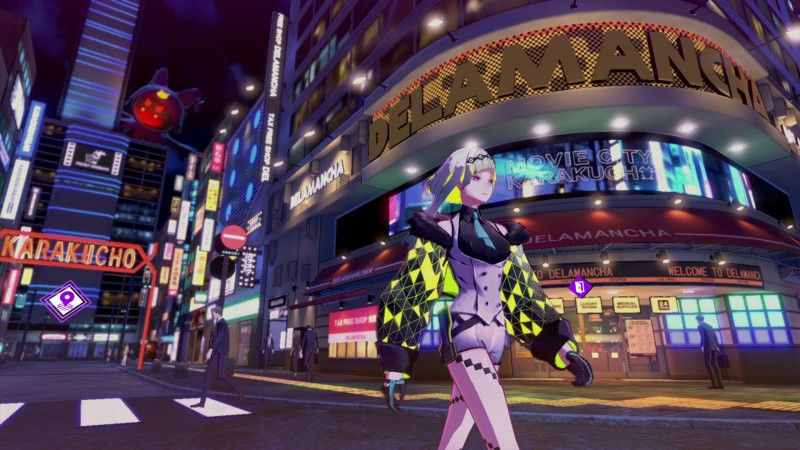
The group of bounty hunters gathers in their favorite bar once more. For the first time, protagonist Ringo pays attention to the lush cherry blossom decoration over the rooftop. Her friends say the real ones are even more beautiful and laugh at the idea of a bunch of Devil Summoners having a picnic and watching the flowers. The friendly mockery leads to a funny yet endearing message: “I think we oughta show Ringo the fun side of being human, don’t you?” Sadly, Soul Hackers 2 doesn’t seem to agree with the sentiment.

Soul Hackers 2 is the sequel to 1997’s Devil Summoner: Soul Hackers, an RPG spun from the Shin Megami Tensei series. 25 years later, after games like Persona 5 put the SMT universe in the spotlight, the landscape couldn’t be more different.

Set in the 21st century, two clans of Devil Summoners fight for an ancient power. As a result, Aion, a highly developed artificial intelligence far closer to reality than I’m comfortable with, predicts that doomsday is forthcoming. The only ones capable of preventing it are Ringo and Figue, two personifications of Aion in the flesh. Both can hack people’s souls to bring them back to life and give them a second chance while serving as key pieces to prevent doom.

The premise is interesting, and although the villains don't carry enough weight to stand out, I was invested in the story. Naturally, the pasts of the three characters joining Ringo on her quest intertwine with the larger narrative. There are glimpses about the meaning of mortality around Ringo’s gift, as well as how the soul-hacked choose to act when allowed to settle a long-standing score or recover a bond with a partner. But the most interesting plot points feel rushed without enough room to create meaningful stakes or emotional tolls. As a result, the few moments that stand out feel unearned.

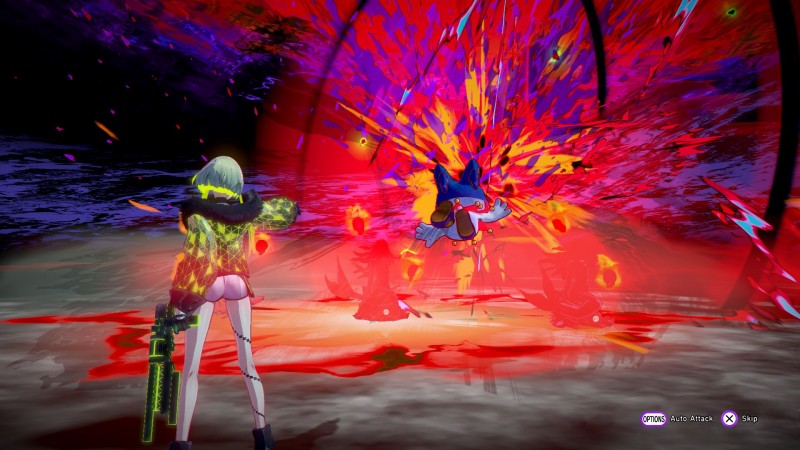
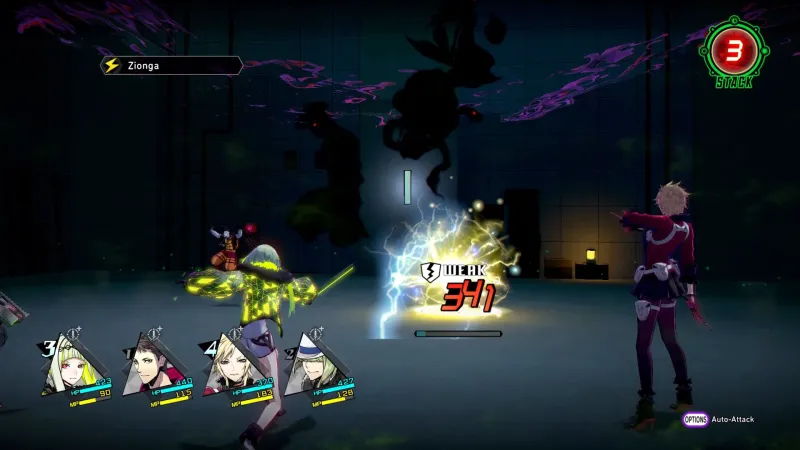
Gameplaywise, Soul Hackers 2 doesn’t offer an incentive to stray off the main path and spend more time in its otherwise interesting world. Side quests are unremarkable and based around revisiting areas that aren’t interesting to explore. The combat is more on par with Persona 5 than Shin Megami Tensei V, offering many upgrades and skills to tailor your experience. Only that it’s far more streamlined, lacking the enticing press-turn mechanic from the mainline games that add turns when you exploit an enemy’s weakness. Instead, doing so adds a stack to the Sabbath, which acts as an all-out-attack at the end of your turn. It makes for a pretty spectacle as the arena is slowly engulfed in a colorful aura the more attacks you can stack. But it also makes for unnecessarily long encounters without much risk. Enemies can’t exploit your party’s weaknesses, either, so you can always just heal up afterward.


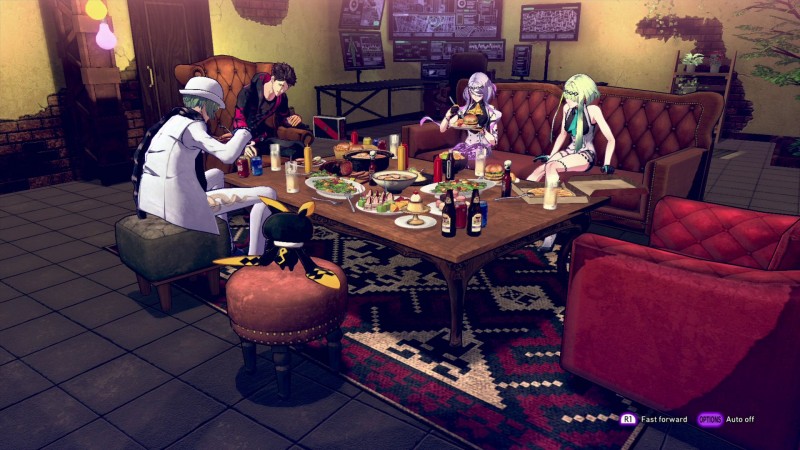
Throughout the 30 hours it took to hit credits, I kept trying to latch onto the elements that work. Soul Hackers 2’s saving grace lies in its main characters, each with a distinct personality that often clashes with the rest. Witnessing the group’s growth by putting their differences aside and opening themselves up to camaraderie was a joy. I loved their conversations about freelancing as Devil Summoners as much as the tough chats about the people they lost over a meal or a drink. But there’s not a seat on the table for the player to take it all in.

During that night at the bar, the group wondered if they’d still be alive by the time the flowers bloomed again. And I know that they will because I put in the effort to make that happen. I just wish I was rewarded with a bit more humanity and meaning to my struggles by seeing them create that memory for themselves.

Score: 6.5

About Game Informer's review system

Purchase

Tuesday, August 16, 2022

Rollerdrome Review – A Dystopian Delight

<p><img src="https://ift.tt/r7cOl5G" width="800" height="433" alt="" typeof="foaf:Image" class="image-style-body-default" /></p>

Reviewed on: PlayStation 5
Platform: PlayStation 5, PlayStation 4, PC
Publisher: Private Division
Developer: Roll7

<p>My roller skates come to life, whirling loudly on concrete before drowning out to the murderous symphony of shotgun blasts and rocket explosions. I spin to avoid a hail of bullets, latch my skates onto a rail, and then flip through the air, my guns blazing as I perform a flashy trick to bring the crowd to its feet. I hope this run creates a big enough death combo to reach a high score and unlock the next stage, where more powerful weapons and foes await. This is Rollerdrome, a skating-shooter that blends the trick system of Tony Hawk's Pro Skater with the kill chains of Doom 2016 to create an exciting dystopian experience that makes you feel like a god on wheels.</p> <p>Roll7, the team behind the OlliOlli series, is locked in on every aspect of this game, delivering enticing skating freedom, challenges that require devotion, comic-book visuals that leap off the screen, and a fascinating science-fiction vision stripped right out of 1970s cinema. Rollerdrome is a love letter to James Caan's classic film <em>Rollerball</em>, following the same theme of corporations ruling the planet and using the poor as contestants in a blood sport. Even the skaters' uniforms are similar in design and color. The retro vibe and inspirations work well to create a fascinating backdrop to skate to. When playing Rollerdrome, the comparison points to other games and entertainment are crystal clear, but they unite to create something unique.</p> <img src="https://ift.tt/1sYadCB" typeof="foaf:Image" alt="" class="image-style-body-default" /> <p>The concept of the gameplay is simple: Skate or die. If you stop moving, a sniper will pick you off, or a mech will blow you to kingdom come. You travel the globe to different arenas, each designed like a skate park with a sea of ramps and rails to help you gain speed and soar. You use these playgrounds to earn advantage points to attack militant groups hired by mega-corporations. They are disposable and are here to highlight the skills of the contestants. You assume the role of a rookie named Kara Hassan, who you never get a good look at since her back is always to you and she's wearing a helmet, but her skills are undeniable and, more importantly, great fun to display.   </p> <iframe width="560" height="315" frameBorder="0" allow="autoplay" allowfullscreen="true" src="https://ift.tt/KYjf5G2> <p>When Kara rips into an area, chaos hits to thunderous applause and doesn't relent until the last body collapses to the floor. Her movements are swift and fluid, and the most significant actions are easy to perform, such as launching off a half pipe or spinning through the air while simultaneously firing a machinegun. Roll7 did a phenomenal job with the controls, making them intuitive to the point that they quickly become muscle memory and don't require much more than a single button press. The timing windows for specific moves are also fantastic, making evading sniper fire not just a cinch but an integral part of the combo system. If you can perform a perfect evade, your point total ticks up.</p> <p>In the first few levels, I skated with the sole intent of winning and moving on to the next stage. But the game's progression system requires more than this. To reach the second tier of stages, Kara must first complete a specific number of mini objectives. These tasks range from achieving high scores to downing specific enemy types in particular ways. These goals are Pro Skater-like but do lead to some frustration if you don't want to try your hand in the same battles numerous times.</p> <section class='type:slideshow'><figure><img src='https://ift.tt/J3uR2Ws src='https://ift.tt/mzqaNLo src='https://ift.tt/GY2bslx src='https://ift.tt/I5WgYj3 src='https://ift.tt/reskuGn>   <p>I felt a little frustration in the later levels, yet I adored how the challenges pushed me to find and execute huge combo strings to reach higher scores. The combo meter multiplier only advances on kills, so you must figure out how to reach and kill enemies in a timely order. These foes spawn across the arena, and your ammo reserve only replenishes when you perform tricks, so you are constantly trying to dazzle the crowd or down an adversary. It's a phenomenal mix of two distinct gaming disciplines. The gunplay fits nicely with the skating, thanks to one of the most generous lock-on targeting systems you'll see. The focus is on gaining ammo and timing shots, which is fantastic given your character's breakneck speed and them often being airborne.</p> <p>The retro sci-fi setting fits the action, but don't expect much from the story. You'll hear voices in the locker room that advance specific plot points and gain more insight into the world through notes and newspaper clippings, but they don't add up to much – all the excitement is in the arena.</p> <p>Rollerdrome immediately clicked with me, and I ate it all up. As polished and fun as the experience is, it feels like Roll7 is just dipping its toes into the water. I hope this talented studio gets the chance to make a sequel to further flesh out this unique concept with more detail in the story and greater player progression. Regardless, Rollerdrome is a fantastic first foot forward. I adored the campaign gameplay and have a feeling my friend group will use this unique title for late-night scoring competitions.</p> GI Must Play

Score: 8.5

About Game Informer's review system

Purchase

Friday, August 12, 2022

Digimon Survive Review - Teenage Wasteland

Digimon Survive

Reviewed on: Switch
Platform: PlayStation 4, Xbox One, Switch, PC
Publisher: Bandai Namco
Developer: Hyde, Inc
Release: 2020
Rating: Teen

Gathered after a tragedy befalls our group, I attempt to calm down and plea that we should trust one another. Blood’s been spilled, and tensions are at an all-time high for this lost party of teens trapped in a dangerous land. That’s not quite the scene I had imagined going into Digimon Survive, a tactical RPG by way of a visual novel based on the sometimes-kid-friendly monster franchise. The dramatic dynamics at play are gripping, but the grid-based battles left me snoozing, souring what could have been a compelling, complete package.

As a visual novel, Digimon Survive is an absolute treat, full of beautifully drawn characters and scenery. Each location has well-crafted character staging with camera pans and zooms, giving these places a sense of depth. I’m often put off by the sparse production values of visual novels, but Digimon Survive keeps the flow of conversations visually interesting, enhanced by a partial Japanese voice-over.

You’re put in the shoes of 14-year-old Takuma, flocked by a cast of other young teens trapped in a dangerous world after getting lost on a school trip. Here, each child is paired with a partner Digimon through a mysterious bond that everyone hardly accepts. This unease leads to many difficult situations testing the group’s trust in one another, their Digimon, and some characters’ grip on reality.  While the story starts slow, I’m impressed by the depth of the characters and learning the interactions and roles each plays within the group.


Early on, I decided who would tend to take my side, who was prone to worrying, who was headstrong and stubborn, and the people who are difficult or insufferable to deal with. I wouldn’t say I liked many of the characters for a while (or ever), which is great, and why Survive succeeds in its characterization and relationships. Throughout my playthrough, I loved how I had to learn to deal with each character, to tell them what they wanted to hear in a particular situation, or what they needed to be told for the betterment and survival of the group. The fate of these kids’ lives is on the line, leading to an enjoyable tension. Even casual chats can lead to interesting turning points for a character that can drag them back from the brink of being a problem for the team or set them off on an anxiety-inducing path for everyone around them.

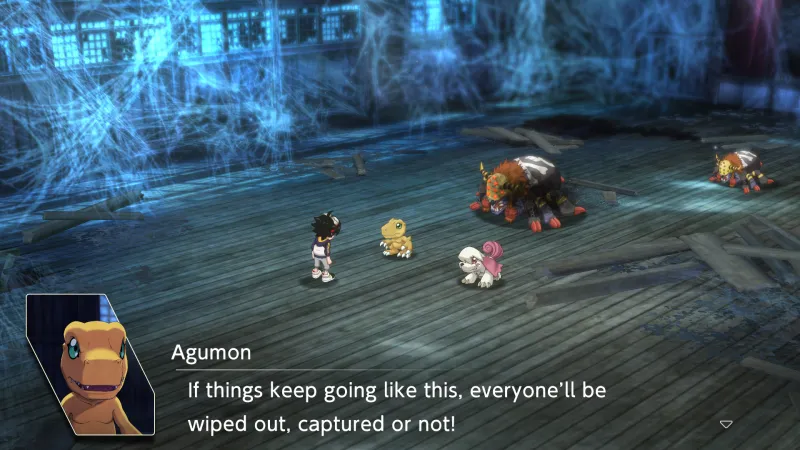
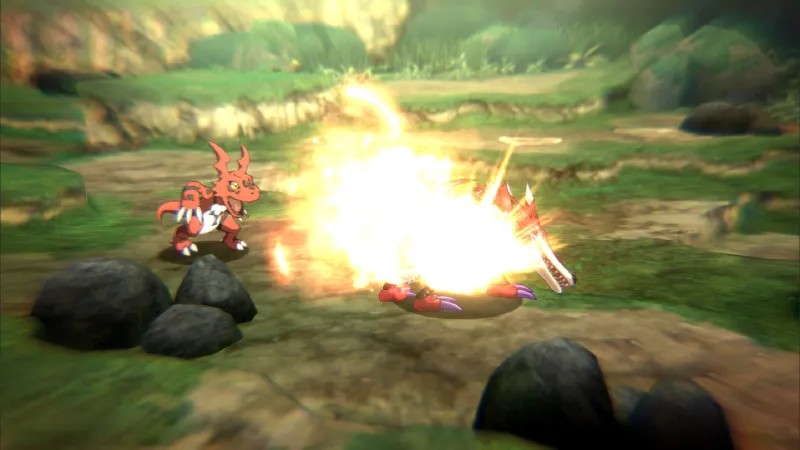
Accompanying each kid is a Digimon who appears as the group enters this new dimension. Series mascot Agumon pairs up with you while others like Floramon, Lopmon, Labramon, and Falcomon become tied to the other recurring teens. These creatures play a pivotal role in the story and are linked emotionally with human partners. I’m disappointed by some underwhelming evolutions for the main Digimon, but overall, the interactions between you and the monsters are fun and rewarding. I enjoyed learning how their budding friendships pan out or not, leading to powerful moments in the story that I’ll remember for some time.

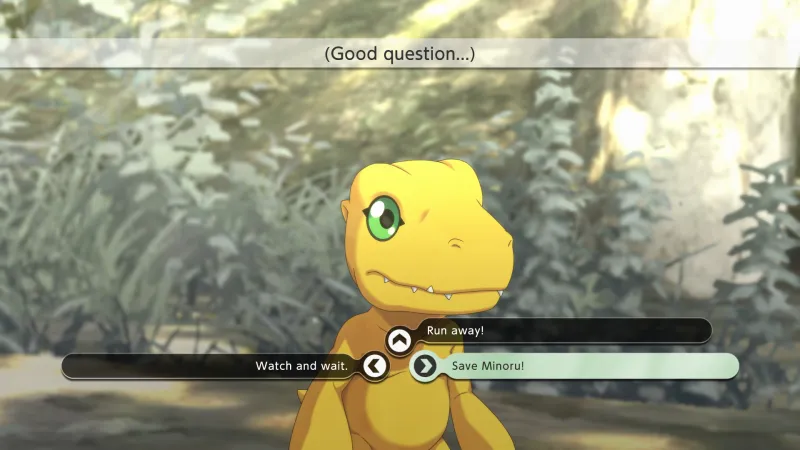
Choices made through conversations can and will affect the Digimon and how they evolve, which is especially true with Agumon. Because emotions drive the connection between the partners, if your conversation choices lean towards one of the three traits of wrathful, moral, or harmony, Agumon’s evolutionary tree will shift throughout the game. These options have overarching narrative ramifications as well, making the one cool link between the story structure and the turn-based battles. I appreciate that my journey can have many different effects on my monsters, but the part of the game where evolutions truly matter suffers greatly compared to the visual novel.

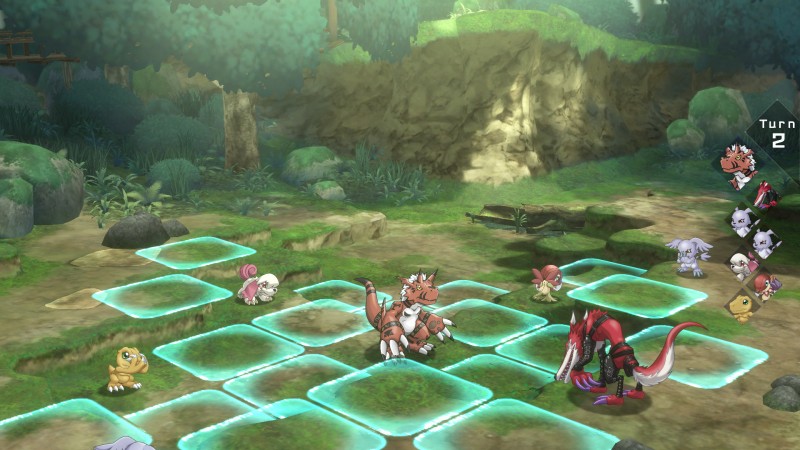
Digimon Survive’s tactical turn-based combat is overly simplistic and lacks excitement and strategy. Each Digimon can shuffle along the map grid to position for attacks against enemy monsters. Digimon have a signature move and a basic attack along with up to two additional equipable skills. My favorite part of skirmishes is the management. Using special attacks and assuming an evolved form consumes SP; remaining in base form for any of the main party’s monsters restores the precious resource. The few times I had to juggle stages of evolution to conserve SP for a last-ditch attack were stimulating and interesting. Still, that’s far from the norm when most battles are far from mentally taxing encounters.

Instead of relying on team composition, formations, and strategically interesting attacks, most encounters play out by just getting your team close to the opposition and hammering them with your strongest ability. Sure, there are elemental advantages at play, and depending on whether you attack from the side or rear flank can yield some additional destruction, but simple brute force typically gets the job done. As a result, the part of this game I was most excited about feels like padding and brings down the overall experience.

Battles also allow for additional Digimon to join your party, but the process is a tedious mess. These recruitment opportunities only come from free battles during exploration and require you to use the talk command to start a conversation. The enemy Digimon will ask you a series of three questions, of which you must respond in the way they prefer multiple times to get the chance to ask them to join the team. It’s clumsy and tedious, with many interactions resulting in failure. Despite my wanting to have a cool new Digimon on my team, I eventually decided it was hardly worth the trouble.
I applaud Digimon Survive for being a dark, harrowing, and wonderful visual novel, and subverting what I thought a Digimon story could be. While I wish the combat evolved as much as the surrounding story presentation, it’s not enough to deter someone from seeing the narrative through. Don’t expect a tactical masterpiece, but rather a well-made melancholy tale depicting Digimon in a light they haven’t been in before.
Score: 7.25

About Game Informer's review system

Purchase

Wednesday, August 10, 2022

MultiVersus Review - Packing A Punch

MultiVersus

Reviewed on: PlayStation 5
Platform: PlayStation 5, Xbox Series X/S, PlayStation 4, Xbox One, PC
Publisher: Warner Bros. Games
Developer: Player First Games
Rating: Teen

Warner Bros. has given new studio Player First Games some of its most popular characters to carve out space in the Smash Bros.-dominated IP-crossover-fighter genre. MultiVersus succeeds where others have failed, but it still has some growing to do.
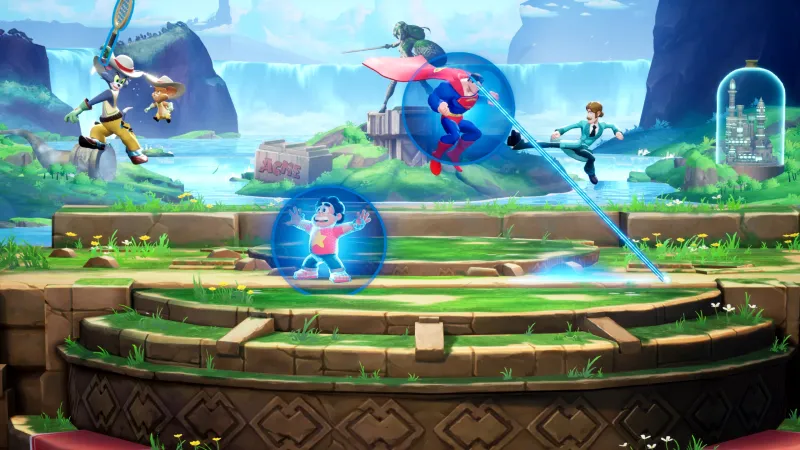
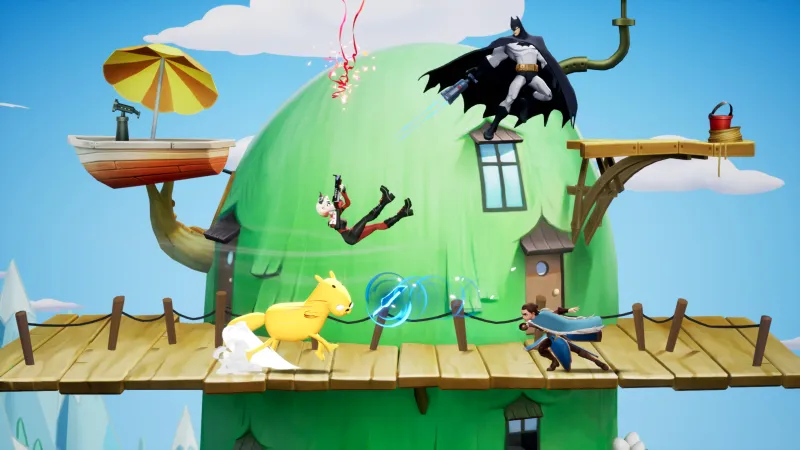
Though LeBron James appears on the roster thanks to his starring role in Space Jam: A New Legacy, the WB roster in MultiVersus doesn’t feel as icky as the roster of that film. Each character is treated with reverence, creating a world where you eventually don’t bat an eye at the fact that Arya Stark from Game of Thrones is stabbing Bugs Bunny.

The tight, Smash-like controls deftly convey the powerful and heavy Iron Giant just as well as the swift and silly Finn from Adventure Time. Just when I thought I had found my main, I started up another character and was always surprised by how unique and interesting they were to learn.

While 1v1 and 4-player Free-For-All are included, everything is built around 2v2 gameplay. Character classes indicate traits at a glance and hint at how teams might gel. For example, Velma can hang back and cover with projectiles and buffs/debuffs, while Superman charges in to pound everyone. You can pair characters that enhance strengths and cover weaknesses, or simply go all in with two rushdown characters; all options are workable in the right hands.

The perks system plays into this directly. Character leveling unlocks boosts to speed, dodging, jumps, and more. It’s smart to match up perks with your partner for a stacking bonus. Superman and Velma both have ice attacks, for example, so you can combo to increase that debuff. Unique signature perks play up character strengths as well. Even in this early state, the team/perk combos are staggering and kept me experimenting constantly.

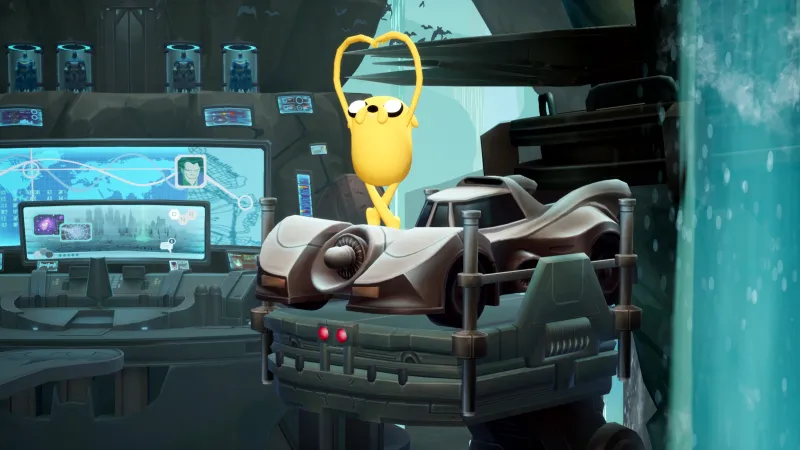
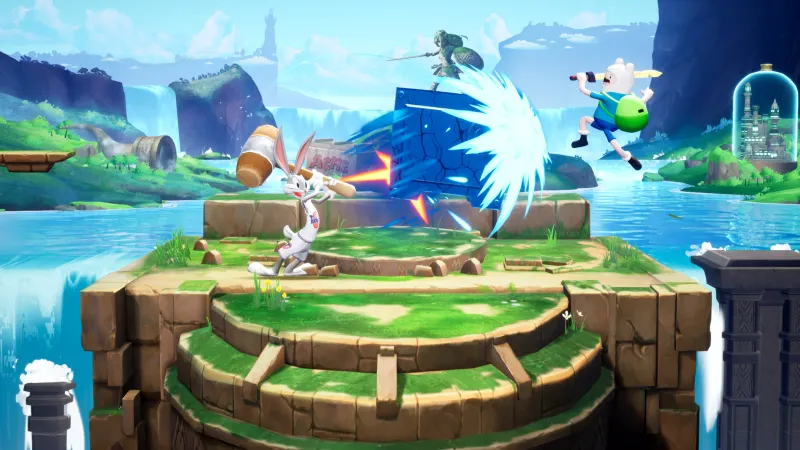
Despite the strength of the current basic modes, the lack of variety needs to be addressed (and apparently will be soon with an arcade and ranked mode). The limited number of maps cover standard size and layout requirements, but none of them match the creativity and detail of a good Smash Bros. level. It’s neat to volley enemies off a Batmobile in the Batcave, but stages like a generic, empty coliseum and stock grassy field with waterfall left me wanting more.

Online play is fantastic thanks to rollback netcode and a massive cross-platform player base. I never had to wait for matches or deal with lag. Reindog – a new character created for the game – turned invisible a couple of times, but that’s about the extent of my technical problems.


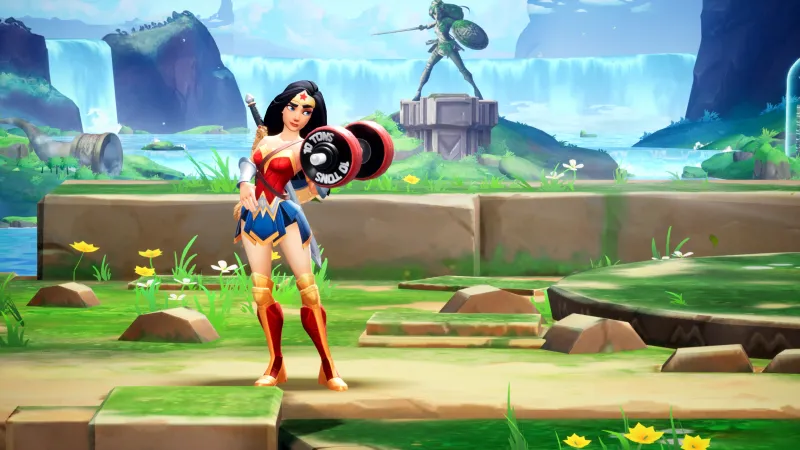
MultiVersus is free-to-play on almost every console and PC, making it easy to access. However, this also triggers microtransaction anxieties. Thankfully, the fair economy provides plenty for players who don’t want to pay. Wonder Woman is free alongside a rotating roster of four characters. An early influx of gold pays for another character so you’re set with 6 of 17 in the roster in short order. The remaining grind is far slower, but not too daunting. And all characters are playable in a practice area. Paid content is limited mostly to cosmetics, instant character unlocks, and the premium tier of the Battle Pass.

The current free and paid mini Battle Passes and daily quests kept me busy throughout my time with MultiVersus. While I enjoyed unlocking content, the need to grind out repetitive bot matches to hit some numbers in a reasonable amount of time can be a slog. Completed seasonal goals annoyingly didn’t clear out for me so I had to dig into the menus and turn past a page of grayed-out items to check my progress constantly.

Living games have the potential to go in frustrating directions, but MultiVersus has a strong foundation. If it can meaningfully roll out content and smooth out its rough edges, this could become a new crossover obsession for years to come.

Note: This review is based on the open beta version of MultiVersus.

Score: 8

About Game Informer's review system

Purchase

Cult of the Lamb Review - Follow The Leader

Reviewed on: PC
Platform: PlayStation 5, Xbox Series X/S, PlayStation 4, Switch, PC
Publisher: Devolver Digital
Developer: Massive Monster
Rating: Teen

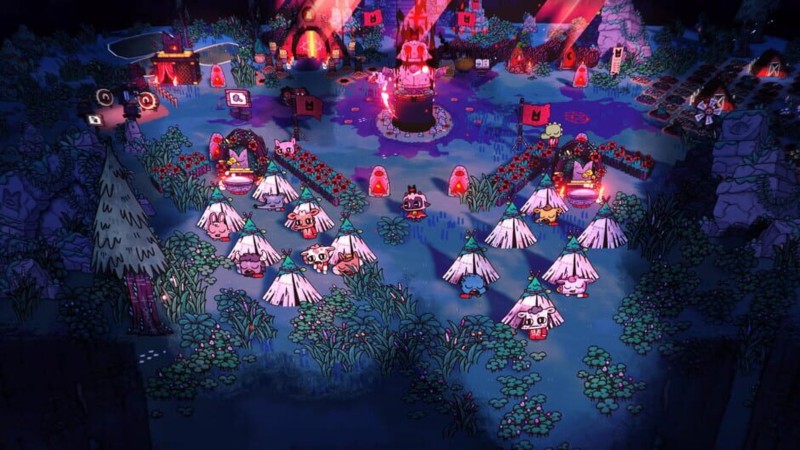
I loved Animal Crossing: New Horizons back in 2020, but its premise wasn’t enough to keep me engaged over time. Designing my island and keeping all of the villagers on it happy was thoroughly enjoyable, but after a few dozen hours, I craved a new type of gameplay to coincide with what I was doing each day. Cult of the Lamb, a mish-mash of adorably cute animals, critters, and creatures and macabre cult-isms, remedies that issue with an expansive action-combat dungeon system. I only wish its base building provided the same kind of satisfaction its combat does. When I wanted to focus on designing a cult aesthetically, I found the game pushing my hand towards focusing on resource management, chipping away at the fun I was having otherwise. Building your cult from the ground up and designing its headquarters is fun, but you’re soon pushed into using your cult as a means of manufacturing in-game currencies and resources, and this sometimes gets in the way of actually making my cult feel like home. 

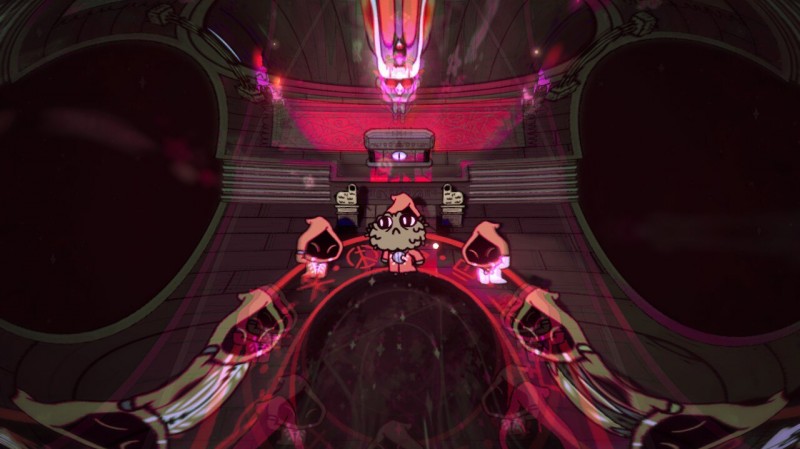
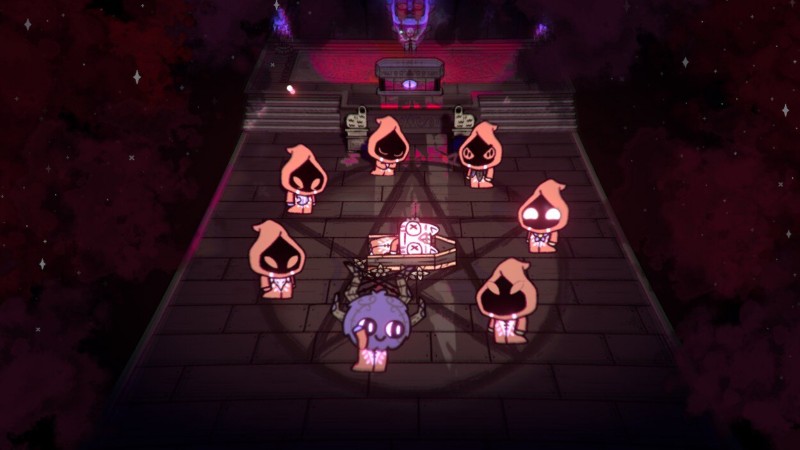
Cult of the Lamb’s premise is simple – you’re a lamb sacrificed to four gods. However, upon death, you discover a fifth god, one the others locked away. They grant you a second lease on life; all you need to do to obtain it is start a cult in their name. And that’s where my journey in Cult of the Lamb began. Nearly 20 hours later, I rolled credits with a cult of more than 20 followers of The Pearl programmed to keep me, their leader, happy, powerful, and stocked with everything I needed. The story that fueled my time in Cult of the Lamb was enough to keep me going, but it takes a back seat to everything else in the game. There’s lore to glean from run-ins with the gods you encounter mid-dungeon, and NPCs will reveal some backstory too, but gameplay comes first here. And for good reason. 


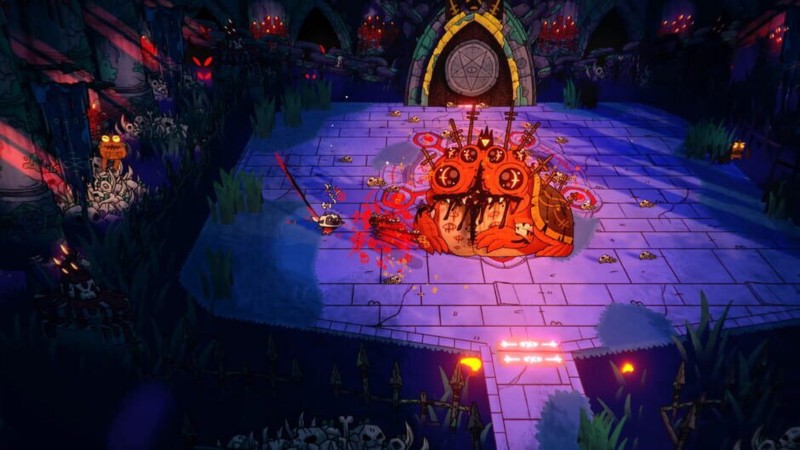
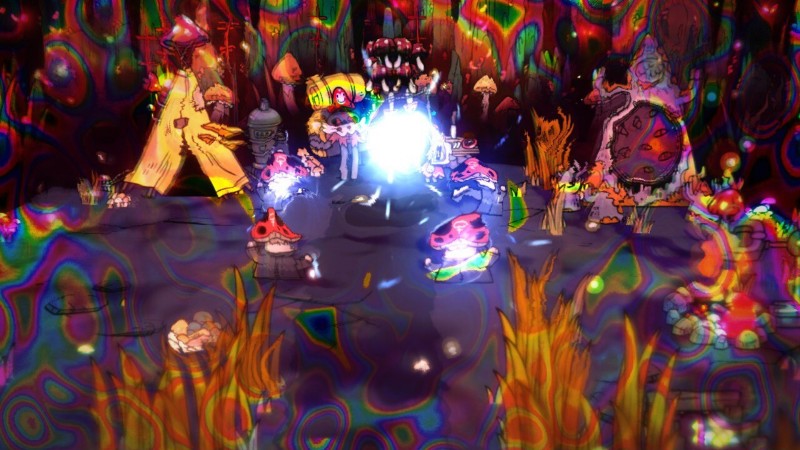
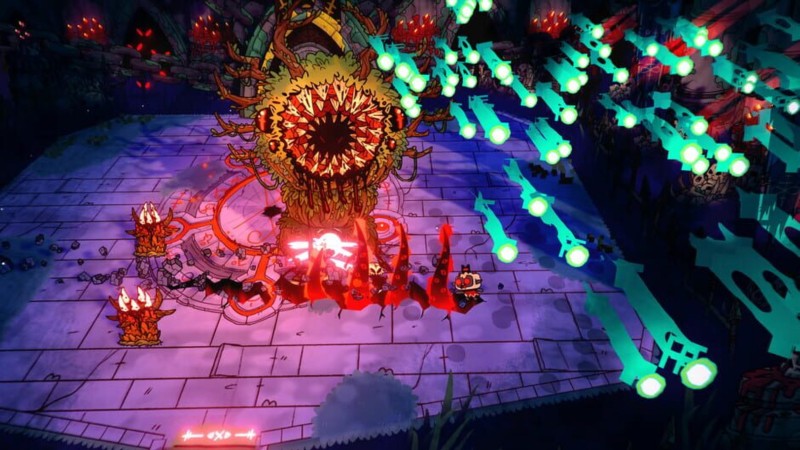
Combat is slick and crunchy, with each attack carrying weight as you battle through randomly arranged dungeons. One room might be jam-packed with skeletons, spiders, killer caterpillars, and cloaked assassins. Using my lamb’s dodge roll, I can escape incoming projectiles and dagger slashes and then counter with my blade, which also has the chance to heal me upon killing an enemy. I close out the dungeon using combo-heavy claws against a boss, relying on the weapon’s randomly-assigned necrotic ability to fling dead enemies back at the boss as projectiles. 

Weapons, like the rooms I found them in, appear at random, keeping combat fresh. Curses, magic-like attacks that typically amount to a projectile or close-combat area-of-effect damage, are random too, but I relied on them a lot less to succeed in the game’s four main dungeons. Curses have limited use because they require Fervor dropped by enemies to use. However, by the end of the game, between pick-up tarot cards that grant special bonuses and other lamb-specific traits, I seldom worried about running out of curses. But I also rarely even used curses, finding them to be more disruptive than not to my flow state; I instead relied on standard attacks and my dodge roll for success in battle. 

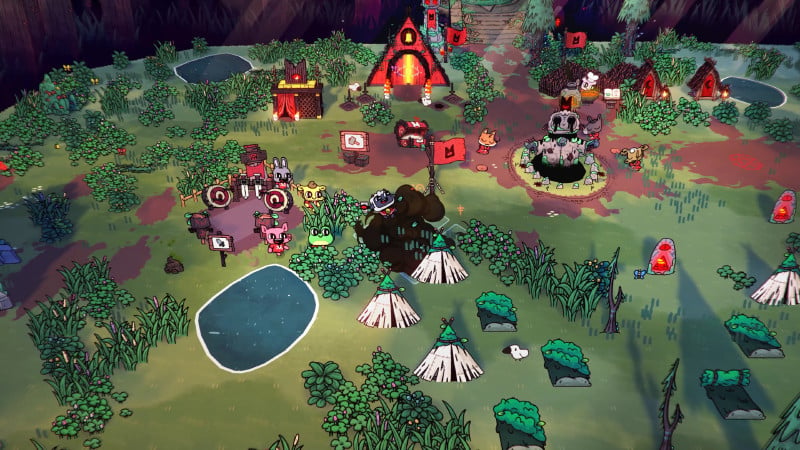
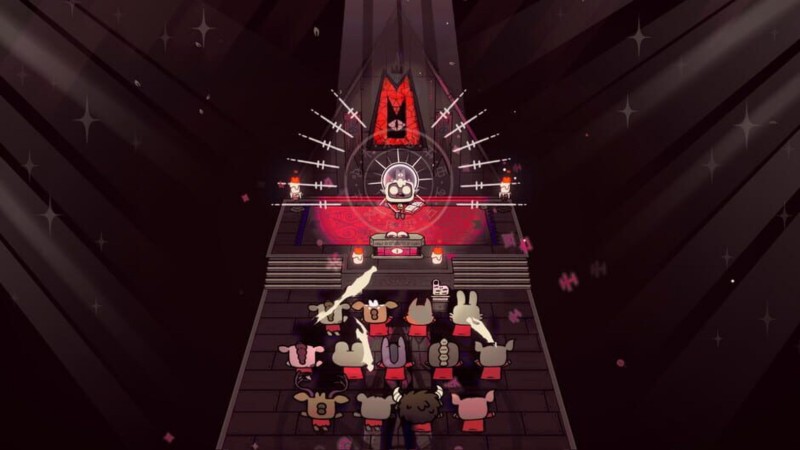
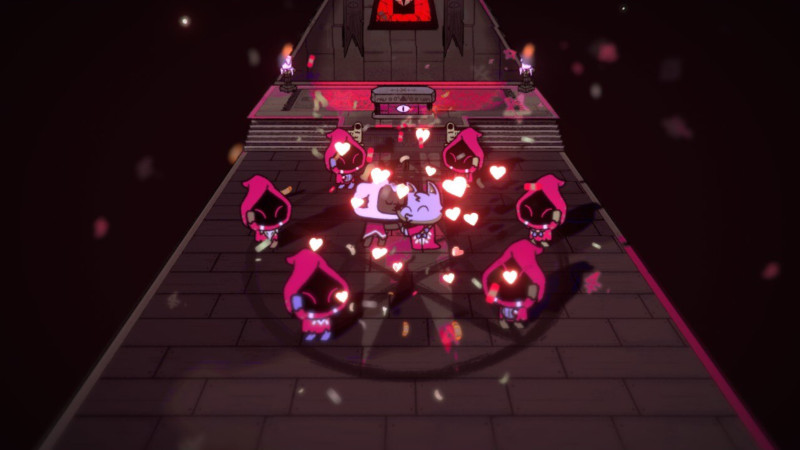
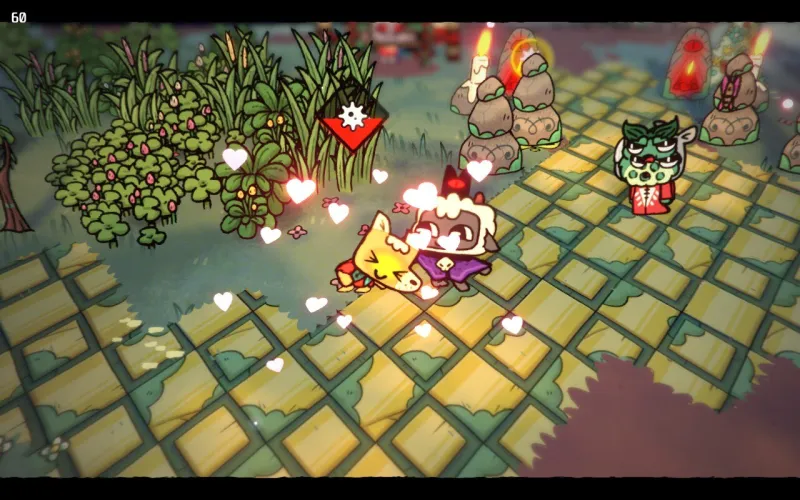
I also had to hone in on the progression of my base, which is where my followers worship and work for me, all to make my lamb stronger so that my next dungeon run, or crusade as it’s dubbed in-game, would be easier. My base began small, with just a shrine for collecting worship devotion and a temple for performing cult-strengthening sermons and beneficial-but-risky rituals. Over time, I learned that my base required much more to succeed. Everything builds on each other, and each system works because of another system happening in-game, so I began to view my cult as a machine whose purpose was to worship, empower, and strengthen me more than as a place to express my inner cult designer. The importance of resource management, as well as the stress of managing cult members’ happiness by keeping them fed, completing their quests, and ensuring their loyalty, often stole the time out of each in-game day. This left little time to make my cult aesthetically pleasing, something I would have liked. 


And that was fine – it’s clearly what developer Massive Monster intended of these mechanics – but with so many cosmetic items thrown into the formula, I was disappointed by how rarely I was afforded the time to focus on them. I wanted to make my cult look and feel like mine, but the pull of resource management often got in the way. 

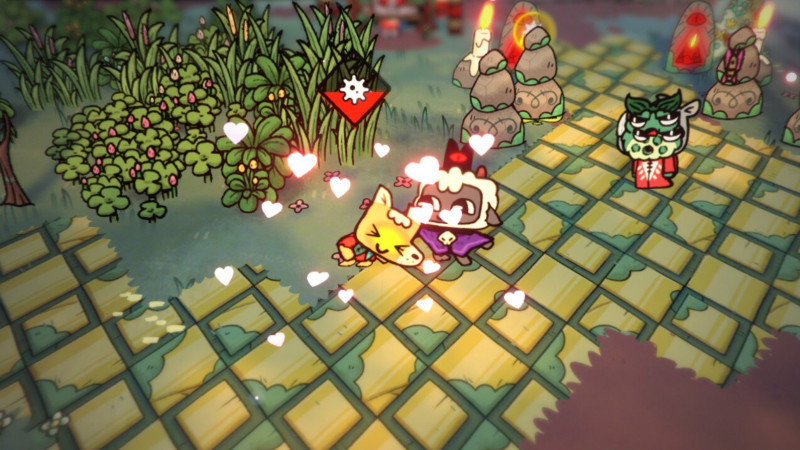
I began the game by naming each follower, designing them to look like one of my dogs, cat, or even my friends. But, after about a dozen hours, I was less engrossed with the simulation aspect of it all, opting to stick with default follower designs, and more focused on completing the next dungeon and upgrading the next building in my cult. That said, running through dungeons and improving my cult compound was satisfying, and I found plenty of enjoyment in Cult of the Lamb as a result, even when I felt more like a ruthless boss than a leader. 

In the post-game cleanup, I’m only now engaging with the aesthetic-serving aspects of Cult of the Lamb. I’m finally making my cult feel like mine and not one I’m sure every other player will at some point make to cultivate as many resources as possible. I only wished I had felt this earlier in my 19-hour journey. Still, everything I did leading up to it, from the fast-paced dungeon combat that never grew stale to the factory-like base building that nailed the stress of resource management, was enough and then some to keep me engaged and indoctrinated.

Score: 8

About Game Informer's review system

Purchase