Pages

Thursday, September 29, 2022

Shovel Knight Dig Review – Digging Down In Glory

Shovel Knight Dig Game Informer Review

Reviewed on: PC
Platform: Switch, PC, iOS
Publisher: Yacht Club Games
Developer: Nitrome, Yacht Club Games

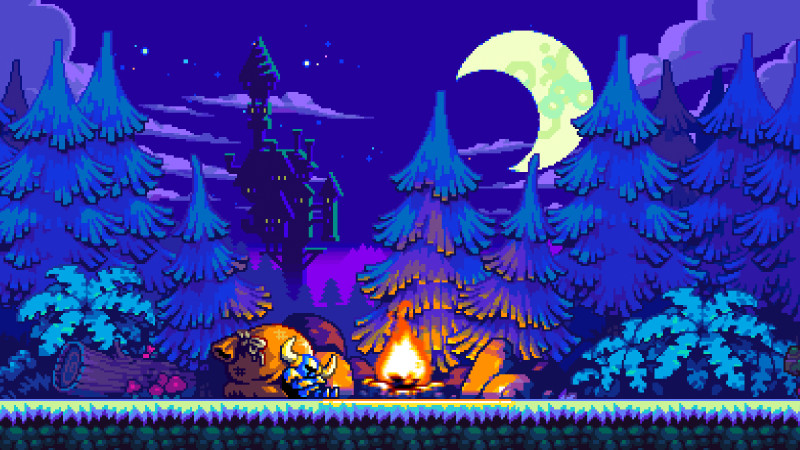
The second I began Shovel Knight Dig, it felt like returning home. As someone who hadn’t played most of Shovel Knight’s post-launch DLC, the last time I touched this series was nearly a decade ago. Gaining control of the titular character immediately felt familiar, and my old Shovel Knight habits returned to greet this new take on the series, led by developer Nitrome this time. The moment-to-moment experience plays excellently, in part because it’s more Shovel Knight with some well-designed gameplay twists. However, the game’s venture into roguelite territory feels inessential and so light-stepped that it didn’t convince me it needed to be a part of this ever-expanding genre. Still, Shovel Knight Dig is more Shovel Knight, meaning retro-game and platforming enthusiasts will find great enjoyment throughout. 

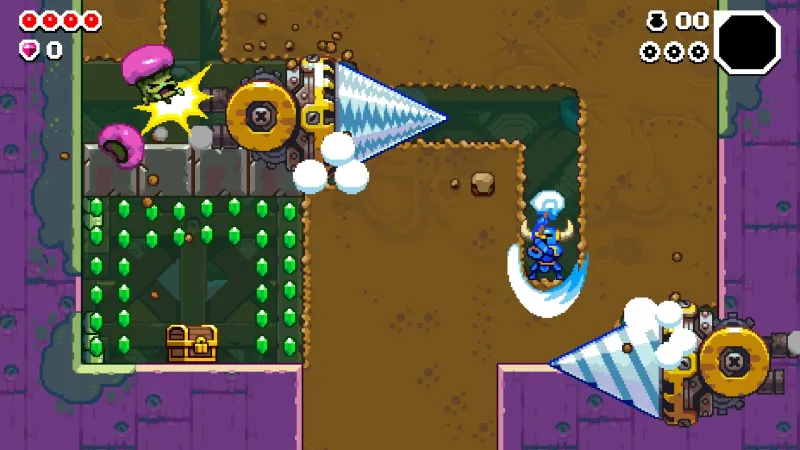
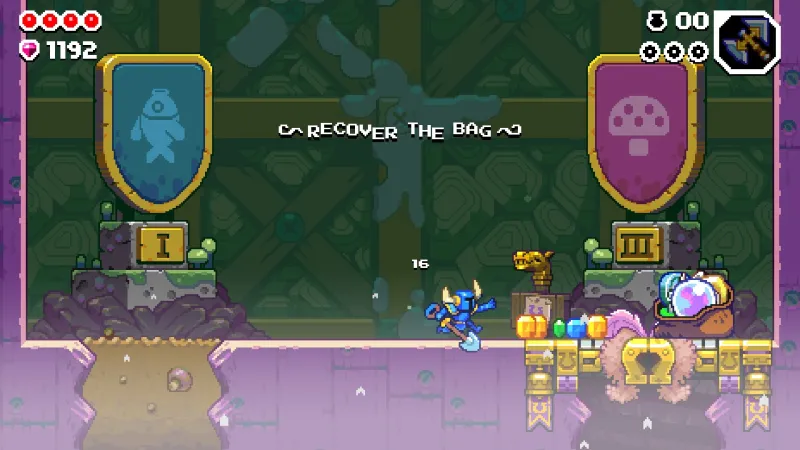
Rather than moving right through a beautifully pixelated stage, Dig tasks players with digging down, deeper and deeper into procedurally generated levels. This presents new feelings in the pantheon of emotions I feel while playing a Shovel Knight game: urgency and stress. Unlike many platformers out there, you can’t take the time to observe where you must go and how best to get there. You have to keep digging down and while going back up a few spaces is possible, it’s not easy. You’re not meant to backtrack because your goal is far below you. If you miss some gems or one of the stage’s three machine cogs, which unlock a special bonus reward, you probably missed your chance. 
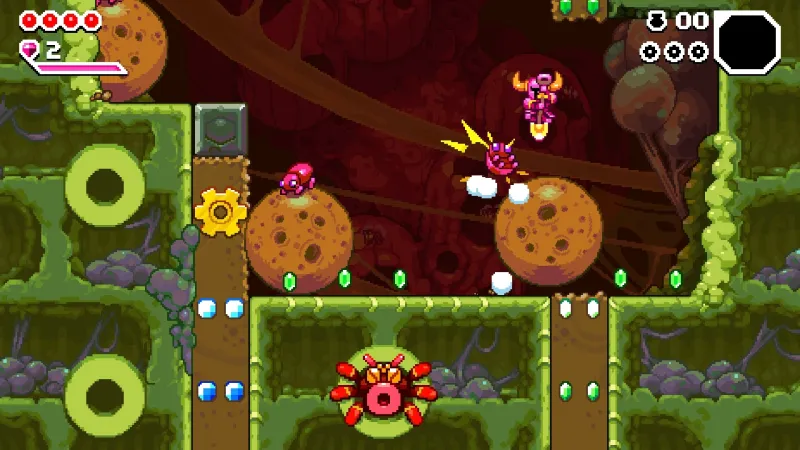
 

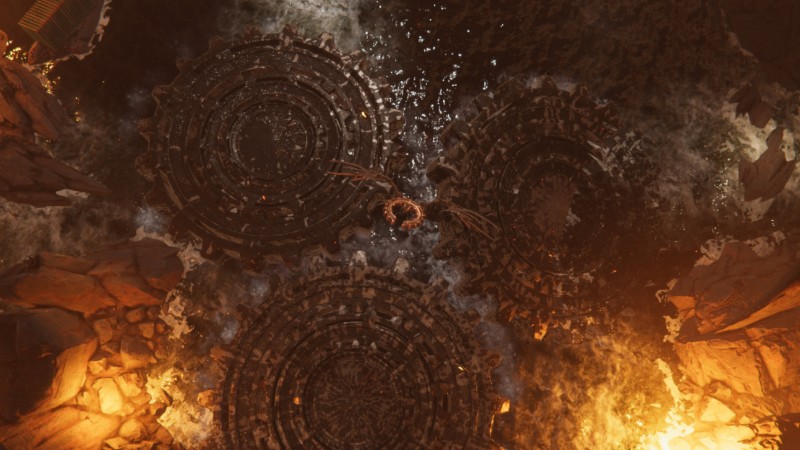
On top of that, if you spend too long in any one place, the antagonist Drill Knight will use a massive one-hit-kill excavation machine to bury you deeper into the Smeltworks, Secret Fountain, Grub Pit, or one of the game’s other stages. I like this added stress to Dig’s platforming, which largely feels identical to that of the original Shovel Knight game. 

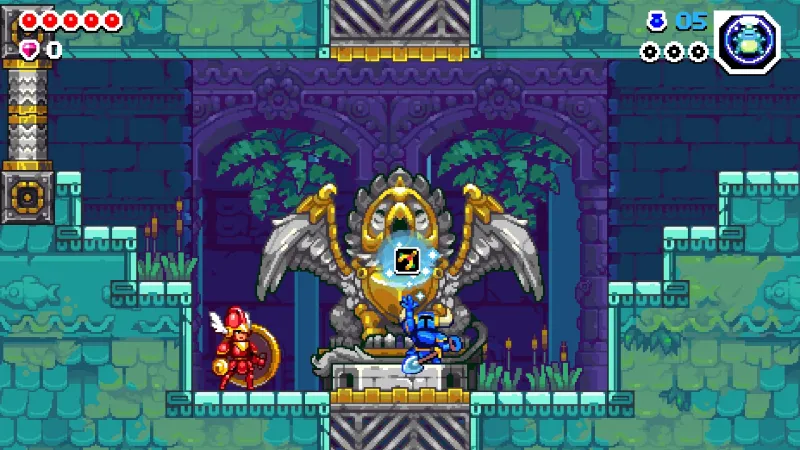
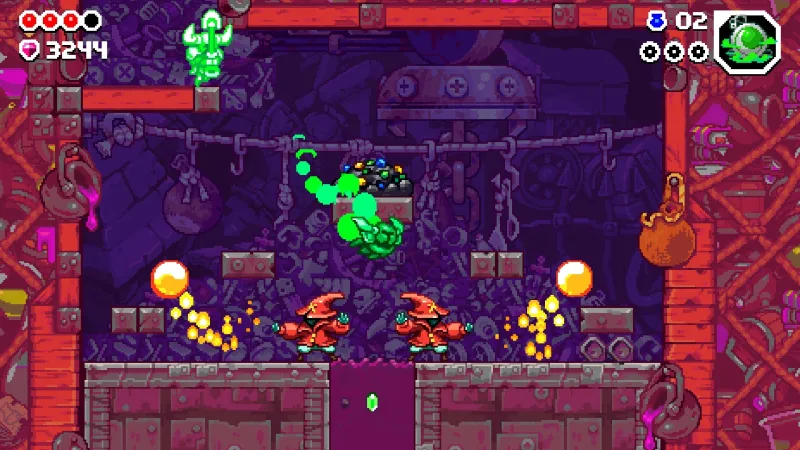
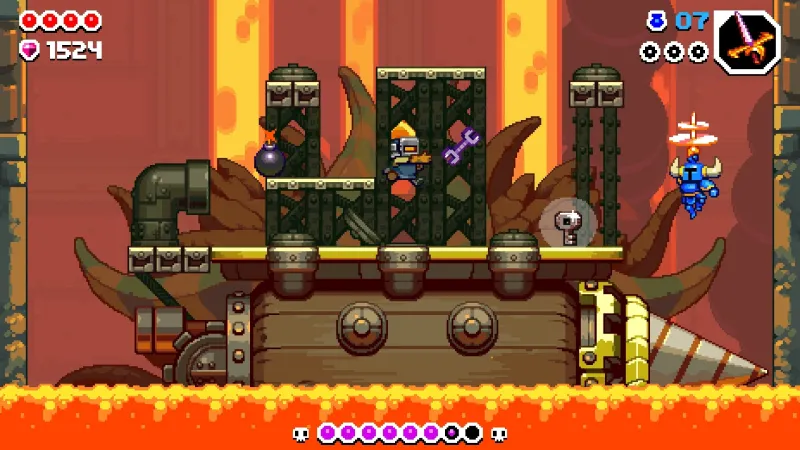
After completing three stages in a given lair, you face a boss. I love these boss fights, but they’re disappointing in the context of Dig. They feel like Shovel Knight bosses, fast-paced and fun, but they don’t take advantage of the new mechanics specific to Dig. You jump around an arena attempting to damage a boss while dodging their attacks. Only the final boss implements the game’s unique dig platforming mechanics and I wish this type of design was present in the multiple other opponents I faced before this one. 

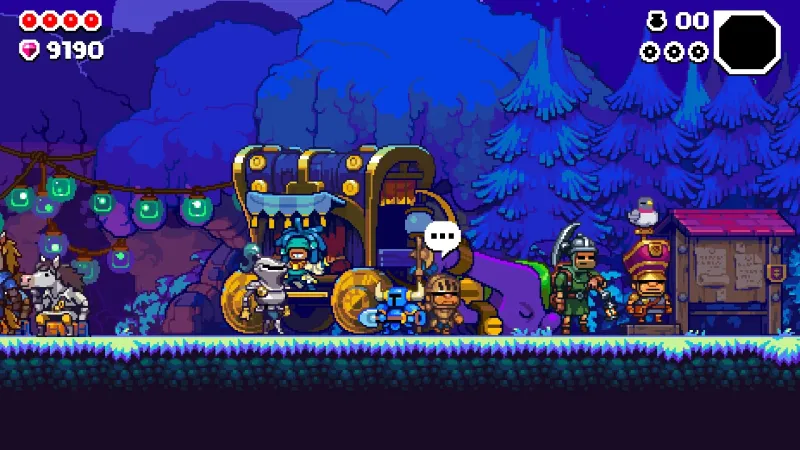
The hours I spent digging down through stage after stage, I rarely felt like I was playing a roguelite. It was only when I died and returned to above ground, which is where a camp of NPCs you’ve met and shopkeepers reside, that I was reminded of the game’s tip-toe into roguelite mechanics. You lose your stage progress and some of your gems upon death, but these losses are so minuscule that I never felt compelled to go out of my way to retrieve my lost currency in the next run. 
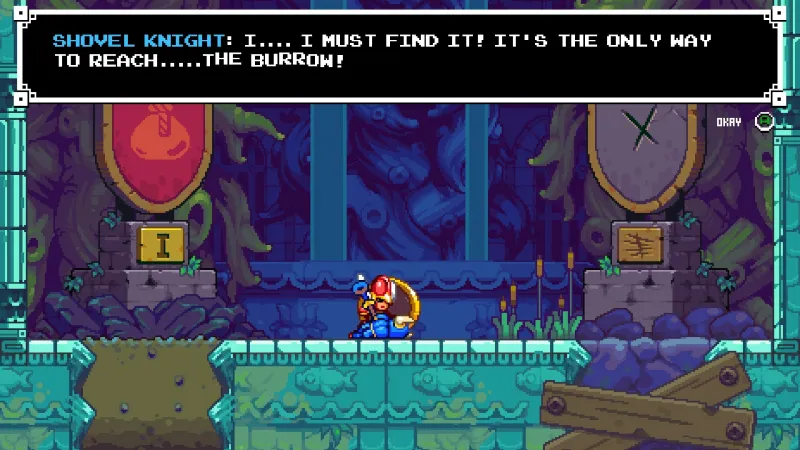
 

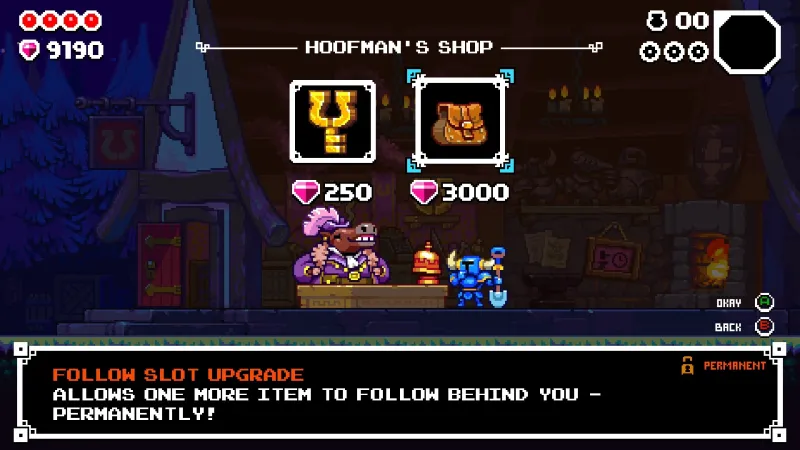
I also never felt the need to equip new sets of armor, which can only be purchased after finding templates of them in secret areas scattered throughout the various stages. In fact, the only permanent upgrade I could make was to my bag, which allowed me to hold onto more than one item, like a door or chest key, at a time. Part of the fun of a roguelite is tracking your progression and growing more powerful each run, but in Dig, each run felt like a brand new start. I didn’t hate this, but it’s not my cup of tea. 

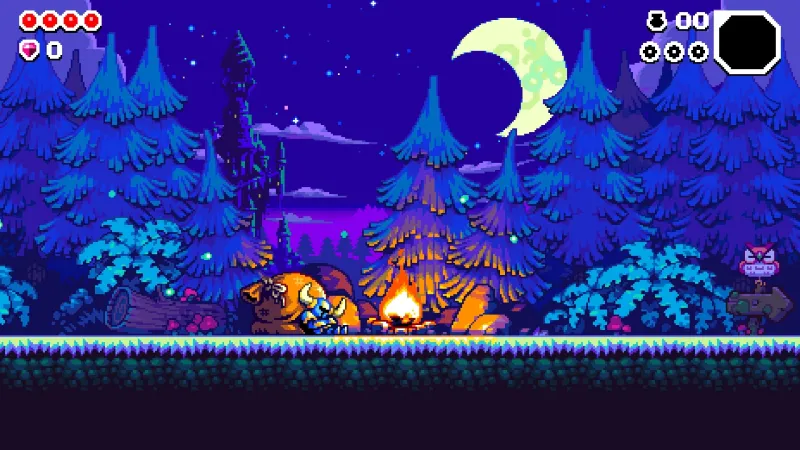
Still though, because most of my eight hours with Dig were spent spelunking through stages leading down, I rarely had to think about the game’s roguelite efforts. I spent most of my time playing through beautiful stages to the tune of chippy synth tunes, fascinated with how far Nitrome and Yacht Club were able to stretch the “dig” aspect of this game. Perhaps the roguelite nature of Dig will play a bigger role in my post-game excavations because I’m rearing to jump back in to discover all of its secrets. Even if it doesn’t, though, I know I still have at least a few more hours of great Shovel Knight gameplay ahead of me and in the world of platforming, that’s a treasure worth digging up.
Score: 8

About Game Informer's review system

Purchase

Wednesday, September 28, 2022

Return to Monkey Island Review - A Return To Childhood Nostalgia

Return to Monkey Island

Reviewed on: Switch
Platform: Switch, PC
Publisher: Devolver Digital, Lucasfilm Games
Developer: Terrible Toybox

"I'm Guybrush Threepwood, mighty pirate!"

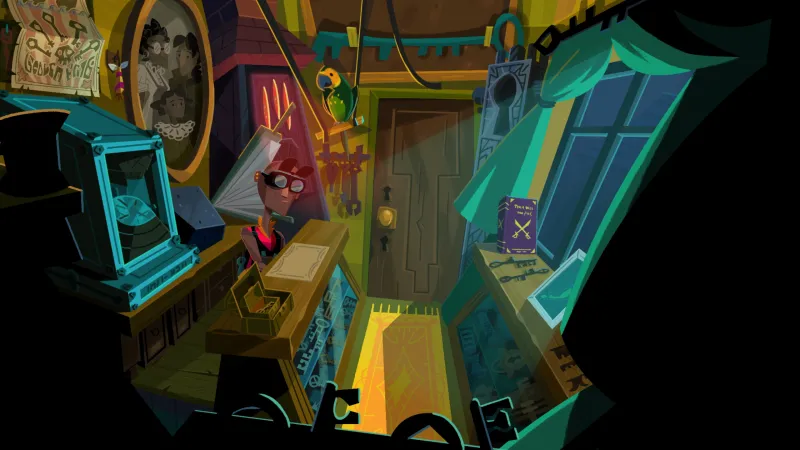
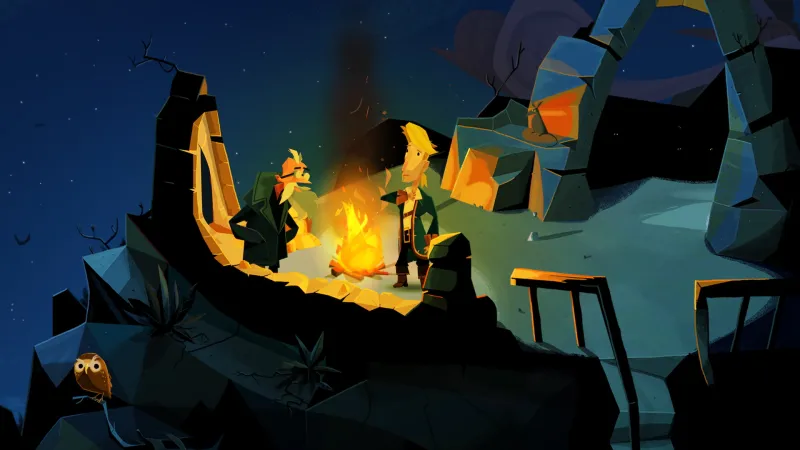
Between the moment Guybrush uttered this iconic line in Return to Monkey Island and our reintroduction to familiar characters like used ship salesman Stan S. Stanman and Cobb, with his "Ask me about Loom" badge, I was already shrouded in a haze of nostalgia. And you would be eating all these up, too, if you're a Monkey Island fan. The thing about Monkey Island enthusiasts is that we can talk your ears off about what makes the series so unique. It's the earnest naivety of its pirate hero Guybrush Threepwood and the series' whimsical and self-referential humor. But most of all, it's that one absurd puzzle you'll need to crack within the original Secret of Monkey Island: the sheer hilarity of transporting an ultra tart blend of a pirate beverage called grog across an island without melting its mug and incinerating your hands along the way.

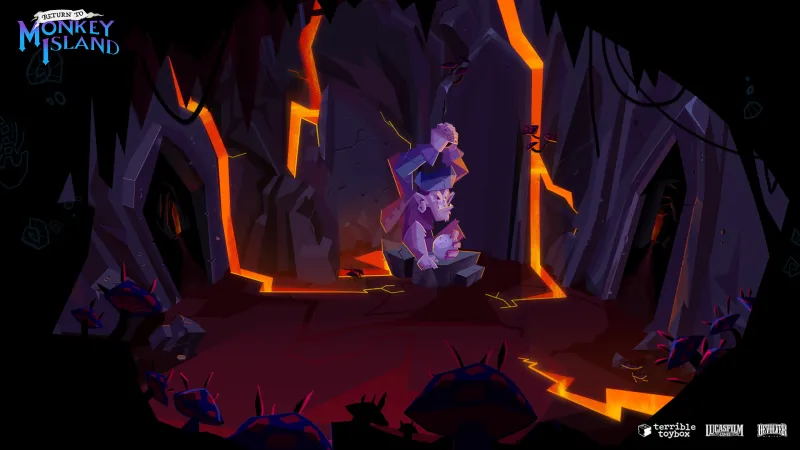
There's still plenty of such fondness to reminisce about in Return to Monkey Island, a point-and-click adventure game that hasn't lost any of its luster and immense charm since creator Ron Gilbert's last Monkey Island game, which is close to 30 years old. It feels like time has barely passed since then, with the premise of its swashbuckling tale faithfully crafted from a Monkey Island structure that feels refined to near perfection.

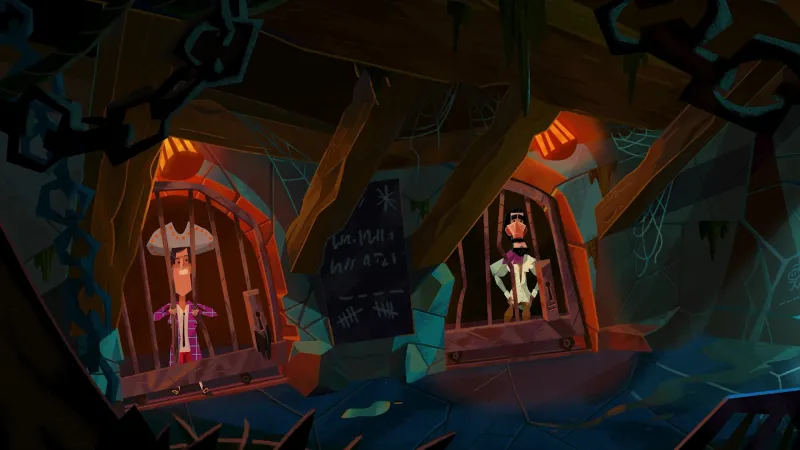
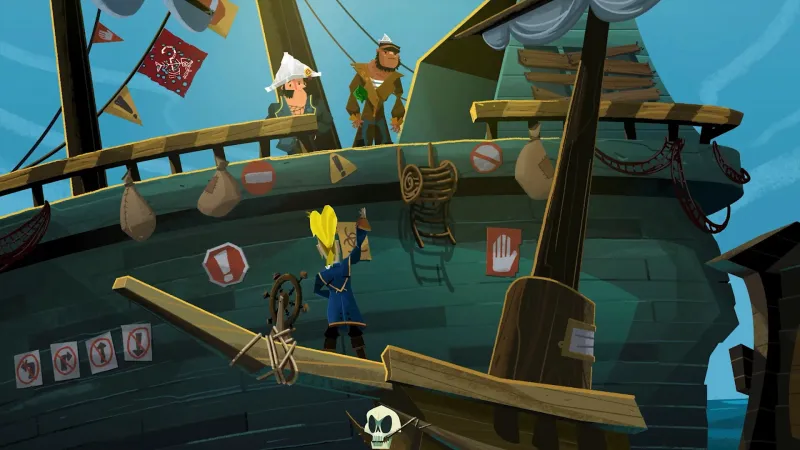
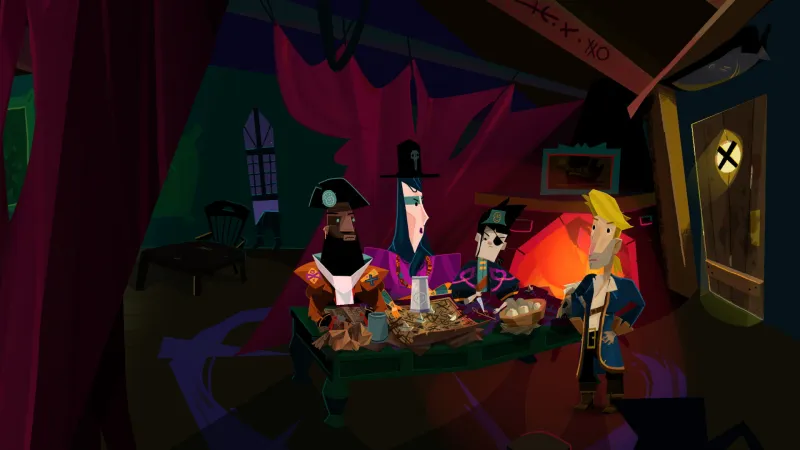
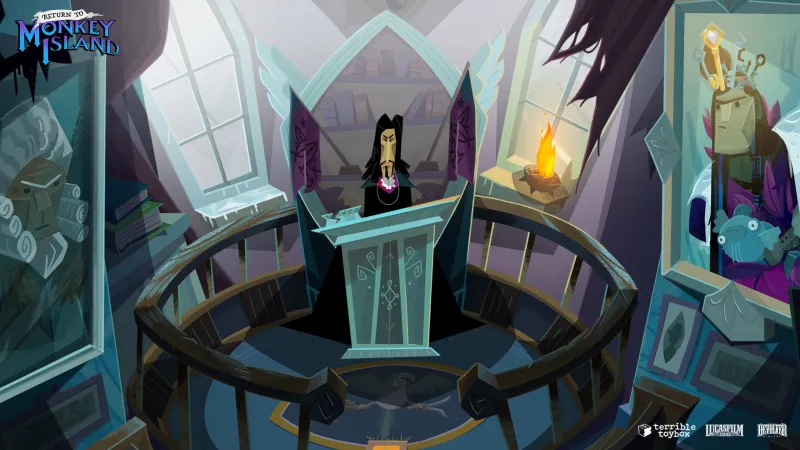
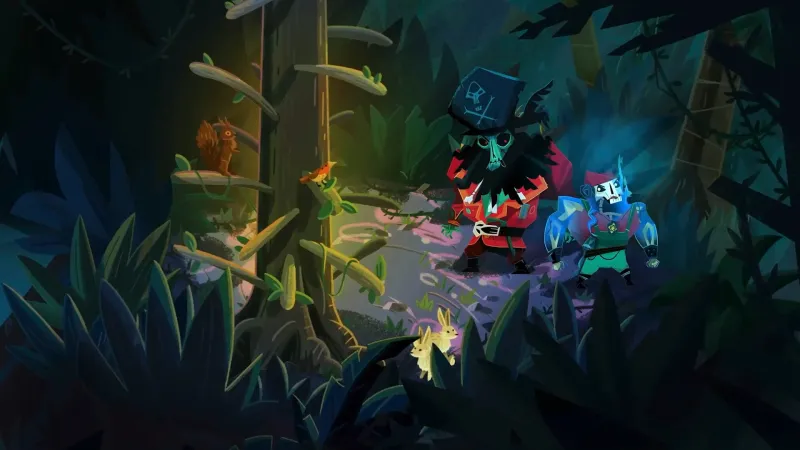
Guybrush is heading to the eponymous island in search of its greatest secret, and he is again in need of a boat and crew. He drops by Melee Island, the favorite haunt of any self-professed Mighty Pirate and others in the Caribbean, and runs into a couple of old friends and less-than-friends there. The Voodoo Lady makes several dramatic proclamations about the nature of Guybrush's ill-fated expedition, with him eventually scrapping up whatever resources he can for his voyage to Monkey Island. Hijinks, which may involve the ingenious use of chicken and other fowl-related products, ensue. You get the drift. 

The essence of Monkey Island lies in its trademark goofy panache and a genuine sense of humor, with which Return to Monkey Island radiates. It's challenging to go into specifics without veering into spoiler territory, but there are a plethora of playful jokes and self-aware gags that left me wheezing due to the game's impeccable comedic timing. One early scenario, meant to introduce the ability to skip through dialogue quickly, has you listening to a rambling monologue about anchors' exquisite function, history, and beauty. 

Return to Monkey Island strings its punchlines with remarkable comedic timing. There are setups for jokes that pay off to ludicrous conclusions at a later time. There are tons of fourth-wall-breaking references poking fun at everything from pop culture to the idiosyncrasies of video games. There are throwbacks to past gags like the eye-watering, immaterial textures of Stan's jacket, which never stops being funny. Such humor is more than just skin-deep; it's thoroughly infused into every part of Return to Monkey Island, from its eccentric cast of characters to the way its puzzles play out, like a particular quest involving a mop, some grease, and a tiny hole. Return to Monkey Island oozes personality, with plenty of charisma to spare.

Given the series' popularity, it would have been easy for Gilbert and his studio, Terrible Toybox, to create a new Monkey Island game that simply banks on its fans' sentimentality for the series – a knowing wink, some inside jokes, or breadcrumbs alluding to long-running gags in Monkey Island (and there are so many of them). But while Return to Monkey Island is a sequel to Monkey Island 2: LeChuck's Revenge, Terrible Toybox isn't content to just let the game serve as an elaborate throwback to the earlier games. 


Notably, there's the game's refreshed art style. Far from a stark departure from the spirit of the series, this feels more like a much-needed coat of fresh paint on a beloved but legacy series, emblematic of the new-yet-familiar direction that Return to Monkey Island is taking. Take, for instance, the scrapbook, a nifty feature that briefly recounts the colorful exploits of the famed Mighty Pirate, meant to ease new players into the game and serve as a recap for a series that spanned three entire decades. 

There's also a hint system that's brilliantly woven into the story, and it's meticulously considered and immensely helpful for folks like myself who can get driven into a corner by its puzzles, and it doesn't reveal all the answers at once. Clues, presented through a spellbook, are gradually revealed depending on the obstacles you're facing, encouraging you to discover the solutions to the puzzles on your own. This is done by presenting keywords that may inspire a solution – an epiphany, perhaps – or through vague clues that gently nudge you in the right direction.

And then there's the refreshing point-and-click interface, which is more intuitive than the antiquated "nine verbs" menu of traditional point-and-click titles. No longer will you haphazardly drag random knick-knacks to these verbs to inadvertently discover what you can do with them; this new interface streamlines such interactions to examining or using these objects. As a result, Guybrush's bits of humor and quips associated with misusing these items in the older Monkey Island games vanish in this title. You will no longer be able to talk to random artifacts you grabbed off the shelf or mash unrelated things together. Fortunately, such gags are largely inconsequential in the first place (you shouldn't worry, anyway; Return to Monkey Island is a wellspring of great jokes). 

Return to Monkey Island

You can even select between two difficulty modes, which lets you choose between an experience that prioritizes the story over its puzzles or another for puzzle enthusiasts who prefer a bit of a brain teaser. The sum of these parts points to an incredibly thoughtful design that makes Return to Monkey Island an adventure anyone can dive into – one that can be equally delightful to new players, especially for those who may be concerned about trudging into a series with decades of history.

Then again, distilling it to its components wouldn't quite encapsulate the splendor of this Monkey Island sequel. Instead, I would point out that Return to Monkey Island feels like a homecoming, of returning to those sepia-toned days where I first relived the exciting adventures of the intrepid Guybrush Threepwood in The Secret of Monkey Island many years ago. It's also why, despite Terrible Toybox's gallant efforts to make Return of Monkey Island more approachable to new players, it's still the original series fans who would get the most out of this point-and-click experience. They're the very folks who will be delighted to catch a glimpse of, say, the same scrap of melted metal that Guybrush once used to hold his grog as they briefly recall the absurdity of that puzzle in their heads. Return to Monkey Island is profoundly nostalgic and relentlessly funny, and I'm once again a kid, laughing at Guybrush's umpteenth last-ditch efforts to distract his opponents with, "Look behind you, a three-headed monkey!"

GI Must Play

Score: 9

About Game Informer's review system

Purchase

Monday, September 26, 2022

Tinykin Review – Little Big Fun

Reviewed on: Xbox One
Platform: PlayStation 4, Xbox One, Switch, PC
Publisher: tinyBuild
Developer: Splashteam
Rating: Everyone 10+

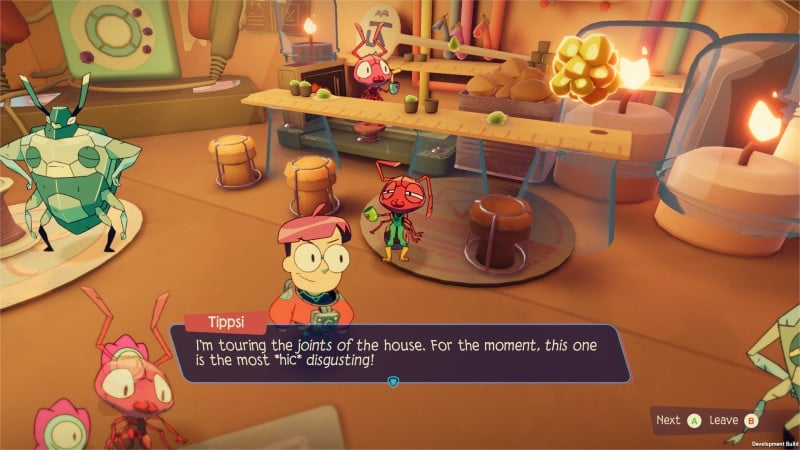
Tinykin smartly blends platforming and puzzle-solving with the minion management of Nintendo's Pikmin series. Players control a flea-sized astronaut who travels from his home planet to Earth to trace humanity’s true origins. The explorer’s journey takes him to an ordinary home occupied by sentient insects who worship a mysterious deity. To return home, the astronaut must assemble a rocket by gathering ordinary household objects with the help of small, adorable aliens called Tinykin. As a fan of “little person in a big world” experiences, Tinykin’s premise and world drew me in, and its gameplay satisfied me until its conclusion.

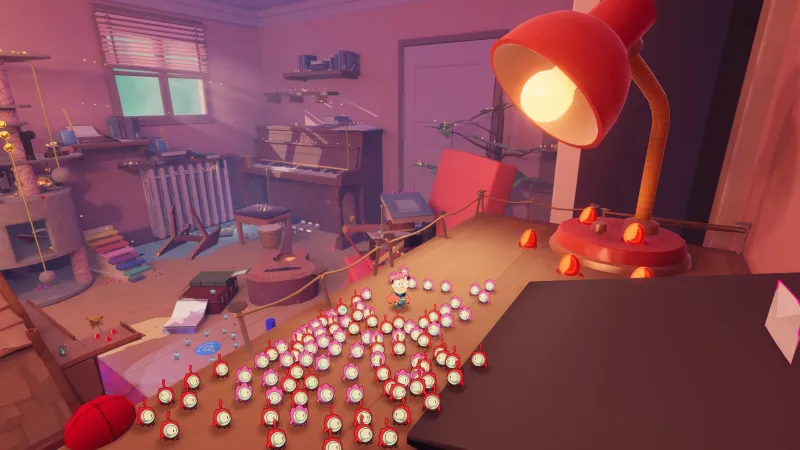
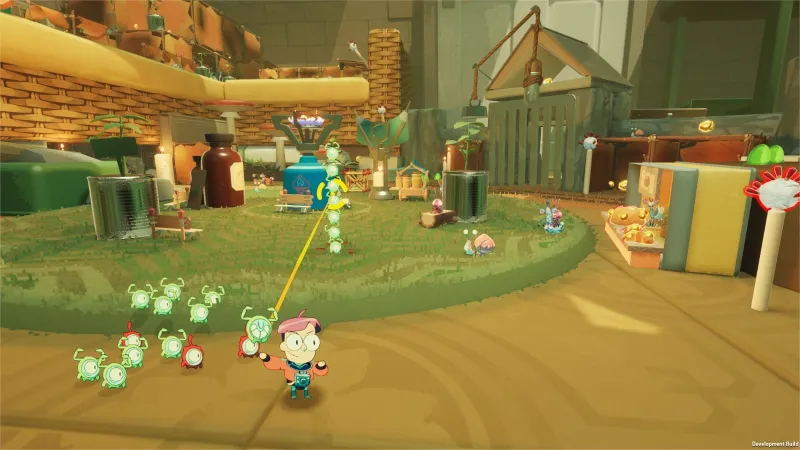
The best, though perhaps reductive, way to describe Tinykin’s gameplay would be “Pikmin as a platformer.” Each room in the house offers large, smartly laid-out playgrounds where players overcome platforming challenges and solve environmental puzzles using different types of Tinykin. These include pink varieties that carry objects, red versions that explode on impact when tossed, and green Tinykin that stack vertically to form a living ladder, among others. I like how the game introduces each Tinykin one stage at a time, letting me spend an entire level getting used to their unique talents before introducing another. 

The well-crafted puzzles become better (and more involved) as you recruit more Tinykin to your ranks. Some obstacles can be as simple as carrying an oversized appliance out of your path. Other tasks become scavenger hunts, challenging you to find creative ways of traversing the world to locate and retrieve scattered items. Solutions tend to be relatively straightforward, no matter what form a puzzle takes; Tinykin never forces you to wrack your brain, at least not for very long. I found this level of challenge relaxing but engaging enough to avoid becoming mundane or overly simplistic. Tinykin’s puzzle-solving has a nice flow that keeps the experience moving, making it a breeze to get through. 

Controlling the Tinykin is simple and intuitive, requiring little more than aiming and flinging them at designated targets. I also love that Tinykin can perform jobs independently, allowing me to multitask. It feels great to let a dozen helpers work on lugging objects to their destinations while I gleefully collect scattered pollen (used to upgrade a hover ability), find missing letters for a mail bug, and complete side quests. 

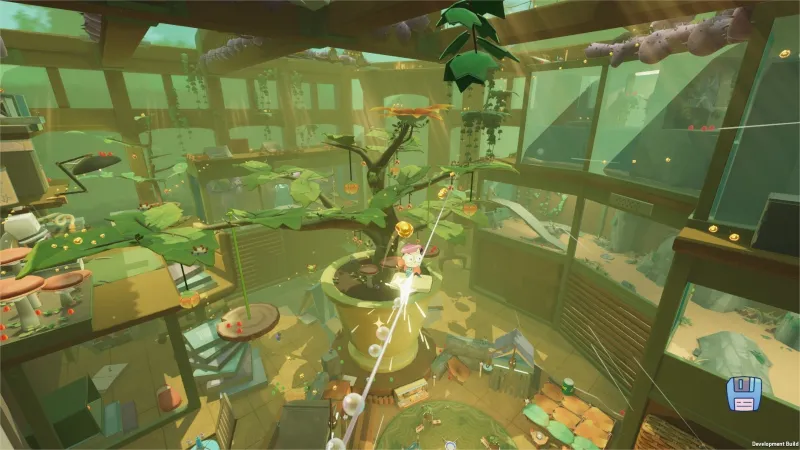
Tinykin is a collect-a-thon like the 3D platformers of old. Gathering items and finding secrets is rewarding because every nook and cranny usually hides a discovery. Sometimes it’s bundles of pollen; other times, it’s a missing piece needed to complete a side errand, such as reuniting a photograph with its frame. The world is a colorful, oversized jungle gym, and I’m impressed with how each room feels like a lived-in dwelling while still having clear pathways that appear organically arranged. 


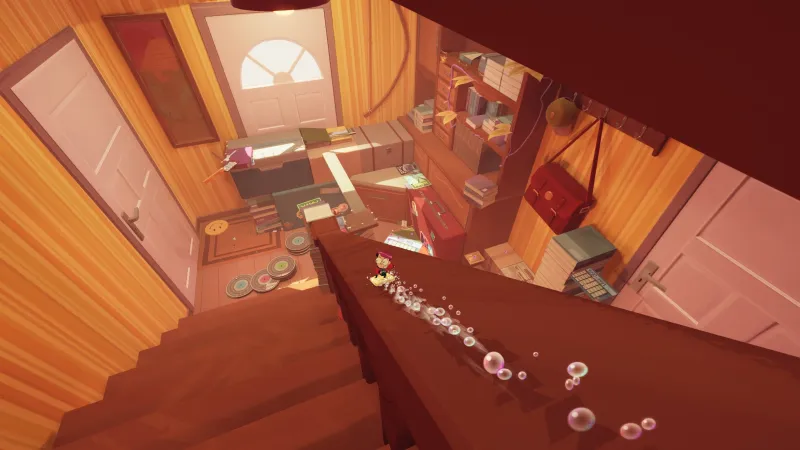
I had the most fun freely exploring and using my Tinykin army to tinker with whatever lay before me, like pushing in protruding books or yanking a washing machine’s door open. Hopping across a kitchen, hallway, or bathroom is a delight from this small perspective, and platforming feels exceptionally tight. Riding soap bars across ziplines to get around faster makes it even better, and locating shortcuts, such as climbing ropes, expedites backtracking. I only wish there was a map because the busy environments make quest givers feel like needles in a haystack whenever it’s time to turn in a job. 

Tinykin feels comforting in an old-school sense. Its challenges never become convoluted, nor does its design reinvent the wheel, and that’s okay. Tinykin executes its handful of ideas exceptionally well, making it a thoroughly enjoyable and laid-back journey that only requires six to eight hours of your time. Don’t let this delightful adventure sneak under your radar.

GI Must Play

Score: 8.5

About Game Informer's review system

Purchase

Friday, September 16, 2022

NBA 2K23 Review - A Hop-Step Forward

NBA 2K23

Reviewed on: PlayStation 5
Platform: PlayStation 5, Xbox Series X/S, PlayStation 4, Xbox One, Switch, PC
Publisher: 2K Games
Developer: Visual Concepts
Rating: Everyone

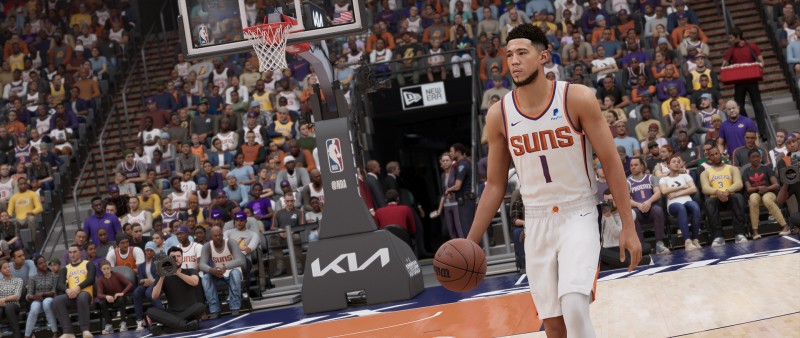
NBA 2K23, the latest in Visual Concepts’ long-running, annualized basketball series, introduces multiple new features and revamped game mechanics while taking us on a stroll down memory lane. Though the 2K franchise has garnered a reputation for focusing more on microtransactions than actual gameplay innovation, this year’s game mode additions and foundational improvements mostly overshadow the notorious pay-to-win schemes. The result is a package that feels more novel than other titles in the series’ recent history.

2K’s in-game mechanics have primarily followed a steady and successful blueprint, but this year introduces several updates, most notably the reworked shot meters and stamina bars. The new shot meter leaves little room for error, making it more challenging than previous iterations. I initially struggled with mastering this updated feature thanks to these stricter release-timing mechanics; previously, you could make a shot even if your timing wasn’t perfect, but in NBA 2K23, success almost always requires a near-perfect release.


The stamina system in 2K23 has also been modified and now has three adrenaline bars to go along with it. Sprinting and using explosive dribble moves now deplete the stamina and adrenaline bars. This is especially helpful in online matches as it prevents individual players from over-dribbling and encourages team play. These tweaks, though challenging to master, make the game feel as close to the actual sport as possible, which only helps the franchise in the long run.

These improvements to the core gameplay permeate the vast array of modes on offer in NBA 2K23. This suite of offerings includes all the series’ mainstays and a few exciting new ones, like the Jordan Challenge, which allows you to relive iconic moments from Michael Jordan’s career, and MyNBA Eras. The former offers fun challenges like “The Shot” and “The Flu Game,” each with its accomplishments to recreate.

In contrast, instead of reliving history, MyNBA Eras enables us to rewrite it by giving us four NBA periods to choose from, each having its own varying rules and rosters. As a Suns fan, I particularly loved revisiting iconic periods, like the “7 Seconds or Less” team of the 2000s, and playing through a season in that era. This type of experience is precisely the kind of innovation the series has been missing in recent years, and its inclusion in 2K23 does wonders for rounding out this entry’s offerings.

If you’re looking for the more traditional 2K modes, MyCareer remains one of the essential features of any 2K release. This year’s storyline leaves a lot to be desired, and the lack of choices makes it feel less like I’m crafting my own player’s career and more like I’m pushing through a predetermined narrative.

However, the bulk of the improvements in MyCareer went into restructuring The City, the hub where you find most of your activities. Here, Visual Concepts fully embraces its RPG aspects with the retention of its quest system and the addition of The Arena, where MyCareer events are now fully integrated. The inclusion of both features gives players a fully immersive experience, and the gameday events, such as press conferences and pre-game shootarounds, make this mode feel even more like an NBA player’s career.

Players can also access the Jordan Challenge throughout the area, not to mention the multiple online competitive matches found in and around it. The four City affiliations reappear, but each of the factions’ neighborhoods has its own beautifully designed theme this time. The City’s size in 2K23 has also been reduced, and with the inclusion of fast travel using the subway system, traversing it is easier than in last year’s release.

As usual, MyTeam includes many competitive contests playable in both single- and multiplayer versions. Rather than letting you choose your starter outright, this year’s edition enables you to try out the starters first in a Triple Threat (3v3) match against A.I. before making you pick. There are also themed challenges and contests available wherein you can earn rewards to help boost your team. If you prefer the casual experience of 2K as I do, MyTeam has plenty to offer in terms of its offline, single-player modes.

Ultimately though, microtransactions are as present as ever in NBA 2K23. Grinding out MyTeam points and tokens is an option for those not willing to spend beyond the game’s premium price tag, but unless you’re incredibly patient, spending real money to buy packs is the easiest way to acquire a stacked squad. It’s tough this year as the currency earned through MyCareer and MyTeam matches is so minimal it takes a ridiculous amount of work to get your team and player up to par with higher-rated groups.

Overall, NBA 2K23 is a fitting tribute to the historical legends and iconic moments that made this sport what it is today. Though the game has its fair share of issues with its poor narrative choices and omnipresent microtransactions, it’s still a solid improvement over the previous game. This year’s release isn’t quite the flashy free-throw line dunk that lands a perfect score, but it is a worthy, all-around effort that would earn M.J.’s shrug of approval.

Score: 7.5

About Game Informer's review system

Purchase

Temtem Review - Competitive Evolution

Temtem review

Reviewed on: PlayStation 5
Platform: PlayStation 5, Xbox Series X/S, Switch, PC
Publisher: Humble Games
Developer: Crema
Rating: Everyone 10+

The Pokémon franchise has been more prolific than usual as of late, with multiple releases over the past year and another big entry coming soon. However, those without a Switch or looking for a suitable monster-battling alternative should focus on Temtem, which has emerged from years of early-access development. While borrowing heavily from the formula of Nintendo’s massive franchise, its world is fun to explore, and collecting and learning all about the titular Temtems is satisfying. Although the core adventure is a smidge repetitive, Temtem is challenging and engaging, even for well-seasoned trainers.

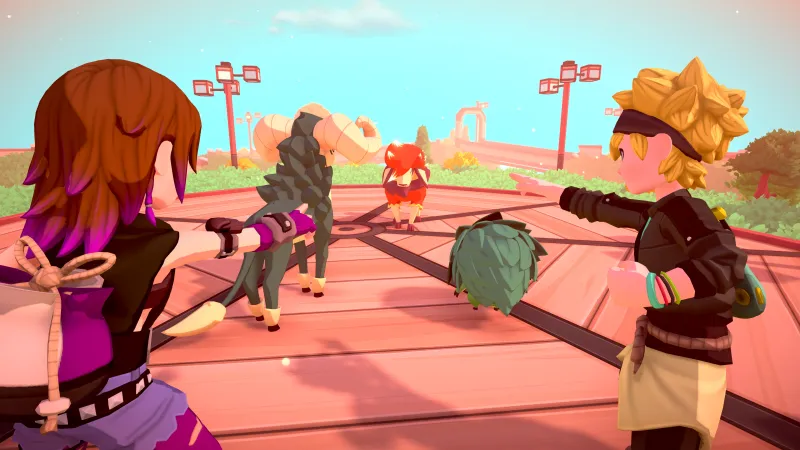
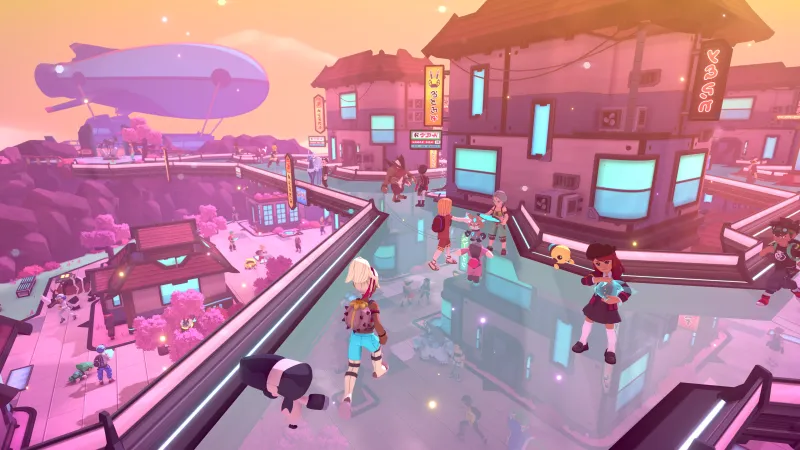
Your Temtem journey begins by selecting a partner monster and setting off to challenge the various dojos (Temtem’s version of gyms) around the Airborne Archipelago. While exploring this series of vibrant floating islands, you gain rivals, challenge dojos, and butt heads with the dastardly Clan Balsoto along the way. The pieces of a classic Pokémon experience are here for better or worse, and while that predictability bored me in the early hours, the story eventually arrives in some cool places I didn’t expect, making Temtem feel more like an "us against the world" JRPG than a typical monster collector tends to.


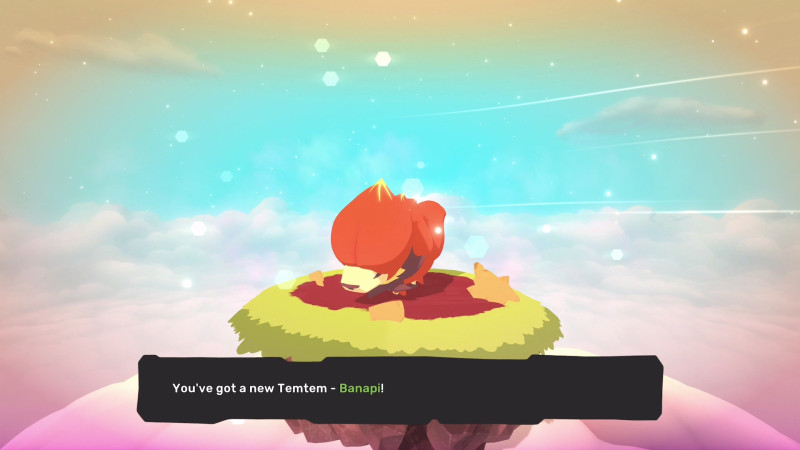
The biggest draw to this genre for me is collecting as many of these cute and destructive creatures as possible. While the lack of variety and abundance of forgettable designs on the first island disappointed me, each subsequent area introduces more enticing monster designs and elemental combinations. My favorites include the deceptively cute Adoroboros and the fiery electric scarab Scaravolt. Figuring out the location of a monster I needed to fill out my Tempedia or one that would complement my current competitive team was a blast.

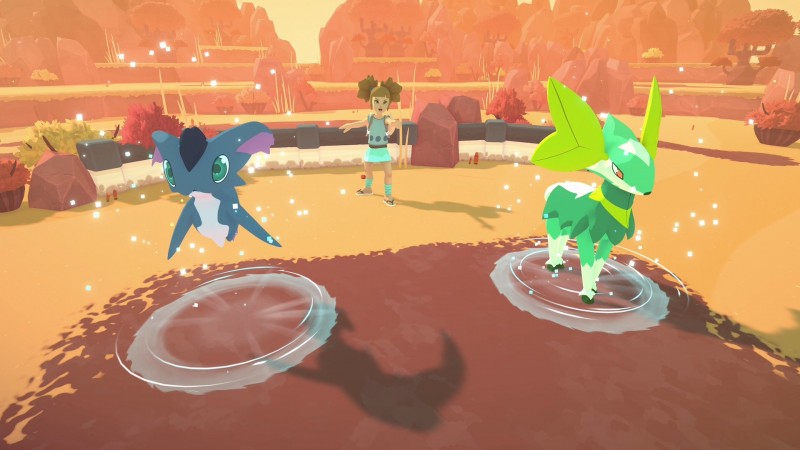
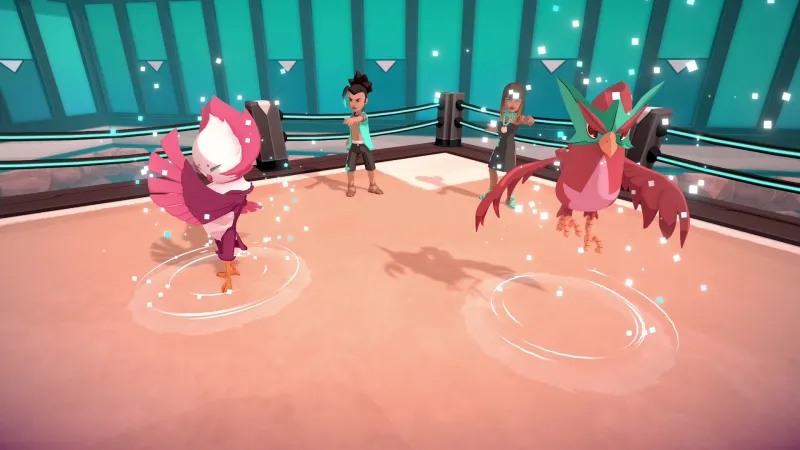
The hunt for new Temtems is exciting, but I’m even higher on the battle system. These fights are strategic and challenging to the point where every tamer battle made me consider my team composition right down to the order of my squad. Contrary to the way most trainers compete in Pokémon battles, the default way to throwdown in Temtem is 2v2. It’s a twist I enjoy that deepens the strategy in just about every battle. I often had to solve battle-based puzzles, like whether my active team is the dominant duo on the board or if they’ll be quickly wiped out by well-matched opposition, with the latter case happening quite often. 

Another wrinkle I love in battle is the stamina system. Each move uses a portion of the Temtem’s stamina gauge, with lighter blows consuming far less than haymakers. However, using more stamina than what’s available takes HP, creating a high-risk, high-reward scenario for making a desperate all-out attack at the cost of your team’s health. It’s a clever solution to spamming powerful attacks, and it results in more deliberate fights, especially when going toe-to-toe with other aspiring tamers.

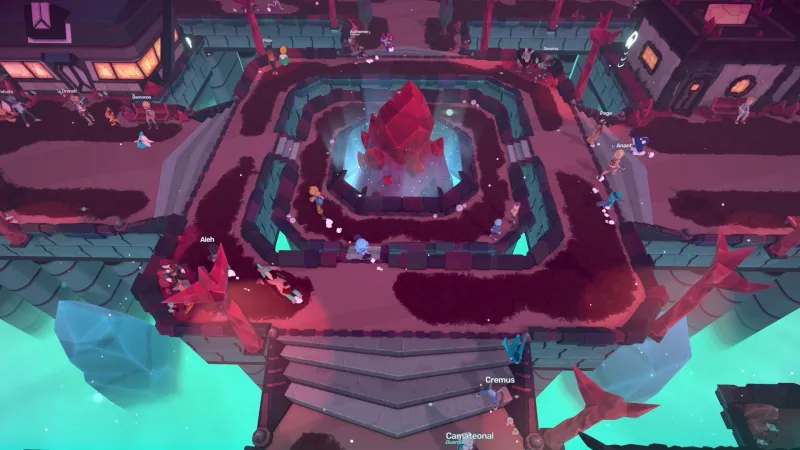
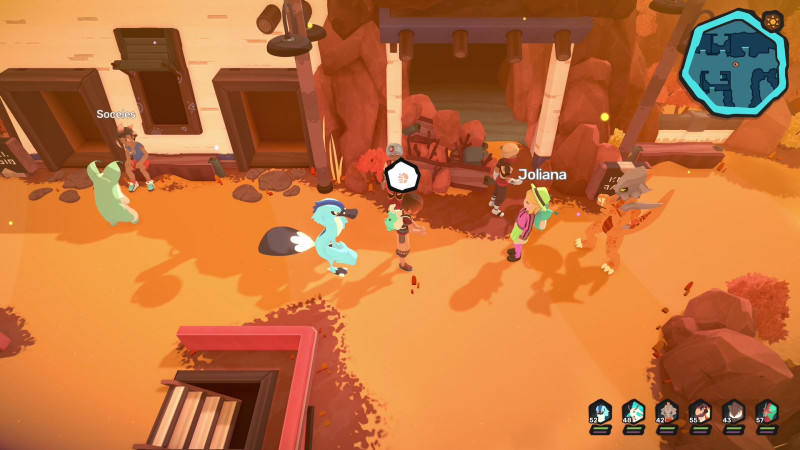
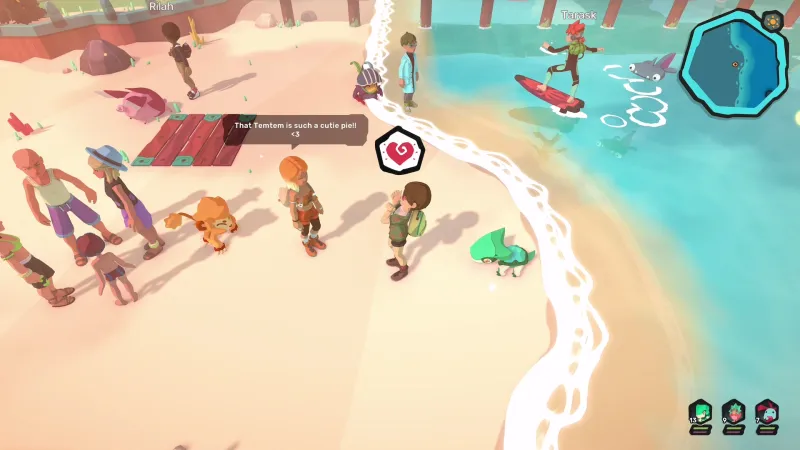
The online features flourish when I interact with others. Throughout the adventure, you see tamers running around with their partner 'Tem in tow. You can challenge them to a battle, trade, or chat about where to find a monster. An always-available rolling text chat also lets you talk with a world full of active players freely. The lack of a barrier to communicating or participating in fights and grouping up with others is refreshing for the genre and should be looked at seriously by companies like Nintendo as a feature to strive for.

There’s plenty to do with tamers online after the main scenario is done. On top of the competitive activities on hand, like joining a club and participating in Dojo Wars, I’ve kept busy with Temtem breeding, skimming auctions for monsters and items, and exploring the player housing neighborhoods that can be decorated with furnishings purchased all across the Archipelago. With all of the above and more to do, there’s plenty of endgame content for those who wish to stick with the game long-term. 

Temtem may look like a copycat on its surface, but its deviations from the Pokémon formula pay off considerably. With unique battling elements and an engaging MMO structure, Temtem evolves as its own experience and offers a vast, challenging adventure that even those without a Nintendo console can enjoy.

GI Must Play

Score: 8.5

About Game Informer's review system

Purchase

Monday, September 12, 2022

Metal: Hellsinger Review – A Rhythmic Symphony Of Destruction

Game Informer Metal Hellsinger Review

Reviewed on: PC
Platform: PlayStation 5, Xbox Series X/S, PC
Publisher: Funcom
Developer: The Outsiders
Rating: Teen

Metal: Hellsinger knows precisely what it is from the second it begins: a love letter to fast-paced first-person shooters, especially Doom, and a tribute to metal music and the culture surrounding it. It’s a no-frills shooter that asks, “What if you had to blow bodies to pieces to the beat of a metal album made by genre greats?” It excels at answering that question. It’s not perfect – the bosses are uninspired at times, and it could use an extra dash of variety in combat design – but my criticisms mattered little to my overall enjoyment of my 11-hour playthrough. What the game gets right far outshines what it doesn’t, and the developer, The Outsiders, has created what I hope is just the start of a new FPS franchise set in Hell.

Metal is the name of the game here, literally. Music plays throughout your experience, whether it’s in the game’s fantastic campaign that takes you through realms of Hell or its trials, which unlock sigils used to strengthen your loadout during the story mode. If you like Trivium, Lamb of God, and other bands like this in the genre and guns with a fiery kick, Metal: Hellsinger is already worth the price of admission. I gunned down a massive skeletal boss to the beat of a near-operatic song backed by iconic vocals from System of a Down’s Serj Tankian. I ripped through hordes of enemy mobs and behemoth demons to the rhythm of Arch Enemy’s Alissa White-Gluz’s death-metal melodies. It was as enthralling as it sounds, in no small part, thanks to precise and punchy shooting mechanics.


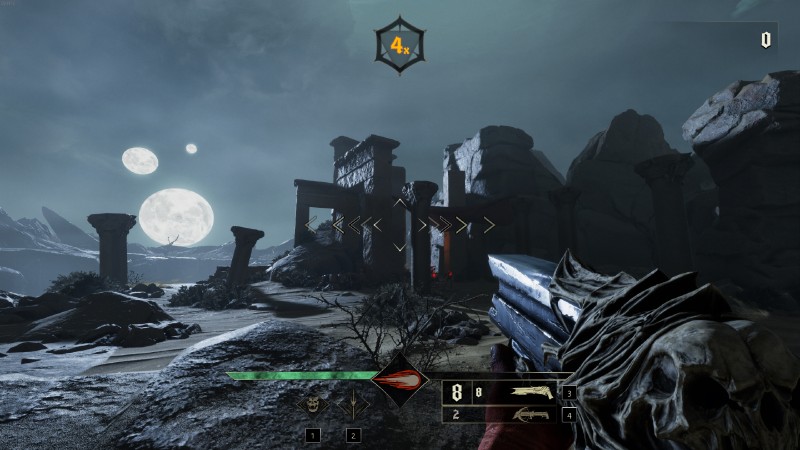
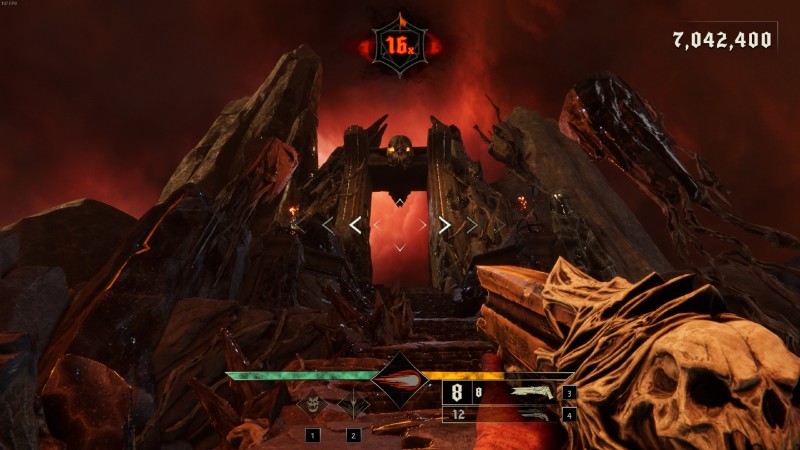
You use one of six different weapons to attack hundreds of demons, and the game rewards you with extra damage if you fire each bullet in perfect match with the on-screen metronome that doubles as your reticle. Streaks increase your damage output and score modifier. What’s unique about this streak counter is that each new level adds a new layer to the music track. At 2x, you might hear a bass rumbling and a guitar’s subtle whine, rearing for what’s to come. At 4x, the drums might kick in. Reach 8x, and the song begins to roar, missing just the vocals, which complete the track at 16x.

Climbing from 2x to 16x, made easier by streak multiplier pickups littered throughout a given stage, remained as exciting the umpteenth time as it was when I first did it. It feels like bringing a song to life, like a producer, except you’re doing it with weapons that rip Hell’s demons to pieces.

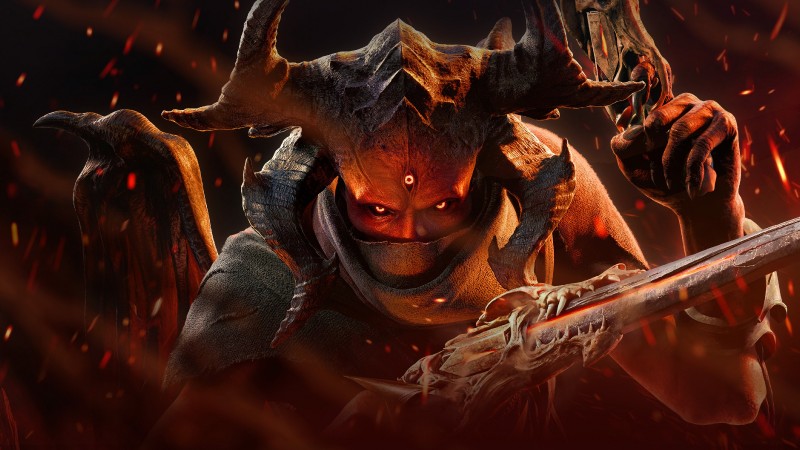
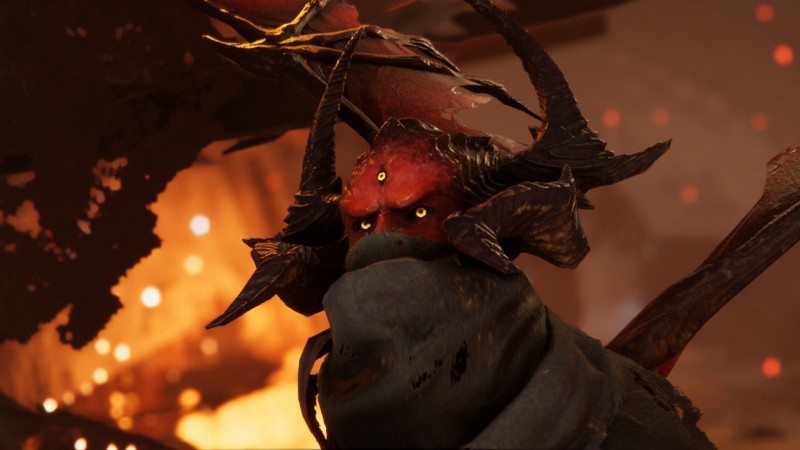
All of this is happening because of The Unknown, the playable character in Metal: Hellsinger, banished to the deepest realms of Hell where only ice and lowly demons remain. The Unknown progresses from the iciest domains to the fieriest alongside a talking skull voiced by Troy Baker. He brings a southern drawl that matches the game’s almost Western-like tone, all to find and kill The Judge, a slithering ruler losing her grasp on Hell, excellently voiced by Jennifer Hale.


There’s not much else to the game besides this campaign, but that’s okay because what’s there is outstanding. There are nine levels and 21 associated Torments that will test your mettle with time trials that task you with killing enemies a certain way using specific weapons and methods. There’s also an in-game codex for additional Hell-related information and extras that let you listen to the game’s tracks, but that’s it. Metal: Hellsinger is short and sweet, but it ends at exactly the right time when it reaches the climax of both its story and its built-in metal album.

I have minor gripes with the game, like its Torment time trials, which either feel cheap and unfair or brilliantly designed in an almost puzzle-like way, and its boss and combat design, which could use a touch more variety, but these critiques are barely worth mentioning. My admittedly small criticisms mattered very little to how much I enjoyed playing Metal: Hellsinger.

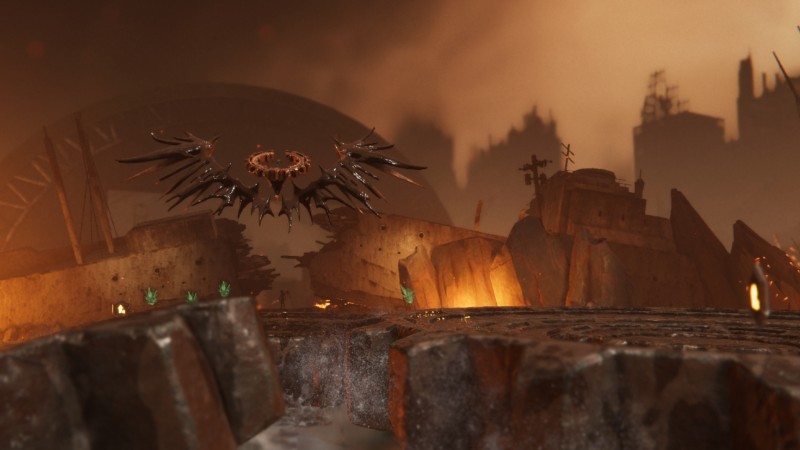
I likely won’t remember my minute frustrations with the game a few months from now, but I will remember “Dissolution,” a Two Feathers track with cathartic vocals from Bjorn “Speed” Strid of Soilwork, the realm of Hell known as Nihil, and the way my shotgun obliterated waves of enemies there. I’m so glad Metal: Hellsinger ends with the promise of more to come because I already want more from this series.

GI Must Play

Score: 9

About Game Informer's review system

Purchase

Friday, September 9, 2022

Ooblets Review – A Cheerful Grind

Ooblets review

Reviewed on: Switch
Platform: Xbox Series X/S, Xbox One, Switch, PC
Publisher: Glumberland
Developer: Glumberland
Release: 2020
Rating: Everyone

Ooblets offers a smile-inducing amalgamation of monster collecting, farming simulation, and relationship building. However, this delightful chill pill becomes tougher to swallow thanks to a tedious, grind-heavy progression that tests your patience in less enjoyable ways.  

The adventure whisks players to Badgetown, a quirky village where residents harmoniously live alongside Pokémon-esque creatures called Ooblets. Despite your newcomer status, the townsfolks turn to you to restore the city to its former glory. That involves tasks such as reopening buildings and cleaning up trash, all while making friends along the way. In many ways, Ooblets feels like a more purpose-driven Animal Crossing, which appealed to me as someone who prefers working towards tangible goals. 

Checking off your to-do list requires the help of Ooblets. These critters serve as partners and protectors and come in many species and rarities. Though cute, some of their designs feel uninspired. For every spring-legged jellyfish, there’s an Ooblet best described as a “mushroom with a smiley face” or “a plain bird.” Instead of catching Ooblets, you must obtain their seeds, then grow one on your farm. How do you get seeds? By defeating Ooblets in dance battles, the game’s humorous spin on turn-based combat.

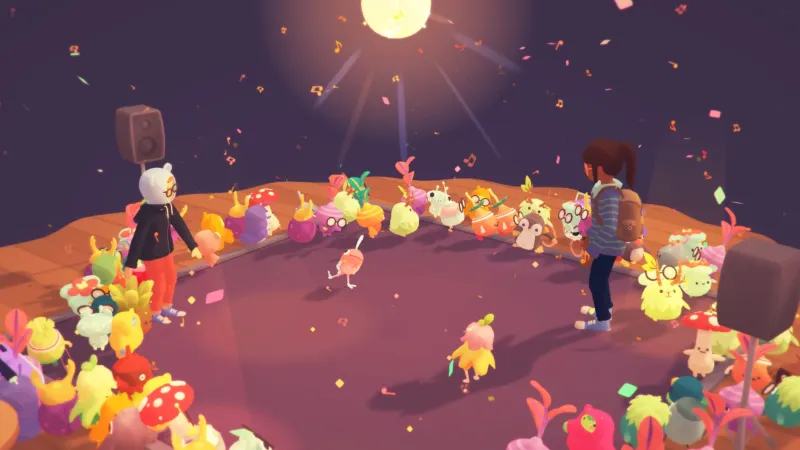
Dance battles pit squads as large as six Ooblets against each other. Commands take the form of cards, adding an element of randomness. Many cards sport a point value, and the goal is to play enough to reach a total value, represented by a meter, before your opponent. However, you can only play a certain amount of cards each turn based on how many Beats (basically mana points) they require. You don’t build your deck; instead, you have a permanent selection of general-use cards with Ooblets bringing unique abilities, thus dictating your line-up. One Ooblet burdens the opponent’s deck with useless cards, another focuses on weakening their attack power, while others raise your card’s power by generating Hype. 
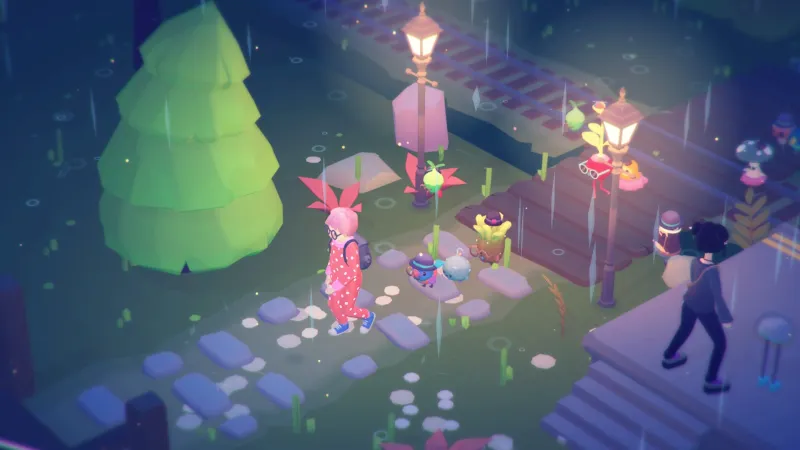
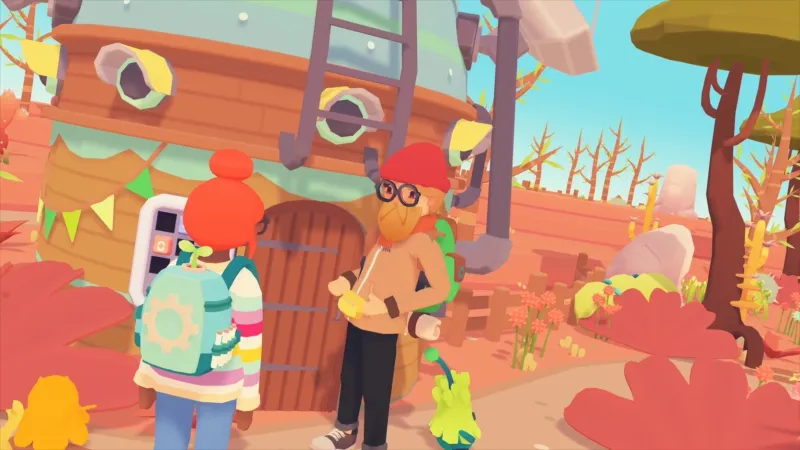
Despite the strategic elements, dance battles are a walk in the park. I never lost one in over 30 hours of playing, and it never mattered what combination of Ooblets I used since the A.I. rarely plays aggressively. I wish dance battles challenged me more because they became an uninteresting formality, especially during quests where you must complete multiple bouts in a row. However, I respect the battle system as a cute, non-violent introduction to turn-based combat for younger or inexperienced players.

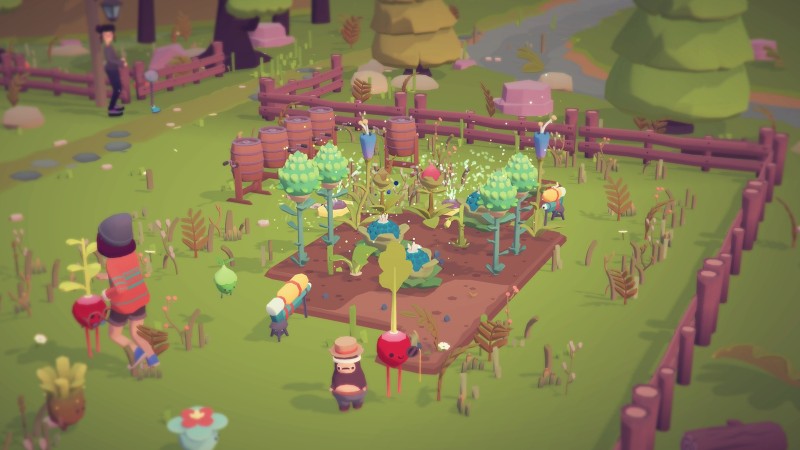
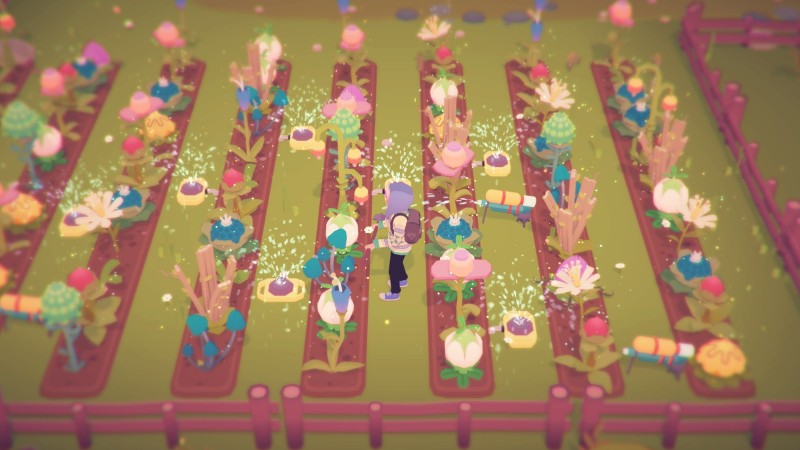
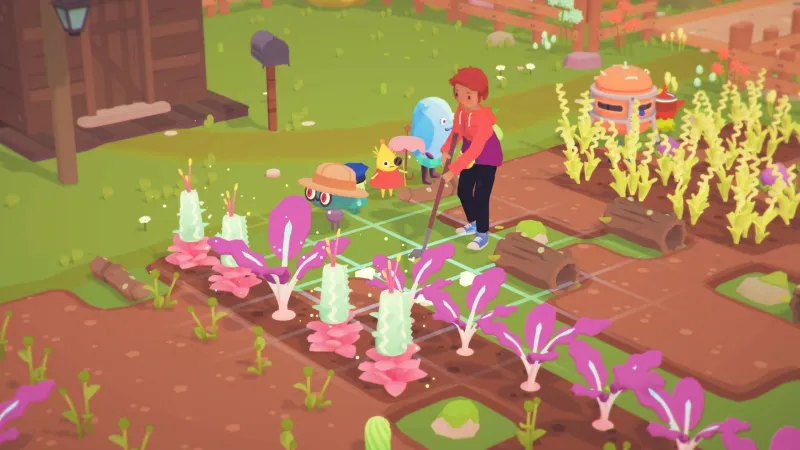
Thankfully, the bulk of the experience unfolds on your farm. In addition to growing new Ooblets, you cultivate crops by plowing land and keeping it watered. This became my favorite part of Ooblets. I enjoyed designing my farm and concocting systems to produce crops as optimally as possible (which sometimes takes days). It gets even better once you construct tools to make the job more autonomous, such as automatic sprinklers. You can also assign extra Ooblets to your farm to tend to responsibilities like pulling weeds or harvesting the ripe yield while you’re away, providing a nice incentive to obtain as many of these little helpers as possible. 


Farming crops and gathering materials, whether plucking them from the earth, fishing them out of the sea, or recycling them out of trash, is pivotal to Ooblet’s progression. Every major task requires players to deliver bundles of materials, whether you’re restoring Badgetown’s clubhouses, repairing a hot air balloon to travel to new cities, or fulfilling a ton of fetch quests. Having a bit of everything on you at all times matters; you can’t even challenge Ooblets to dance battles unless you’re carrying a specific crop or a dish made from them. Running into new Ooblets loses its excitement when they require a vegetable you left in storage, forcing you to trek back home. 

Quests began to lose their appeal once I realized they’re the same, sometimes lengthy, exercise of growing or scavenging materials. This often left me at the mercy of meters and the clock, creating stretches where I meandered with few substantial options until a vital resource sprouted or replenished itself. Additionally, these progression roadblocks sometimes go overboard. One campaign mission required me to grind hundreds of precious Gummies, the game’s currency, to pay an arcade hacker. Another job repeatedly forced me to climb up and down a mountain path gated by NPCs whose requests could only be satisfied by returning home. Having some tasks rewarded with Wishies, a secondary currency spent on upgrades, helps but it’s not enough. 

Other elements and activities don’t entirely click either. Running a shop feels needlessly tedious since batches of items can only be sold in single quantities, making restocking a hassle. Making the rounds to chat up the same group of citizens each day to build friendship meters, which unlock decent rewards, also loses its appeal. I began to avoid the Dance Barn, which hosts dance battle tournaments to win a daily prize, due to my boredom with the combat. Locations beyond Badgetown offer little incentive to revisit them once you wrap up their campaign quests, outside of collecting missing Ooblets. Given how crucial eating food is to keep your energy up, a meter that drains throughout the day and fuels many basic actions, I was annoyed that snacks couldn’t be consumed without entering the menu, even when equipped.  

Ooblets offers solid fun, and I enjoy its cheerful tone. I only wish playing it didn’t feel so much like work. Despite the pride I had in my farm, clearing checklists eventually felt more laborious than satisfying. There’s fun to be had as long as you’re willing to work for it.

Score: 6.75

About Game Informer's review system

Purchase