This is default featured slide 1 title

Go to Blogger edit html and find these sentences.Now replace these sentences with your own descriptions.This theme is Bloggerized by Lasantha Bandara - Premiumbloggertemplates.com.

This is default featured slide 2 title

Go to Blogger edit html and find these sentences.Now replace these sentences with your own descriptions.This theme is Bloggerized by Lasantha Bandara - Premiumbloggertemplates.com.

This is default featured slide 3 title

Go to Blogger edit html and find these sentences.Now replace these sentences with your own descriptions.This theme is Bloggerized by Lasantha Bandara - Premiumbloggertemplates.com.

This is default featured slide 4 title

Go to Blogger edit html and find these sentences.Now replace these sentences with your own descriptions.This theme is Bloggerized by Lasantha Bandara - Premiumbloggertemplates.com.

This is default featured slide 5 title

Go to Blogger edit html and find these sentences.Now replace these sentences with your own descriptions.This theme is Bloggerized by Lasantha Bandara - Premiumbloggertemplates.com.

Friday, January 31, 2020

Coffee Talk Review – A Caffeine High And A Crash

Publisher: Toge Productions
Developer: Toge Productions
Rating: Teen
Reviewed on: PlayStation 4
Also on: Xbox One, Switch, PC

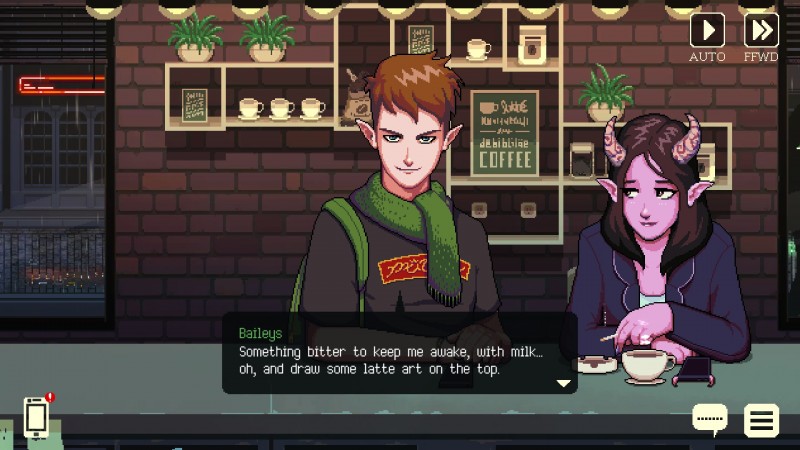
When life gets tough, people often reach for what comforts them and provides the extra boost to endure. For a lot of people, that can just be a good cup of coffee; they develop routines around when to get it, find favorite cafes that cater to their style, and get to know the baristas who are serving their beverage of choice. Toge Productions taps into this concept in Coffee Talk, an interactive experience that shows the powerful relationships that can form around a cuppa joe. While this theme makes for some engaging conversations, the writing falls into a tangle of clichés that go exactly where you expect. 

Coffee Talk is set in Seattle in 2020, but isn’t exactly a representation of the real world. In this alternate reality, creatures like werewolves, vampires, and succubi coexist with humans. Elves are building startups, dwarves are creating automotive empires, and orcs are using computers instead of axes for job satisfaction. You play as the owner and barista of a small coffee shop – one of the few open past midnight. Your job? Fulfill patrons’ drink requests and listen to their troubles.

It’s important to go into Coffee Talk knowing that it tells an authored story; it’s a visual novel first and foremost. This isn’t a game of choice, and it has no dialogue options. The only control you have to how events sometimes play out is by correctly fulfilling drink orders. For instance, if you find a special concoction, you may be able to help a werewolf contain his rage. The game is more about capturing the relationships that form between a barista and their customers. Many times you’re just watching interactions play out between other customers who have also formed companionships due to their shared interest in late-night coffee.

For such a text-heavy game, the dialogue is well done, albeit with a few grammatical errors. I especially liked the banter between everyone. It isn’t all fun and games, though. Coffee Talk gets creative and uses its characters to explore various issues in society, from racism to crunch. Sometimes the writing waxes philosophical. For example, it discusses how even if the world was one race, we’d still find some differences among us and use them to marginalize others. 

Click image thumbnails to view larger version


I like that Coffee Talk poses these questions, but it does so in predictable, well-worn ways. You have an elf and succubus whose parents want them to marry within their species. A father struggles to let his daughter make her own mistakes, while the daughter can’t seem to grasp how little life experience she has. These scenarios feel too familiar, and they unfold without many surprises. The most interesting storyline centers on Neil, a mysterious being from another planet who is merely looking to breed and enters the world of dating apps. If anything, Coffee Talk feels like a game full of interesting concepts that are only half-realized. I was more entertained with the ideas than their execution. 

When you’re not chatting up customers, you’re creating their requested drinks, and this is really the only way you can show people you’ve been listening to them. Sometimes, customers say, “Make my usual.” Other times, they say, “Surprise me.” Sometimes they make requests you can’t fulfill exactly, forcing you to improvise. A lot of the later game drink requests require experimentation, and sometimes you’re just fumbling in the dark. At the very least, you can trash a drink up to five times before serving it, and the loading menus sometimes provide hints at how to create the fancier coffees. 

The specificity required to make some drinks is frustrating. For instance, you get one primary ingredient and two secondary ones. The order that you put the secondary ingredients can alter the drink you’re making. You can have all the right ingredients, but still endure some trial-and-error to craft what you want. And the controls (on PS4, at least) make creating latte art more trouble than it’s worth, to the point where I had to stop bothering with it. Outside of these annoyances, I had fun trying to unlock all the different drink types.

Coffee Talk is an interesting experience. At times, it struggles with just how far it wants to explore certain topics, sometimes only giving a cursory look at the issue at hand. I was still entertained during my playthrough, and I genuinely cared about the characters and their journeys – even if those journeys don’t take them to unexpected places.

Score: 7.5

Summary: Coffee Talk shows the powerful relationships that can form around a cuppa joe, but it does so in predictable, well-worn ways.

Concept: Step into the role of a barista, creating drinks and interacting with customers, but in a world where humans and fantastical creatures co-exist

Graphics: Pixel-art visuals give the game personality, and the character designs are imaginative, especially for the orc game designer and nekomimi popstar

Sound: Basic sound effects and music set the tone, but it’s all pretty minimal

Playability: Coffee Talk is primarily a visual novel, and easy to pick up and play. Some mechanics, such as discovering drink recipes and creating latte art, take a little more experimentation

Entertainment: Getting to know your customers is the highlight of Coffee Talk, but some arcs are too cliché

Replay: Moderate

Click to Purchase

Monday, January 27, 2020

Kentucky Route Zero Review – A Surreal Road Trip

Publisher: Annapurna Interactive, Cardboard Computer
Developer: Cardboard Computer
Rating: Teen
Reviewed on: Switch
Also on: PlayStation 4, Xbox One, PC

As Kentucky Route Zero opens, an aging delivery man with a faithful dog by his side pulls his truck into a gas station. The man’s name is Conway, and he needs directions to 5 Dogwood Drive so he can make his final delivery of antique furniture. That’s the game’s narrative frame, but with each passing scene, you learn Kentucky Route Zero is about other things – like community, debts, and uncertainty. Plot beats punctuate the journey, but the evocative scenery, bizarre mysteries, and imaginative writing are even more compelling. Think of Kentucky Route Zero like taking a road trip, but the places where you stop are only half the fun; the other half is deciphering the signs and arrows along the way, contemplating what lies beyond the horizon of the roads you’re not taking.

If that all sounds too ambiguous and artsy, then this game may not be for you. At its most grounded, Kentucky Route Zero is an adventure game suffused with magical realism. At its most fantastic, it is a collage of pure dream logic. You meet android musicians, a giant eagle, and glowing skeletons. You drive down extra-dimensional highways, watch experimental performances, and question the shape of reality. In short, Kentucky Route Zero is delightfully weird. It is focused intently on ideas rather than traditional puzzles or obstacles – but as a piece of interactive art, it’s poignant and enthralling.

Click here to watch embedded media

The story unfolds primarily through text boxes and dialogue choices. You start by controlling Conway at the gas station, but you dip in and out of the lives of many others as the cast expands over the course of five acts. The writing deftly portrays a bleak world with lonely inhabitants, and though your decisions can’t exactly change that, you aren’t just advancing text like a visual novel. Players still have a sense of agency. This can come from something as simple as deciding a mundane detail about a character’s past, like why Conway’s parents were reluctant to let him watch TV. Some choices have immediate outcomes, like deciding which lyrics come next in the song you’re hearing. Other options – particularly in Act IV – are important because they lead to certain scenes at the exclusion of others.

Kentucky Route Zero’s approach to player choice is fascinating because it is impossible to optimize outcomes. No decision is better than another; you have no good or bad consequences, no scenes are more beneficial than others, and you can’t change the trajectory of the overall story. What you’re left with is the freedom to define the tone and mood of the events and interactions, which is more gratifying and powerful than I expected. How haunted are the characters by their pasts? How guarded are they around strangers? Your answers to those questions may not result in a grand branching narrative, but they still affect your perception in cool ways. It reminds me of a page in a coloring book, where you control the tint and shading, but the black outlines of the big picture are the same.

Click image thumbnails to view larger version


Also like a coloring book, the blank spaces can be just as interesting as those you fill in. Kentucky Route Zero revels in its strangeness, and rarely pins down details with clear exposition. This intentional vagueness usually frustrates me in games, but I enjoy it here. It works because the game never promises what it can’t provide; it raises questions and presents mysteries, but doesn’t feel like it’s building toward big revelations that never come. Instead, it mixes quiet moments and inexplicable phenomena, then invites your imagination to explore the fuzzy boundaries of the fiction.

Kentucky Route Zero was successfully crowd-funded in 2011, and the first act launched in 2013. The game is now complete, with the subsequent acts and interludes releasing sporadically over the last several years. Even so, the flow doesn’t feel disjointed; each new act feels like a natural expansion as the world and characters blossom. In fact, they may blossom a little too much; by the end, the characters and story beats are too numerous and diffuse to coalesce into a fully satisfying finale. I won’t spoil it here, but even my relative disappointment at the conclusion reinforces something I love about the rest of the experience: Kentucky Route Zero is about appreciating the journey, not reaching the destination.

Score: 8.5

Summary: Kentucky Route Zero is delightfully weird. It is focused intently on ideas rather than traditional puzzles or obstacles – but as a piece of interactive art, it’s poignant and enthralling.

Concept: Deliver some furniture, meet other travelers, and things get more complicated from there

Graphics: The graphics are simple, but they are used in cinematic and unconventional ways to surprise you

Sound: Atmospheric sound design sets the right tone, and a few brilliant musical moments are expertly deployed to great effect

Playability: Characters occasionally get caught up on environments, but movement and interactions are generally straightforward

Entertainment: Though it seems to be a traditional adventure game at first, this is an enticing and bizarre tale unlike anything you’ve played before

Replay: Moderately High

Click to Purchase

Journey To The Savage Planet Review – A Worthwhile Expedition

Journey to the Savage Planet

Publisher: 505 Games
Developer: Typhoon Studios
Release:
Rating: Teen
Reviewed on: Xbox One
Also on: PlayStation 4, PC

Your adventure in Journey to the Savage Planet doesn’t start with much promise; as a member of the fourth-best company in space exploration, you arrive on a remote planet with lackluster equipment, incorrect intel, and insufficient fuel for the return trip. With so much going against you, it’s a miracle you can get anything accomplished. Thankfully, with a planet full of unique wildlife, fun discoveries, and plentiful resources, things aren’t so bad after all.

The titular savage planet you explore is AR-Y 26. This unassuming name hints at just how little your company thinks of the place. Much to your surprise, not only is it teeming with life, but a giant spire towers over your landing spot, indicating some form of advanced civilization. However, there’s no sign of that species anywhere, so your scouting mission quickly gets a secondary goal of figuring out what happened – a mission that becomes more enticing as you learn about the planet and the creatures that came before you.

Click here to watch embedded media

The early objectives in this first-person experience are centered on getting your bearings and scanning the surrounding area, which is about all your equipment allows for. However, exploration quickly proves rewarding. For example, I found (and ate) a mysterious orange goo behind a waterfall, bestowing permanent health and stamina upgrades. In addition to 100 orange goo pods, you also find alien alloy (which can be used in crafting), as well as resources dropped by creatures and caches. Cracked walls, high ledges, and grapple points hint at secrets worth exploring, with lore-based discoveries like alien tablets and explorer logs that provide you with videos and messages explaining what happened before your arrival.

You can craft a better battery for your pistol, plus thrusters that give you a double jump, but new crafting options open as you complete sidequests. I love having the option to expand the crafting tree to reach more meaningful rewards like an explosive charged shot, more powerful bombs, and even interface overlays that reveal the locations of nearby collectibles. Even if you don’t want to deviate from the main mission, you still unlock handy traversal abilities like the ground pound to smash through brittle floor, or my personal favorite: a grappling hook to swing from specific points like Spider-Man. Each of these upgrades opens new possibilities for exploration, giving you a reason to return to areas you thought you finished.

Click image thumbnails to view larger version


As much I enjoy discovering the various secrets, the act of reaching them isn’t always fun. First-person platforming is difficult to get the hang of due to your restricted field of vision, making some platforming sequences harder than they should be. Another problem is the gunplay, which is adequate at best. While your primary weapon is upgradeable with faster reloads, increased damage, and a bigger battery, shooting enemies never feels fun. Aiming is imprecise no matter how you tune the sensitivity, and hitting moving or small targets often proves even more upsetting than the challenging platforming sequences.

If you’d like to chart the planet with a friend, you can jump into an online co-op session. Players scale to the host’s abilities, meaning your friend who hasn’t played more than a couple of hours has access to all the late-game gear you’ve unlocked. While the two co-op explorers aren’t able to play off each other in any meaningful way, having an extra gun in encounters or an extra set of eyes to spot secrets is immensely helpful.

Journey to the Savage Planet presents you with a well-constructed world full of fun collectibles to hunt down and interesting wildlife to survey, but the way the world design encourages and rewards exploration is its biggest accomplishment.

Score: 8

Summary: Journey to the Savage Planet provides a fun world to explore from start to finish, even if the shooting doesn't feel great.

Concept: Explore a colorful and dangerous alien planet to uncover its mysteries

Graphics: Bright colors and cute monster designs make even the most dangerous sections on the planet a delight to look at

Sound: Dynamic music reacts during encounters and ratchets up the tension. I regretted choosing the dog character from the start, as I got sick of hearing its whimpers every time I took damage

Playability: Navigation is easy thanks to an intuitive waypoint system and easy-to-understand controls. The game isn’t particularly challenging, but floaty gunplay and hit-or-miss platforming can make sequences harder than they should be

Entertainment: With fun discoveries galore, I was always excited to step back onto the surface of this uncharted world

Replay: Moderately high

Click to Purchase

Friday, January 24, 2020

Kingdom Hearts III Re Mind Review – A Series Of Letdowns

Publisher: Square Enix
Developer: Square Enix
Reviewed on: PlayStation 4
Also on: Xbox One

Kingdom Hearts fans are used to crazy plot twists and cliffhangers that leave them with more questions than answers. The core Kingdom Hearts III experience finally provided resolution to hanging threads, but the Re Mind DLC muddied those waters and made me feel toyed with. Re Mind was an opportunity for Square Enix to provide additional context and shore up the story’s weaknesses. Instead, this add-on feels more like a director’s cut, with only a few new scenes and tweaks to battles. It offers flashes of worthwhile content, but Re Mind demands too much of players to see it.

Re Mind takes you back to the Keyblade Graveyard sequence – the start of the base game’s final stretch. Sora travels back in time to search for Kairi, hoping to alter the outcome of events. However, to do so in this DLC, he sacrifices his corporeal form. I don’t want to spoil anything, but the overall story is incomprehensible and outlandish. Expect drawn-out explanations for all the hearts and vessels, more time-travel talk, and unresolved beats dangled in front of you as if they’ll be explained soon – but they won’t. 

To make matters worse, you get thrown into a sequence you’ve already played through, fighting every Keyblade Graveyard boss in mostly the same places. Going through the motions rewards you with a few new scenes and battles that can play out differently. A couple are new, but most of them play like they did before. To shake things up a little, you get the opportunity to play as keyblade wielders other than Sora, like Aqua, Roxas, and Riku, who have different fighting styles. For instance, Roxas has access to a quick reversal, dual wields, and is more melee-focused. The best part of these fights is the cool team-up attacks that are representative of their bonds and determination. While I enjoyed these moves, they don’t make up for the high amount of reused content and the sparseness of new scenes. 

The DLC is at its best when it adds some new elements to fights. One boss battle combines all the core characters, alternating between them as you perform finishers, which creates a spectacle to behold. In a separate showdown, you even get to control Kairi, which fans have been begging for. Sadly, it’s only one battle, and I don’t care for her moveset because she uses floaty attacks that don’t feel powerful. I had to double-check to see if my strikes were even connecting, since I couldn’t feel the impact of obliterating foes with Kairi as I could with other heroes. 

Click image thumbnails to view larger version


That seems to be the trend for this DLC: Nothing feels substantial. You get very little for your investment, and none of the seemingly exciting teases ever lead anywhere interesting. A great example of this is getting to explore more of Scala Ad Caelum, a breathtakingly beautiful place that was only featured briefly in the main game. After getting a closer look at it, it’s more disappointing than intriguing, and full of tedious puzzles like lining up objects to match shadows. Also disappointing is that the Final Fantasy characters are still mostly absent for the DLC. You see Yuffie, Aerith, Cid, and Squall, but their roles are minuscule. 

Once you complete Re Mind, an episode called Limit Cut unlocks, granting you access to several challenging boss fights. They’re ultra-tough, and one false move (like not blocking at the exact right moment) means you lose everything. These are comparable to the series’ secret bosses (e.g., Sephiroth), which are notoriously difficult but rewarding to defeat. Those who revel in besting these can spend a lot of time here. But a warning: If Sora isn’t high-level (which is probably the case if you only completed the main quest in Kingdom Hearts III), you don’t have an easy way to grind or level up. This leaves you either banging your head against a wall as you hope to be perfect, or restarting the DLC after getting stronger in the base game.

Overall, Re Mind is disappointing. Between all the reused content and very few additions to the story, I felt like I wasted my time. Yes, a few new threads and pieces of info are there to unravel, but they are the tiniest of crumbs. The biggest revelation is in the new secret movie, which shows the series potentially moving in a strange direction that makes me more uneasy than excited. Ultimately, you really have to dig for the fun in Re Mind, because it’s buried in all this content you’ve already played.

Score: 6.5

Summary: You really have to dig for the fun in Re Mind, because it’s buried in all this content you’ve already played.

Concept: Play through an extended cut of the finale, complete with new scenes, new characters to control, and updated battles

Graphics: Nothing has changed much from the base game. Some new team-up attacks look cool, though

Sound: This is still an area where Kingdom Hearts III excels, but some of the voice acting is poorly mixed

Playability: The controls are smooth, and new moves and fighting styles make for great combos

Entertainment: This DLC has a lot of recycled material, and the payoff for trudging through it again is low

Replay: Moderate

Click to Purchase

Dragon Ball Z: Kakarot Review – Flawed But Still Enthralling

Publisher: Bandai Namco
Developer: CyberConnect2
Release:
Reviewed on: PlayStation 4
Also on: Xbox One, PC

Dragon Ball Z: Kakarot frequently powers up to Super Saiyan levels to deliver awe-inspiring battles between godly beings who can topple mountains with atomic blasts and swing fiery fists to knock each other into the stratosphere. However, when the fight is over and one of the warriors is sent to the afterlife, Kakarot struggles to find a pulse within its sprawling open worlds.

Holding true to the 100-plus Dragon Ball Z television episodes it’s based on, Kakarot is an uneven experience with explosive highs and cratering lows. Amid the ups and downs, it delivers enough charm and hard-hitting moments to be enjoyable for a lengthy 40-hour playthrough. Some of the content feels like filler, but I was thoroughly entertained by the battles and retelling of the wild Dragon Ball Z story.

Click here to watch embedded media

No footage from the animated show is used, and we instead see Goku and his family’s life unfold through beautifully animated in-engine footage for the dramatic moments, and animation-free conversations for the relationship building and mundane story beats. Most of the voice cast from the TV series reprise their roles, once again bringing these characters to life in clever and over-the-top ways.

Since the game covers the Saiyan Saga through the Buu Saga, players take to the skies as a variety of characters. Each is similar in build for the base moves, but with a little different flavor in their attributes and super attacks. No matter who you are using, combat is fast and frantic, pushing you to dart through the skies, pepper foes with fire blasts from afar, and then get in close for quick combos. When a foe is stunned or at a specific range, the big moves like Spirit bomb and Super Kamehameha can be used to deal serious damage. In the standard open-world battles, a fair bit of strategy comes from prioritizing targets and bouncing between foes. The boss battles, which can be against a foe with millions of hit points, push you in a different way, where you are more defensive and looking for windows to unleash the heavy arsenal or rejuvenate ki (which is essentially your magic meter).

Combat is satisfying, both against low-level foes who you can eventually one-hit kill, and against enemies that are a higher level than you. These battles can last for roughly five minutes, require plenty of healing items, and reward you well with plenty of experience points and loot.

The thrill of controlling a powerful hero continues within open-world exploration. Each character flies with the strength and speed of Superman. Flying is a satisfying means of travel, but ends up being the one truly enjoyable part of the open worlds, of which there are over a dozen to explore. Outside of flying around to collect orbs that can be used to buy new special moves, these areas aren’t much fun. Sure, you can hover in the air to take down a dinosaur or spaceship for crafting materials, but no danger or skill is really involved. You’re essentially just ripping across the land to gather supplies. Side missions are periodically thrown at you, but if they don’t involve combat, you’re not doing anything entertaining – unless you like the idea of picking apples. The fishing minigame is too repetitive, and the checkpoint car races are too easy, but they do deliver nice rewards, which are sometimes Soul Emblems.

If you love collecting every minifigure in the Lego games, you will likely find similar appreciation for the 80-plus Soul Emblems you can track down. While you don’t get new playable heroes from them, Soul Emblems are the key piece of Kakarot’s most rewarding RPG system. Once obtained, a Soul Emblem can be placed on one of seven different community boards, each giving stat boosts to unique fields like combat, cooking, and more. Soul Emblems represent relationships with certain characters, and you have to think about which board the character on the emblem should be on. You also need to figure out who they should be positioned next to for relationship links and even bigger bonuses. If you track down the best emblems, you can even give yourself a 100-percent boost to battle experience, or reduced cost for item purchases.

Kakarot also offers huge skill trees for all of the playable and support characters (who help you in combat), but they are gated by the story. That means even if you have millions of orbs to spend on new skills, you can’t until you reach a specific level or story beat. Limiting progress makes sense in terms of the narrative flow (you can’t have Goku going Super Saiyan 3 out of the gate), but it does take some of the fun out of collecting orbs. Another problem comes from the story itself, which switches who you are controlling without warning. If you pump all of your orbs into Piccolo’s skills, you may not get control of him again for hours. These jarring switches can sometimes hand you an underpowered character for a big battle. You’re just kind of along for the ride, never really knowing who you will be controlling for the next story mission.

Click image thumbnails to view larger version


As for the Dragon Balls, they are obviously used for story moments, but can also be gathered in the open worlds. They are listed on the map and are just lying out in the open with no one guarding them. Once you have all seven, you are granted two wishes: You can become rich, get more orbs, or bring bosses back to life just to kill them again for better loot. Having to track the orbs is a bit of a pain, but it does deliver meaningful content if you put forth the effort.

If you approach Kakarot for the story and the harrowing battles, it can be amazing. Outside of collecting Soul Emblems, the RPG elements are mostly lacking, even if they do push you to keep leveling to take on harder foes. All told, CyberConnect 2 gives fans a fun way to reexperience this saga.

Score: 8

Summary: It can reach Super Saiyan levels of enjoyment, just not in the open worlds.

Concept: A lengthy action/RPG experience that prioritizes combat and struggles with side content

Graphics: Although many story sequences only consist of talking heads, the big moments are presented beautifully through animated in-engine sequences that look just like the show

Sound: The soundtrack and character voices are fantastic. Some open-world chatter is repeated too often

Playability: The combat controls are spot-on, and flying around the open world is an empowering delight

Entertainment: Some of the content is hit or miss, but the story is told nicely throughout and ends up being an enjoyable way to relive this saga

Replay: Moderately High

Click to Purchase