This is default featured slide 1 title

Go to Blogger edit html and find these sentences.Now replace these sentences with your own descriptions.This theme is Bloggerized by Lasantha Bandara - Premiumbloggertemplates.com.

This is default featured slide 2 title

Go to Blogger edit html and find these sentences.Now replace these sentences with your own descriptions.This theme is Bloggerized by Lasantha Bandara - Premiumbloggertemplates.com.

This is default featured slide 3 title

Go to Blogger edit html and find these sentences.Now replace these sentences with your own descriptions.This theme is Bloggerized by Lasantha Bandara - Premiumbloggertemplates.com.

This is default featured slide 4 title

Go to Blogger edit html and find these sentences.Now replace these sentences with your own descriptions.This theme is Bloggerized by Lasantha Bandara - Premiumbloggertemplates.com.

This is default featured slide 5 title

Go to Blogger edit html and find these sentences.Now replace these sentences with your own descriptions.This theme is Bloggerized by Lasantha Bandara - Premiumbloggertemplates.com.

Monday, April 29, 2024

Teenage Mutant Ninja Turtles Arcade: Wrath of the Mutants Review – Better Left In The Sewers

Teenage Mutant Ninja Turtles Arcade: Wrath of the Mutants

Reviewed on: PlayStation 5
Platform: PlayStation 5, Xbox Series X/S, PlayStation 4, Xbox One, Switch, PC
Publisher: GameMill Entertainment
Developer: Cradle Games, Raw Thrills
Rating: Everyone 10+

The Teenage Mutant Ninja Turtles were synonymous with gaming in the late ‘80s and early ‘90s, largely thanks to their influence over arcade brawlers. Games like 1989’s Teenage Mutant Ninja Turtles (also known as ’89 Arcade) and 1991’s Turtles in Time are time-honored classics that shaped the side-scrolling beat-‘em-up genre, and 2022’s Shredder’s Revenge demonstrated that the style is still viable in the modern landscape. Teenage Mutant Ninja Turtles Arcade: Wrath of the Mutants clearly takes inspiration from those beloved games, but it falls spectacularly short of those acclaimed titles.

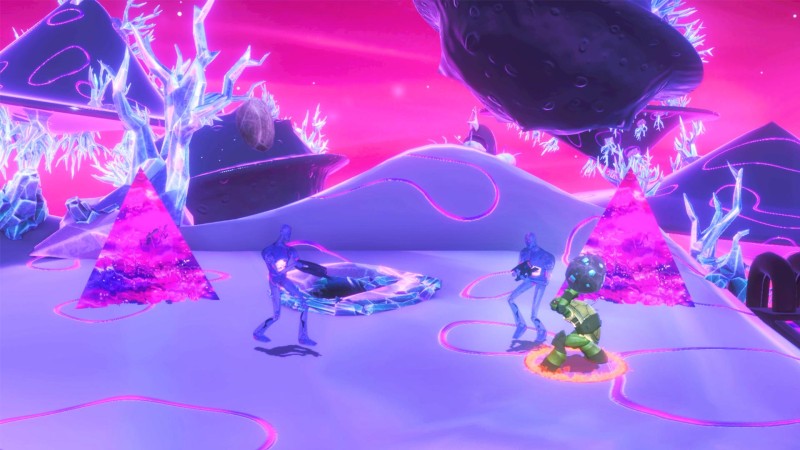
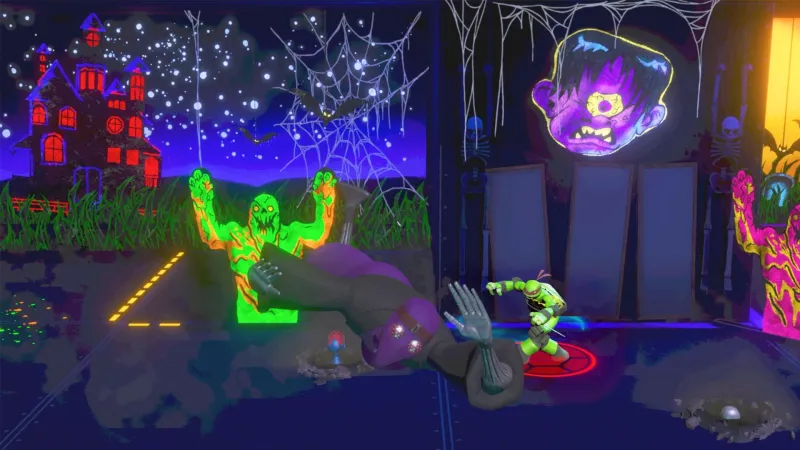
Originally released to arcades in 2017, Wrath of the Mutants takes a similar approach to gameplay as the original TMNT arcade games: You choose from Leonardo, Donatello, Michelangelo, and Raphael, each with distinct moves, as you slash and brawl through stages full of baddies. Based on the 2012 Nickelodeon cartoon, Wrath of the Mutants includes a ton of enemies for the Turtles to beat up in various locales; this home port adds three all-new stages and six new bosses. Unfortunately, no amount of Easter eggs and fanservice can compensate for its uninteresting gameplay.

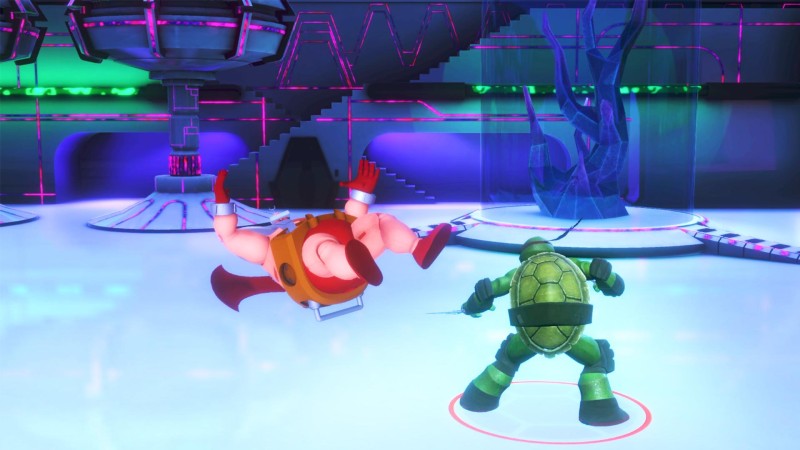
Though the core concept is the same as the most beloved entries in the series, I never felt anything more than listlessness as I fought through the six extremely linear stages on offer. Each Turtle brandishes their signature weapon and a unique Turtle Power that clears the screen of enemies. These moves should feel empowering, but instead, they throw the action to a halt while a drawn-out animation plays; Leo spins to form a tornado that sucks up all the minions, while Raph drums on the ground, sending enemies flying.
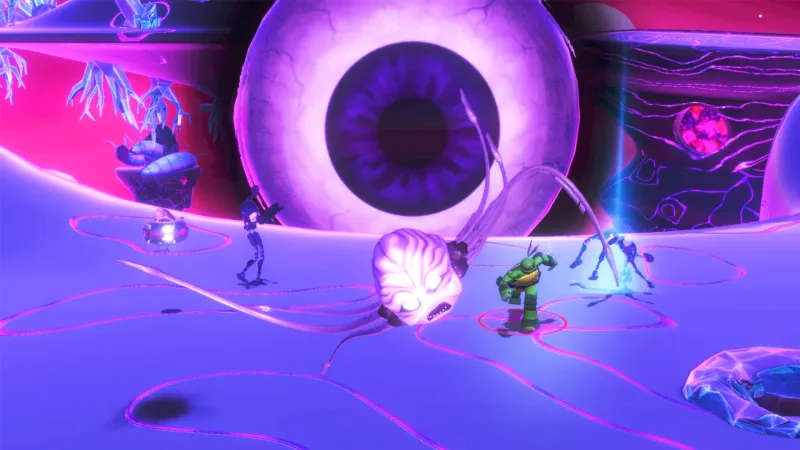
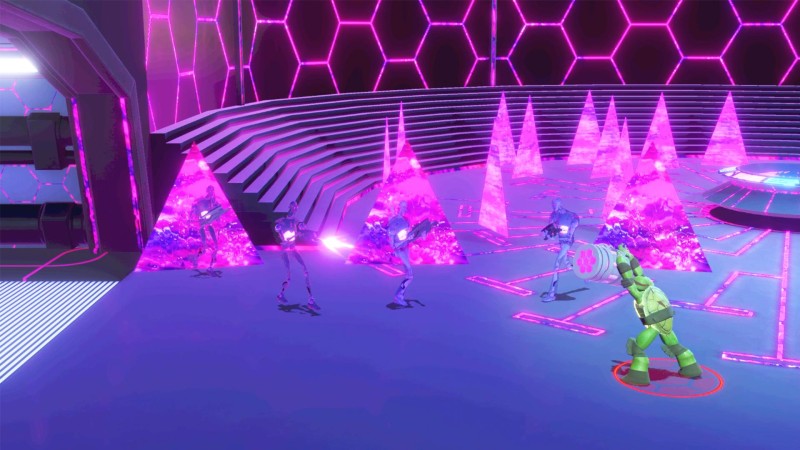
 

But it all feels so routine as you fight through waves of the exact same enemies in tedious stages that require no strategy – you just go right and spam the attack button. You can also pick up power-ups that cause your character to spin on their shell or summon side characters to dispatch enemies, but with the base combat so uninteresting, I only enjoyed deploying these frequent special moves because they provided a quicker path through the long levels.

Brawling the seemingly endless screens of Foot and Krang minions found in each stage wouldn’t be so bad if the signature arcade unfairness wasn’t ever-present. TMNT Arcade: Wrath of the Mutants isn’t a tough game by any measure, but there are moments where you simply cannot avoid being hit. At nearly every phase, enemies attack you from off-screen, where you can’t see or reach them, and they frustratingly won’t stop attacking you nor come into view unless you go to the other side of the screen. Additionally, enemy projectiles are deadly accurate, and with the Turtles’ sluggish movement and no way to effectively dodge, you’re all but guaranteed to take hits.

These enemies don’t do a ton of damage, but it’s often death by a thousand papercuts, and since each hit briefly stuns you, your combos are constantly getting interrupted. The bosses, who often just repeat the same attacks over and over, are trials of patience rather than engaging challenges. These boss encounters typically bring slight variations on the same move sets, causing them to all play out similarly. Even the final fight against Shredder does little to differentiate itself; he just lumbers around the screen while you wail on him with little strategy required other than jumping when the game tells you to jump – another repeated convention in nearly every boss battle.

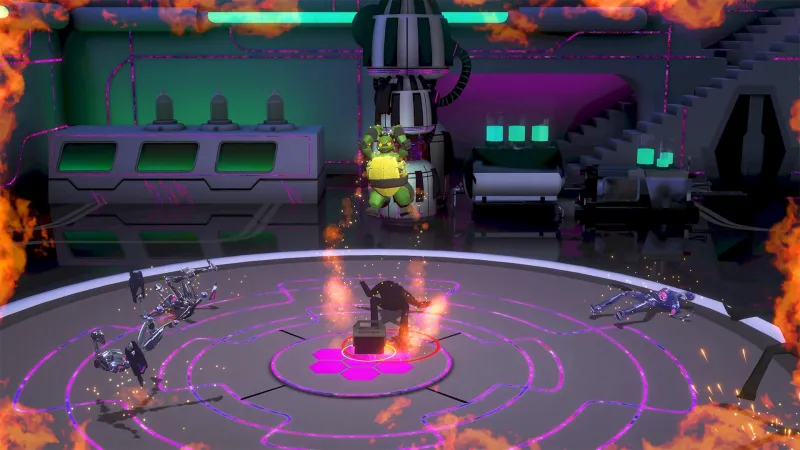
Stage elements meant to break up the monotony serve as more frustration than diversity of experience. Trains speed past, Krang’s Android body shoots electricity at you, and explosive barrels litter the levels, but they add so little. In one instance, where a giant eyeball continually blasts lasers at you while you fight waves of enemies, your character is too slow to avoid getting zapped unless you’re just standing around waiting for it to broadcast where it’s firing. I should be excited to see these new challenges and twists emerge, but I met most of them with a shrug and others with annoyance.

Though seeing the 2012 animated series get some attention in 2024 is fun, the presentation also disappoints. The visuals are nothing special, and I’m not a fan of some of the character designs of this era, but they fit the show's look well enough. It’s the audio that most irritates, as the Turtles obnoxiously scream the entire time and enemies repeatedly spout the same lines while generic action-oriented music loops in the background. After the first few levels, I was relieved to crank the volume down and listen to something else instead.

Beating the entire game takes less than two hours, but it still somehow manages to drag. You can return to the game’s six stages to try and get higher scores, but I had zero interest in doing so. The arcade games of yesteryear sometimes lacked depth, but they at least had a hook that stuck with you and kept you itching to return to pump more quarters into the cabinet. Teenage Mutant Ninja Turtles Arcade: Wrath of the Mutants strives for the greatness of the influential arcade hits of the past but falls well short. Thanks to uninteresting and annoying gameplay, repetitive enemy and boss encounters, and grating audio design, Wrath of the Mutants is little more than a shell of the series’ glory years.

Score: 5.5

About Game Informer's review system

Purchase

Friday, April 26, 2024

TopSpin 2K25 Review - A Strong Return

TopSpin 2K25

Reviewed on: PlayStation 5
Platform: PlayStation 5, Xbox Series X/S, PlayStation 4, Xbox One, PC
Publisher: 2K Games
Developer: Hangar 13
Rating: Everyone

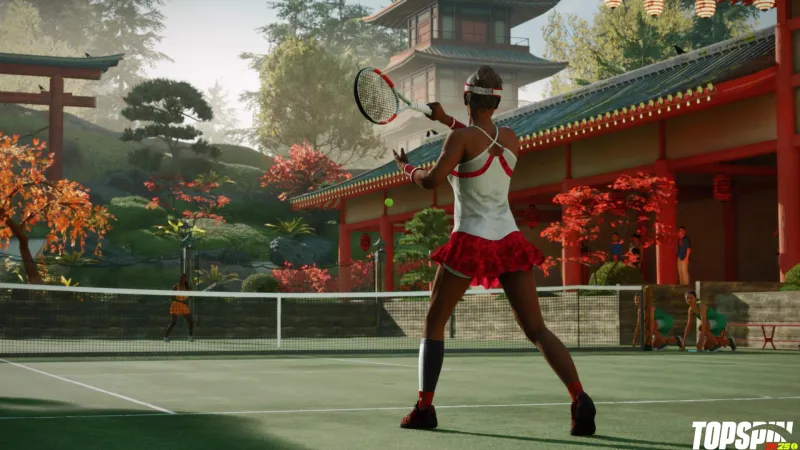
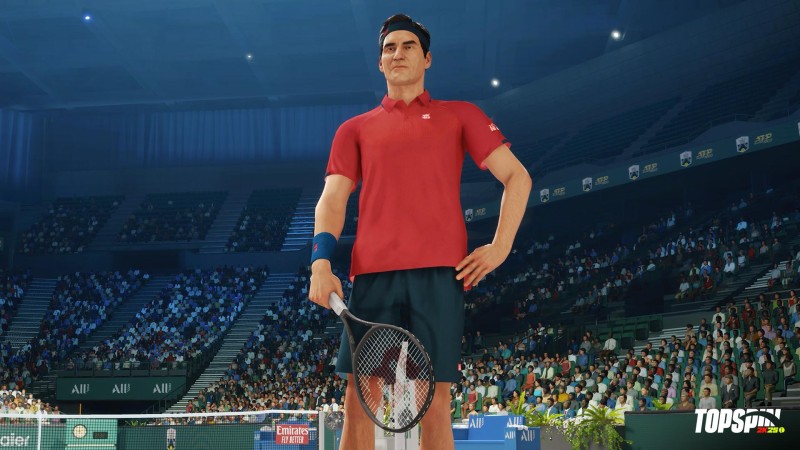
In the heyday of the tennis-sim video game genre, Top Spin and Virtua Tennis were the best players in the crowded space. However, in the time since the genre’s boom settled, the offerings have fallen off considerably, with both franchises going more than a decade without a new release. TopSpin 2K25 signals the reemergence of the critically acclaimed series, and though it’s been a while since it stepped on the court, it’s evident the franchise hasn’t lost its stroke.

TopSpin 2K25 faithfully recreates the high-speed chess game of real-world tennis. Positioning, spin, timing, and angles are critical to your success. For those unfamiliar with those fundamental tennis tenets, 2K25 does a superb job of onboarding players with TopSpin Academy, which covers everything from where you should stand to how to play different styles. Even as someone who played years of tennis in both real life and video games, I enjoyed going through the more advanced lessons to refamiliarize myself with the various strategies at play.

Once on the court, you learn how crucial those tactics are. The margin of error is extremely thin, as the difference between a winner down the baseline and a shot into the net is often a split-second on the new timing meter. This meter ensures you release the stroke button timed with when the ball is in the ideal striking position relative to your player. Mastering this is pivotal, as it not only improves your shot accuracy but also your power.

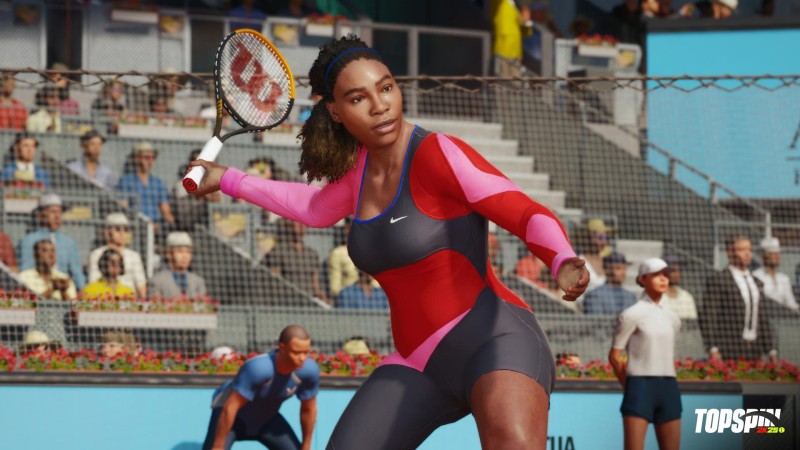
TopSpin 2K25 is at its best when you’re in sustained rallies against an evenly-matched opponent. Getting off a strong serve to immediately puts your opponent on the defensive, then trying to capitalize on their poor positioning as they struggle to claw back into the point effectively captures the thrill of the real-world game. I also love how distinct each play style feels in action; an offensive baseline player like Serena Williams presents different challenges than a serve-and-volleyer like John McEnroe.

You can hone your skills in one-off exhibition matches, but I spent most of my time in TopSpin 2K25 in MyCareer. Here, you create your player, with whom you’ll train and climb the ranks. As you complete challenges and win matches, you raise your status, which opens new features like upgradeable coaches, equippable skills, and purchasable homes to alleviate the stamina drain from travel. Managing your stamina by sometimes resting is essential to sustain high-level play; pushing yourself too hard can even cause your player to suffer injuries that sideline you for months.

I loved most of my time in MyCareer, but some design decisions ruined the immersion. For example, I ignored portions of the career goals necessary to rank up my player for hours, so while I was in the top 10 global rankings, I was unable to participate in a Grand Slam because I was still at a lower status than my ranking would typically confer. And since repetition is the path to mastery, it’s counterintuitive that repeated training minigames award fewer benefits, particularly since the mode as a whole is a repetitive loop of training, special events, and tournaments. Additionally, MyCareer shines a light on the shallow pool of licensed players on offer. Most of my matches were against created characters, even hours deep. 2K has promised free licensed pros in the post-launch phase, but for now, the game is missing multiple top players.


I’m pleasantly surprised by how unintrusive the use of VC is. In the NBA 2K series, VC, which can be earned slowly or bought using real money, is used to directly improve your player. In TopSpin 2K25, it’s used primarily for side upgrades, like leveling up your coach, relocating your home, earning XP boosts, resetting your attribute distribution, or purchasing cosmetics. Though I’m still not a fan of microtransactions affecting a single-player mode – particularly since it’s almost certainly why you need to be online to play MyCareer – it’s much more palatable than its NBA contemporary.

If you’d rather play against real opponents, you can show off your skills (and your created character) in multiple online modes. World Tour pits your created player against others across the globe in various tournaments and leaderboard challenges, while 2K Tour leverages the roster of licensed players with daily challenges to take on. Outside of minor connection hiccups, I had an enjoyable time tackling the challenges presented by other players online. However, World Tour’s structure means that despite the game’s best efforts, mismatches occur; it’s no fun to play against a created character multiple levels higher than you. Thankfully, these mismatches were the outlier rather than the exception in my experience.

TopSpin 2K25 aptly brings the beloved franchise back to center court, showing that not only does the series still have legs, but so does the sim-tennis genre as a whole. Though its modes are somewhat repetitive and it’s missing several high-profile pros at launch, TopSpin 2K25 serves up a compelling package for tennis fans.

Score: 8

About Game Informer's review system

Purchase

Wednesday, April 24, 2024

Another Crab's Treasure Review - Undercooked Adventure

another crab's treasure review game informer 7 10 aggro crab soulslike cartoon

Reviewed on: PC
Platform: Xbox Series X/S, Xbox One, Switch, PC
Publisher: Aggro Crab
Developer: Aggro Crab
Rating: Teen

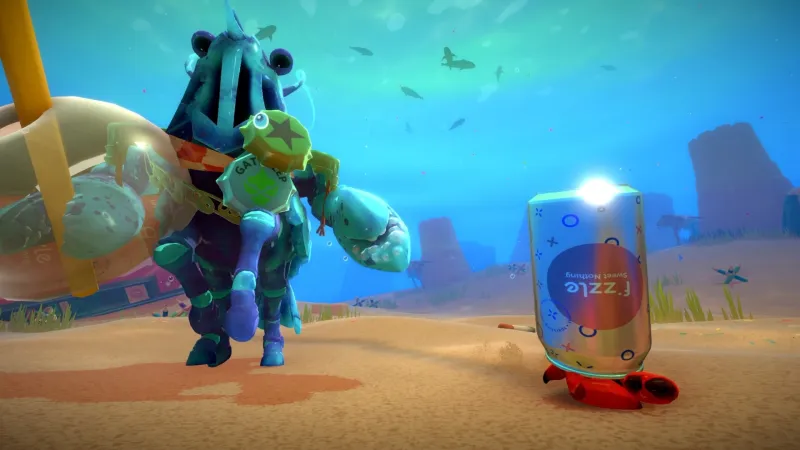
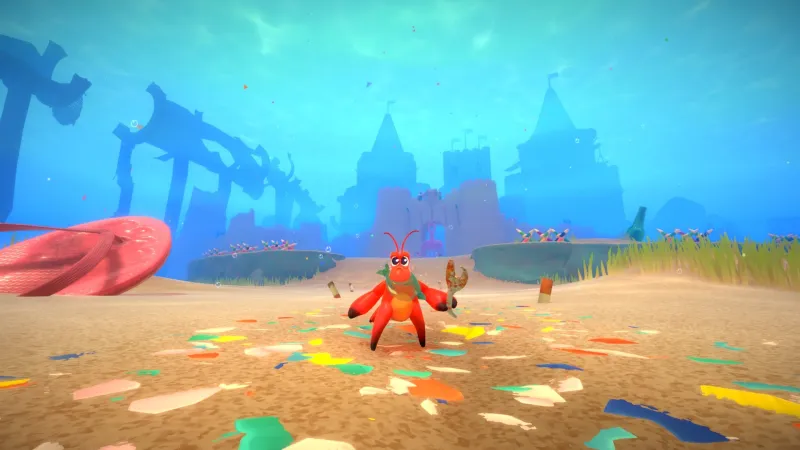
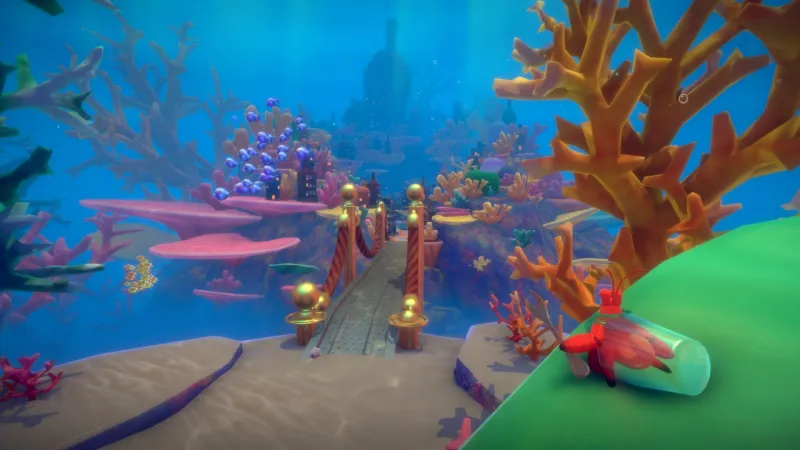
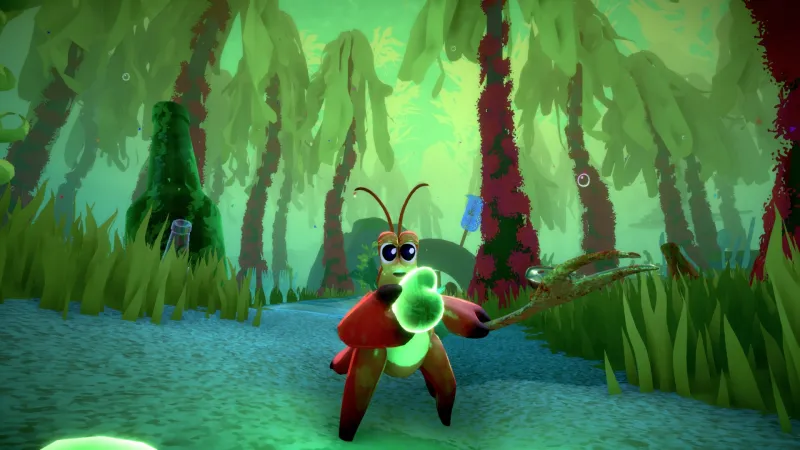
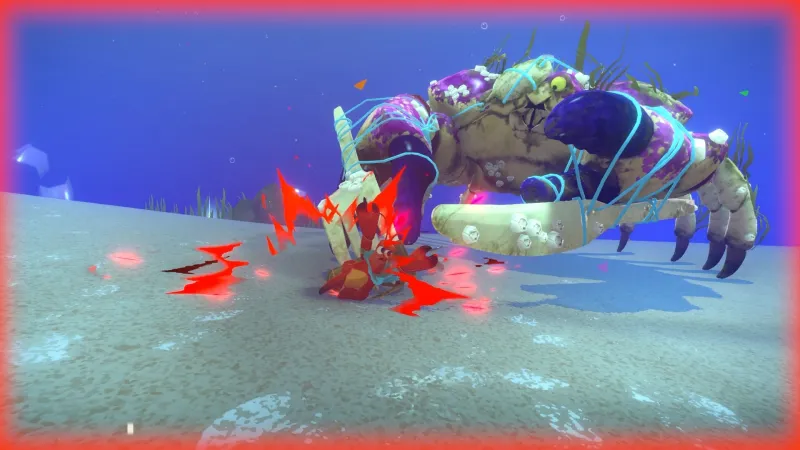
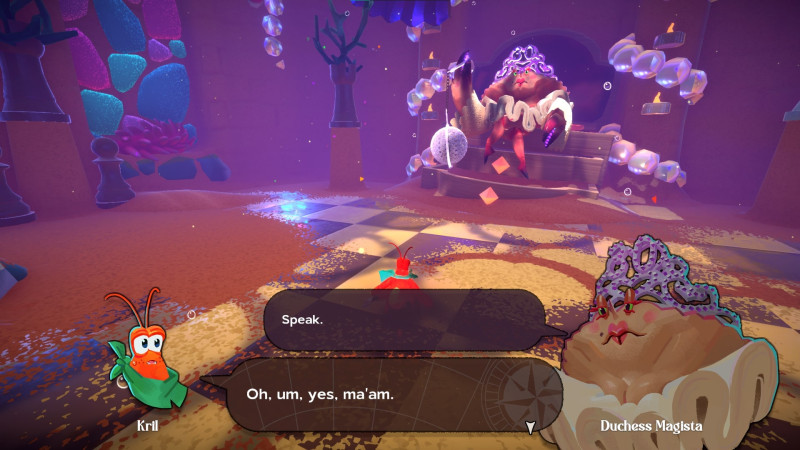
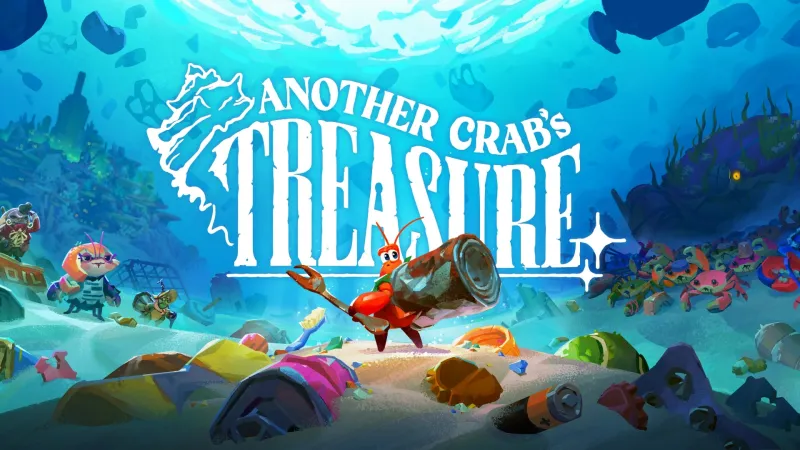
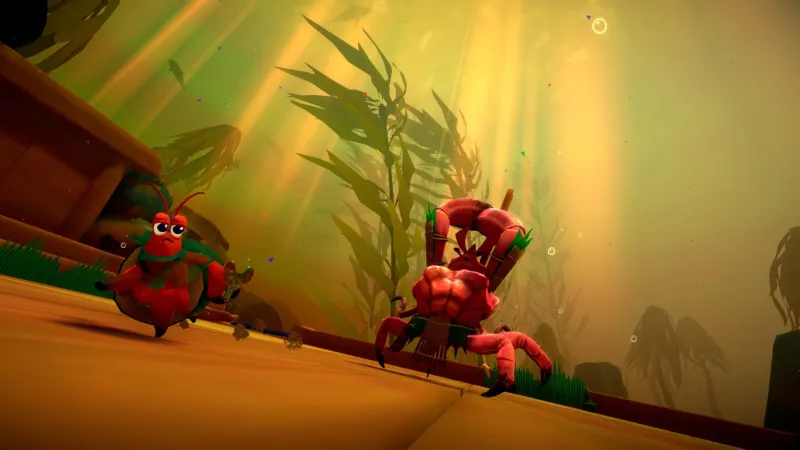
Another Crab's Treasure, as the name suggests, is a humorous and pun-filled world where the sea is your Soulslike oyster. A fork acts as your defacto sword, while various other remnants from above, like shot glasses, soda cans, and more, serve as your shield. With fork in hand and can on back, Kril, a shy but easygoing hermit crab, sets out into the aquatic kingdom to find his favorite shell, stolen from him by a loan shark tax collector. What follows is an adventure that excels at being an amusing and bright reprieve from the otherwise dark and terror-filled Soulslike genre. However, the action doesn’t hit the same highs; while unique and expansive in some ways, it feels too floaty, too imprecise, and too annoying too often, polluting an otherwise fun 15-hour jaunt through a trash-filled ocean. 

Developer Aggro Crab smartly leans into the game's premise, and the results often had me chuckling. Whether it was in-world jokes, pokes at real-world and human-made problems with the ocean, or simple wordplay (words like shuck, carp, cod, and more replace similar-sounding real-world curse words), I was constantly smiling while interacting with the various creatures of the ocean. Solid voice acting and design also make each NPC and boss a treat. 

This lean into the premise extends to the game's action, too, but it's less successful. To Aggro Crab's credit, the combat progresses meaningfully with distinct, eccentric mechanics and abilities. Instead of a standard weapon-based parry, you must hide in your shell and pop out of it right before an enemy strikes to parry properly; defeating a large crustacean boss grants you a special hammer claw-like ability for large sweeping strikes; "Umami" magic within each shell manifests in interesting ways, like a shot glass that splits into shards when attacked, a bowling ball-like roll within a tennis ball shell, or homing carbonation bubbles that shoot out of a soda can. 

Most of my joy in combat came from seeing the "new" – the special Umami magic in a new shell, the new ability gained after defeating a major boss, or the new stowaway attachment that increases my vitality or defense, for example. There's no shortage of quirkiness in the combat, and there's a respectable amount of departure that works from what I typically expect in a Soulslike. 


That's why it's a shame the foundation of the combat is so shaky. It's floaty, likely on purpose, considering Kril's adventure largely takes place underwater, but the tradeoff for that feel is impreciseness that doesn't work with such challenging gameplay. The camera is finicky, too, leaving me to fight various enemies at once who cornered me against a wall giving me no real view of what's happening. Critically, when I died in combat, it usually felt less like something I could personally improve on – an important aspect of the genre – and more like the game had cheated me into death. 

All of this is exacerbated by a story that starts strong before meandering into a rushed finale, with my least favorite area and a slew of bosses that each felt like they could have been the final in the game. It doesn't help that various game crashes and bugs in the final hours slowed my progression forward here. 

another crab's treasure review game informer 7 10 aggro crab soulslike cartoon

Though the combat, which falls between serviceable and irritating, threatened my enjoyment, I still found delight in the currents of Another Crab's Treasure. Kril's reluctance to become a hero and his subsequent journey, messaging surrounding the dangers corporations pose to our oceans, and clever twists on the Soulslike formula deliver a satisfying, albeit uneven and flawed, wade through uncharted waters.

Encouraged by Aggro Crab to try the game out on Steam Deck, I was impressed with how well Another Crab’s Treasure performs on the handheld PC device. Its visuals popped on the smaller screen, and the performance rarely dipped below 30 FPS, often climbing higher, even to 60 FPS at some points. Locking the Steam Deck’s FPS to 40 ultimately made for the smoothest experience, and Steam’s cloud saving worked flawlessly, making Another Crab’s Treasure an easy game to play at a desktop or on the couch, Steam Deck in hand.

Score: 7

About Game Informer's review system

Purchase
Stellar Blade Review - More Than A Pretty Face

Reviewed on: PlayStation 5
Platform: PlayStation 5
Publisher: Sony Interactive Entertainment
Developer: ShiftUp

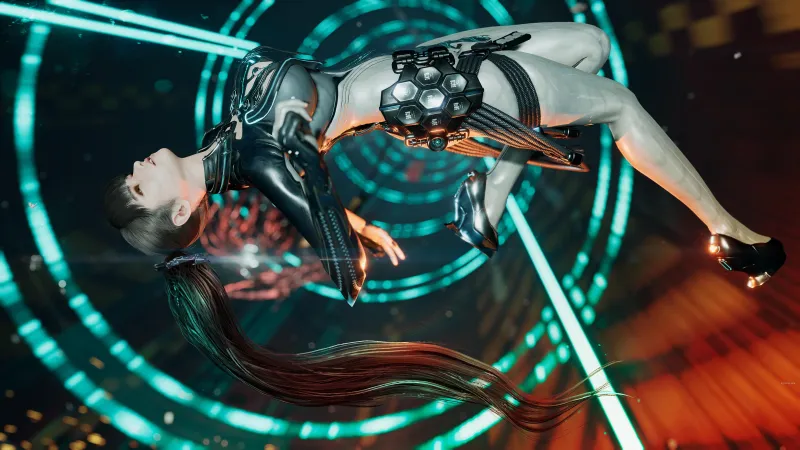
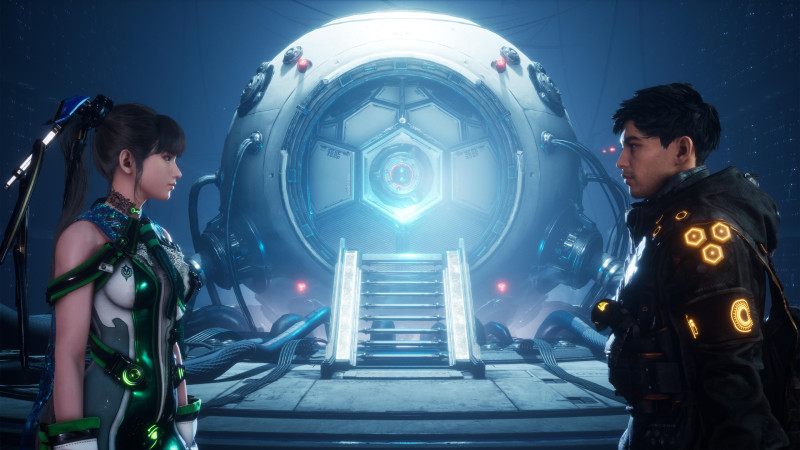
Stellar Blade’s opening minutes are an apt encapsulation of the game ahead. A beautifully rendered but confusing cinematic sets up big sci-fi stakes. A splashy character intro moment focuses on the lead character’s sex appeal. A bombastic action sequence leads into a stylish and visually arresting boss battle. It’s truth in advertising from the very start, and developer Shift Up seems to be making a statement in those opening minutes: This is what we’re about – climb aboard, or jump ship – the choice is yours.

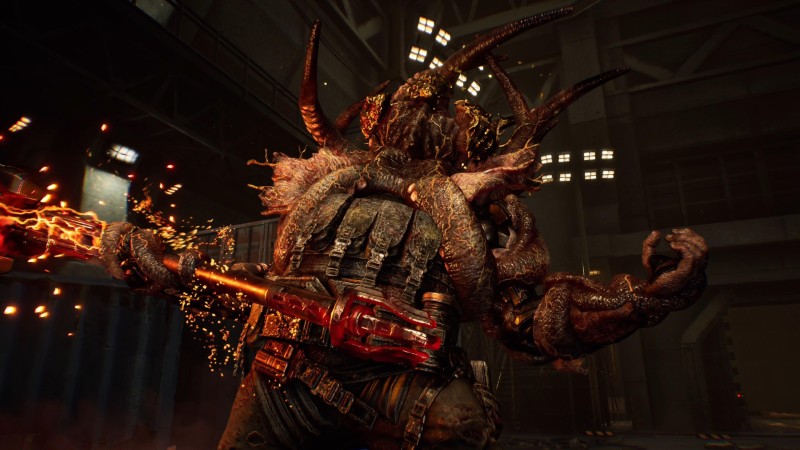
The extraordinarily versatile and rewarding action steals the show in the many hours ahead. Dedicated action gamers should have little trouble recognizing the apparent influences, from Nier: Automata and Bayonetta to the protective parrying of Soulslike games like Sekiro. Stellar Blade teeters back and forth between a fast-moving “stylish action” experience and a focus on enemy observation and tight timing windows for attack and defense. I found combat consistently challenging and exciting, with a steady curve of trickier enemies and bosses to balance against an impressive array of unlockable skills. Battle animations are smooth and varied, enemies are fascinating and grotesque, and the pace of any given fight has a film-like quality. It’s great fun.

While combat is critical, other action and exploration experiences round things out. Platforming can be enjoyable, with thoughtfully hidden optional secrets to discover. The jumping sometimes feels floaty, and it’s too easy to get caught on geometry in the environment, but it only rarely causes big problems. Other sequences, like grinding at high speed down a rollercoaster or slipping past a laser security grid, help to keep things fresh, if occasionally frustrating.

I enjoy the unusual pace and flow of the game, which gleefully meanders from linear strings of combat to moments of open-world side quest adventures and through brief excursions into horror-fueled infiltrations where your melee options are stripped away. Stellar Blade keeps the player guessing right up through a brutal sequence of final boss battles that aim to test everything you’ve learned so far. Even if there were times when things felt uneven, I was frequently just happy to be kept on my toes.

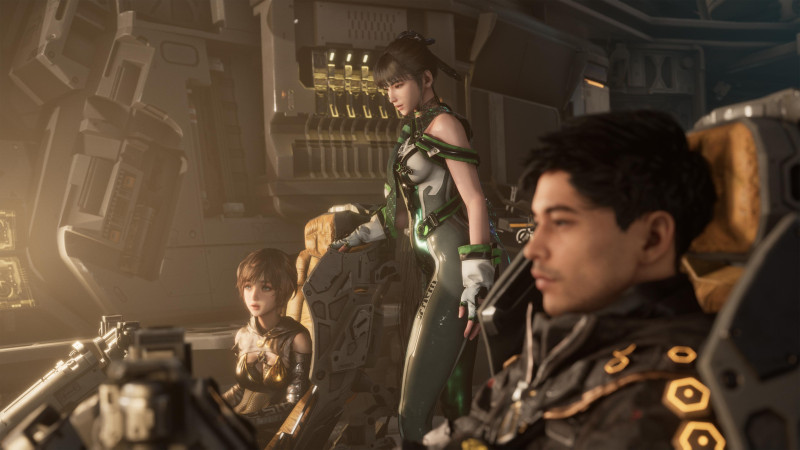
The high-concept science fiction tale is convoluted and predictable, and the dialogue often suffers from translation troubles or perhaps just a questionable starting structure. Even so, the grand scale of this post-apocalyptic setting is gorgeous, and I was happy enough to puzzle past awkward conversations just to see the next momentous setpiece or beautiful backdrop.

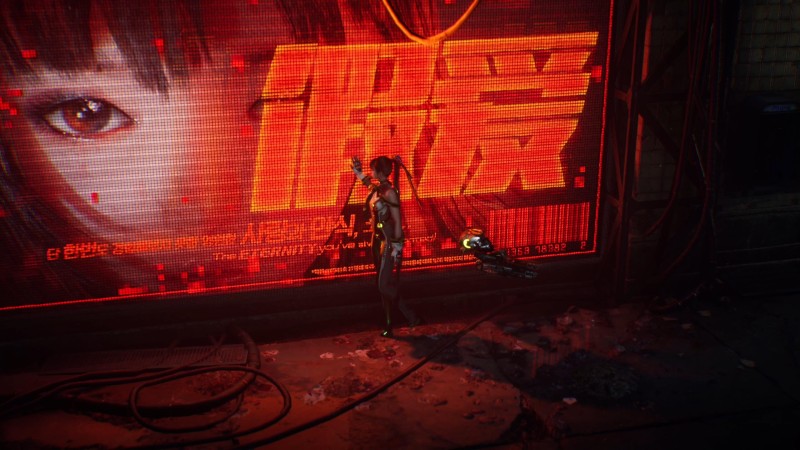
In shaping the game’s style, Shift Up embraced a hyper-sexualized character lead, not to mention a similar treatment for virtually every other female character in the story. Eve is mostly a blank slate of a character, and it’s disappointing that we see so little character development throughout her lengthy adventure. But on the visual front, there are plenty of ways to play dress-up with her hair, jewelry, and clothes. Increasingly skin-baring or fantasy-fulfilling costumes are chief rewards for exploration and quest completion. Camera angles for cinematics and big finishing moves are often provocative. Call it sex-positive or call it exploitative, but it’s a notable thrust of the game’s presentation, and players should know what they’re getting into.  

The further I played into Stellar Blade, the more it surprised me with the depth of its action and the breadth of play experiences. The story never clicked for me, but the world-building, top-notch art, and silky animation certainly did. Even when certain devastating bosses made me curse, it was always because I made a mistake and was left eager to dive back in for another shot. I loved the gradual mastery I developed as I explored its many interlocking systems of combos and special moves. Stellar Blade is unabashed in its titillating approach to sex and violence, but unlike so many games that use those appeals as a crutch, it’s also a top-notch action experience that can easily stand with the big girls.

  GI Must Play

Score: 8.75

About Game Informer's review system

Purchase
Monday, April 22, 2024

Tales of Kenzera: Zau Review - Spirit Over Substance

Reviewed on: PlayStation 5
Platform: PlayStation 5, Xbox Series X/S, Switch, PC
Publisher: EA Originals
Developer: Surgent Studios
Rating: Everyone 10+

In Tales of Kenzera: Zau, the debut game from Surgent Studios, the use of the word "Tales" is more literal than it initially seems. To kick off the events of the game, protagonist Zuberi reads a book written by his late father about a place called Kenzera. He uses fiction to cope with his grief, just as the player might do with the plot of the game, and as the studio founder, who lost his father as well, did when creating the story to begin with. While combat and map design in Tales of Kenzera falters at times, this strong, emotional core was what pulled me through to the credits.

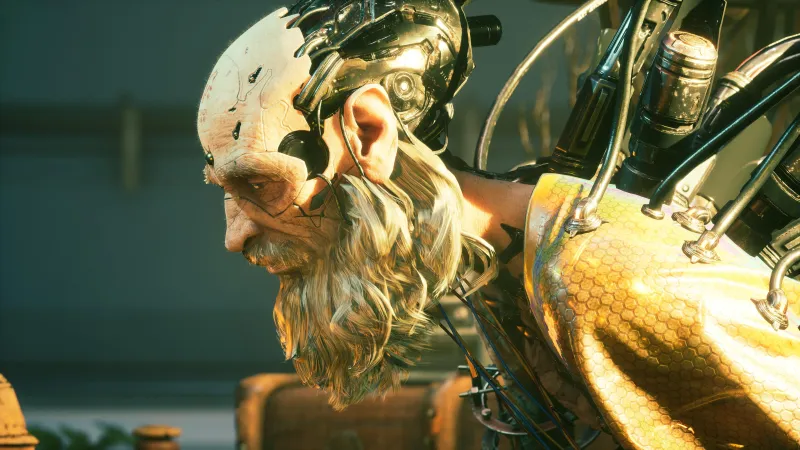
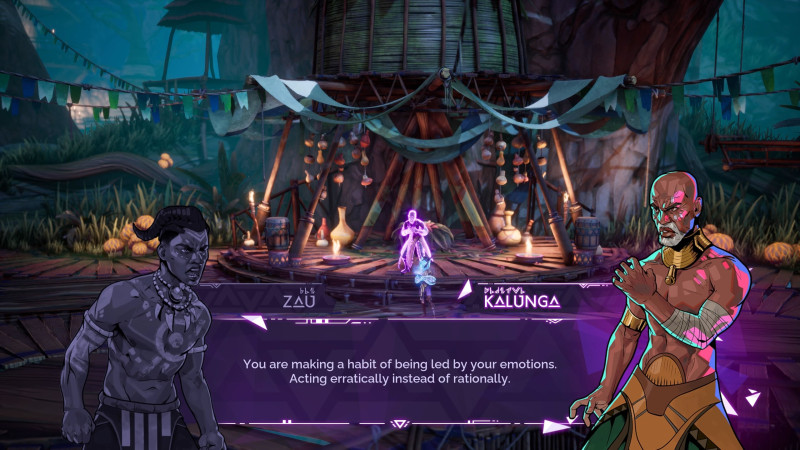
Zau is the protagonist of Zuberi's book, and he's who the player controls for the vast majority of the roughly eight-hour game. After his father's passing, he goes to Kalunga, the god of death, to perform a risky exchange: defeating three great spirits to bring his father back to life. Kalunga, who simply appears as an older human man, accompanies Zau throughout his journey, providing wisdom and guidance to level Zau's often reckless behavior. It is a stellar dynamic, and I enjoyed watching them butt heads as they struggled to deal with the other grieving characters of the game.

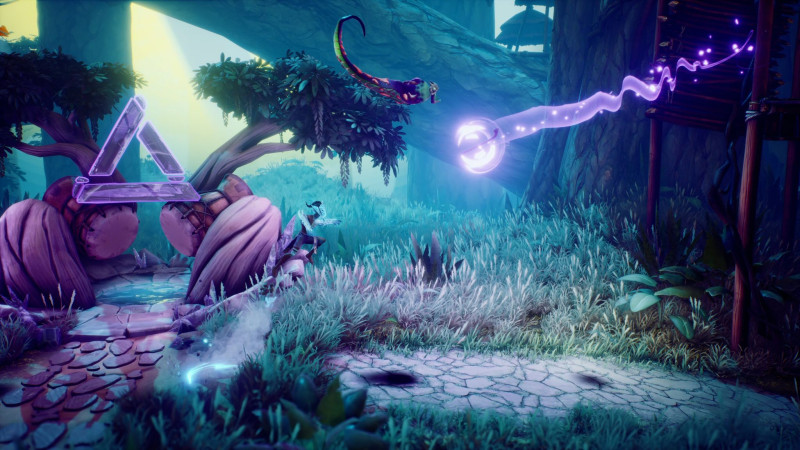
Zau battles his way through the world of Kenzera using the Masks of the Sun and Moon, relics gifted to him when his father passed. The Mask of the Moon has more ranged options with ice abilities, while the Mask of the Sun is melee-focused with fire abilities, and both are fun to use. Because you can flip between them at the drop of a hat, combat feels creative, giving the player the opportunity to flip to whichever stance fits them best at that moment. That said, later encounters with large crowds of enemies with regenerating health bars sometimes tested my love of the combat, with late-game combat encounters feeling like a chore purely based on how long they took.  

The game is also rife with platforming challenges that make use of all your abilities gained up until that point in the story, but since you start with a double jump and a mid-air dash, movement is a blast from the start. Many challenges involve instant-kill spikes, which can be irritating, but quick respawn times generally keep me from pulling my hair out. This is not the case in certain challenge sections and some chase sequences in story missions, which require you to make it all the way through with only a handful of checkpoints. They're not insurmountable, though, and allow the game to test player platforming skills as well as combat skills during boss sequences.

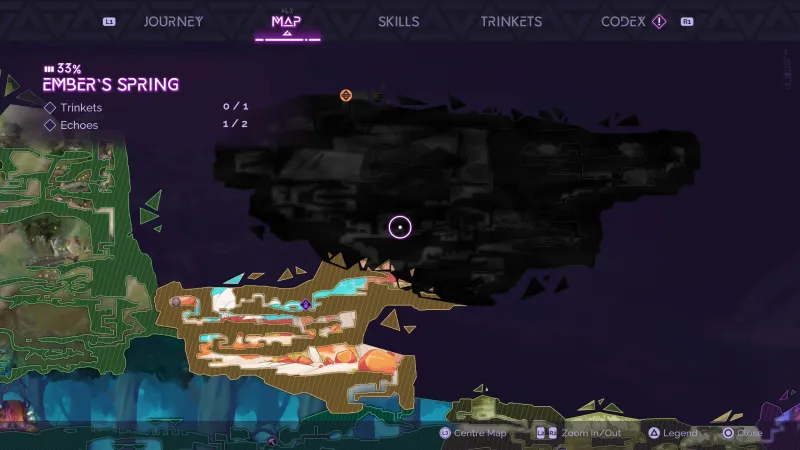
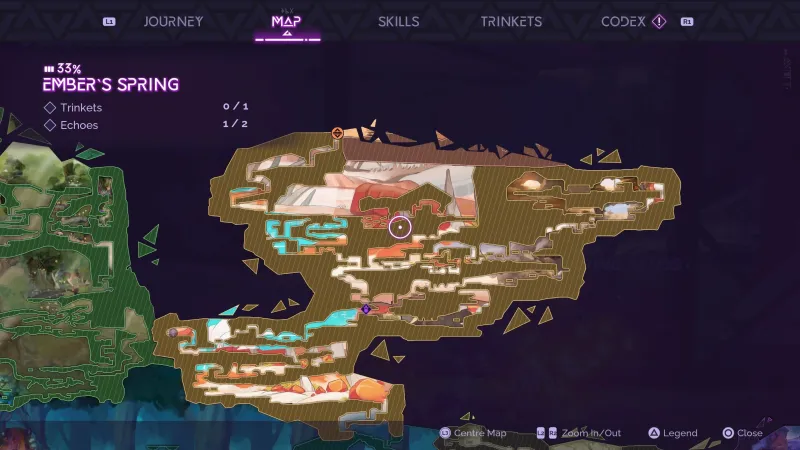
Tales of Kenzera's main flaw is its map and world designs, which turn a pretty good game into one that's uninteresting and unintuitive to explore. While most games obscure sections of the map until players explore them, Tales of Kenzera opens up an entire zone as soon as you enter a biome. It's a minor convenience for navigating through the main plot but a nightmare for figuring out where you have and haven't been. There's no way to mark the map or see where you've previously visited, save for icons that mark collected items, so in some cases, it's actually more difficult to backtrack to find secrets.


Even then, areas are pretty linear, thanks to objective markers making sure the player always knows where to go, so most secrets are just a quick little branch into a room to the left or an alternate path to the right. On top of that, most secrets only reward a small chunk of experience points, which is useful but not particularly exciting to discover and doesn't do much to incentivize further exploration. However, there are also meditation trees that increase your maximum health and platforming challenges to unlock stat-boosting trinkets, so it's still worth heading down the occasional side path.

However, the most frustrating element here is a specific set of secrets: Spirit Trials. Unlike most hidden elements, these combat challenges require the player to backtrack significantly and open an ability-gated area to proceed. I enjoy secrets, but there are only three Spirit Trials in the whole game, and they are the only way to upgrade your spirit bar and trinket slots, which are vital to Zau's abilities. It's a baffling choice to funnel both upgrades into one area and even more puzzling to hide them away like this, especially when their existence is not mentioned until you find one. If the map allowed you to mark certain areas to revisit or had a traditional un-fogging system to see where you haven't explored, it would be one thing, and if it were the norm for other secrets to require a little more work to find, it would be another. But when the player is neither implicitly nor explicitly incentivized to search for major upgrades, it creates a balance issue.

Despite my gripes with Spirit Trials and the map, I have a lot of respect for Tales of Kenzera: Zau, particularly in how it handles grief and self-reflection – it is one of the most thematically cohesive games I've ever played. Every element of gameplay and story is tied back into the dual struggle Zau and Zuberi face in coping with the loss of their respective fathers. Health upgrades come from points of meditation and the processing of emotion. Each character you encounter deals with loss in their own way, which grants perspective to Zau's situation. Even combat upgrades represent Zau's path to get closer to his father – if he can't spend time with the man himself, he'll spend time with the legacy his father left behind.

Tales of Kenzera: Zau conveys its somber themes with nuance and passion. It's just a shame the gameplay doesn't always match those highs, especially in a genre flooded with quality indies, because Zau's journey – and Zuberi's parallel journey – are stories I'll be thinking about for quite some time

Score: 7.5

About Game Informer's review system

Purchase
Sunday, April 21, 2024

Eiyuden Chronicle: Hundred Heroes Review - An Old Star Rises

Eiyuden Chronicle: Hundred Heroes

Reviewed on: PC
Platform: PlayStation 5, Xbox Series X/S, Xbox One, PC
Publisher: 505 Games
Developer: Rabbit and Bear Studios
Rating: Everyone 10+

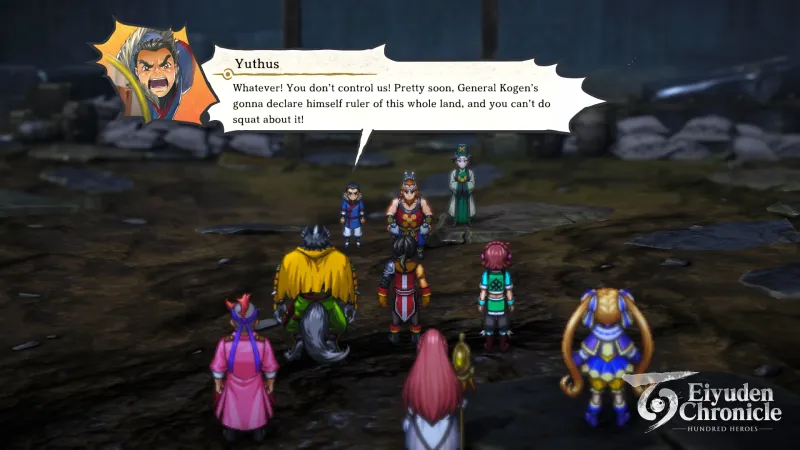
“Don’t judge a book by its cover.” A small child dressed as legally distinct Sailor Moon chirped this trite little phrase at me about an hour into Rabbit and Bear’s Suikoden successor Eiyuden Chronicle: Hundred Heroes. I’m not sure when I realized the adage applies to Hundred Heroes itself as much as it did to whatever the child was talking about. It might’ve been after I met a cleric whose vices included violence and foul language; but whenever it was, it encouraged me to overlook the misgivings Hundred Heroes’ poor first impressions raised in me, and there were plenty. Hundred Heroes adheres a bit too closely to outdated design conventions, but the strength of its writing and characters makes up for its short-sightedness.

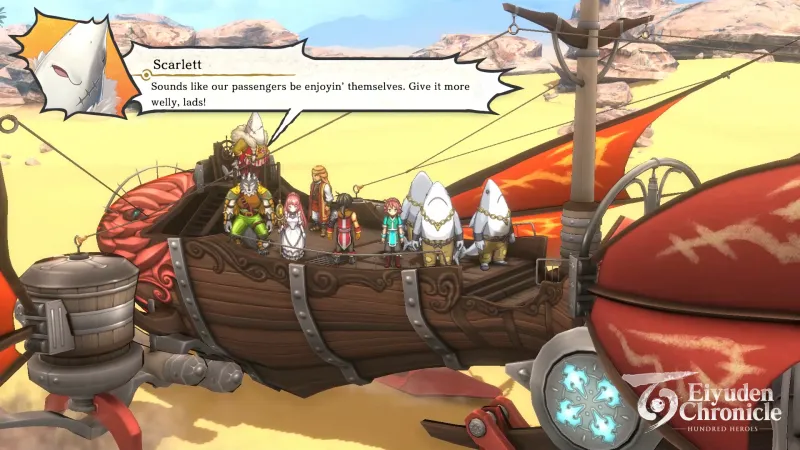
Rabbit and Bear were serious when they promised a modern Suikoden-like. You play as Nowa, a member of the Eltisweiss Watch mercenary corps devoted to keeping the peace. What starts as a piddling series of errands for nearby villages soon turns into something more serious as Nowa and the Watch get drawn into conflicts that threaten their beliefs and the entire world. Also, like Suikoden, Hundred Heroes divides its time between world exploration, where you pick up quests and new characters, battles, and dungeon crawling, the latter of which is basically an excuse for more battles.

Eiyuden Chronicle: Hundred Heroes

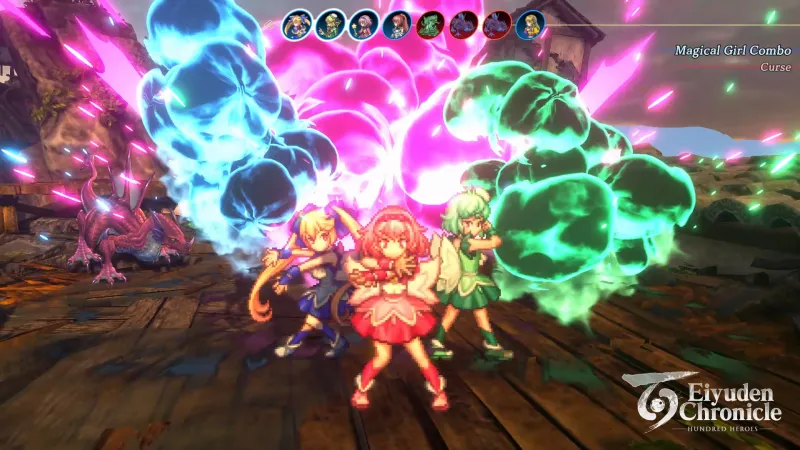
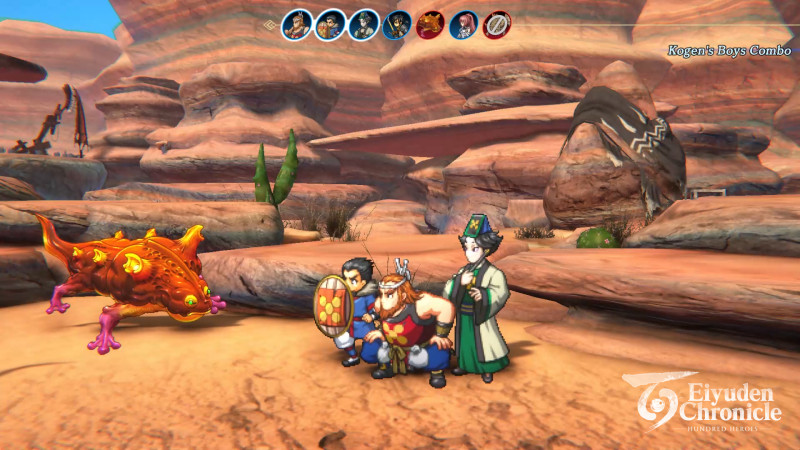
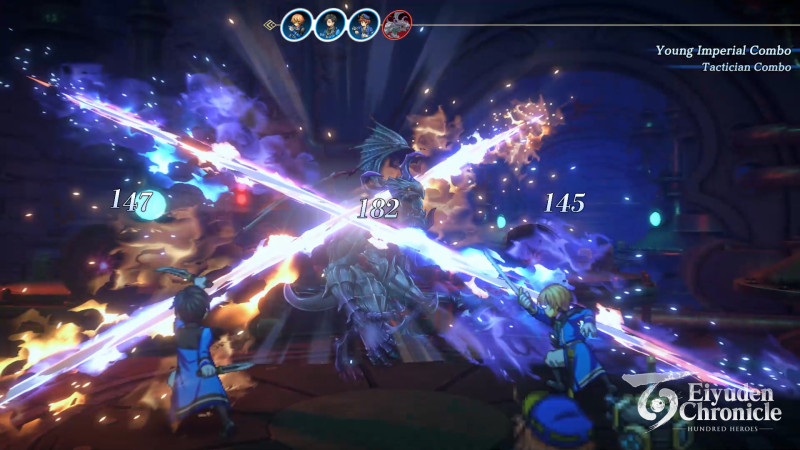
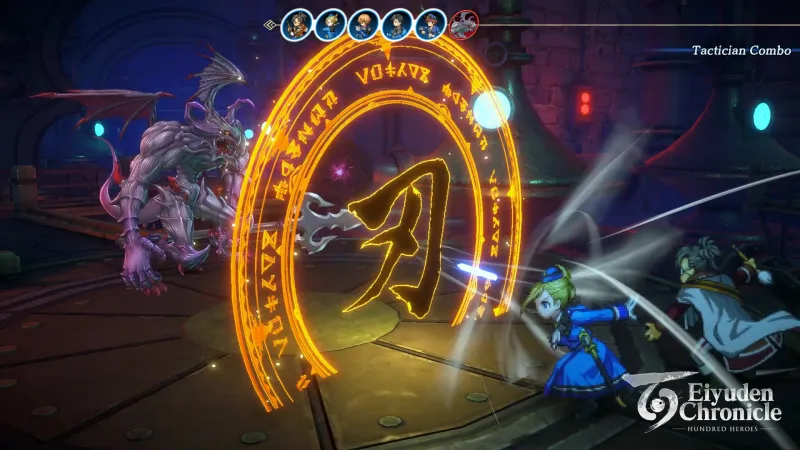
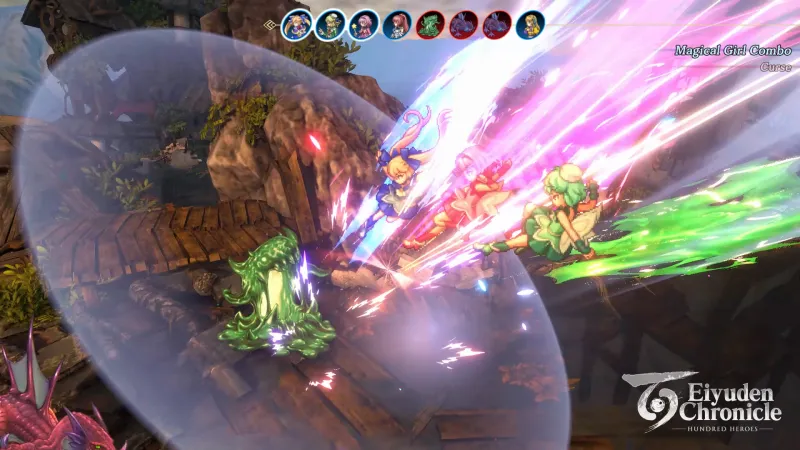
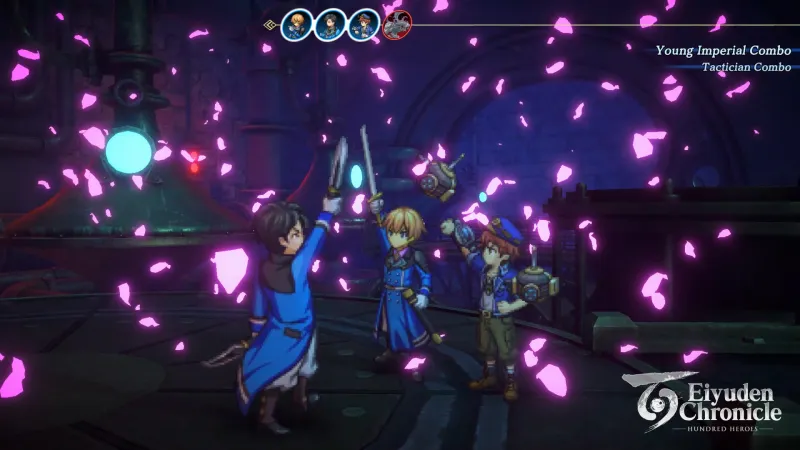
Hundred Heroes also sticks pretty close to Suikoden 2’s combat with a few refreshing expansions. Your team includes up to six active characters with skills you can augment with runes, which grant different abilities and buffs, and each character gets several rune slots that allow for extensive customization. The system is satisfying in itself but comes into its own once you start linking character attacks and forming unique combos.

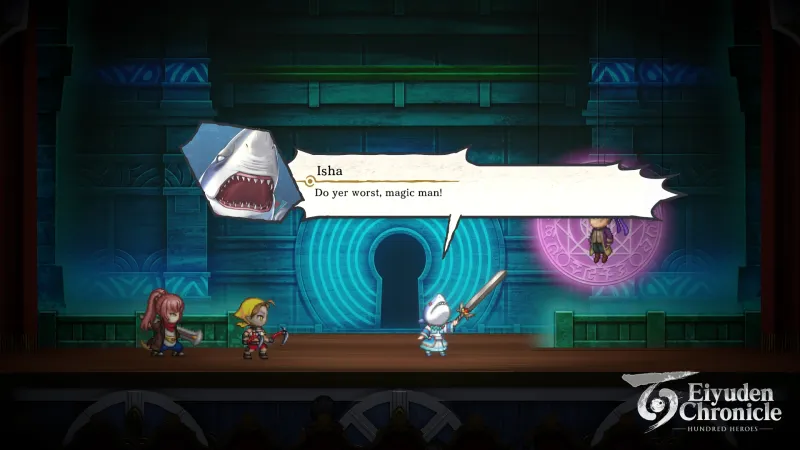
As the name suggests, recruiting the game’s 100-plus heroes plays a big role. Some join automatically, but the more interesting ones have a quest associated with them that gives a bit more insight into their personality and place in the world. They often play a minor role in the story after that, but their detailed sprite animations and voiced lines still make them feel like part of the story and not an afterthought.

The setup sounds too familiar, but despite writer Yoshitaka Murayama drawing clear inspiration from his previous works, Hundred Heroes never feels derivative and eventually surpasses its source material. It owes much of its personality to that strong cast of brilliantly written characters and a willingness to embrace humor and the ridiculous as a way to cut deeper with its serious themes of autonomy and equity.

Eiyuden Chronicle: Hundred Heroes

They also save Hundred Heroes from itself. Slow traversal, an empty world map, and tedious dungeons make Hundred Heroes more frustrating than it should be, but the promise of a new character vignette or more plot advancement was always enough to keep me pressing forward.

Hundred Heroes expands Suikoden’s base-building feature with new guilds and groups for your party members to form. At a glance, that seems like busywork, and it is. But it also represents something deeper. Your castle is a microcosm of Hundred Heroes’ themes, a small society of people who look, act, and think nothing alike but who respect each other and fight for the right to live freely, without hate.

In battle, a robust AI system lets you program commands and let your party deal with weaker enemies based on how you’ve customized their runes. Boss fights are just complex enough that they demand your full attention, though, thanks in some part to the gimmick feature. These live up to their name, for better and worse, such as making you guess where an enemy will move or forcing you to attack a specific object. They’re a nice change of pace at first but quickly outstay their welcome.


Eiyuden Chronicle: Hundred Heroes is a good reminder of why the RPG genre left some parts of its Golden Age behind. It’s also a testimony to what makes the genre special and the power of good storytelling to move and inspire. Admittedly, rigid adherence to archaic structures makes those first impressions tough to look past, but a creative battle system, extensive party customization, and top-notch writing make up for the retro jank.

Score: 8

About Game Informer's review system

Purchase
Wednesday, April 17, 2024

Children of the Sun Review - Spot On

Reviewed on: PC
Platform: PC
Publisher: Devolver Digital
Developer: René Rother

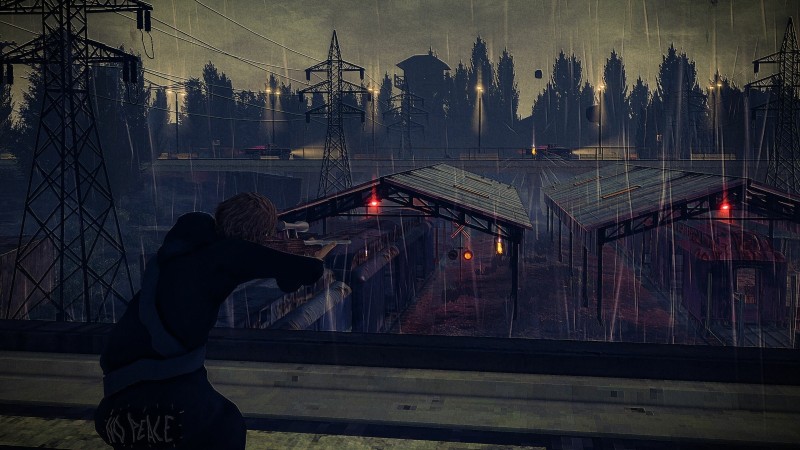
Children of the Sun is hellbent on occupying your mind. During the six hours it took me to hit credits, I was engrossed in mastering its simple, yet wonderfully executed central mechanic. At first, taking down dozens of cultists with just one bullet was a fun gimmick to tinker with. As time passed, I became obsessed with pushing the tools at my disposal to their limits, repeatedly using people as target practice until I had concocted a satisfactory murder plan.

Introduced as a puzzle shooter, Children of the Sun has you incarnating a young woman who lost her family after getting involved with the eerie namesake cult. Using just one bullet of your sniper rifle, you plunge through over 20 levels by connecting kills until you take everybody down in one swift sequence. As you make progress, the foundation gains complexity with special foes that require different strategies, as well as a handful of abilities around the bullet itself.

It's easy to see the influences from the likes of Killer7, Sniper Elite, and the latter Hitman games. But there are echoes of Ghost Trick: Phantom Detective as well, infusing inanimate objects with a paranormal force to interact with the environment, and people's bodies, to your advantage.

At the start of a level, you only get a narrow view of the whole map, so to speak. Ideally, you want to tag every single cultist before pulling the trigger, so you can plan ahead of time – similar to scanning a room in Hotline Miami before kicking down the door. More often than not, you first need to kill a few of them just to tag others or get a better view at the far end of an area. It makes for a compelling exploratory phase that doesn't frustrate but rather encourages you to fail until you've gathered all the visual information you need.

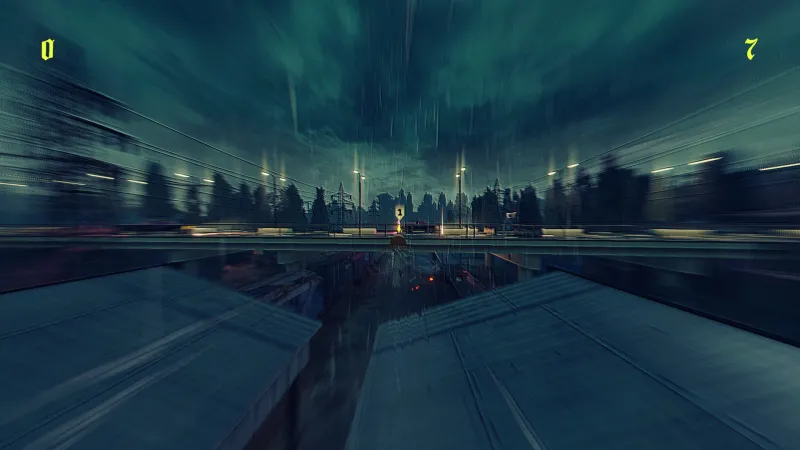
Time slows down when you're moving the bullet. It also completely stops once you hit a target. This gives you some breathing room, and a chance to gain a different perspective. You can shoot birds to gain altitude or gas tanks to find an angle that allows you to continue chaining down targets, for example. Yet, you're rewarded via a scoring system for executing a killing with style and aggressiveness. It works as the perfect contrast to the exploratory phase, forcing you to see whether your plan can be executed swiftly or if you need another strategy. There's a leaderboard at the end of each level that incentivizes you to push for this cruel finesse, as well as vague clues for challenges to uncover.


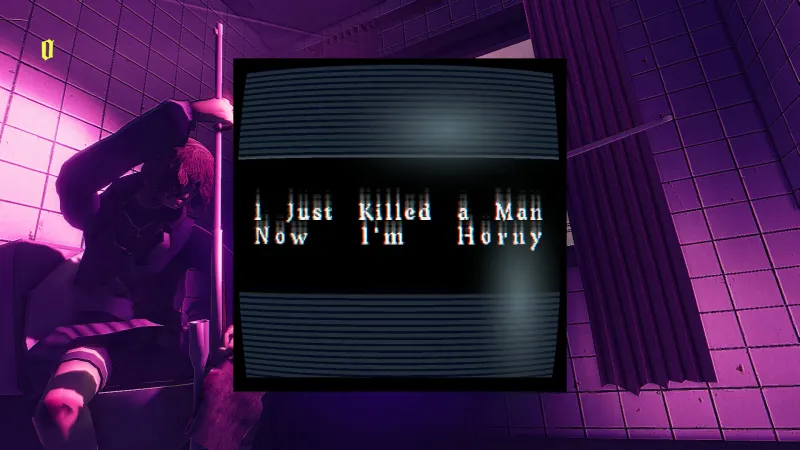
The macabre tone of Children of the Sun pairs well with its human gamification. Shooting an arm gives you 25 points. Shooting a groin rewards 50 points instead. The over-the-top violence turns gratuitous after seeing the words "I Just Killed a Man, Now I'm Horny" before playing a Pac-Man-style minigame during a special level. The abrasive tone never comes off as mere window dressing for the sake of shock value but rather thrives in its repulsiveness.

Both the visual and sound design work make for a haunting sensorial stimulation. There were times when I felt underwater, zip-zapping from one corner of an ocean to the next as the bullet pierced head after head, like waves colliding against each other. The effect of a late-game ability, which allows you to increase the speed of a shot, sounds like an electric guitar distorted to the brim with effect pedals.

Children of the Sun is a prime example of an experience born from a straightforward premise and then iterated for the right amount of time before it loses its charm. On occasion, the central mechanic can't keep up with itself – I missed more than a few finicky shots that should have landed, forcing a retry. But once you successfully execute a strategy and finish a level, the satisfaction is unmatched. You then seek to replicate the feeling during subsequent hunts, completely alienated from the messiness of your actions as you chase a higher score.
GI Must Play

Score: 9

About Game Informer's review system
Purchase