This is default featured slide 1 title

Go to Blogger edit html and find these sentences.Now replace these sentences with your own descriptions.This theme is Bloggerized by Lasantha Bandara - Premiumbloggertemplates.com.

This is default featured slide 2 title

Go to Blogger edit html and find these sentences.Now replace these sentences with your own descriptions.This theme is Bloggerized by Lasantha Bandara - Premiumbloggertemplates.com.

This is default featured slide 3 title

Go to Blogger edit html and find these sentences.Now replace these sentences with your own descriptions.This theme is Bloggerized by Lasantha Bandara - Premiumbloggertemplates.com.

This is default featured slide 4 title

Go to Blogger edit html and find these sentences.Now replace these sentences with your own descriptions.This theme is Bloggerized by Lasantha Bandara - Premiumbloggertemplates.com.

This is default featured slide 5 title

Go to Blogger edit html and find these sentences.Now replace these sentences with your own descriptions.This theme is Bloggerized by Lasantha Bandara - Premiumbloggertemplates.com.

Wednesday, November 30, 2022

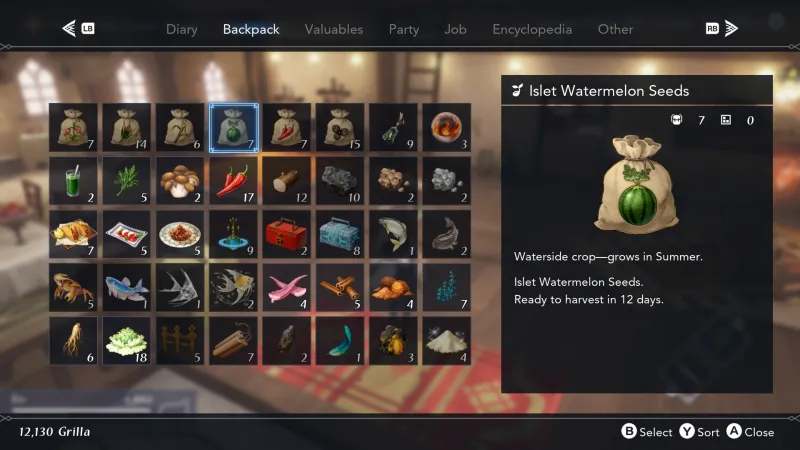
Harvestella Review – So Much For So Little

Harvestella Review

Reviewed on: Switch
Platform: Switch, PC
Publisher: Square Enix
Developer: Square Enix
Rating: Teen

Harvestella wants to be a jack of two trades, but winds up a master of none. Part action-RPG, part farming/life simulation, this combination can sometimes be enjoyable, but the two styles clash more often than not. The result is a sluggish grind more likely to repel fans of each genre than bring them together.

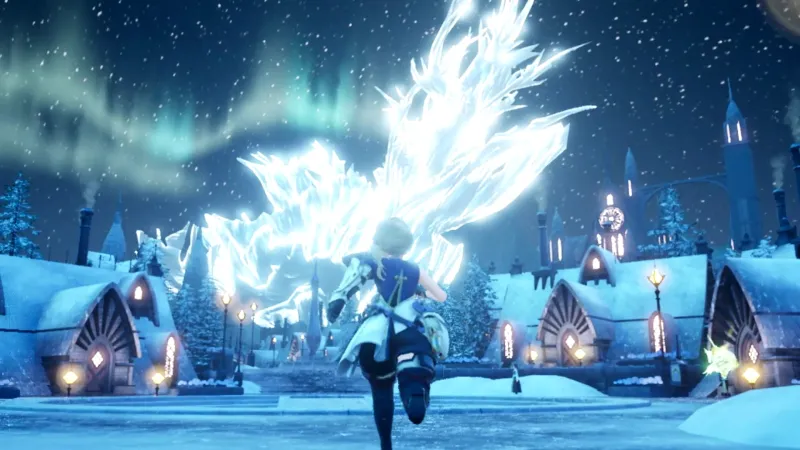
As an amnesiac warrior, you awaken on the outskirts of a quaint village, unaware of your origin and purpose. Four powerful, monolithic crystals called Seaslight govern the environmental stability of the picturesque continent, namely its seasons. However, a deadly fifth season called Quietus occurs between each of the four normal seasons, wiping out crops and endangering humans. This strange normalcy becomes unstable when the Seaslight begin behaving irregularly, seemingly triggered by the mysterious arrival of Aria, a young scientist from the distant future. Like you, Aria is clueless about how she got here, so you partner up to discover your respective origins while also combating a global crisis. Oh, and building a nice farm too. 

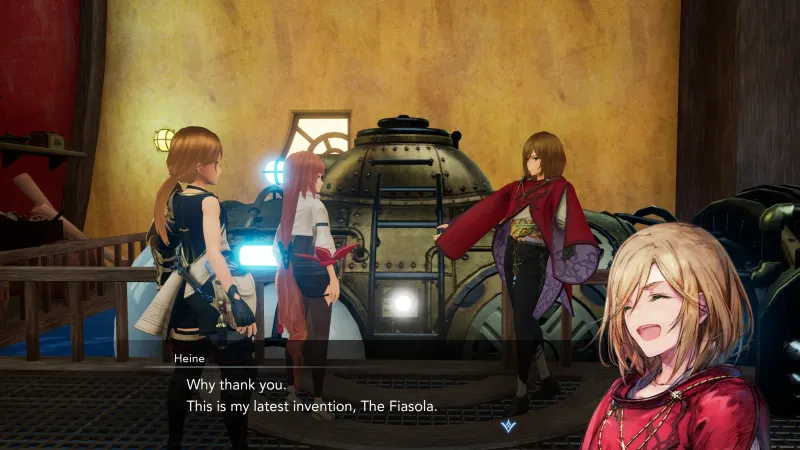
To its credit, the plot is engaging in its absurdity. In typical JRPG fashion, the mystery gradually becomes more grandiose and unhinged as it unfolds. While much of it is silly, I found little of it boring. One revelation made me laugh out loud at how bizarre it is, and I can’t help but respect Harvestella’s willingness to take some wild turns while sprinkling a few poignant moments. A large band of likable party members, such as a smooth-talking inventor, an A.I.-powered robot, and a talking unicorn, joins the primary duo, but you largely spend time with them one-on-one. As such, you don’t often see everyone hang out together, and when they do, the lack of group chemistry is noticeable and disappointing. It’s like inviting a bunch of good friends to hang out who know you, but not each other. 

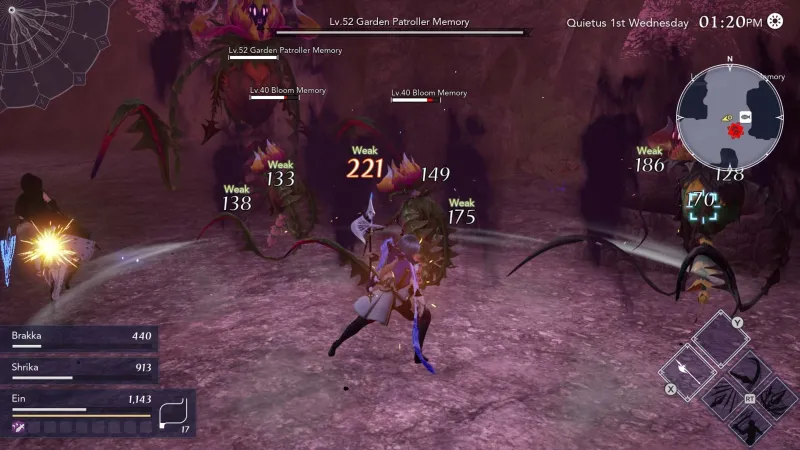
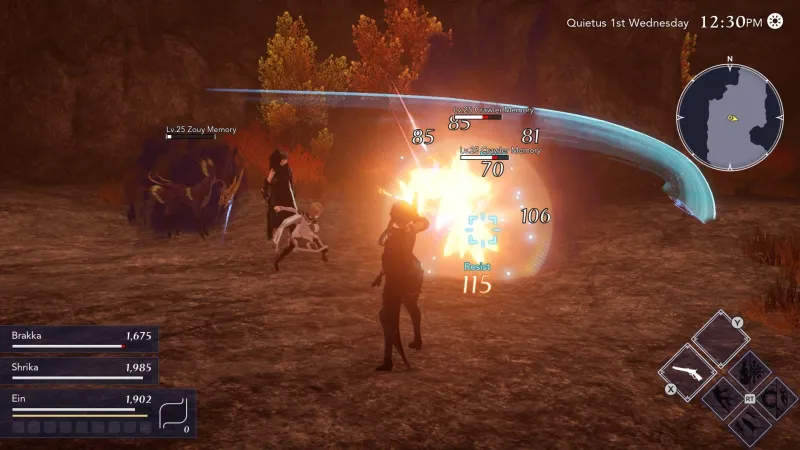
Harvestella promotes two styles of play but feels like an action-RPG first and a farming game second. Gameplay involves running through bland dungeons and hacking apart foes, collecting crafting materials and ingredients along the way. A robust job system offers a good variety of playstyles, but I only gravitated toward a few of them. My favorites include the nimble, combo-centric Shadow Walker and the dancing floating blades of the Pilgrim class. Other jobs, like the Mechanic and singing-focused Woglinde, simply aren’t fun to use, and the game rarely encouraged me to experiment once I settled on my favorites. Even with classes and attacks I enjoyed, the combat is middling, and bosses are either pushovers or infuriatingly cheap. 

Farming fans won’t find much unique about Harvestella. You plant crops on tilled land that can be expanded in size several times, process food using machines, but you only rear two animal species. The farm changes with the seasons, which shift every 30 days, and certain food can only grow during specific times of the year. Quietus, which only lasts a day, eradicates crops, but I found it easy to plan around, making it less threatening than likely intended. 

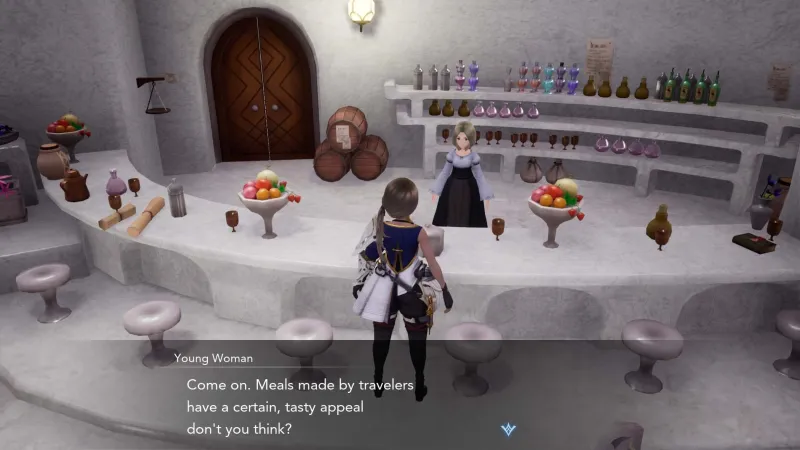
Like combat, farming only feels passable, but is crucial to success. Selling crops serves as one of the few ways to earn money. You also need a full pantry to whip up a variety of dishes. Eating keeps your belly full, which in turn fuels your stamina bar. This meter governs actions such as farming, sprinting, and even executing special attacks. Eating also replenishes health, often in large amounts depending on the dish. However, you can’t eat if you’re full, which becomes a maddening hindrance during tough battles. Since traditional health potions don’t exist, you’ll be making all of your recovery items. Doing so takes time which feeds into Harvestella’s biggest nuisance: the clock.
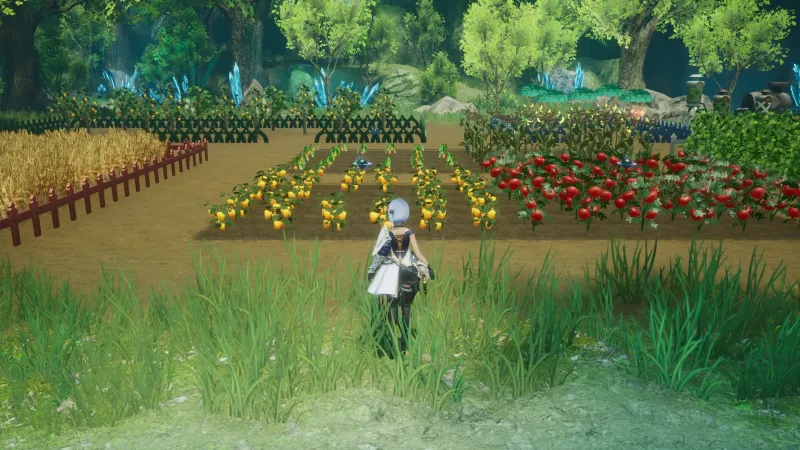
Harvestella operates on an in-game day/night cycle that advances in 10-minute increments faster than you expect. Night begins at 6 p.m., and your character becomes sleepy at 10, slowing their stamina recovery. Thus, returning home to crash in your bed – and only your bed as, annoyingly, you can’t sleep at the game’s several inns – is vital. Staying out past midnight causes your hero to collapse from exhaustion, warping them back home. Falling to exhaustion or death comes at the oppressively steep price of paying an increasingly exorbitant doctor’s fee while clicking through the same unskippable cutscene. It’s a loathsome penalty that’s too strict for its own good. 

Since you have to drop everything to return home each night, progress becomes a massively slow grind. Dungeon crawling consists of inching forward before you have to stop and resume the next day. Simply reaching a location on the world map burns precious minutes until faster means of travel open up. Even after finding shortcuts and fast-travel checkpoints, you still rerun sections of a dungeon repeatedly until you reach uncharted territory. Doing so inevitably drains your food supply, so you have to set aside time to cook beforehand. Making dishes eats a substantial chunk of the day, limiting the time to adventure. Running out of cooking ingredients means growing more of them, as only a handful of staples can be purchased. That means spending at least a few days waiting for crops to replenish, then creating enough food to venture back into a dungeon, and repeating the cycle all over again.

This framework effectively makes it impossible to progress the story for very long. There’s often so much work that has to be done beforehand that I was often lucky to have enough daylight to pursue the missions I wanted. This frustrated me most when the plot hit an interesting turn, and I wanted to see what came next. It’s an awful form of gating, as progress is bottlenecked no matter how powerful or well-equipped I was. In some cases, it can take days of work and prep to complete a single dungeon floor. 
 

When I didn’t have enough time in the day to complete a story mission, Harvestella admirably provides plenty to do outside of the main narrative and farming. A ton of multi-chapter sidequests await, though most of them involve reading lengthy conversations, completing a basic combat encounter, or running tedious errands. Despite a few interesting stories, these missions aren’t great, but the game makes completing them worthwhile, for better or worse. Side missions offer tons of cash, vital recipes, blueprints, and seeds. To my chagrin, completing as many as possible became a necessary evil. I preferred the party bonding missions, in which I learned about my teammates’ troubles by helping them through unique storylines. These quests were at least more interesting and rewarded me with enhanced physical perks, such as greater strength, defense, etc., practically making them required playing. 

Though it runs well, Harvestella also suffers from graphical glitches that make it feel unstable at times. Specifically, a strange bug where half of the screen occasionally flickered a solid color, whether docked or in handheld mode. The game also doesn’t look great on the big screen due to its low-resolution textures and models.

Harvestella’s systems feed together in a way that forces you to engage with nearly everything it offers, whether you want to or not. But those slice-of-life activities are mundane and get in the way of letting you enjoy the RPG elements on your own terms. Maximizing a day’s schedule is sometimes rewarding, but the sluggish pacing makes it tough to stay engaged for the long haul. Harvestella forces you to do a whole lot to complete comparatively little. At 70-80 hours, it’s one of the biggest chores I’ve played in some time. That’s unfortunate because the combat, story, and characters are decent enough that, in a more traditional RPG framework, they’d shine brighter. As it stands, squeezing this fruit isn’t always worth its small amount of juice.
Score: 6.75

About Game Informer's review system

Purchase

Tuesday, November 22, 2022

Vampire Survivors Review - Single-Stick Masterpiece

Reviewed on: PC, Xbox Series X/S
Platform: Xbox Series X/S, Xbox One, PC
Publisher: Poncle
Developer: Poncle
Rating: Teen

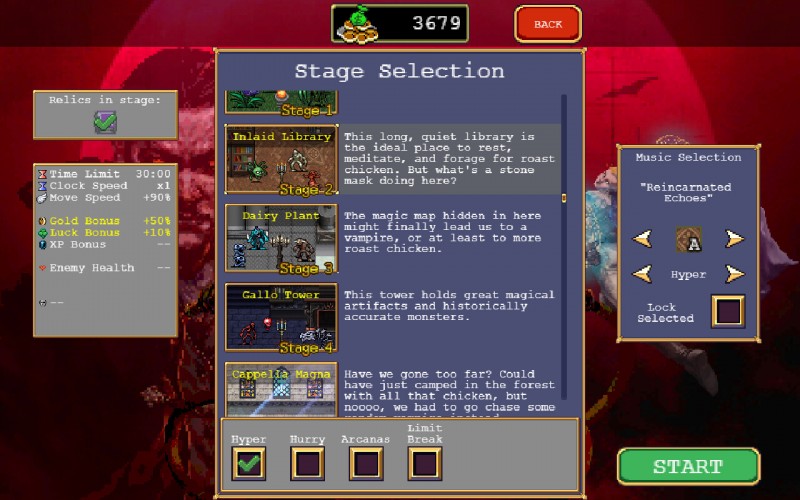
Ever since it hit Early Access on Steam last December, the cult of Vampire Survivors has grown and spread its gospel far and wide. Over the past year, the seemingly simple game has expanded with a steady stream of free updates adding astonishing amounts of depth and content. The fantastic gameplay and compelling progression system combined with a ridiculously low price point made Vampire Survivors extremely recommendable. That tradition continues in the full game release making over 50 hours of pure gaming bliss accessible to a larger audience.
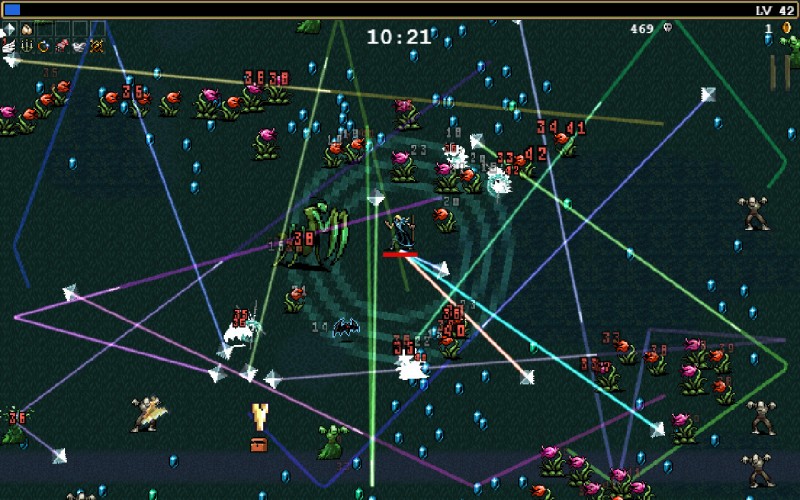
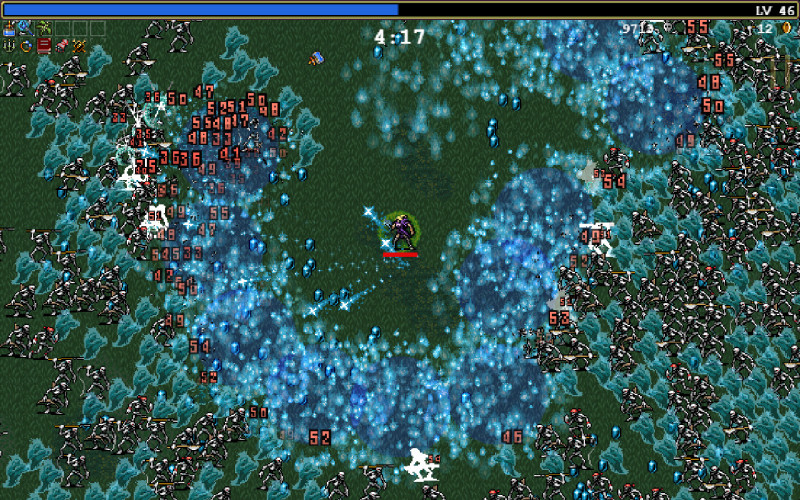
Vampire Survivors starts out simple enough. You only use the left analog stick to move around, and your attacks automatically happen at regular intervals. Monsters approach non-stop from all directions as you dodge through the gaps and make sure they’re in your attack radius. The Castlevania influence is clear as you start with a whip and take on creepy creatures from classic gaming horror in addition to imaginative original creations. If you can last 30 minutes, Death will swoop in for an instant kill, but you can consider that "beating" the level.

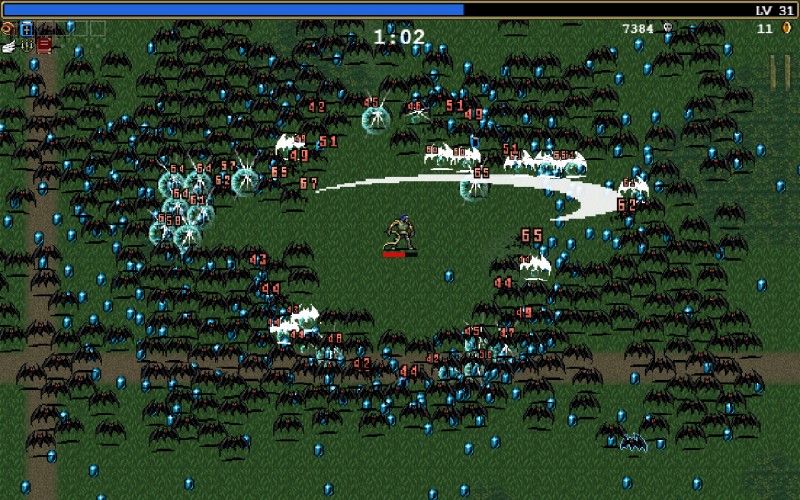
Every attempt starts you at a base level with only your character’s starting weapon. While they may seem insufficient at first, almost all offensive options can be built to feel amazing. Blast a firehose of knives in front of you to clear a path. Melt a colony of bats as you wade through them with garlic’s circular field. Take shelter in a cloud of fighting cats. Every weapon type I could imagine and several things I would never have dreamed of were all at my fingertips.


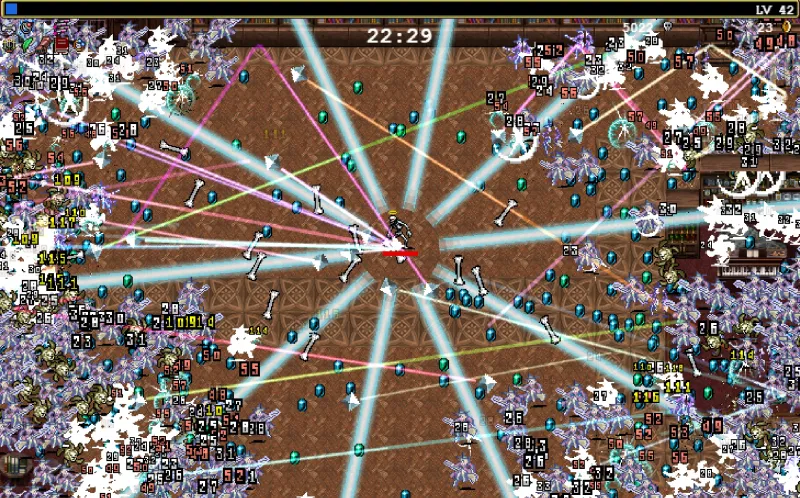
You’re constantly making decisions, weighing the pros and cons of every randomized item presented during the leveling process. At maximum, you can have six weapons all firing at once in addition to six accessories that modify weapons and gameplay, like increasing the size of projectiles, reducing cooldown time, or increasing the rate of experience gained. On top of that, certain weapon and accessory combos provide ultra-powerful evolutions that can turn the tide at your darkest hour. It’s difficult to convey the supreme satisfaction you feel when your incomprehensible barrage of attacks makes it impossible for enemies to hurt you, no matter how hard you try to kick the hornets’ nest. I rarely take screenshots or videos of games I’m playing, but Vampire Survivors puts on such a glorious show based on your smart choices that I couldn’t help but share it.

Developer Poncle has expertly balanced the rollout of unlocks so you’re never overwhelmed by the mix of weapons and powers, but you never tire of them either. There’s always a new character, weapon, accessory, or mechanic to look forward to all the way to the very end. The initially daunting list of objectives provides a sense of direction and gets you to experiment outside of your comfort zone. In one run, I’d blow it or get a bad shake on level-up options and die without checking off any objectives, but the next, I’d have a perfect run and accomplish a dozen tasks. The unlocks/achievements rain down in a gratifying flurry of dopamine hits. Even when you fail, you learn something and gain more gold to unlock permanent upgrades at the in-game shop. 
Almost every rule you come to know (including many mechanics described above) gets completely upended or twisted as you progress deeper into the game. Vampire Survivors loves setting your expectations and completely subverting them. At several points, I exclaimed, "What the hell is happening? Wait, so I can do this now?" Everything is built to make it impossible to resist that next run. "Well, I have to see how this crazy-looking new character plays." "What’s this unsettling new stage?" "This other strategy has to work. This can’t wait until tomorrow."

My only hesitation in recommending it to Xbox players is the unwelcome presence of launch bugs that impede stage and achievement unlocks for some and other strange odds and ends. Patching has helped so far, and I hope it gets to be as relatively issue-free as the PC versions soon. 

Despite these early console setbacks, Vampire Survivors has quickly become one of my favorite games of all time. Consider this me grabbing the sides of your head and shouting, "Play Vampire Survivors, you fool!"

GI Must Play

Score: 9.75

About Game Informer's review system

Purchase

Monday, November 21, 2022

Pokémon Scarlet And Violet Review – The Struggles Of Evolution

Reviewed on: Switch
Platform: Switch
Publisher: Nintendo, The Pokémon Company
Developer: Game Freak
Rating: Everyone

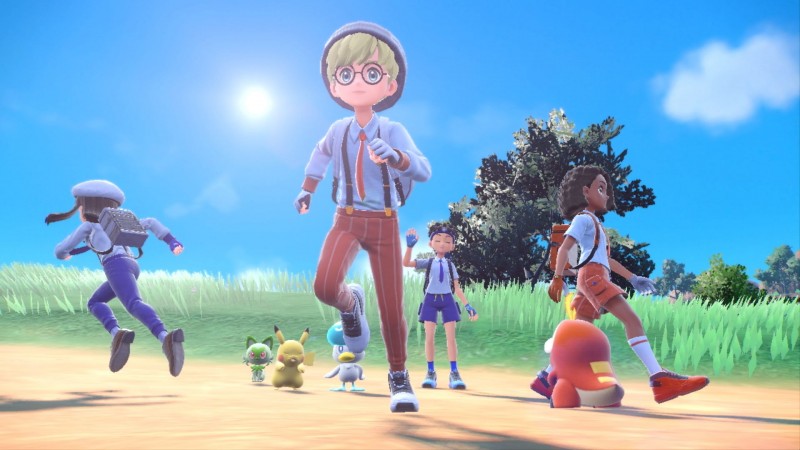
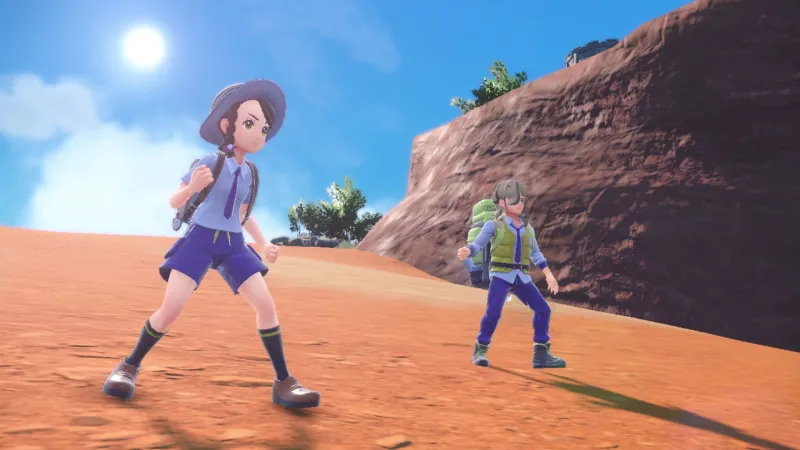
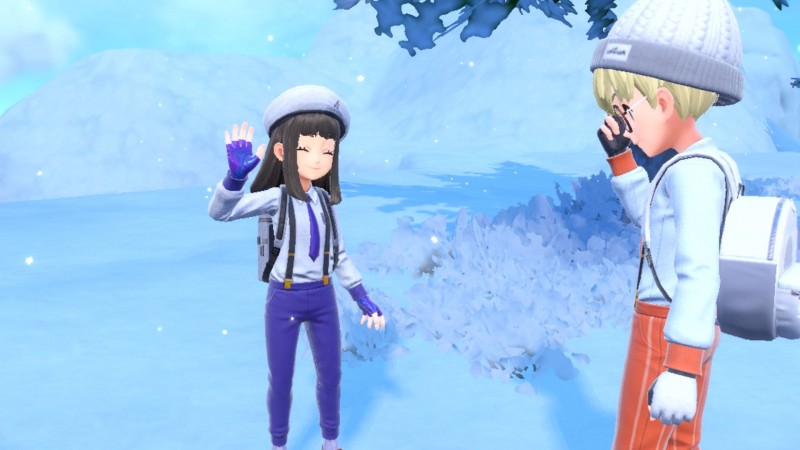
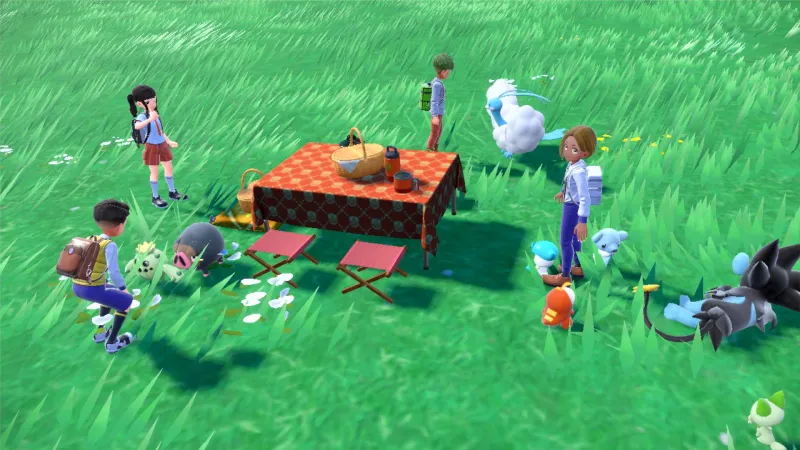
Each new generation of Pokémon promises changes and iterations to the long-standing franchise formula. Pokémon Scarlet and Violet kick off the ninth generation of Pokémon games, offering some of the biggest changes to date. An open world, four-player co-op, and other additions effectively push the series forward in meaningful ways, but the technical shortcomings often break immersion and temper an otherwise strong Pokémon game.

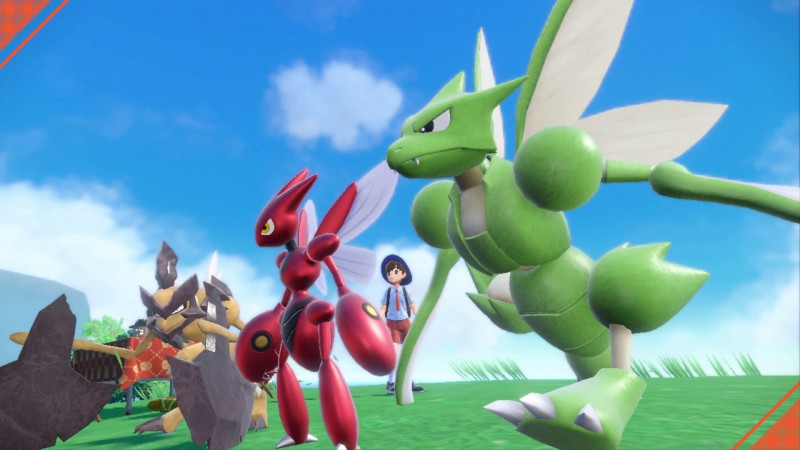
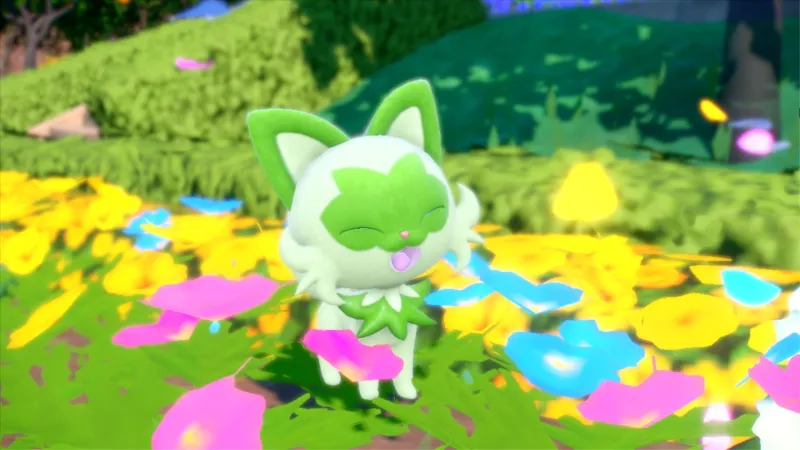
The Pokémon formula remains mostly intact through Scarlet and Violet. Your main goals still involve catching, training, and battling the Pokémon that inhabit the world. But this time, you do so in the series’ first true open world, expanding the formula in unprecedented ways. The Paldea region is ripe for exploration, with diverse biomes and various nooks and crannies in which to hunt. Thanks to a wide swath of Pokémon, new and old species alike, I always felt rewarded for journeying off the beaten path. When I did discover an all-new monster, I often appreciated the design, making this batch one of my favorite new generations in a long time.

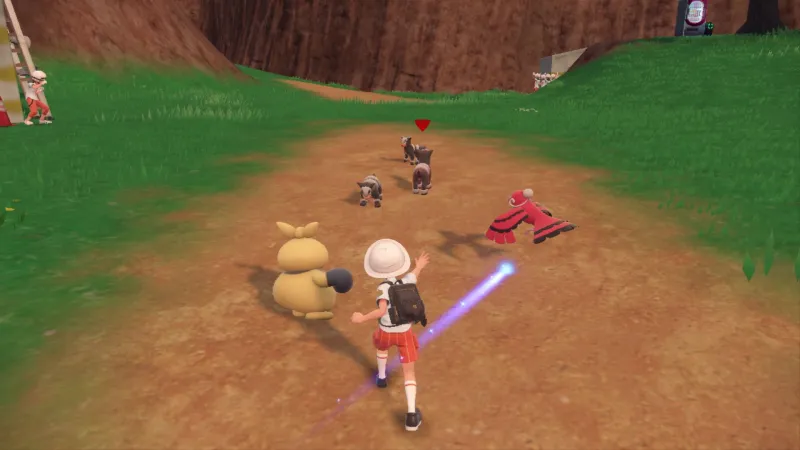
Thanks to this open-world approach, most battles are now optional. Trainers occupy the world, but you must initiate the battle with them to start. I like this approach, as it let me skip fights I wouldn’t otherwise want to be in, though the money, experience, and rewards often make them worthwhile. The same could be said of wild Pokémon encounters, which only happen if you run into them; random encounters are completely gone this time around. You can also use the new Let’s Go mechanic, where you send your lead Pokémon out to auto-battle, if you’re just looking for quick experience and crafting materials.

Unfortunately, the larger world comes at a cost, as Pokémon Scarlet and Violet suffer from poor performance across the board. Characters pop in and out of existence before your eyes, textures appear in extremely low resolution, and the frame rate stutters around every turn. Game Freak shot for the stars with its first open world, but it’s clear it still has a ways to go when it comes to making it work on Switch. 

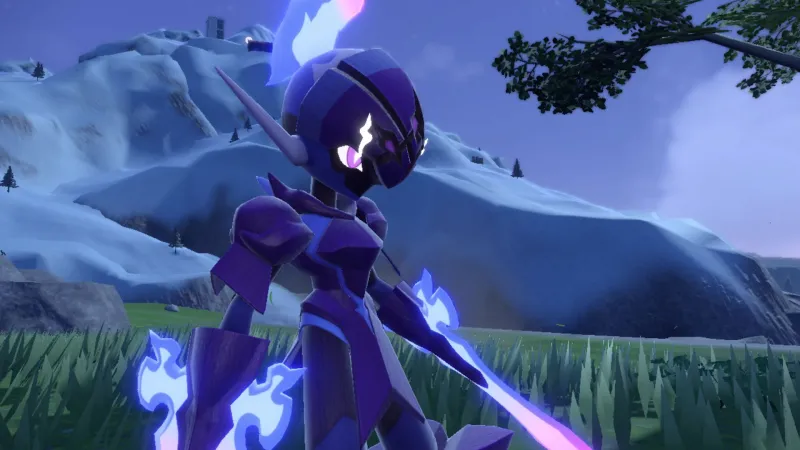
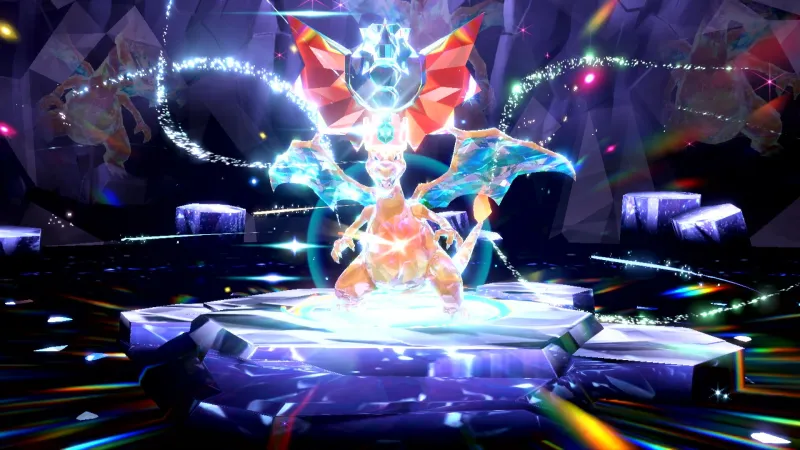
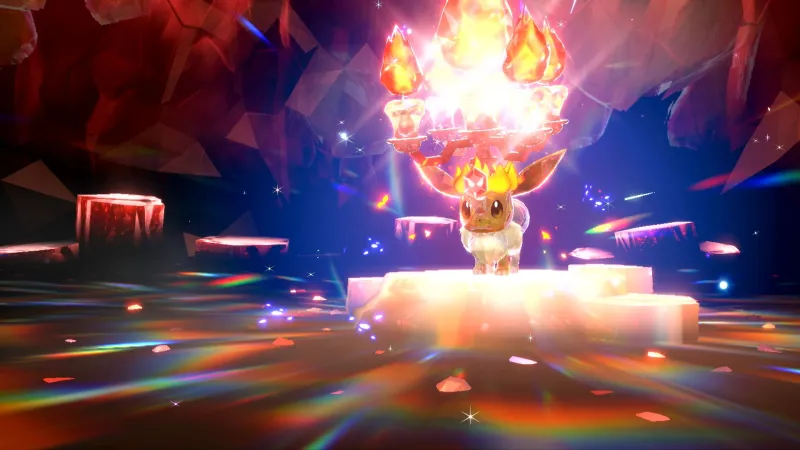
Once you’re in battle, longtime Pokémon players will feel right at home, as it reverts to the traditional turn-based format where type strengths and weaknesses create compelling rock-paper-scissors-style matchups. The new Terastallization mechanic, where an in-battle Pokémon takes on a gem-like appearance and boosts moves of its specific Tera Type, accentuates the type match-up system; some Pokémon even change type when they’re Terastallized. While the moves of the Pokémon’s Tera Type are boosted, they’re hardly overpowered, and since Terastallizing is limited to once per Pokémon Center visit, it adds an extra layer of strategy. The Terastallized forms look uniformly goofy, but Terastallization is my favorite generational battle gimmick in series history.

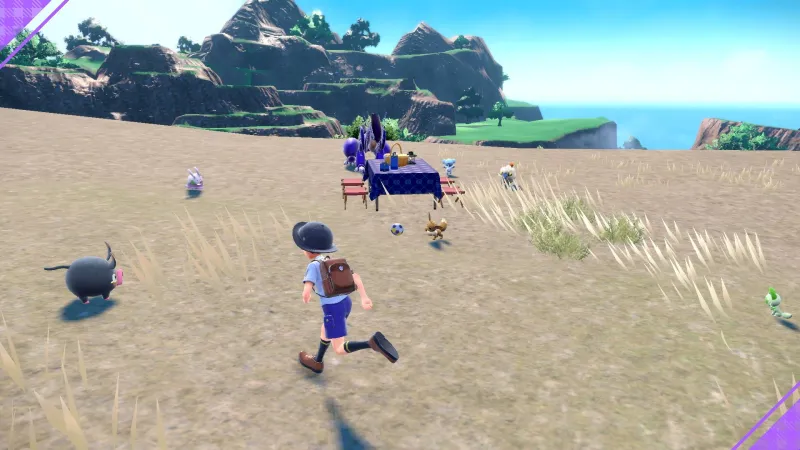
Players can explore this new, open Paldea region together thanks to four-player cooperative play. Once players join the host’s instance, they can freely explore, catch new Pokémon, battle in Tera Raids, and even trade with each other. I’m sad there aren’t more interactions between players in these sessions (you can’t even watch battles unfold), but the freedom offered by co-op outweighs the shortcomings.

The open-world design also enables you to choose the order in which you approach the three main questlines. Victory Road offers the series’ traditional eight-gym conquest with the goal of taking down the Elite Four, while Starfall Street lets you attack bases held by Team Star, the rival group of this entry. Gym challenges preceding each leader battle diversify the lead up, but they’re either mundane or revert to the traditional trainer-gauntlet style. Team Star base assaults are easy affairs, where you need to use the Let’s Go mechanic to defeat 30 Pokémon in 10 minutes before an often-challenging boss battle. Path of Legends, a third questline, grants engaging battles against huge Titan Pokémon, provides the best rewards, and serves up a touching story. I enjoyed each individual questline, and while they’re disparate in nature, they converge in the meaningful end and post-game content.


Of course, the persistent mission of filling out your Pokédex exists alongside those three story quests. This mission becomes more satisfying than ever, thanks to a terrific redesign that depicts your Pokédex as a shelf of encyclopedias. I loved watching the shelf fill with each new encounter, but I’m disappointed Pokémon Legends: Arceus’ goals, which required you to study Pokémon before their entry was complete, have vanished.

Despite technical shortcomings and some filler content, Pokémon Scarlet and Violet are chock-full of meaningful additions to one of gaming’s most popular franchises. At worst, these games are steps towards the Pokémon games for which players have clamored, but more often, they serve as effective thesis statements for where the series goes from here. Either way, I can’t wait to see where Game Freak evolves the experience from this point.

Score: 8.25

About Game Informer's review system

Purchase

Tuesday, November 15, 2022

Pentiment Review - Quill Power

Reviewed on: PC
Platform: Xbox Series X/S, Xbox One, PC
Publisher: Xbox Game Studios
Developer: Obsidian Entertainment
Rating: Mature

The best stories in video games manage to fuse narrative, art, and gameplay in a way that elevates all three. Pentiment, the latest from Obsidian Entertainment, is a perfect example of this, telling a deep, complex story about religion, truth, and history in the form of a book, which the player experiences as it’s being written. Despite a few sections with inconsistent pacing, it’s a must-play for fans of adventure games.

Pentiment tells the story of traveling artist Andreas Maler and his time spent in Tassing, a fictional town in the countryside of the Holy Roman Empire, way back in the year 1518. While Andreas’ regular routine has him working on his masterpiece or making copies of one of the local abbey’s manuscripts, he quickly becomes wrapped up in a series of local mysteries he tasks himself with solving.

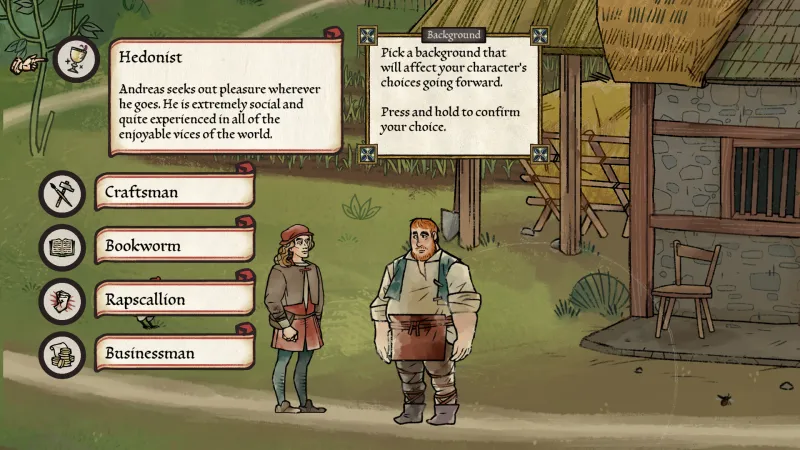
Andreas can be customized with different backgrounds and personality traits to unlock different dialogue options. My Andreas was a theological scholar with a history of hedonism, but another might have studied law and spent his time enjoying nature. The dialogue options these different backgrounds unlock aren’t usually anything substantial, but it’s nice to have a sense of control over your conversations since they make up the vast majority of the game.

Pentiment tells its story across three acts, two of which involve investigating murders. Between the high stakes and the huge accusations, these murder mysteries are when the game is at its best. There’s only so much time to solve the case, but significant actions like eating meals with suspects or searching abandoned ruins will push you through the day, meaning you only have a limited number of chances to chase down the truth. I was desperate to learn as much as possible, but there are more leads than time to follow them. While many murder mysteries end with a satisfying conclusion, Pentiment forces you to pick a culprit with the information you have and live with the consequences of accusing them. 

It’s not immediately clear whether or not you made the correct decision, but it is immediately clear how the town feels about it. Accuse a brother of the abbey, and the church resents you upon your return; accuse a beloved member of the townsfolk, and the people of Tassing might not admire you as they once did. These consequences are part of what made Pentiment’s story so impactful for me. Each act is years after the last, and the effects of your choices in the previous chapter always feel significant. The town of Tassing changes a great deal too; babies are born and grow into adults, the elderly get older and pass away, and the townsfolk adapt and change. The town is arguably more of a protagonist than Andreas.

Perhaps the strongest part of Pentiment is its adherence to its core themes. It’s a game about passing stories down from generation to generation and how the truth can become distorted over time, for better or for worse. There are rumors that Tassing harbors ghosts, conspiracy, and a dark history, but the only sources of this information are stories from the locals, and each person has a different opinion on what’s true and what isn’t. Andreas’ search for the truth is presented as a story being copied into a book, which is fitting. Like the player, he’s trying to chronicle the complete truth once and for all.

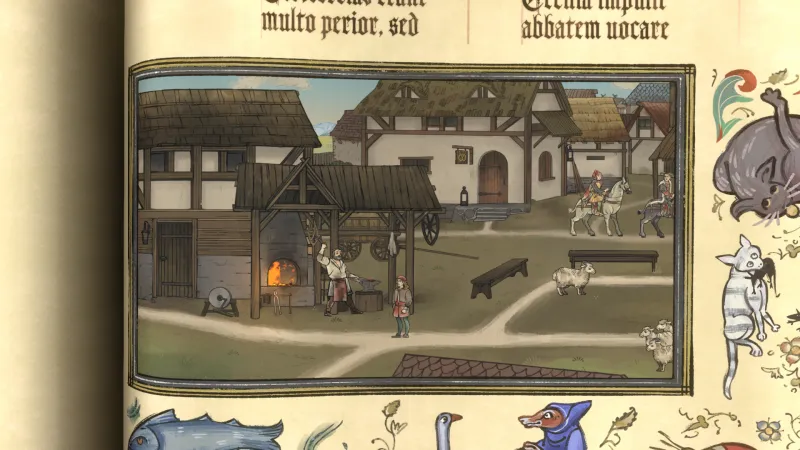
This book-like aesthetic is one of Pentiment’s most charming qualities. It starts from the first moments of a new save file, where you scrub the pages of an older book to write this new one. Characters and their surroundings are depicted as beautiful, era-specific illustrations. The menu is also a book, complete with a glossary to keep the player filled in on all the historical terms they might not be familiar with. You can press a button whenever one of these terms appears to see their definitions scrawled in the margins of the book the game takes place in.

The dialogue maintains a storybook aesthetic as well. You won’t hear voice acting; instead, the font changes depending on a character’s social or occupational status. Andreas speaks with a neat yet elaborate font, where each letter is traced, filled in, and outlined. Common townsfolk speak in plain cursive, the printer and his family speak in blocks of printed text, and the brothers of the abbey speak with ornate lettering that looks like it belongs on the inscription of a Roman statue. And as a reminder that the player is witnessing the book’s creation live, dialogue is sometimes written with a typo or two that the invisible author of the book quickly erases. The fonts are a wonderfully effective way of instilling personality into the characters of Tassing, but if you have a hard time reading cursive, they can be disabled in the settings in favor of “easy-read” fonts.

While the presentation of Pentiment’s story is beautiful, its pacing leaves a little to be desired. I adored the sections with murder mysteries, but the sections without them felt slow. The story preceding the first murder takes a while to get going, and I wouldn’t be surprised if a less-patient player bounces off the game because of it. Still, it’s far more noticeable in the third act, when the stakes noticeably dwindle before ramping back up in the final hour or so. Without going into spoilers, the third act brings significant shifts in the gameplay and story, both good and bad. At that point, it started to feel like I was watching the events in Tassing rather than playing them; I still enjoyed the story, but I didn’t get to make big decisions like in the first two acts, and there was no impending trial to push the characters along.

In these slow sections, I also started to process my issues with the game’s audio design. Most of the time, Pentiment doesn’t have music playing in the background, which feels awkward when most of the gameplay is just talking to people. The sound of the quill scratching is nice, but I would have liked to hear more of the game’s score, even if it was something sparse and atmospheric. Background characters also don’t stop their idle animations when you talk to a different person nearby, and the audio for these animations continues as well. Mostly silent conversations would be one thing, but talking to a character for two to three minutes while the only sound is the repetitive, incessant sweeping of a nearby broom had me taking my headphones off more than once.

Despite some issues with the audio and the slowness of the third act, Pentiment is a wonderfully unique storytelling experience overflowing with respect for the historical era it strives to recreate. Much like the game’s themes of stories persisting over time, I’ll be thinking about Andreas Maler and the town of Tassing for years to come.

GI Must Play

Score: 8.5

About Game Informer's review system

Purchase

Monday, November 14, 2022

Somerville Review - High Highs And Technical Woes

Reviewed on: PC
Platform: Xbox Series X/S, Xbox One, PC
Publisher: Jumpship
Developer: Jumpship
Rating: Everyone 10+

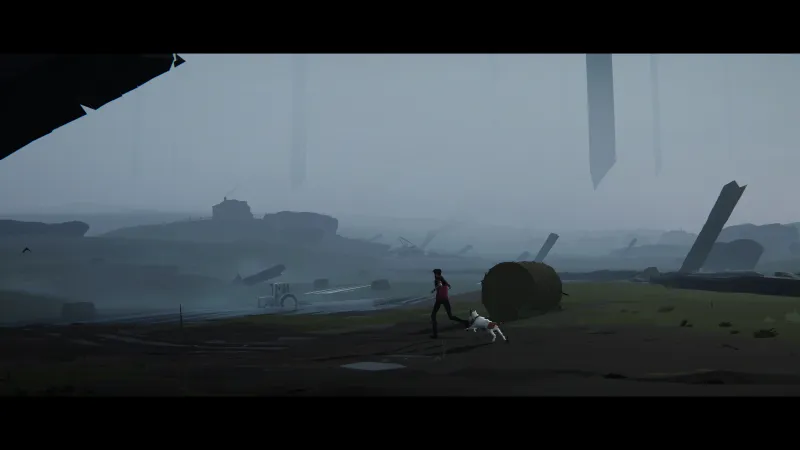
Somerville begins with a peek into the life of a young family and their dog. Everyone fell asleep watching TV on the couch, but the curious toddler gets themselves into some inconsequential trouble, forcing the family into their routine. Both the child and dog need to be fed and the kitchen needs to be cleaned, but something feels off. In an explosive moment that truly caught me by surprise, the family is suddenly reckoning with an alien invasion. An intense, often scary adventure kicks off from there. When Somerville hits its highs and fires on all cylinders, it’s a moving spectacle, but unfortunately, technical hiccups and some unclear puzzles hold it back from being truly incredible.

To call a video game an alien invasion story might recall Space Invaders, but Somerville represents something much more intimate and human. The story mainly follows the father of this young family and examines, without any text or dialogue, what the world might look like and how you would survive if everything you knew about Earth instantly changed. You make your way through Somerville by moving along a linear path, solving environmental puzzles, and avoiding instant death at the hands of imposing enemies. By the end, I didn’t know much about the invading force, but I didn’t care because I was only interested in how to stay alive and connected to my family.

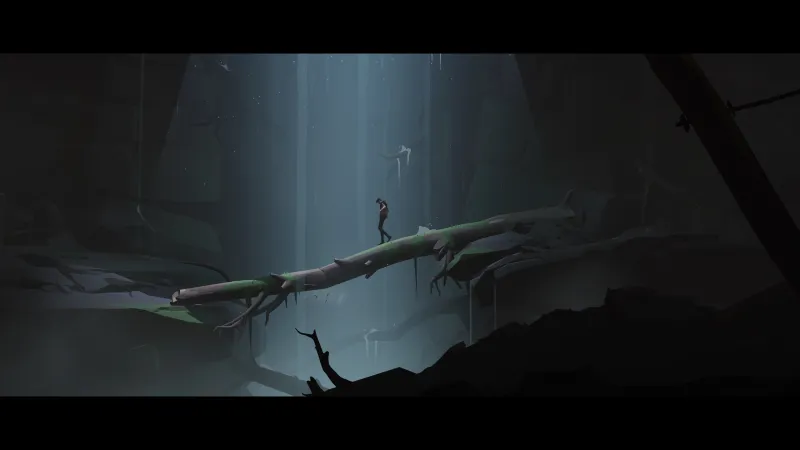
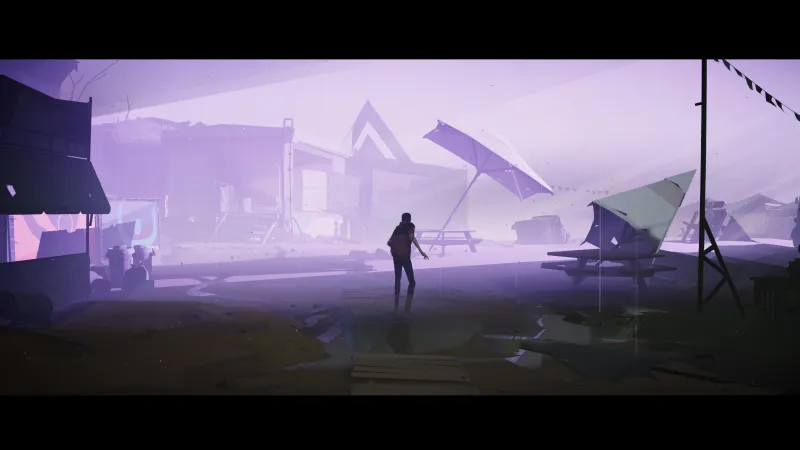
After an inciting incident sets the game in motion, the father must leave his home to find safety and take advantage of a strange newfound ability to help solve puzzles and progress. The game’s visuals and audio design are fantastic and mysterious. Bizarre sound effects paint strange explosions in the distance and the occasional light, synth orchestration and unassuming piano pieces are expertly used to punctuate scenes.

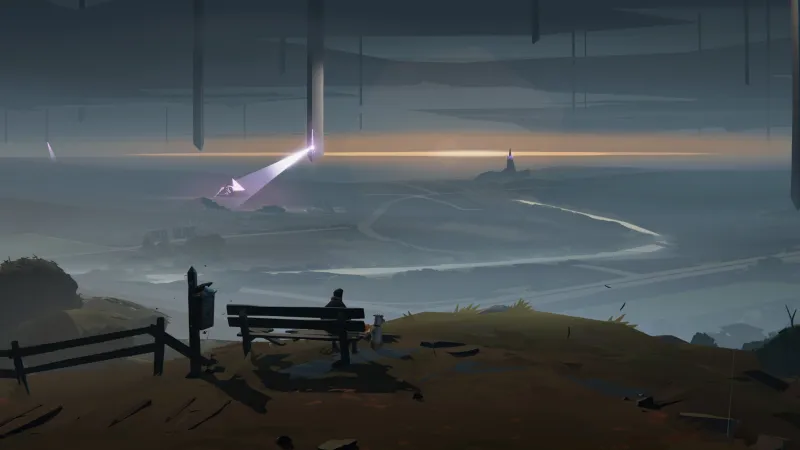
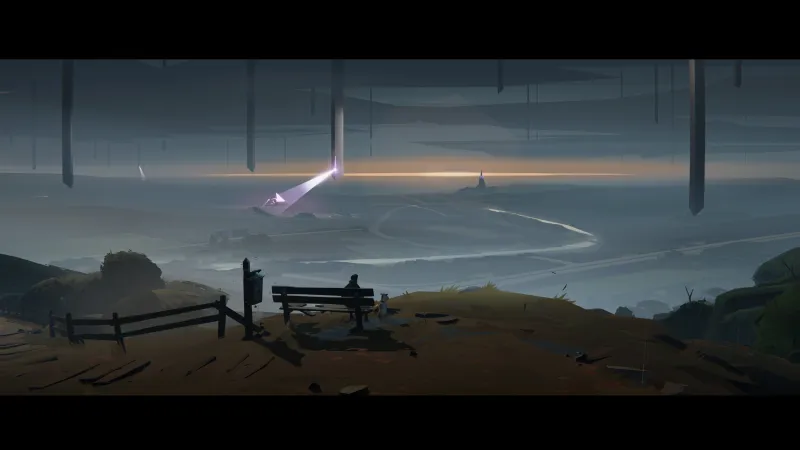
The simplistic designs of the characters and environment are striking. The world feels big despite being tangibly small, and there are plenty of moments where the camera looks out toward the horizon to frame a particularly impressive vista. The animation also feels natural and fluid… when it works.

Somerville’s biggest issue is ultimately a functional one that is sometimes easy to look past, but unfortunately, more often, impossible to ignore. Moments of emotional sincerity are undercut when a character blinks out of existence for a moment, or worse, the protagonist gets stuck in geometry while trying to solve a puzzle. I had to restart checkpoints often just to make sure things executed as they should. The bugs were particularly frustrating in the moments where I would think, “I bet that would have looked great… had it animated correctly.”


Those issues also extend to puzzle solving. Grabbing levers and switches is inconsistent and jumping up on ledges – a frequent action – is sometimes harder than it should be. Even without those issues, though, there are some puzzles whose solutions I just didn’t enjoy. An early one, for example, involved carrying an object to a specific spot that I accidentally avoided.

When Somerville is working properly, however, and the story is being delivered as it should, it leads to some of the most memorable moments in the genre. The invaders are truly scary. I teared up during at least one emotional moment, and the adventure goes places I never would have predicted and ends in a way that would make Steven Spielberg proud.

My first playthrough with Somerville was rough, but I immediately restarted the game after seeing the credits. There is no incentive to replay. No new game plus, or even added context from a second playthrough – I just wanted to experience the story again and hoped giving it a second shot would make for a more consistent experience. It did work better when I knew exactly what I was doing, but I was disappointed my first playthrough felt like a dress rehearsal.

Somerville is held back by technical shortcomings, but is full of impressive moments worth experiencing with the lights turned low and and your headphones up high. The father’s adventure lingers in my mind as I reflect on what happened, and those memories do ultimately outweigh the technical shortcomings. I hope time will provide improvements to bring the game to where it deserves to be, which is high in the sky alongside the ships of the invading forces.

Score: 8

About Game Informer's review system

Purchase

Tuesday, November 8, 2022

A Little To The Left Review – Tidy Tranquility

Reviewed on: PC
Platform: Switch, PC, Mac, iOS
Publisher: Secret Mode
Developer: Max Inferno

Puzzle-solving takes up much of our everyday lives, whether we realize it or not. Cleaning a messy junk drawer to make everything fit neatly or categorizing a bookshelf presents subtle mental exercises that flex our logical thinking and creativity. A Little to the Left shines a light on these ordinary tasks with dozens of challenges that promote organization and the satisfaction that comes with it, making for a uniquely pleasing experience.  

A Little to the Left’s puzzles present tasks as simple as arranging pencils by height or stacking spoons by size. These bite-sized exercises don’t always make me sweat, but I enjoy the tactile sensation of, say, clicking and dragging bits of crumbs away from a dining table to create a clean surface for setting plates. If you find pleasure in even the simplest forms of tidying, you’ll likely sink into this game right away, and this intangible x-factor makes the experience satisfying. 

Some puzzles have multiple answers. For example, you can arrange books by height or thickness, and I liked finding two or three alternative solutions to a straightforward problem I wouldn’t normally consider. Eventually, things get a bit more complicated. What’s the best way to arrange spice shakers with different amounts and color patterns? What time should I wind a clock’s hands to have the shadows align a certain way? These harder conundrums give the game a nice bite, and I find most solutions clever; at best, I walk away feeling part Marie Kondo, part Einstein. But some problems feel too open-ended in their answers.

When, for example, arranging piles of disparate shells or leaves to form a hidden pattern, I’ll stare at the screen for long periods wondering what the heck I was supposed to do. Every puzzle has some logic, and tinkering eventually leads to a breakthrough, but sometimes I still didn’t grasp the problem even after solving it. That’s probably more of a “me” issue; I vibe best with less abstract puzzles, like finding the optimal way to hang tools on a nail board. However, others require objects placed a bit too precisely. While tilting picture frames on a wall, I fiddled with one for way too long before, to my annoyance, it randomly settled on a pixel-perfect angle I’d covered numerous times. 

The game’s inventive hint system, where you manually erase an obscuring doodle to reveal a puzzle's correct configuration, is cute and can be helpful, but it has flaws. For one, I usually only wanted to expose a specific piece of the puzzle, so erasing the section I needed required careful precision to avoid showing too much. Since hints are in black and white, color-based answers don’t translate as well. Ultimately, simply looking at the solution isn’t the same as understanding it, making me wish the game presented hints with more direct guidance. Thankfully, A Little to the Left doesn’t require you to finish a puzzle to move on (at least for most of it). Selecting “Let It Be” lets you skip segments without consequence if they prove too tough or simply aren’t as fun. The game wants you to think, but not at the expense of its relaxing atmosphere. 


A Little to the Left provides a good mental jumpstart to my day, so I appreciate the Daily Tidy. These once-a-day challenges offer a decent dose of brain food once you’ve devoured the 70-plus primary puzzles or a good warm-up for them. So far, most of the ones I’ve seen are variations of riddles I’ve encountered, so I hope more unique challenges pop up in the future.

A pleasant and, at times, playful soundtrack, fun visual effects, and the occasional light interference of a mischievous cat add to an overall charming package. A Little to the Left may have left me scratching my head in confusion at times, but more often, it left me pleased and content with the neatly arranged spaces I created.

Score: 8

About Game Informer's review system

Purchase

Monday, November 7, 2022

Sonic Frontiers Review - Into The Wild Blue Yonder

Sonic Frontiers

Reviewed on: PlayStation 5
Platform: PlayStation 5, Xbox Series X/S, PlayStation 4, Xbox One, Switch, PC
Publisher: Sega
Developer: Sonic Team
Rating: Everyone 10+

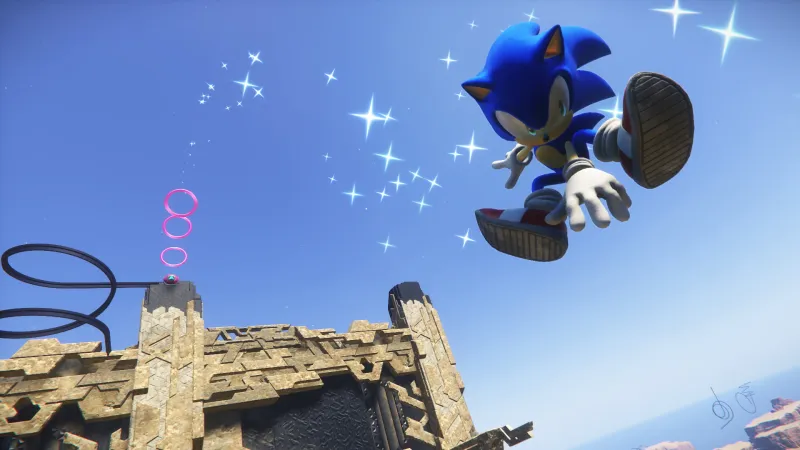
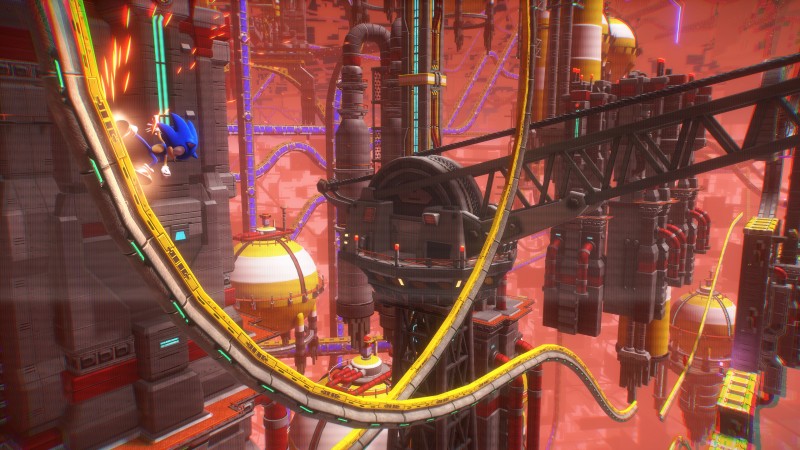
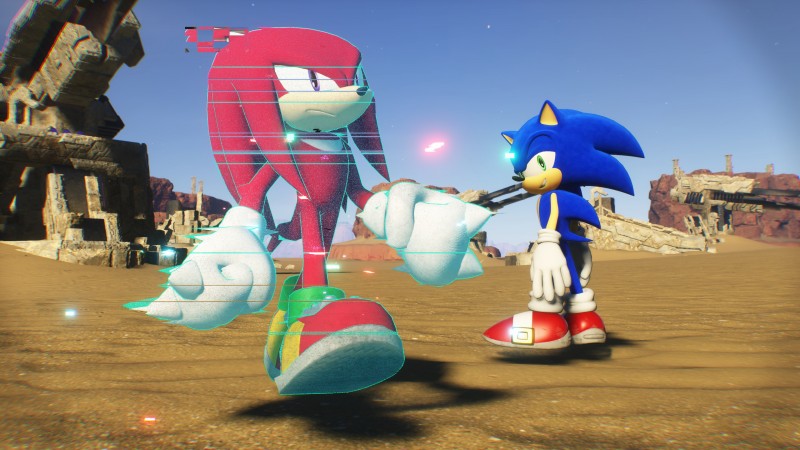
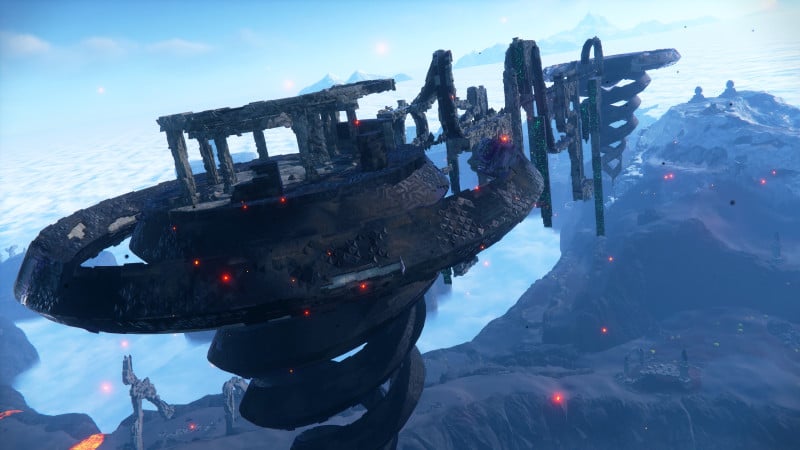
In Sonic Frontiers, Sega finds the intersection of the series’ linear past and its “open-zone” future, paying capable service to both eras of the franchise. The open Starfall Islands offer engaging exploration, while linear Cyber Space stages deliver the familiar speed-based Sonic experience. Though each side of the coin has faults, Frontiers is an overall positive experience that serves as a boost in the right direction for the franchise.

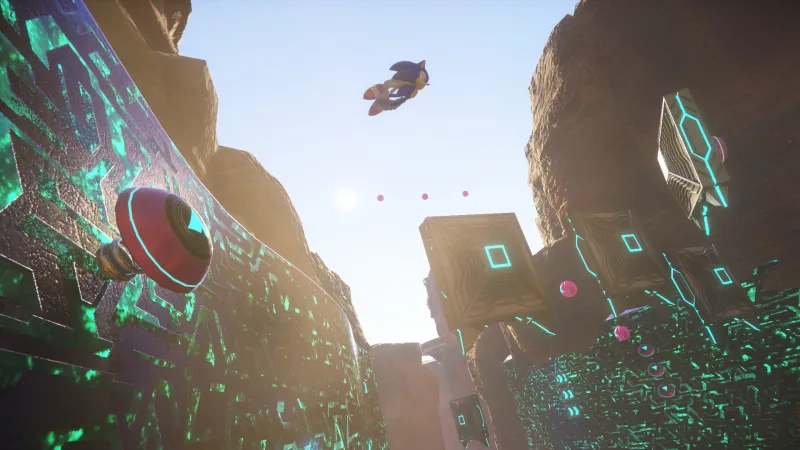
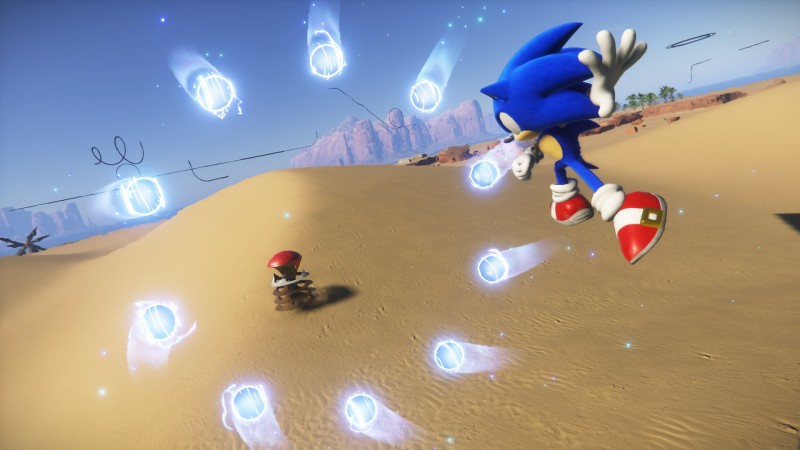
Running through the open zones is often a joyful experience. Sonic controls remarkably well as he runs through the lush fields, sandy straights, and other biomes I encountered during my 30-hour playthrough. The islands deliver terrific playgrounds through which Sonic grinds, boosts, and bounces; hitting a dash panel that sends you up a rail, off a spring, and into a line of rings never ceases to satisfy. That satisfaction is accentuated by how good it feels to chain these segments together, thanks to the tight 3D gameplay.

The most notable new ability in Sonic’s arsenal is Cyloop, a blue trail you activate with a push of a button. Cyloop has utility in combat – drawing a circle around enemies deals damage, stuns them, or breaks off armor – but its primary use is in exploration; if ever I didn’t know what to do, the answer was typically to draw a Cyloop around the object in question. You can even run in circles to spawn infinite rings, a method I often used in boss battles. I like this mechanic overall, but reasons to use it in the world sometimes felt shoehorned.

On top of that, several areas of the open zones aren’t optimized for exploration. The in-world obstacle courses are among the worst offenders. I lost track of the number of times I tried to go in one direction, only to hit a dash panel that sent me flying hundreds of feet in the opposite direction before I knew what had happened. This dilemma is further brought into focus by atrocious pop-in, which primarily affects the rails and platforming elements in the open areas, making it difficult to understand the best way to navigate. Other segments force you into a 2D perspective and lock you into a set path until you either complete the sequence or backtrack out of that area. When combined with various dead-ends and areas that feel overtly tucked away, the world design of Sonic Frontiers doesn’t reach the standard of modern open-world games.

Though the open-zone design sometimes lacks cohesiveness, the islands do a terrific job of doling out the core gameplay loop. Exploration rewards you with memory tokens to progress the side-character stories, but outside of lore drops and revealing the map, scouring every corner of an island is rarely as fruitful as I would have liked.

When you’re not sprinting between destinations, Sonic Frontiers gives players the most comprehensive combat mechanics in the series’ history. What starts as button mashing for melee combos evolves as you face new enemies who can counter and block your attacks. As you level the skill tree, you unlock more fast-paced combos to unleash devastating damage on your foes. While the combat is far from the highlight, I enjoyed engaging with enemies when they popped up, and the collectibles and skill points made the encounters worthwhile.

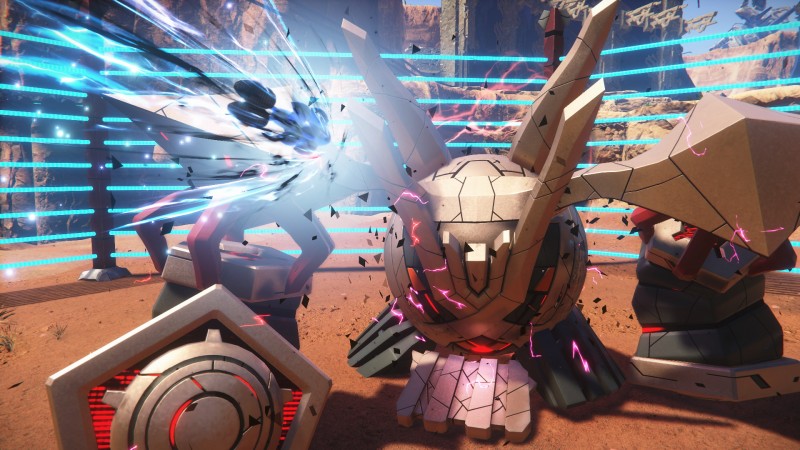
Perhaps the biggest reward, however, comes from defeating enemies and mini-boss Guardians in the open area. These Guardians offer novel battles against a wide range of monsters, offering unique encounters that require you to use different tactics to win. Ranging from creatures that lead you on a chase through the world to a tank that forms a closed arena and shifts the encounter to a bullet-hell experience, I was always excited to see what bosses the next island housed.

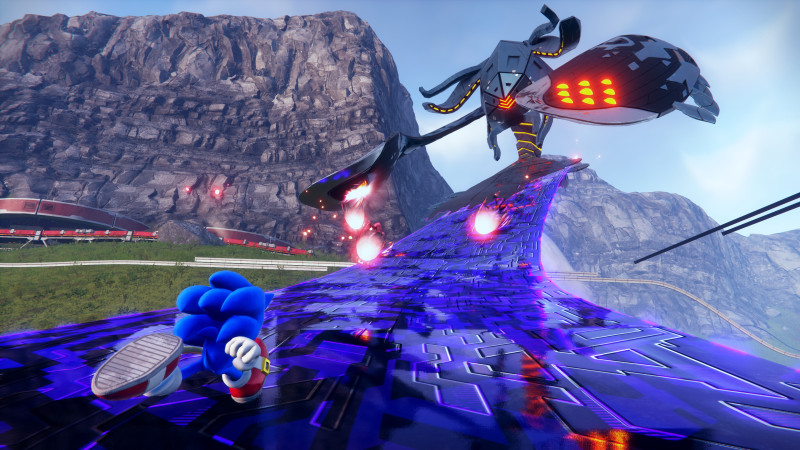
Defeating Guardians grants Cyber Space Gears, which let you access the linear, more traditional 3D Sonic levels. These stages concentrate the action into bite-sized chunks, often lasting fewer than a couple of minutes. Each stage features four objectives that grant a Chaos Emerald Vault Key, the main collectible for progressing the main story.

I loved playing the levels over and over to accomplish all these goals; efficiently speedrunning these branching stages is satisfying beyond belief. However, the S-Rank times are poorly balanced, meaning sometimes I would achieve the time on my first attempt, while others are unrealistic unless you nail a perfect run.


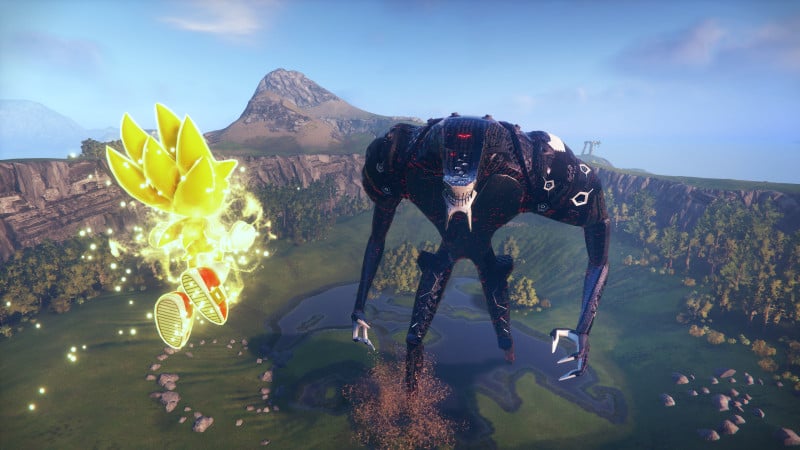
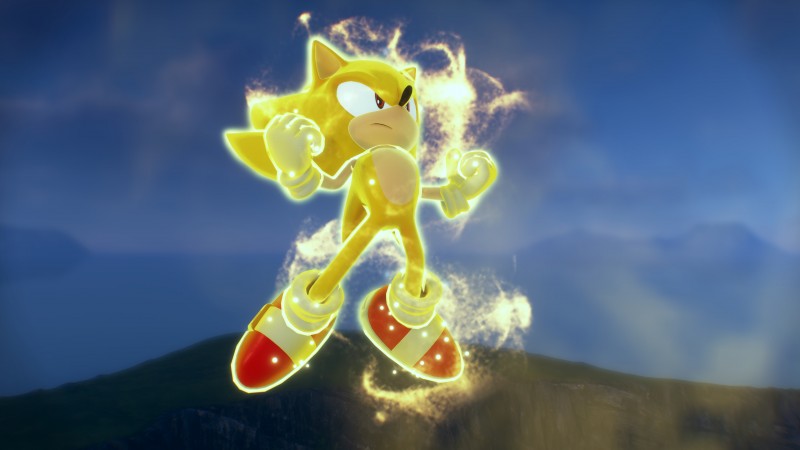
The culmination of each island is a massive boss battle against that area’s Titan. Each Titan battle is drastically different, but they all have you facing an impossibly large foe as Super Sonic. Since Sonic’s golden form is invincible but slowly depletes rings, the battles are more about beating the clock than worrying about damage. This dynamic often leads to frustration as their attacks and projectile spam are meant to delay you as you watch your ring count drop. But with music that feels ripped straight out of an anime credits sequence and multi-phase battles that get more climactic with each transition, the epic, over-the-top nature of these battles won me over and provided some of the most memorable moments in the game.

Juxtaposed against the grand scale of these bombastic boss battles, Sonic’s adventure is a largely solitary experience. Save for occasional interactions with his friends and a mischievous A.I. character, our hero goes it alone. This, combined with the minimalistic music score, sets a contemplative tone that I rather enjoyed despite its seeming opposition to the series’ theme of speed.

This tone fits the more somber narrative. The eponymous blue hedgehog is still the same fun-loving speedster. But with a storyline centered around a mysterious species that seemingly befell tragedy long ago, this story is the most mature Sonic has ever been in games, and it largely works. The story features some of the best character moments and contextual callbacks in series history; from Sonic 3 to Sonic Forces, diehard fans will love the passing references the characters make to their previous adventures. I won’t spoil the conversation, but one chat Sonic has with a friend about personal growth is as heartfelt as the franchise has ever been.

Though it’s rough around the edges, Sonic Frontiers is the best 3D Sonic game in years. This first attempt at the open-zone concept is an admirable effort, and I can’t wait to see how Sonic Team iterates on this formula in future entries, but it’s obvious this is not the formula’s final form. For now, Sonic Frontiers stands as a solid first foray into a brave new world for Sega’s speedy mascot.

Score: 7.75

About Game Informer's review system

Purchase