This is default featured slide 1 title

Go to Blogger edit html and find these sentences.Now replace these sentences with your own descriptions.This theme is Bloggerized by Lasantha Bandara - Premiumbloggertemplates.com.

This is default featured slide 2 title

Go to Blogger edit html and find these sentences.Now replace these sentences with your own descriptions.This theme is Bloggerized by Lasantha Bandara - Premiumbloggertemplates.com.

This is default featured slide 3 title

Go to Blogger edit html and find these sentences.Now replace these sentences with your own descriptions.This theme is Bloggerized by Lasantha Bandara - Premiumbloggertemplates.com.

This is default featured slide 4 title

Go to Blogger edit html and find these sentences.Now replace these sentences with your own descriptions.This theme is Bloggerized by Lasantha Bandara - Premiumbloggertemplates.com.

This is default featured slide 5 title

Go to Blogger edit html and find these sentences.Now replace these sentences with your own descriptions.This theme is Bloggerized by Lasantha Bandara - Premiumbloggertemplates.com.

Wednesday, September 8, 2021

The Artful Escape Review – A Rocking Space Oddity

Publisher: Annapurna Interactive
Developer: Beethoven and Dinosaur
Rating: Everyone 10+
Reviewed on: Xbox Series X/S
Also on: Xbox One, PC

Gripping his shimmering guitar, the performer formerly known as Francis Vendetti steps onto the ultimate stage for an astronomical rock showdown. Success means universal glory and fame; failure, a laser-based annihilation. The moment is awesome, but for all its undeniable show-stopping power, this crowning event doesn’t outshine the game’s more thoughtful moments. The Artful Escape’s strength lies in the protagonist’s relatable journey of self-actualization, which serves as a crucial foundation for its dopamine-spamming extravaganzas.

Francis Vendetti is an amazingly talented musician who suffers from imposter syndrome and self-doubt thanks to the inescapable legacy of his uncle, renowned folk singer Johnson Vendetti. He is a likable protagonist, and the game’s fun writing makes listening to his quippy observations enjoyable, but the game is not subtle. It wastes no time hammering home the promising musician’s hardships.
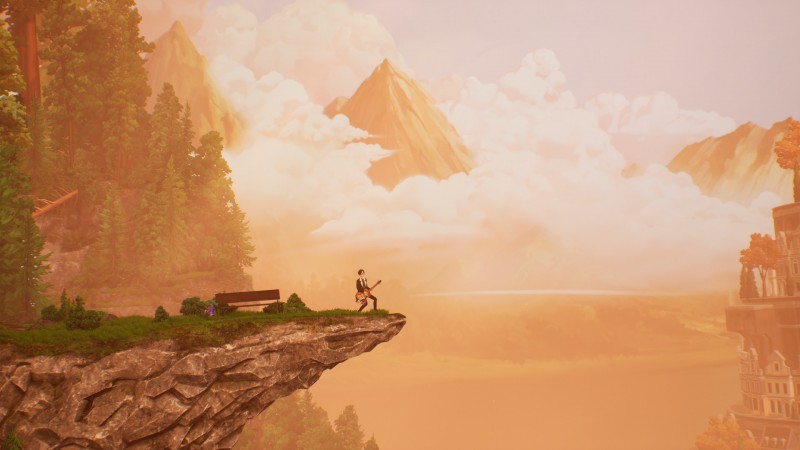
The starting screen features a poster for Francis’ upcoming debut concert. It’s dominated by a picture of his famous relative, barely leaving space for the actual headliner. Throughout the initial chapter, Johnson Vendetti’s looming shadow becomes darker and darker. Francis’ hometown welcome sign proudly displays a towering depiction of its most famous native son. An elderly neighbor remarks on his family resemblance to the deceased artist. And – due to the ongoing Johnson Vendetti festival – the singer’s music continuously plays throughout the city. The narrative teeters toward heavy-handed but quickly moves on to Francis’ transformative space escapade.

To escape his community’s expectations and the pressure of being the other Vendetti, Francis develops a dramatic alter-ego, and the action moves away from his pleasant small town into the enthralling expanse of the cosmos. The path from small-town strummer to stellar sensation is satisfying. It builds up from frustrating moments where Francis’ insecurity gets in the way of what he wants, to the final epiphany leading to self-acceptance and stardom. Between those two points is an intergalactic trek, with each extraterrestrial location looking as impressive as the next. The levels include alien snowscapes, deserts, and jungles, each exploring a different aspect of identity, helping Francis discover himself and create his new stage persona.
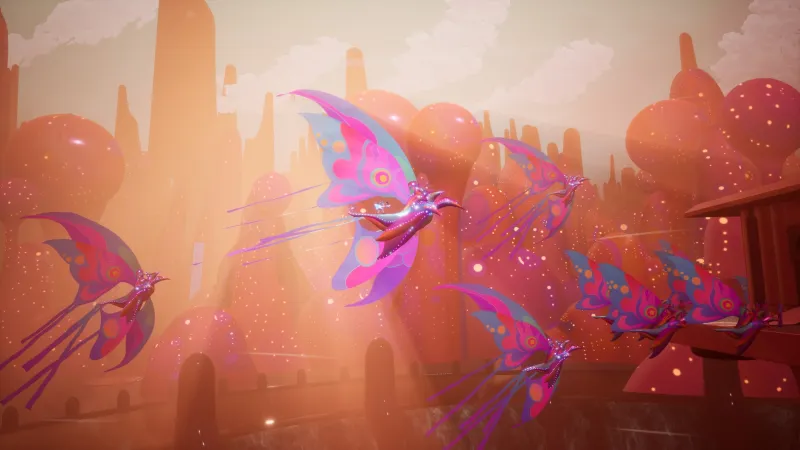
At set points, you make meaningful choices about Francis’ fictional interstellar identity. These choices connected me to a narrative that otherwise might have felt too bizarre. This process is like a character creator drawn out over the course of the adventure, but one that also allows you to confront your character’s mental health. The Artful Escape provides interesting ways to define your new persona, like giving yourself a grandiose backstory during an out-of-this-world late-night talk show interview or running through a magical wardrobe with a mall inside to pick out the ideal outfit.

As someone who spends ridiculous amounts of time crafting the perfect character before setting out in a video game, I found this multi-step approach to developing an alter-ego really fulfilling. I felt personally cool whenever characters later used my created title or referenced my hand-picked home planet. I put thought into my extraterrestrial counterpart, and The Artful Escape rewards that well.
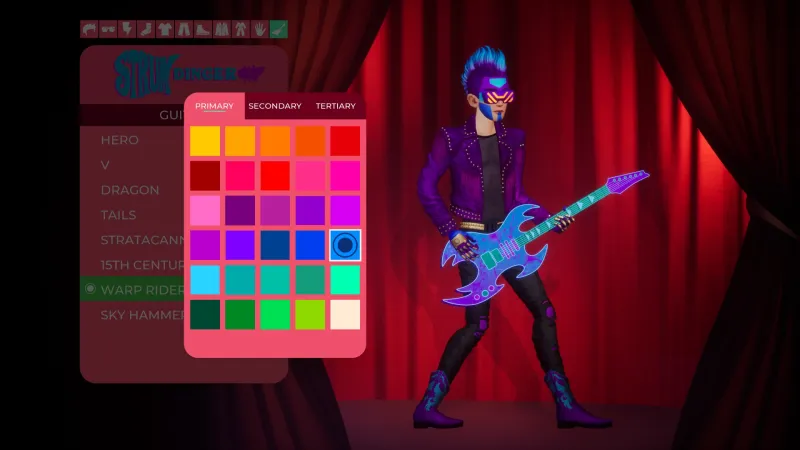
For all its appearance of incomprehensible cosmic grandeur, The Artful Escape is mechanically simple. You move through aesthetically stunning side-scrolling levels jumping over gaps and obstacles. Sprinkled throughout every distinct location are designated performance platforms where you play through a short rhythm game. This may turn off gamers seeking a challenge, but the game’s simplistic nature is empowering and made me feel like a superstar.

During your travels, you can hit a button to play your guitar, and typical platforming actions trigger fun, rock star-like animations. For instance, a simple long jump transforms into a truly epic guitar solo. The slide button causes the protagonist to slide dramatically across the ground on his knees. These actions don’t have much of an impact on the gameplay, but if you combine these flourishes with how the unbelievably beautiful world reacts to your energizing notes with bursts of color and movement, then The Artful Escape more than makes up for its shallow platforming.

Click image thumbnails to view larger version


The performance mini-games are hard to mess up. From small jam sessions to stellar concerts, the rules remain simple: hit a series of notes by pressing the five corresponding buttons in the correct order. There is no set timing and no fail state, but like the platforming sections, the on-screen effect of this simple game is fantastic. Amidst reactive laser shows and bursting pyrotechnics, I found it easy to feel like I was actually the galaxy’s shining star performer.

Like its protagonist, The Artful Escape leans into its unique identity and comes out the better for it. The game is breathtakingly beautiful, rich in music, and makes you feel like an intergalactic rock star while examining some thoughtful, relatable fears.

Score: 8.5

Summary: The Artful Escape is a gorgeous experience that makes you feel like a star, but challenge-seekers may need to look elsewhere.

Concept: Overcome suffocating expectations by creating an out-of-this-world stage persona in an epic musical quest to the edges of the universe

Graphics: From Earth’s amber waves of grain to space’s most psychedelic starfields, The Artful Escape is a symphony for the eyes and the ears

Sound: Backed by a rocking score, playing your guitar through the levels makes the world, and the game, come to life

Playability: The controls are simplistic, but everything works together to make you feel like the biggest rock star in the galaxy while you battle self-doubt

Entertainment: It won’t challenge your platforming skills, and the action boils down to galactic Simon Says, but The Artful Escape is a gorgeous experience that makes you feel utterly cool

Replay: Moderately High

Click to Purchase

Life is Strange: True Colors Review – More Powerful In Life Lessons Than Supernatural Talents

Click to watch embedded media
Publisher: Square Enix
Developer: Deck Nine
Rating: Mature
Reviewed on: PlayStation 5
Also on: PlayStation 4, Xbox One, Switch, Stadia, PC

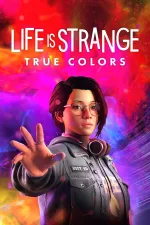
Life is Strange has always been about emotions and coping with life’s challenges. Through the series, we’ve experienced different perspectives and a multitude of complex situations, from the perils of depression to the ugliness of racism. Stepping into a character’s shoes, we get to know their world and the people around them, often finding things are not always what they seem and using a superpower to change things for good measure. While Life is Strange: True Colors has all the hallmarks of past entries, like having a special power and consequences for your actions, it’s much more fueled by its emotional moments and realistic dilemmas. This is when the game is at its best, bringing a fantastic, well-written protagonist in Alex Chen, who you want to get to know and see succeed. 

You can think of Alex as the new kid on the block. The journey begins with Alex leaving the group home she’s stayed at for the last eight years to live with her brother Gabe in Haven Springs. It’s a heartwarming and sometimes awkward reunion, but her and Gabe’s bond and love for each other are evident from the get-go. Unfortunately, an accident happens and Gabe dies. From here on out, Alex is on a mission to make sense of his death. Could it have been prevented? 

The story has some good twists and is especially strong in how it explores Alex’s past in the foster care system and her family issues. The narrative is emotional, dealing with grief, abandonment, and self-worth, but it’s also just as much about finding your own path in life. The latter really comes together nicely in the final moments, letting you have a considerable impact on what Alex’s future holds. I enjoyed the narrative’s suspense and heartwarming moments, but it’s the characters that truly make the experience. 

Alex Chen is one of the best protagonists I’ve encountered in years, and it comes down to her resilience and undying hope for the better. Being thrown into the foster system, she has led a different life, but she hasn’t let it take away her sense of humor or her desire to help people in need. Voice actress Erika Mori gives Alex an emotional depth that cannot be overstated: her delivery is spot-on for Alex’s charming sarcasm, and when Alex is at her most vulnerable during emotional scenes, Mori never overacts, keeping you right in the moment and feeling for Alex and her circumstances.  

The people around Alex also made me feel connected to the town and her journey. All the denizens of Haven Springs are like a protective family, from father figure Jed who gives Alex a place to stay rent-free to the grandmotherly and overly affectionate Eleanor who just wants to see everyone happy. All the residents have their issues that you can choose to uncover more about, but what’s so touching is they’d do anything for a fellow. It works well as a contrast to Alex’s previous life, where she had to fend for herself and never felt a true belonging. Alex’s growing friendships with Steph and Ryan (either is romanceable if you like) are a highlight. Ryan is more laidback and a big dork at heart, while Steph is more sassy and independent. The three’s interactions became my favorite as their dialogue really showcases their bond, whether it’s taking silly pictures or joking around about who would be better at seducing a middle-aged lady. 

Click image thumbnails to view larger version


The majority of Alex’s adventure is story-based, giving you dialogue options as you explore the town and try to piece together certain clues about people and places. The game offers a lot of exploration, so you’re best to go off the beaten path to get the most out of it. I was happy that it didn’t feel like there were filler puzzles, like finding some number of bottles to move on to the next scene. Everything you do fits well into the plot, including a fun LARP romp through town, a Spring Festival, and even just taking a job as a waiter. Learning about the people is part of the fun, and making choices about how to play scenes or handle situations keeps you involved in the plot.

Some choices are mainly role-playing options, but a lot of the decisions are big and don’t come easy. Sometimes it comes down to choosing whether to reveal personal information to another party that could help the person but also jeopardizes their trust. Other times, you’ll have to decide how and if you want to support a particular character. However, the tricky decisions come with Alex’s power. Alex understands the emotions of others on a very different level. She has a supernatural ability to experience, absorb, or manipulate feelings. It’s a power of empathy, but it’s not exactly what I was expecting, and I found the power a bit disappointing in its effort to be more supernatural.

Alex can straight-up read people’s minds to learn if something deeper is going on; she can also see colored auras around them that represent their feelings, such as blue for sadness and red for anger. Issues of consent aside, using her power felt like cheating and avoiding the difficult work of trying to get someone to open up to you about their problems. I struggled the most with instances where you can decide whether to take feelings away from others. For example, if fear prevents someone from standing up for themselves, should you take it away? Or is that work they need to do for themselves?

Doing this takes a toll on Alex as a consequence, and it’s an interesting conundrum, but the ability to take away emotions feels wrong. In one case, a woman is clearly going through the stages of grief; if you take away a step in that process, aren’t you denying her the room to heal as she needs? My biggest issue is that the game gives you such a huge responsibility but shies away from taking a hard stance on the emotional ramifications at play. I tapped into the power to take away a feeling once and felt rewarded for it. It felt extra weird because I used it for Alex’s personal gain, but the game never made me feel any big consequences for it. The whole power just feels muddy in its execution, and I wish it was represented with a bit more depth. 

True Colors’ writing is so strong that it didn’t need a supernatural ability to tell this story. I laughed, I cried, and the things that stick with me are the moments where Alex is tested and comes into her own. And there’s something special in how True Colors gives you the power to decide her future and what her life needs, making for a memorable ending with a highlight reel of what you envision for the character. Due to all branching choice variations, you can probably get in a few different playthroughs, but the overall message never changes: Don’t give up. It may be a well-worn saying, but it means a lot in Alex Chen’s pained life. 
 

Score: 8.5

Summary: You’ll root for Alex Chen, and feel good about helping shape her path forward.

Concept: Step into the shoes of Alex Chen as she enters a new chapter of her life and must deal with her brother’s unexpected death while harnessing her supernatural power of empathy

Graphics: An impressive upgrade in the visual department, the characters’ realistic facial expressions and mannerisms, especially their eye movement, add to the authenticity of each moment

Sound: The soundtrack doesn’t disappoint, with fitting songs to color the world and emotional stakes. The voice acting is also spectacular; Erika Mori gives an exceptional performance, showcasing the emotional complexity of Alex

Playability: True Colors is an easy game to pick up and play, and it’s great to see accessibility options that let you decide on aspects such as longer timer choices and volume warnings

Entertainment: Life is Strange: True Colors is a powerful adventure, full of twists and thoughtful yet heartbreaking subject matter. You’ll root for Alex Chen, and feel good about helping shape her path forward

Replay: High

Click to Purchase

WarioWare: Get It Together Review – Only As Strong As Its Weakest Link

Click to watch embedded media
Publisher: Nintendo
Developer: Intelligent Systems, Nintendo
Rating: Everyone 10+
Reviewed on: Switch

In an era full of 100+ hour open-world campaigns and games as service titles that can be played in perpetuity, WarioWare's 3-to-5-second microgames almost feel like a commentary on the state of the industry. On the one hand, Get It Together's microgames require split-second thinking, continually offer the unexpected, and feel refreshingly original. On the other hand, this ultimately shallow experience left me wanting more.

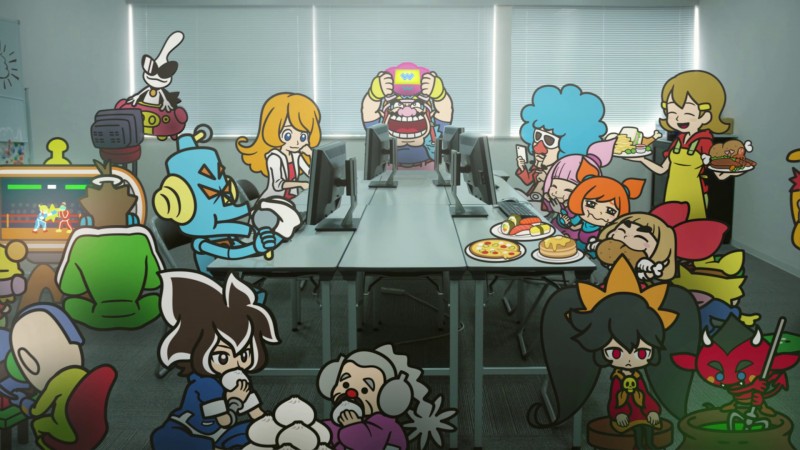
For ages, our mustachioed menace and his eclectic crew have designed aggressively short games in the hopes of earning piles of cash. But this time around, the only thing the group gains is a trip into the digital world; Wario and his oddball crew are trapped in their own digital landscapes, and the only exit is on the other side of these half-baked amusements.

Click image thumbnails to view larger version


As usual, the minigames in this WarioWare collection are completely bonkers. Get It Together's oddball objectives are also a testament to Nintendo's creativity. In one moment, I was connecting water pipes so someone could wash their hands. In the next, I was tweezing hairs from the armpits of a bodybuilder, dumping ketchup onto a plate of spaghetti, or punching an eggshell to release a trio of frightened squirrels. Completing these objectives is always simple, but tension quickly mounts when you have mere seconds to register and achieve each goal. I was often frantically zigzagging around the screen with a smile on my face, sometimes failing in a hilarious fashion.

This setup isn't new for seasoned WarioWare players, but the big change in Get It Together is that Wario and his companions now take center stage in all the games. Each character has their own controls. For example, Wario comes equipped with a jetpack, so he can fly around the screen and dash punch objects, while 18-Volt fires discs from a stationary position. Each character is easy to control, but some are better suited for specific tasks. For example, dodging objects is easy with a character like Ashley who can freely move around the screen, but harder with Kat who constantly bounces up and down. All characters can complete any game, but you are randomly assigned a new character for each minigame, and it always feels unfair when your character is a poor fit for the task at hand.

Another unexpected outcome of the WarioWare crew's inclusion in these microgames is that the whole experience feels unified. Sadly, this isn't necessarily a good thing. WarioWare's strength has always been in its off-the-wall antics and how quickly it pivots from one wild concept or gameplay mechanic to the next. In the past, you might easily jump from a first-person shooting tower defense game to a racing game to a bizarre sequence where you ripped a Band-Aid off someone's knee. Get It Together's themes and visuals remain charmingly random, but the gameplay mechanics are more conventional because you're always playing as Wario or one of his companions. As a result, while Get It Together's minigames remain amusing diversions, I grew tired of them faster than usual.

Click here to watch embedded media

Get It Together's local multiplayer offers a few reasons to come back to these microgames with up to 3 friends. Most of the multiplayer experiences work off a theme. For example, Puck 'er Up is an air hockey game where the player who scores a point each round gets to play one of Get It Together's minigames. However, I liked the simplicity of Duelius Maximus, which has two players racing through a series of microgames to see who can stay alive the longest.

WarioWare: Get It Together's lively visuals are temporarily engaging, but this candy shell has a hollow center; like any sugary snack, the experience doesn't stick with you. As soon as I'd wrapped Get It Together's brief single-player campaign, I was content to move onto something else. These microgames are a nice treat if you're in an eccentric mood, but these miniature experiences only offer short-lived joy.

Score: 7.75

Summary: Help Wario and his companions escape their own game by completing over 200 wacky microgames.

Concept: Help Wario and his companions escape their own game by completing over 200 wacky microgames

Graphics: Cutscene animations are slick yet simple; the art in each game features a range of disjointed but playful styles

Sound: Strange sound effects are used to a humorous degree, but the soundtrack is plain and lacks punch

Playability: Each character has a simple one-button control setup, and the minigames require split-second thinking

Entertainment: As always, WarioWare's randomness is charming, and the minigames are fun, but this is far from a high watermark for the series

Replay: Moderate

Click to Purchase