This is default featured slide 1 title

Go to Blogger edit html and find these sentences.Now replace these sentences with your own descriptions.This theme is Bloggerized by Lasantha Bandara - Premiumbloggertemplates.com.

This is default featured slide 2 title

Go to Blogger edit html and find these sentences.Now replace these sentences with your own descriptions.This theme is Bloggerized by Lasantha Bandara - Premiumbloggertemplates.com.

This is default featured slide 3 title

Go to Blogger edit html and find these sentences.Now replace these sentences with your own descriptions.This theme is Bloggerized by Lasantha Bandara - Premiumbloggertemplates.com.

This is default featured slide 4 title

Go to Blogger edit html and find these sentences.Now replace these sentences with your own descriptions.This theme is Bloggerized by Lasantha Bandara - Premiumbloggertemplates.com.

This is default featured slide 5 title

Go to Blogger edit html and find these sentences.Now replace these sentences with your own descriptions.This theme is Bloggerized by Lasantha Bandara - Premiumbloggertemplates.com.

Tuesday, November 23, 2021

Death's Door Review – Reaping The Rewards

Publisher: Devolver Digital
Developer: Acid Nerve
Rating: Everyone 10+
Reviewed on: Xbox One
Also on: PlayStation 5, PlayStation 4, Switch, PC

Death is one of the few things we all have in common. We all experience death sooner or later, and that can be terrifying because we don’t truly know what awaits us on the other side. Salvation? Oblivion? Death’s Door offers an amusing interpretation of death by framing it as a boring, day-to-day business run by crows. While some of the crows may not find much enjoyment in their work, playing Death’s Door couldn’t be further from their dull reality. It’s an entertaining and engrossing action-adventure romp that you’d do well to enjoy before your time is up. 

As a young crow and a rookie reaper working for this morbid organization, your task is to retrieve one particularly large soul. Once you do, however, it’s promptly stolen by a mysterious figure. The soul’s recovery is paramount because while the crows are immortal in their home dimension, traveling to the living realm leaves them vulnerable to aging and death, and they can’t return home for good until the job is done. While this recovery mission of why your soul was taken is a good hook on its own, the story quickly expands into a larger, more compelling mystery revolving around figures who have cheated death for ages and the true meaning behind your work.

Relieving bad guys of their souls is a fun, strategic dance of dealing simple close-range combos and rolling to evade, all while chipping away at their health from afar using your bow and ranged spells such as a fireball. When it comes to attacking at a distance, you have a limited number of shots, but ammo refills with every successful melee strike. I love this system as it kept me from leaning on ranged attacks as a crutch and forced me to get my hands dirty. It also rewards that aggression by renewing your chances to back off. Tight controls allow for smoothly dealing attacks after making split-second dodges, and that maneuverability becomes swifter by upgrading your abilities. 
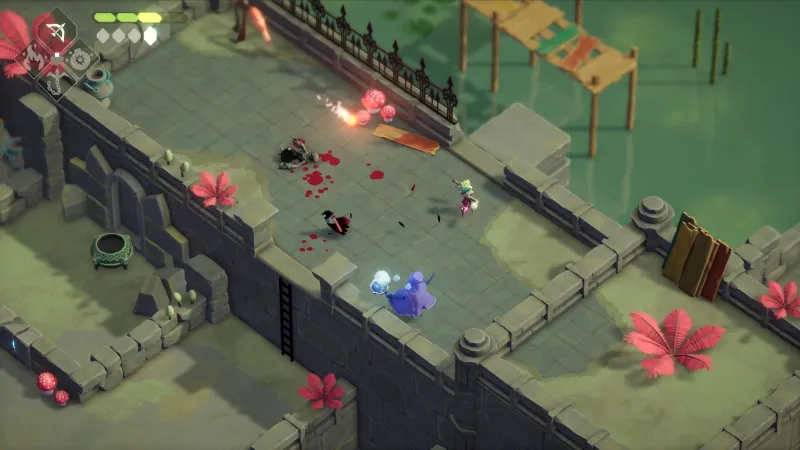
That sense of risk versus reward extends to refilling health. Throughout the environment, you collect flower seeds, and when you plant them in scattered pots, they bloom into permanent health stations. However, you have a limited number of seeds, depending on how thoroughly you explore, so deciding which pots to plant requires serious thought. The choice of healing now or waiting until I visit a pot I’m more likely to frequent gives the design a fun element of risk and improvisation as I’m effectively creating my own safe zones. 

You can mix up combat by finding hidden weapons such as daggers that trade power for slightly speedier combos or a mighty hammer that channels electricity. While these alternatives feel fine in battle, the differences between them and your standard sword are negligible. I happily stuck with the sword for much of my adventure. Thankfully, the same can’t be said for your arsenal of spells, all of which feel useful. A chain hook attaches to foes so you can quickly zip in their face and close the gap. I smiled every time I lobbed a bomb-like fireball and watched it obliterate multiple targets in short order.

Combat encounters are often challenging, especially when an assortment of baddies swarms you, forcing you to use every trick you have to survive. That includes using their own abilities and the environment against them. Many projectiles can be deflected back to the sender or to their buddies. Arenas sometimes contain hazards such as laser turrets or plants that fire mortar-like exploding gas bubbles that, with the right positioning, can easily clear entire mobs. Death’s Door does a great job encouraging players to work smarter and not harder to overcome its occasionally overwhelming combat challenges. 
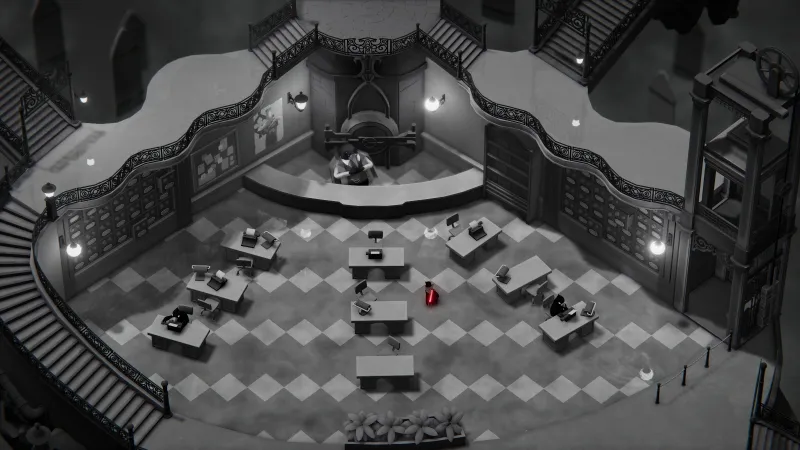
The handful of major boss battles against beings who have lived far beyond their natural life cycle are fantastic and are my favorite confrontations in the game. These epic bouts pushed me to use my full suite of abilities, and the giant armored frog who gradually destroys your small platform with each hop was a particular standout. The final boss battle, in particular, plays out as a neat amalgamation of every obstacle you faced before, offering an entertaining final exam of everything you’ve learned. In a great touch, enemy bodies accumulate scratches and cracks to indicate damage status, which is way cooler than a plain old health bar. 

Your journey to retrieving your wayward soul involves exploring pretty, visually distinct areas such as seaside docks, an eerie-yet-opulent mansion, and a forest-covered temple. I also like how the living world’s color contrasts with the noir-esque greyscale of your otherworldly headquarters. Areas are littered with enemies, tons of secrets, and hidden paths that lead to goodies such as new weapons, flower seeds, collectibles, and vital souls used to purchase stat upgrades. You can even find hidden bosses that bestow powerful upgrades to your spells. 

Many areas are ability-gated; I’m sure you can connect the dots on what a cracked wall or unlit torch requires. Other environmental puzzles and secrets require more observational skills, such as spotting discreet hedge maze entrances or using a bathroom floor’s reflection to find a concealed door. Death’s Door’s world feels like a living puzzle that I was always chomping at the bit to fully unravel. Plus, some of its coolest mysteries don’t reveal themselves until after the credits roll. 

Click image thumbnails to view larger version


Despite their long association with death and the macabre, crows are clever animals known for their funny behavior; the game’s tone sports a similar playfulness. Your quirky co-workers include a typing-obsessed data entry worker elated to generate all of the paperwork your adventure creates. A passionate bard tags along for a period in search of inspiration for a wacky song, the quality of which I’ll leave you to judge. A jovial knight cursed with having a stewpot for a head is bluntly, but hilariously, named Pothead. 

Death’s Door is more lighthearted than it looks, and that’s to its benefit. These amusing moments complement weightier themes about respecting the dead (no matter how terrible they were in life), the fear of death’s inevitability, and whether anything we accomplish truly matters when our time is limited. Death’s Door isn’t the most profoundly written story, but it handles these sensitive topics well. My favorite moments, outside of the moment-to-moment action and exploration, are when it reminds us that death isn’t something to be feared. Rather, it’s just a necessary step in the cycle of life; a cycle that cannot exist without it.
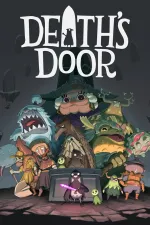
Score: 9

Summary: Death's Door marries fine-tuned hack n' slash action with a cool world ripe with secrets to unravel. The result is an entertaining, densely-packed trip to the other side.

Concept: As a reaper of souls working for an organization of crows, you must recover a stolen soul while unraveling a mystery surrounding figures who’ve lived for centuries

Graphics: The black-and-white headquarters contrasts nicely with a colorful world, and Death’s Door biomes are distinct visual treats

Sound: Pleasant piano melodies and epic boss music perfectly suit the ebb and flow of combat and exploration

Playability: I love the strategic loop of executing melee attacks to refill ranged abilities, and exciting boss fights push an otherwise simple combat system to enjoyable limits

Entertainment: Death’s Door presents a compelling world begging to be explored until every secret is found alongside satisfying combat and intriguing lore

Replay: Moderate
Click to Purchase

Monday, November 22, 2021

Inscryption Review – Engraved Secrets

Publisher: Devolver Digital
Developer: Daniel Mullins Games
Rating: Not rated
Reviewed on: PC

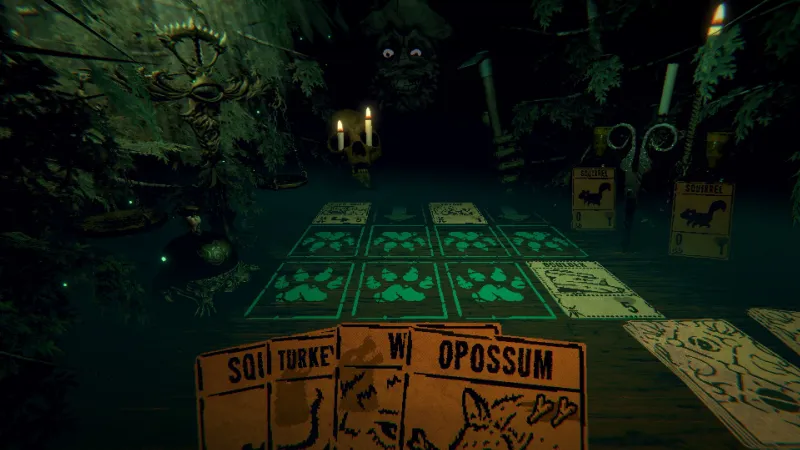
You wake up in a dark cabin, chained to a worn table. A mysterious man sits on the other side of the room. You can't see the details of his face through the darkness, but his crazed eyes pierce the shadows. Something under your belly lurches as he invites you to play a card game. The rules seem simple; you summon creatures to attack your opponent's army of foes, and you easily win the first few hands. Still, you can't shake the anxiety of what might happen if – no – when you lose. You play on, the eyes on the other side of the table slowly burning a hole in your stomach.

Inscryption is an incredible tone piece that taps into horror themes while telling an engaging and ever-evolving mystery. While those horror elements are important to the narrative, they are also just a backdrop to this adventure. I loved Inscryption’s moody atmosphere, but I also appreciate that it doesn't force any jump scares on the player, making it a fairly approachable horror experience.

Click here to watch embedded media

At the center of the adventure is a robust card combat system that has you summoning creatures into lanes on a battlefield. Your creatures deal damage to the critters on the opposite side of their lanes and, ultimately, directly to your opponent. The basic setup should be familiar to fans of games like Hearthstone and Magic: The Gathering, but Inscryption puts several fun twists on the formula that kept me coming back for more. For starters, some creatures require a sacrifice to enter battle. This means that when you want to summon a powerful creature like a bear, you'll have to kill several beasts that you already put on the field. I liked the push/pull of trying to get your strongest creatures into the fray without thinning your ranks too much.

Inscryption's deck-building system is also much deeper than it first appears. For example, some creatures can be summoned into battle only if you have a certain number of bones acquired through fallen allies. This allowed me to turn my defeats into victories; even if all my creatures were wiped from the board, I often felt like I had an ace up my sleeve or could tap into another strategy to turn the tide in my favor.

As you continue to take down opponents, you move along a gameboard and encounter random events à la titles like Slay The Spire. Some encounters give you new cards, buff existing cards, or grant additional tools to use in combat, such as a fan that allows your creatures to fly over their opponent's heads. You also have the chance to affix sigils to your cards that offer unique powers, such as the ability to transform into stronger creatures over time or attack multiple lanes at once. These elements give Inscryption's card system a unique flavor, and I loved experimenting with my deck to find new card synergies or create brand new cards that almost felt overpowered.

Click image thumbnails to view larger version


Between card battles, you can stand up from the table and explore your cabin. This space is full of locked drawers and other puzzle boxes. Solving these adventure-game-like mysteries earns you new cards and brings you one step closer to unraveling Inscryption's larger mysteries. You eventually reach some startling revelations about who you are and why you're trapped in this cabin, but the less I say about those revelations the better. However, Inscryption successfully flipped my expectations multiple times before the journey was over, and I couldn't wait to see its satisfying narrative conclusion.

Inscryption is an oddity of the best order. It's a horror game that isn't aggressively trying to scare you. It's also a clever card system wrapped around a compelling mystery that plays with video game conventions. Like a bat out of hell, Inscryption came out of nowhere and quickly became one of my favorite games of the year.

Score: 9

Summary: A horror-themed deck-building experience that evolves in unexpected ways the more you play.

Concept: A horror-themed deck-building experience that evolves in unexpected ways the more you play

Graphics: Inscryption's low-fi art style and dark atmosphere sends chills up your spine

Sound: A moody soundtrack helps sell the horror theme, but it's subtle and largely unmemorable

Playability: The card system has clearly defined rules, so playing cards is simple. Building an overpowered deck is highly rewarding

Entertainment: The card combat is engaging, and the larger narrative elements make Inscryption incredibly hard to put down

Replay: Moderately High

Click to Purchase

Friday, November 19, 2021

Battlefield 2042 Review

battlefield 2042 review

Publisher: Electronic Arts
Developer: DICE
Reviewed on: PC
Also on: PlayStation 5, PlayStation 4, Xbox One

Battlefield has always been the largest and loudest multiplayer experience in the business. It’s the video game equivalent of Texas, and its bombast cannot be overstated. Battlefield 2042 offers a variety of ways to participate in simulated near-future warfare. Whether you prefer to fight via land or sky, you can experience dizzying on-screen explosions, tense firefights, and more vehicles than teammates who know how to drive them. Unfortunately, Battlefield 2042 is full of almost as many bugs as bad pilots, dragging down an otherwise solid online shooter.

If nothing else, Battlefield 2042 is familiar. It continues the series’ trend in delivering multiplayer maps with the largest player count possible and a range of reliable character archetypes that have become standard in first-person shooters. The newest addition to Battlefield’s long-standing formula is a weather system that lets you ride lethal tornados alongside the vehicles and debris they pick up on their route across the map. These storms are a neat touch and add a sense of panic to already-tense battles, but their inclusion feels inconsequential in the grand scheme. The 128-player matches and large maps guarantee dramatic moments, but there’s a thin line separating spectacle and chaos, and 2042 often devolves into the latter.

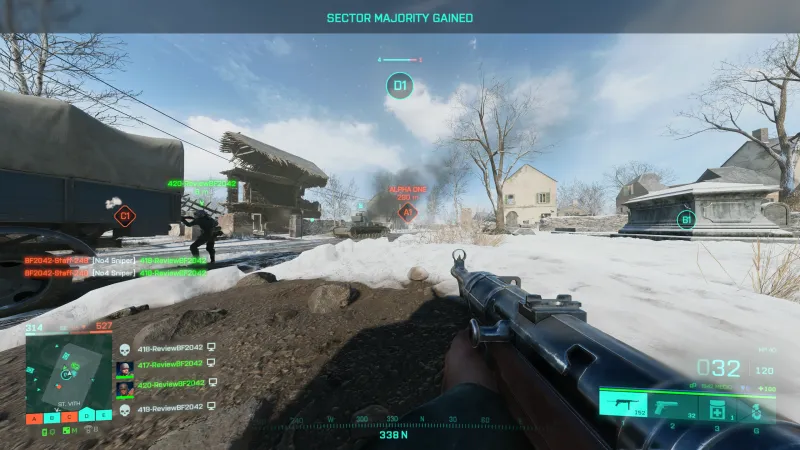
There’s never been a Battlefield game released without Conquest, the signature mode which tasks two opposing teams to capture and defend objective zones across the map. Each side has a limited number of reinforcements that slowly drain according to how many sectors the team controls. The popular format is alive and well in 2042, but unfortunately, it’s my least favorite way to play. For the first time, Battlefield hosts too many players in each match. Without the presence of Commanders to take charge of assaults, Conquest feels disorganized and incoherent at times since there’s no good way for all 64 players on each team to communicate and focus their attacks. Also, respawns frequently place you in the middle of a contested area only to be immediately killed by an enemy from somewhere off-screen.

Click here to watch embedded media

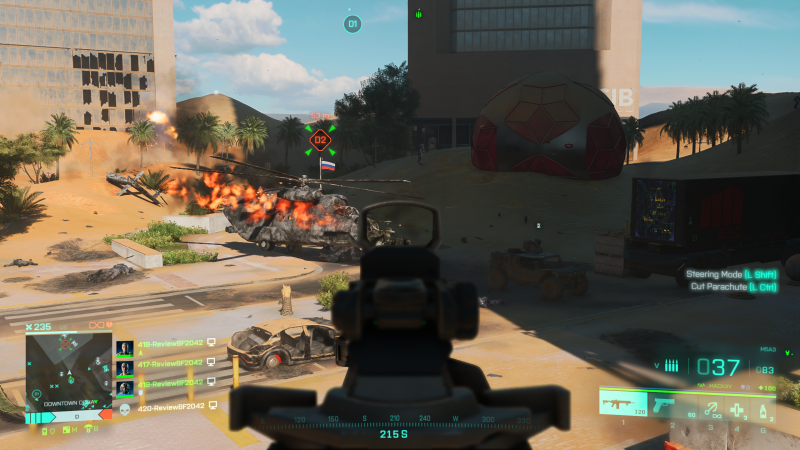
Even if the larger picture is occasionally blurred, the moment-to-moment gameplay loop is fun. Gunplay is solid even though hits don’t always seem to register when they should, and the wide array of vehicles are equally entertaining to pilot when running on foot becomes tiresome. I was disappointed by the lack of naval warfare, which is notable considering its importance in the series and the fact that several maps are surrounded by large bodies of water.

Breakthrough is the second mode in the game’s multiplayer suite, and it provides more focused engagements by separating maps into multiple segments, each containing two Control Points. If the attacking team successfully captures all of the objectives in a zone, they can force the defending team to retreat to the next area. While Breakthrough still suffers from an inflated player count, it is undoubtedly the best path to participating in a traditional Battlefield experience.

Hazard Zone, a brand new multiplayer format introduced in 2042, pits eight squads of four against one another and tasks them with retrieving data drives located in satellite crash sites scattered across the map. Each location is guarded by opposing AI forces that attack your team on sight. Hazard Zone has no respawning unless your teammates have a Redeploy Uplink. The only way to win these matches is to extract in a highly-contested Helicarrier, which only visits the map twice throughout the game. If you miss the flight or die before making it onboard, it’s game over, and you lose the credits you spent in the pre-match munitions shop. However, if you successfully extract, you’re rewarded with Dark Market Credits, a meta currency that persists between games, which you can spend to purchase better gear before your next match. Hazard Zone is tense and strategic, and the white-knuckle firefights at the end of each game make it my favorite way to play Battlefield 2042.

Another new addition to the series is Battlefield Portal, a community-driven platform that players can use to make custom games or play others’ weird creations. For example, there’s a free-for-all rockets-only mode in which the only way to reload your launcher is to jump five times. Watching rockets fly across the screen in such a ridiculous scenario is hilarious, but like most of the games in Portal, the fun fades after a match or two.

battlefield 2042 review

In theory, Portal is an opportunity for players to create inventive spins on Battlefield, especially since the Battlefield Builder is easy to grasp and is accessible via a web browser. Portal lets you customize the game mode, map rotation, arsenal restrictions, and you can program advanced rulesets with visual scripting in the Logic Editor; however, the latter is less approachable to beginners. As a fan of past creative suites like Halo Forge and Fortnite Creative, I’m not compelled to interact with Portal’s tools since they’re designed for modifying existing game settings and don’t allow you to design your own original levels. 

Portal also includes remastered versions of classic maps, and you can augment their rulesets or play them in their original form in a developer-featured playlist. I love this inclusion and am very happy to have a convenient way to return to beloved locations like Valparaiso, Caspian Border, or the Battle of The Bulge. These are effectively remastered versions of the series’ best maps, and I’m interested to see which ones DICE adds next.

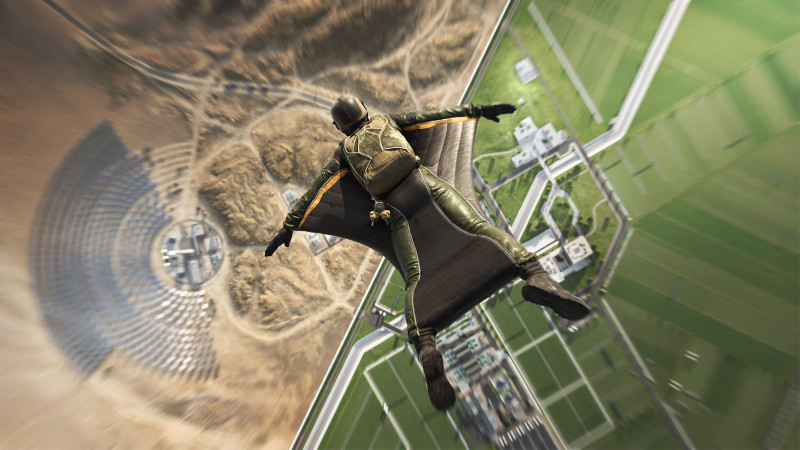
Whether you’re grappling above the competition like Spider-Man, flying through a deadly tornado with a wingsuit, or sniping enemies from behind mobile barricades, each Battlefield specialist offers a unique way to participate in the battle. The title launched with ten specialists, and each of them falls into one of four classes: Assault, Engineer, Support, and Recon. You can fine-tune these characters in myriad ways (including being able to use any weapon). Still, my favorite customization feature is the option to swap weapon attachments mid-fight without needing to respawn. My go-to sniper lens is the 6X scope, but I found it convenient to switch to a different optic on the fly with the press of a button. This new feature vastly improves the multiplayer experience and should be adopted by other first-person shooters.

battlefield 2042 review

Battlefield 2042 includes seven maps at launch. Hourglass features an isolated city reclaimed by the neighboring desert, Discarded hosts colossal shipyards along India’s western coasts, and Breakaway is nestled amidst the icy mountains of Antarctica. The other maps – Manifest, Kaleidoscope, Orbital, and Renewal – are standard fare but still feature landscapes worth exploring. Every map is affected by violent weather systems that are exciting to navigate, but I wish more maps hosted unique elements like Orbital’s rocket launch and Breakaway’s explosive silos that permanently augment the map mid-match. Regardless, there aren’t any bad maps, and I enjoy playing on each of them.

Unfortunately, Battlefield 2042 currently feels underbaked due to an abundance of bugs. While most bugs I encountered are minor, each one dilutes the fun I have when playing. For example, the grappling hook’s zipline clipping through the front of the device during its animation or not being able to call in air support on a map like Hourglass because of an issue with the sand’s navmesh. More serious glitches can negatively affect gameplay, like when sniper scopes lose their magnification after interacting with gadgets like Irish’s mobile barricades. While playing on PC, the game also hard crashed to my desktop once during a week spent playing the game. One of my friends wasn’t as lucky and experienced several crashes in one of our play sessions. These crashes left me especially disadvantaged in Hazard Zone. 

Don’t get me wrong: Battlefield 2042 is playable, packed with content, and often really fun. The title’s seven maps are distinct from one another, its bevy of customization options make it easy to play how you want, and I love the extreme weather systems and the quick-equip weapon feature. Portal hasn’t reached its full potential, but it introduces a convenient way to access six beloved experiences from Battlefield 3, Battlefield 1942, and Bad Company 2. Battlefield 2042 is an easy recommendation for existing fans or players looking for a modern war game, but I struggle to fully endorse it due to its current lack of polish. As long as DICE continues to publish hotfixes and patches as they have, Battlefield 2042 could eventually become a go-to online shooter, but it’s a shame it was released like this.


Battlefield 2042 was reviewed on PC with a code provided by the publisher for review purposes.

Score: 7

Summary: An otherwise solid online shooter bogged down by an abundance of bugs.

Concept: Battle for objectives across large-scale maps via land, sky, and in the middle of tornados

Graphics: The visuals are sacrificed in modes with larger player counts, but environments are rendered beautifully in smaller modes like Hazard Zone

Sound: Deep bass, large drums, and guttural synths comprise a familiar but compelling modern combat soundscape

Playability: Myriad customization options and approachable combat make for a varied first-person shooter

Entertainment: Each weapon has a unique feel that is fun to master and contested objectives always keep you busy

Replay: Moderately High

Click to Purchase