This is default featured slide 1 title

Go to Blogger edit html and find these sentences.Now replace these sentences with your own descriptions.This theme is Bloggerized by Lasantha Bandara - Premiumbloggertemplates.com.

This is default featured slide 2 title

Go to Blogger edit html and find these sentences.Now replace these sentences with your own descriptions.This theme is Bloggerized by Lasantha Bandara - Premiumbloggertemplates.com.

This is default featured slide 3 title

Go to Blogger edit html and find these sentences.Now replace these sentences with your own descriptions.This theme is Bloggerized by Lasantha Bandara - Premiumbloggertemplates.com.

This is default featured slide 4 title

Go to Blogger edit html and find these sentences.Now replace these sentences with your own descriptions.This theme is Bloggerized by Lasantha Bandara - Premiumbloggertemplates.com.

This is default featured slide 5 title

Go to Blogger edit html and find these sentences.Now replace these sentences with your own descriptions.This theme is Bloggerized by Lasantha Bandara - Premiumbloggertemplates.com.

Tuesday, July 17, 2018

Unrealized Potential In A Flooded World

The prospect of exploring the cartoon apocalypse of Adventure Time’s Ooo in a video game is incredibly enticing. Pirates of the Enchiridion turns Ooo into a world where you can go off and explore in any direction at nearly any time, which is what I want from a game taking advantage of the Adventure Time license, but it fails to deliver an engaging adventure within that framework. Covering the world in water limits potential exploration opportunities, you have little reason to do more than just the main story missions, and technical problems make the whole thing feel unstable.

Pirates of the Enchiridion begins with the land of Ooo getting flooded after the Ice King’s kingdom inexplicably melts. Jake the dog and Finn the human procure a boat to figure out what happened, and it sends them on a trip to familiar locations like the Fire Kingdom to fight bad guys and complete simple missions like finding Princess Bubblegum and returning her to her Candy Kingdom.

The strange humor of Adventure Time comes through in the story, thanks in large part to the cast reprising all of their roles. The crew sings silly shanties recounting what is happening in the story, and Jake makes frequent jokes about how their adventures usually end in about 20 minutes and how he expects once they complete this adventure, it will be like Ooo never flooded. I was also a fan of the narrative’s conclusive reveal that is played for one final, solid joke.

Calling this version of Ooo an open-world is only technically accurate. You can go anywhere on the map after completing the opening tutorial, but only a few islands are truly accessible and slowdown and excessive load times make everything feel disconnected. A compass at the top of the screen points you in the right direction as you travel, but no on-screen minimap is present to guide you. This means you must frequently pause to check the map, and pausing the game interrupts your ship’s momentum. Every time I checked the map, I basically had to start my boat from a stop, which was annoying.

Incentives for exploring while on your boat are rare, so you generally just beeline to the next story mission. It gets more interesting when you leave the boat to roam the handful of kingdoms and complete missions. In these moments you can hot swap between your team of Jake, Finn, Marceline, and BMO to run around the small kingdoms to pick fights, find treasure, and use abilities. For example, Jake can grow to carry everyone to higher ground, and BMO can hack locked doors. In the kingdoms, going off the critical path can pay off, but the rewards are generally additional healing or combat items, which are helpful but underwhelming.

The turn-based combat fighting is one of Pirates of Enchiridion’s strongest elements. Each of your four characters has distinct abilities that play well to support one another, and they power up their ultimate attacks in different ways. Finn charges by attacking, Jake charges by taking damage, BMO charges by using items, and Marceline charges by delivering killing blows. This dynamic forces you to be thoughtful about your actions and go beyond the basic attack command. The combat isn’t challenging, but it had enough depth to keep me from getting bored.


Technical issues drag it the total Enchiridion experience down. The load times and slowdown are annoying, misplaced or oddly mixed sound cues are frequent, and I experienced two full crashes. Good checkpoints made getting back into the action quick, but the crashes made me nervously cross my fingers at every loading screen. I also noticed strange, transparent lines on the map-screen icons that just lent the whole game a feeling of being unpolished.

Pirates of the Enchiridion is not the open-world game I was hoping for, but it is on the right track. This is a genuine attempt to create the type of experience the Adventure Time license deserves. It comes up short in many ways, but I still did get to have an adventure in Ooo, even if it was flooded with both water and technical issues.
Friday, July 13, 2018

The Dullest Invasion

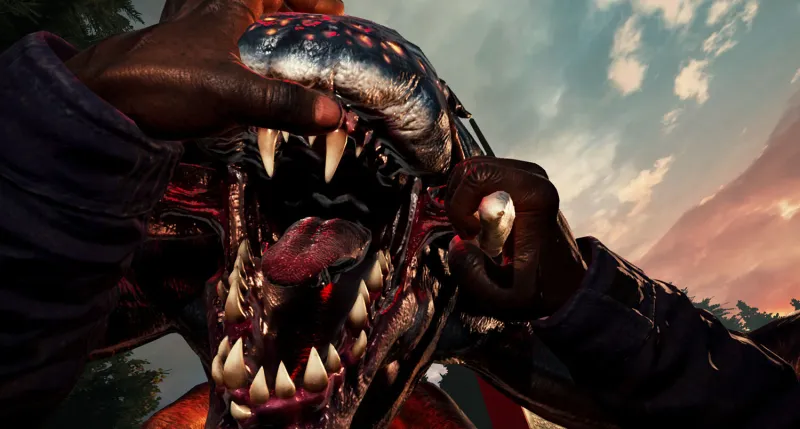
You cut through the maze of white picket fences, with a shotgun and only a couple of shells in hand. In the distance, you can hear them chittering. The three friends with you are growing nervous. “Need some health,” one of them says. Suddenly that dreaded alarm bellows and out of the bushes jumps a massive beast, capable of slaughtering you all in a few swipes…only for half of it to suddenly disappear into a wall and become stuck. Its giant hands are swinging but failing to reach you. You all shrug your shoulders, put a hundred rounds into the monster, and then move on.

Earthfall, a co-op shooter in the vein of Left 4 Dead and Warhammer: Vermintide 2, is filled with moments like this where there’s an amorphous sort of potential, a promise of fun or a challenging situation to discover around the corner, only for the game to stumble over its own feet even when it comes to the most basic qualities of a first-person shooter. Earthfall hedges more into the territory of clone than homage, with “Left 4 Dead But With Aliens” being an apt description without caveat or modification.

Set in a world that’s been invaded by aliens after a massive meteor strike, you play as one of four characters (with the other three characters filled by players or bots) trying to survive long enough to gather up enough people to lead a resistance against these extraterrestrial jerks. You progress through linear levels, fending off swarms of aliens to reach the end, occasionally setting up shop with auto turrets and deployable barricades to survive swarms of foes. There are two campaigns, each with five levels, and none of them are particularly memorable. The threadbare story is also backed by ‘lore entries’ that you can collect by shooting enough enemies with weapons. Unless you like reading about random resistance fighters’ fond memories of their assault rifles or clichéd lab reports on enemy foes, these aren’t worth the effort.

Earthfall’s biggest failing is that it apes the conventions and structure of fantastic co-op games without managing to engender the moments that make its influences so interesting. Earthfall’s weapons run the gambit from a machete to shotguns, but the many weapons all look generic and lack a satisfying punch. Enemy designs are also stale, with the countless drones that swarm you, all looking like gray crabs. More powerful, special enemies are capable of pulling players away from your group and doing damage to them until another player intervenes, but they’re also lacking in imagination when it comes to how they look. Like Left 4 Dead, Earthfall randomly sends out these special aliens to give you an extra dose of challenge but the lack of proper optimization, coupled with glitches leads to frustration more than it does excitement.

In certain session, three, high-damage dealing brute monsters would hit one after another in rapid succession, with no way to grab enough ammo between the encounters to fend them off. During one game, my group and I entered a small tunnel only to have one of those giant monsters spawn a few feet in front of us. You can only kill the beast by shooting it in the back so there was no way to escape or fight the monster off. We were trapped in an unwinnable situation; I closed out the session feeling cheated rather than spurred to head back in so that Earthfall could rob me of another 20 minutes of my time due to technical issues or lackluster randomization.

You can play Earthfall as a single-player experience but I can’t recommend it. Even with bots’ skill set up to the highest competency, they’re still aggressively stupid, often letting themselves be beaten to death by monsters or getting stuck in hilly environments. The whole enterprise becomes more about managing the needs of your idiot partners when you’re playing with A.I. allies instead of  actual players, making an experience that already feels like a chore even more of one.

Earthfall just isn’t fun. The game has a solid foundation but that structure doesn’t hold anything that’s entertaining or interesting enough to merit the effort of playing it, especially when there are already several superior games that inhabit the same subgenre.


Nintendo recuts a semiprecious stone

The software lineup for the Switch’s second year doesn’t measure up to its blockbuster opening year. Fortunately, Nintendo still has a volume of critical hits that launched on the underperforming Wii U to help pad out a thin release calendar. Titles like Mario Kart 8 Deluxe and Donkey Kong Country: Tropical Freeze are robust ports of their Wii U counterparts. This rerelease of Captain Toad: Treasure Tracker isn’t filled with nearly as many new goodies, but it remains a delightful romp for anyone who missed this treasure hunt the first time around.

I first fell in love with Captain Toad’s quirky diorama-like adventures in Super Mario 3D World. I adored helping the mushroom-topped hero dodge traps and enemies in a series of single-screen levels while hunting for rare treasures. When Nintendo expanded on this concept with a stand-alone adventure, I happily joined the expedition. Each level only took around five to ten minutes, and the bite-sized sequences were refreshingly free of fluff. Captain Toad’s levels aren’t challenging, but I discovered a peaceful joy in rotating the camera around each level as I shifted around the pieces of each environment like they were miniature puzzle boxes.

Bizarrely, this Switch version removes a handful of levels based on Super Mario 3D World’s environments. In their place, we get an entire bonus chapter of new levels based on the worlds in Super Mario Odyssey. This is more than a fair trade, because these new levels are some of the best in the game. I got a thrill at seeing my favorite worlds from Super Mario Odyssey again while helping Toad dodge Bullet Bills atop an upside down Pyramid, or finding a way to power the moving lifts underneath New Donk City. I just wish these new levels were available from the start; fans of the original release must play through most of the game again to unlock them, unless they have access to the Super Mario Odyssey wedding Amiibos.

Since Captain Toad: Treasure Tracker originally launched on the Wii U, it made full use of the Wii U controller’s touchpad, asking players to touch sections of the environment to move them around or to tap on enemies to slow them down. Sadly, this feature doesn’t translate perfectly to the Switch. When the system is docked, players use their controller’s motion controls to move a cursor across the screen, which acts as a stand-in for your fingers. These controls feel fine, but I got tired of watching the cursor buzz across the screen like an annoying fly when I wasn’t using it. Alternatively, handheld mode allows you to use the original touchscreen mechanics without a cursor, which is the ideal way to play.

Captain Toad’s only other significant addition is a two-player mode. Sorry, did I say, “significant?” I meant trivial. Like many of the two-player modes in other Nintendo games, this is simply a tweak to the single player campaign, where one player controls Toad and the second player controls the camera while throwing turnips at enemies from off-screen. This is far from a destination mode, but it technically meets the back of the box requirements of allowing two players to interact with the game at the same time.

Captain Toad: Treasure Tracker was a fun time when it hit the Wii U, and it’s still a fun time today. The new levels are easily some of the best in the game, but they don’t really justify a second purchase. I’m thrilled Nintendo wants to make use of this well-traveled fungi, but I hope the next time I see Captain Toad, he’s going on a completely new adventure.