Go to Blogger edit html and find these sentences.Now replace these sentences with your own descriptions.This theme is Bloggerized by Lasantha Bandara - Premiumbloggertemplates.com.
Go to Blogger edit html and find these sentences.Now replace these sentences with your own descriptions.This theme is Bloggerized by Lasantha Bandara - Premiumbloggertemplates.com.
Go to Blogger edit html and find these sentences.Now replace these sentences with your own descriptions.This theme is Bloggerized by Lasantha Bandara - Premiumbloggertemplates.com.
Go to Blogger edit html and find these sentences.Now replace these sentences with your own descriptions.This theme is Bloggerized by Lasantha Bandara - Premiumbloggertemplates.com.
Go to Blogger edit html and find these sentences.Now replace these sentences with your own descriptions.This theme is Bloggerized by Lasantha Bandara - Premiumbloggertemplates.com.
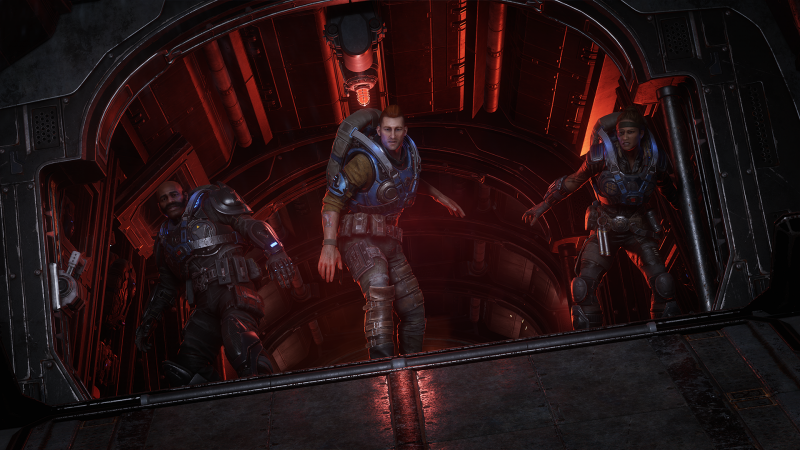
Short and bloody sweet, Gears 5: Hivebusters pumps out excitement with the urgency of a rattling lancer, rarely slowing as it hits the mark with its cover-based firefights. The troubled open-world exploration that was introduced in Gears 5 is nowhere to be found, and neither are Kait Diaz or the Fenix Family. We instead see Gears doing what it does best: mulching Locus Horde flesh. Players experience this familiar action through the high-powered mayhem of Scorpio Squad, a band of misfits who have assembled for a suicide mission.
Scorpion Squad is the team that was introduced in Gears 5’s Escape mode, and Hivebusters tells their origin story. They must sacrifice themselves to take out a massive Swarm hive – a selfless act that could save all of Sera. This narrative moves along quickly, but isn’t short in vision. We get plenty of fun and over-the-top banter from the squad’s Leslie Macallister, Lahni Kaliso, and Jeremiah Keegan, who have traveled to the lava-rich and beautifully realized Galangi islands. They move through jungles and caverns as they track down the hive, as well as something else that is big, unexpected, and spewing a toxin. The story and narrative truck along nicely, making the three hours it lasts for fly by.
The squad is equipped with a familiar arsenal, but they are without Jack – a flying robotic helper that previously provided support functionality. To make up for Jack’s absence, each character has a different ultimate ability that runs on a cooldown and can be enhanced through upgrades. Mac deploys a useful energy shield, Keegan generates ammo, and Lahni gets to have some fun with an electrified knife, the best of the three. The ultimates are game-changers in how frequently they can be used and how much they aid the team.
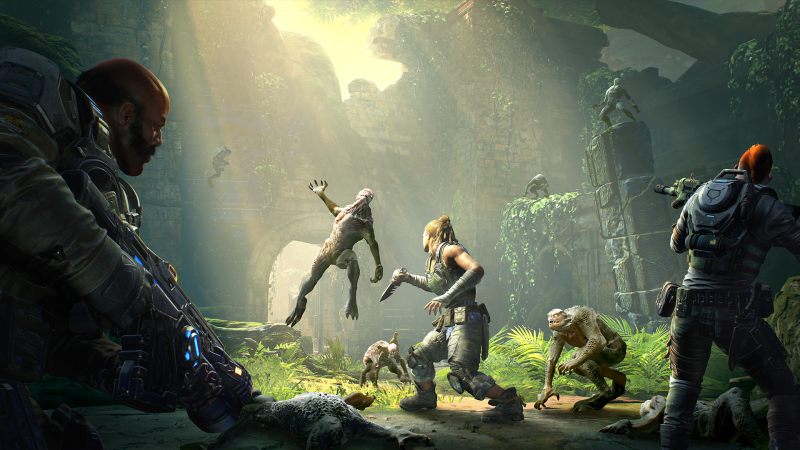
Most of the firefights throw caution to the wind and bombard the player with all types of enemies attacking from every vector. Locust foot soldiers take cover behind barriers, howling juvies leap from the trees, and swarms dance overhead. The intensity achieved by some of these firefights is awesome, and developer The Coalition does a nice job of changing them up from moment to moment. One minute, you need to hunker down and hold the line as foes approach. The next minute, you can use the environment as a weapon to melt or crush foes. Many of the fights are decently long, and reach satisfying levels of chaos. The Coalition’s fingerprint is pushing the player to the point of feeling overwhelmed, then turning it up a notch by throwing in a boss-like encounter at the end.
Given how quickly environments can be explored, the annoying transitions to other areas where the team needs to cut through vines, climb a cliff, or pry open a door are in great abundance and do slow the fervent pace down, but they are just small blemishes on an otherwise outstanding Gears of War experience.
Hivebusters doesn’t have the variety or world-building of the core Gears games, and doesn't take any chances along the way, but is a fun alternative that I wouldn’t mind seeing more of. It’s nice to get to know more of the characters in this universe, one of whom flips double middle fingers in the face of danger, which may be the most Gears of War thing I’ve ever seen.
Score: 8
Summary: The cover-based firefights continue to satisfy in big ways.
Concept: The series’ long-running cover-based formula still packs a punch, and is the core focus of this entry. It has a retro feel and moves along nicely
Graphics: The protagonists’ bulky shoulder pads are barely noticeable given the immense level of detail in the environments. The backdrops and foliage in the jungles are a sight to behold
Sound: Great voice performances that meld with the terrifying shrieks of the monsters. The score pounds at the right times
Playability: The lancer’s chainsaw may have some rust on it, but it’s still fun to use, as are all of the familiar gameplay mechanics. The new ultimate abilities add a little strategizing to the gunplay
Entertainment: Hivebusters provides about three hours of excellently designed gunfights that are great solo or with friends
Also on: PlayStation 5, PlayStation 4, Xbox One, Stadia
Cyberpunk 2077 is a work of awe-inspiring ambition, dazzling with its massive scale and creative vision. The world of Night City is a metropolis of futuristic art, stealing your eye with stunning neon-lit architecture and streets filled with citizens made of flesh and metal. Night City is an open world that immediately pulls you in and keeps you engaged with its dark narrative, meaningful player choice, and overwhelming amount of side content.
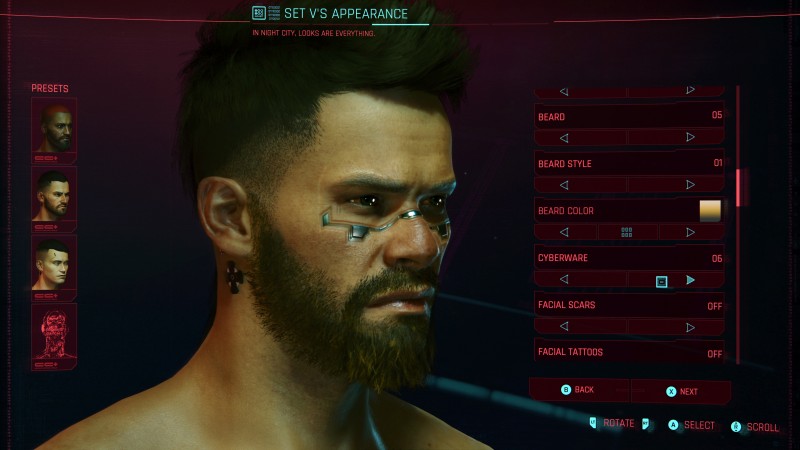
Your lens into this tech-obsessed society is the protagonist simply named V, a cyberpunk who you fully design, including their voice, backstory (which subtly alters the narrative), and even their genitals. I spent far too much time creating my look, even though I rarely saw it during play due to the mostly first-person perspective. V is fun to control thanks to immense amounts of cybertech, but is an unlikable lead, spouting off profanity and groan-inducing one-liners, and generally displaying a “scum of the earth” personality.
V, while making a mess of conversations, has an interesting story to tell. It goes places I didn’t expect and gets wild toward the end. The narrative hits its stride when V meets Johnny Silverhand, a former terrorist who is now a digital construct that lives in V’s mind. Silverhand’s thoughts and dark ambitions are twisted and dangerous, leading to great conversational choices and decisions that allow players to shape the story and action. The biggest allure of Silverhand is how he’s brought to life by actor Keanu Reeves, who looks and sounds as awesome in the role as he does in any film on the silver screen. Given how wonderful some of the other characters are (with their own long and fantastic arcs), Reeves doesn’t steal the show – but Silverhand is a constant throughout most of the game and helps save V from being too overbearing.
Silverhand will bring a smile to your face, but Cyberpunk 2077 doesn’t have many joyous bones in its body, and is often heavy in the delivery of its dark content. Night City may be vibrant, but it's home mostly to evil people doing terrible things. Some of the content made me uncomfortable, including story moments dealing with abuse and sexual assault. Even the average bystanders sometimes gave me pause, such as a drugged woman being held in place by a man, a setup seen all over the city. Developers should be free to explore all subject matter, but it sometimes feels careless in Cyberpunk 2077 – more like edgy set-dressing than meaningful commentary.
Much like V’s inability to think clearly with Silverhand clouding the mind, Cyberpunk 2077’s story often has different tones, and is all over the place from mission to mission. In one side story, V may come across as likable and mature. In the next, V suddenly sounds like an angsty teenager again (the tone you hear most). It’s hit or miss, but most quests deliver awesome moments, particularly when new NPCs are introduced. Almost every mission-giver or notable character is vividly brought to life in voice, animation, and by the crazy amounts of detail on their body. The same can be said for many of the locations they inhabit; an outstanding level of detail in the world makes each unique area a sight to behold. I can’t stress this enough; exploring Night City is a huge hook that CD Projekt Red knocks out of the park.
Some of the more memorable characters and story arcs are tucked off to the side, and you may never see them if you don’t veer off of the critical path (which can be completed in roughly 15 to 20 hours). I don’t know how many dozens (or hundreds) of hours of side content are around it, but the mission log just keeps growing as you play. While the main story sequences often end with cliffhangers that demand resolution and the thought that you should continue on that path, the best way to experience Cyberpunk 2077 is to see what the city has to offer. Walk into a crowded market, explore a mysterious question mark on your map, and take on the side missions that the denizens are offering – just surrender yourself to moment-to-moment discovery.
Click image thumbnails to view larger version
CD Projekt Red wants you to soak in the beauty of the world, but also demands you spend plenty of time in menus assigning new abilities, crafting, and sorting through heaps of loot. That isn’t a knock against the game. It’s all handled quite well. Any room you enter could have numerous items to pick up, as well as world-building text you can read. The amount of leveling you can do is immense, which is reflected on sprawling ability charts that take considerable amounts of time to fill out. If you only focus on the critical path, you barely scratch the surface of the abilities, which carry significant advantages to combat, stealth, hacking, and dialogue. It’s amazing how much you can improve and expand upon V’s standard attributes. I also love how doing various things helps improve V in those fields.
Using cyberware and abilities to mess with enemies is good fun, such as cooking a grenade in an enemy's pocket. Hacking cameras and activating devices from afar to distract foes makes stealth satisfying. I enjoyed creeping through environments, hacking the cameras and turrets as I went. I leaned more on stealth than expected, partially because I didn’t find the gunplay enthralling. The weapons you obtain feel awesome (and give good reason to track down the legendary and iconic versions), but the enemy A.I. isn’t great, leading to headshots being delivered like they are going out of style. Some enemies think they are hidden behind thin railings, others charge foolishly toward you and then stop without any cover around them. Harder missions (which are nicely indicated on the log) are a little more intense given the spike in difficulty, but the adversaries are still easy to manipulate, unless they are an aggressive boss or cyber ninja that crowds you quickly.
Johnny Silverhand sadly isn’t the only glitch in Cyberpunk 2077. Not since The Elder Scrolls V: Skyrim have I played a game that is riddled with so many graphical bugs at launch. The danger of entering a seedy bar loses its bite when one of its patrons stands motionless in a T-pose. A high-speed motorcycle chase down a highway is far less intense than it should be when an NPC biker shakes so much he looks like a blur. Little visual hitches in the environment and characters occur frequently, and they’re jarring, but I rarely ran into anything that affected gameplay. The only major issues I experienced were I could no longer look down the sight of my guns during one mission – reloading my save fixed the issue. I also had a digitized visual effect remain after a cutscene. Again, I had to reload and replay a sequence to get the proper outcome. Regardless, the frequency of the odd visual moments hurts immersion, and can outright ruin a suspenseful moment.
Cyberpunk 2077 is dark and disturbing at times (frighteningly so), but the majority of its content is fascinating, and loaded with depth through the various RPG systems and lore. I thoroughly enjoyed my time in Night City, and Johnny Silverhand is a great partner to see the sights with. Cyberpunk 2077 doesn’t overstay its welcome with its critical-path story, and invites players to jack in and stay for hundreds of hours of unique content should they want to. It didn't blow me away like The Witcher 3: Wild Hunt, but is still a hell of an opening to what will hopefully be a new series.
Score: 9
Summary: The wait is worth it for CD Projekt Red's next open-world RPG, but it's an uneven playthrough that shines in particular areas and struggles in others.
Concept: A deep RPG experience that struggles with gunplay and glitches, but excels with its world, characters, and wealth of loot
Graphics: The level of detail is staggering. Every street corner and interior is worth examining. However, visual glitches occur frequently in the animations and environments
Sound: The electronic and synth-heavy score is fantastic. The radio stations also have a unique mix of songs that fit Night City’s vibe. Keanu Reeves is every bit as good as you would hope he is, and helps overcome some of the protagonist’s cringey banter
Playability: Cybernetic upgrades make stealth incredibly fun, but problematic enemy A.I. steals the fun out of the gunplay
Entertainment: An open world you can get lost in and continue finding new things to do
Also on: PlayStation 5, PlayStation 4, Xbox One, Switch, PC
Yu and Kay are two people stuck on an isolated planet together. The good news is they’re in love, so they already enjoy each other’s company. The bad news is parts of the planet are covered with an unstable substance they call rust, which makes the surrounding areas (and the animals that inhabit them) dangerous. Haven bounces between these two driving concepts, emphasizing Yu and Kay’s relationship at home in their spaceship, then following them as they explore the planet’s mysterious frontiers. The result is a low-impact fusion between visual novel and RPG, but it fails to fully harness the best of both worlds. Even so, Haven gets the fundamental elements right.
The bond between Yu and Kay is the most important part of the story, and I appreciate how developer The Game Bakers commits to making players view their interactions through the lens of mundane activities. During their time at home, they cook and eat together, have conversations on the couch, and argue about hair in the shower drain. Most relationships aren’t forged in the fires of world-ending threats and high-stakes adventure, after all. They are built in casual and comfortable spaces, and Haven largely feels authentic in its portrayal of an established (but still young) love. Physically intimacy is naturally a part of that, but Haven often uses it as a crutch instead of developing the characters in other ways; by the end of the game, the number of innocuous situations that ended in implied sex had me rolling my eyes.
The story surrounding Source (the planet Yu and Kay have settled on) is less compelling than the characters’ romantic arc. You learn why they fled their homes, and uncover some sinister facts about Source, but the threads never come together in a satisfying way. The developers clearly have an elaborate vision for this fictional sci-fi universe and its history, but the portions that find their way into the Haven’s narrative are peripheral and incomplete. I didn’t feel like I was getting a tantalizing glimpse of a bigger picture; I felt like a much larger and clearer story once existed, but important parts were gradually trimmed away until these abbreviated pieces were all that remained. Yu and Kay are ultimately still the focus, but my lack of investment in the events around them made the grand finale fall flat.
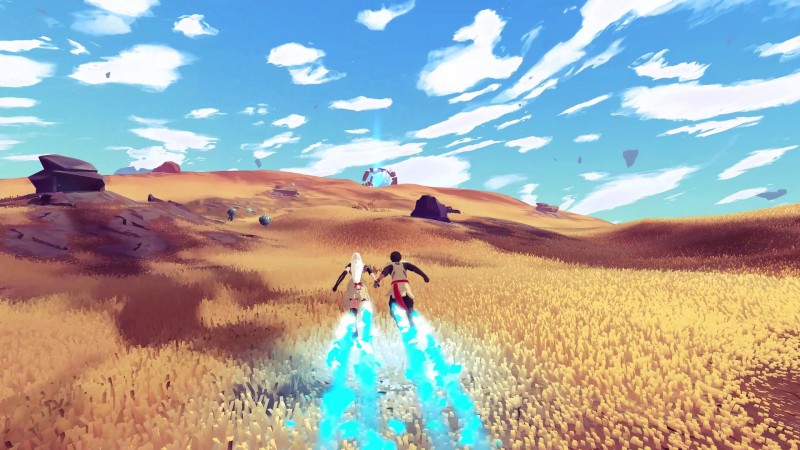
When they aren’t spending time in their ship (which is broken and can’t fly), Yu and Kay strap on hover-boots and go soaring across the colorful floating islands of Source. This is another core component that Haven gets right; simply moving around the planet is exhilarating. You glide above open plains and ride energy currents around rocky terrain, cleansing the rust of the ground as you pass over it. This is satisfying whether you’re playing solo or co-op, but even with a partner, the two characters need to stick close together. With the stylish visuals and chill soundtrack, exploration can have a pleasant and meditative quality – assuming you aren’t trying to anything specific. Any precise navigation is incredibly finnicky, even with the ability to drift for sharper turns. This makes it easy to get caught on the environment and inadvertently fall from high places, but apart from occasional enemy encounters, getting where you need to go isn’t too much of a hassle.
Click image thumbnails to view larger version
In addition to the vast expanses to explore, the combat is the most RPG-like part of Haven. It involves charging and releasing attacks in real time, coordinating Yu and Kay’s actions to clear the field. The focus on timing and cooperation is interesting, but after a few basic upgrades, the battle system doesn’t evolve in meaningful ways. As you progress, you don’t learn many abilities that open up new tactics; the challenge comes mostly from different enemy types restricting your available strategies from an already-limited selection, so your combat options are shrinking over time rather than expanding. However, Haven also isn’t a demanding game, so the blunt repetition of these fights is a bigger disappointment than their difficulty.
Even when I was frustrated, I was impressed by the touching and thrilling moments Haven creates. I enjoyed the genuine connection between Yu and Kay, and jetting off into the unknown with a pair of hover-boots is a blast. But this otherworldly adventure extends itself too far beyond its strengths. Sometimes the rough patches are worth working through, but like any relationship, sometimes you’re just giving more than you’re getting.
Score: 7.75
Summary: Sometimes Haven's rough patches are worth working through, but like any relationship, sometimes you’re just giving more than you’re getting.
Concept: See the blossoming love of two young heroes as they fly across the surface of a strange planet and search for parts to repair their ship
Graphics: Colorful and stylized visuals are a good fit for the sci-fi landscape. The static portraits convey the necessary reactions, but don’t exactly bring the characters to life
Sound: The two leads put in good voice performances, and the pop-synth soundtrack makes it easy to relax while playing
Playability: Navigation is too imprecise for fine maneuvering, but the controls work great if you’re just cutting across open fields
Entertainment: Haven finds a groove in its exploration and character-building, but the combat and big narrative beats throw it off