This is default featured slide 1 title

Go to Blogger edit html and find these sentences.Now replace these sentences with your own descriptions.This theme is Bloggerized by Lasantha Bandara - Premiumbloggertemplates.com.

This is default featured slide 2 title

Go to Blogger edit html and find these sentences.Now replace these sentences with your own descriptions.This theme is Bloggerized by Lasantha Bandara - Premiumbloggertemplates.com.

This is default featured slide 3 title

Go to Blogger edit html and find these sentences.Now replace these sentences with your own descriptions.This theme is Bloggerized by Lasantha Bandara - Premiumbloggertemplates.com.

This is default featured slide 4 title

Go to Blogger edit html and find these sentences.Now replace these sentences with your own descriptions.This theme is Bloggerized by Lasantha Bandara - Premiumbloggertemplates.com.

This is default featured slide 5 title

Go to Blogger edit html and find these sentences.Now replace these sentences with your own descriptions.This theme is Bloggerized by Lasantha Bandara - Premiumbloggertemplates.com.

Monday, August 9, 2021

The Great Ace Attorney Chronicles Review – You Know These Methods, And They Still Work

Publisher: Capcom
Developer: Capcom
Rating: Teen
Reviewed on: Switch
Also on: PlayStation 4, PC

From the zany characters to outrageous courtroom theatrics, the Ace Attorney series has made a name for itself, becoming revered for its offbeat antics and heartwarming moments. Even after finishing the iconic Phoenix Wright trilogy, the franchise has found ways to keep going. Since then, we’ve had new attorneys like Apollo Justice, spin-offs starring Miles Edgeworth, and a crossover with Professor Layton. However, one of the more creative efforts to reboot the formula lies in the Great Ace Attorney series, which transports players to a different time and place: Britain’s Victorian era. Sadly, the Great Ace Attorney’s two entries never made their way Westward until now. Capcom’s The Great Ace Attorney Chronicles includes both games, dual Japanese and English audio, eight “slice of life” escapades, and a new auto-advancing story mode. I couldn’t recommend a better way to experience one of the most over-the-top stories in Ace Attorney history.

Sometimes a change of scenery makes all the difference. The Great Ace Attorney Chronicles ushers players back in time to the turn of the 20th century during Japan’s Meiji Period and Britain’s Victorian, showcasing the culture and standards of both countries. Of course, Chronicles has a huge focus on both legal systems and how their courtrooms function. At this point in history, Britain is increasingly modernizing, and the Japanese are learning a great deal from their methods. However, as we all know, no system is perfect, and each case exposes some of the flaws and corruption at play. This time around, you play Phoenix Wright’s ancestor Ryunosuke Naruhodo, who is just discovering his passion for law. Ryunosuke heads overseas to Britain to learn more, but in true Ace Attorney fashion, everything that can go wrong does, forcing him to step into the courtroom before he’s ready.

Fans will be quick to notice that not only does Ryunosuke fall to the same bad luck as Phoenix Wright, he also uses similar mannerisms. His judicial assistant Susato Mikotoba also channels some major Maya Fey vibes in her unwavering support for Ryunosuke and fangirling over Herlock Sholmes. I enjoyed the familiar overtones in these characters, but they also feel like their own people with personal journeys. For instance, Susasto is a bit more reserved and pensive than Maya and has to hold her own in a time when women weren’t often taken seriously. Spotting the similarities and connections is fun, but you don’t need to play past games to follow The Great Ace Attorney storylines. These are brand-new stories and characters, so this collection is a fine starting point.

As a standalone story, this is one of the most outlandish plots in the Ace Attorney universe. I mean, you team up with the great detective “Herlock Sholmes,” who is just a silly man with barely half a clue about what’s going on. Even with a more comical bent, I like how the narrative doesn’t lose sight of how messy and imperfect the judicial system can be, shedding light on side deals and government interference. However, sometimes the game struggles with its dark humor, making for some uncomfortable moments, such as a character who spits up blood and one who waves a gun near his head, threatening his existence.

Outside of those few instances, the unpredictable mystery and interesting characters kept me engaged; I especially love the overly animated man who loves literature and speaks in haikus. Herlock Sholmes made me shake my head quite a bit, but there’s also something charming about his dense nature. My favorite new character is Iris, a child prodigy who is the true mastermind behind Sholmes’ famed stories. Iris is extremely perceptive and clever, but she also has an endearing innocence that reminds you she’s just a child. I immediately wanted to protect her from life’s darker truths.


I’m glad that Capcom released the two games in a collection because the stories are tightly connected. You get to the end of the first game and notice several hanging threads, and I enjoyed the interesting ways returning characters and events made their way into cases in the second game. Part of the magic is never knowing when, if, or how someone from a past case might find their way back into an investigation. The writing is clever and creative, but the way it’s done in The Great Ace Attorney really shines because you feel in on the joke, quickly realizing there must be a reason the same characters keep showing up.

The bulk of the gameplay revolves around defending clients in the courtroom and investigating crime scenes for evidence. It also involves a lot of dialogue to gather further information. At times, the slow pacing drags, as cases, especially later ones, often require investigating and talking to witnesses at multiple places. At the same time, the trials contain multiple testimonies that often take two to three intermissions. Each case demands a lot of your focus and patience, but once things start to unravel, they’re extremely rewarding, especially as you make connections about what really happened. My favorite moments are when I realize I have the evidence to completely end a witness and expose their lies.

The Great Ace Attorney features some new tactics to keep sleuthing and the courtroom drama more exciting. Herlock Sholmes often jumps to the wrong conclusions in his “Logic and Reasoning Spectaculars,” so you must course-correct his initial deductions about what happened. This requires investigating things more closely, like paying attention to a character’s line of sight to find a clue or seeing the object from a different angle to unearth new information. I like the thought behind this aspect and seeing new revelations come to light, but this was far too easy in the first game, so I never felt too accomplished solving them.

Summation Examination is another new feature, where you pit jury members against each other to expose their flawed thinking and sway them to your side. I like the idea of interacting with the jury and finding ways to make them support my argument, but this is another component that seems better in theory. The inconsistencies you spot are random, and I rarely feel like they make a huge difference in discovering what really happened in the case. Instead of feeling like a fun battle of the wits, these moments seem to prolong cases without having enough startling revelations.

The Great Ace Attorney Chronicles is a solid package, retaining the charm and entertainment of previous entries. It's not the series’ best, but there’s plenty to keep you entertained as you work your way through case after case. The new scenery and characters made things feel fresh, but playing another Ace Attorney game also felt a bit like coming home.

Click image thumbnails to view larger version


Score: 8.25

Summary: The Great Ace Attorney Chronicles delights in its over-the-top fashion and inclusion of a certain famous detective.

Concept: Reboot the Ace Attorney series using Phoenix Wright’s ancestor Ryunosuke Naruhodo as he pursues law at the turn of the 20th century

Graphics: The visuals have improved from their original releases, and the eccentric character designs don’t disappoint. The animated cutscenes are a highlight, so it’s a shame there are so few

Sound: Sound effects and different character themes inject life into the courtroom, but music and voice acting are used sparingly, never having a chance to shine

Playability: As a point-and-click text adventure, the controls are easy to grasp, but the real challenge comes in the courtroom, where you must use your noggin to present fitting evidence and make sound deductions

Entertainment: The Great Ace Attorney Chronicles offers an entertaining package with two closely connected games that delight in their over-the-top fashion and inclusion of a certain famous detective

Replay: Moderate

Click to Purchase

Thursday, August 5, 2021

Eldest Souls Review – What A Rush

Publisher: CI Games, United Label
Developer: Fallen Flag Studio
Rating: Teen
Reviewed on: PlayStation 5
Also on: PlayStation 4, Xbox One, Switch, PC

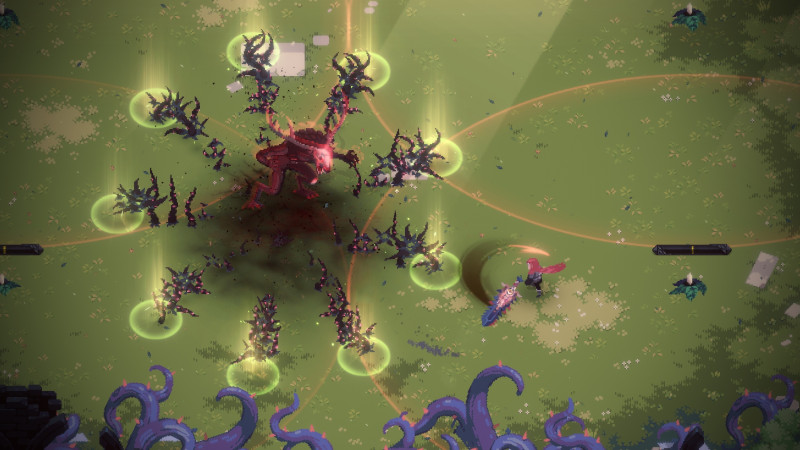
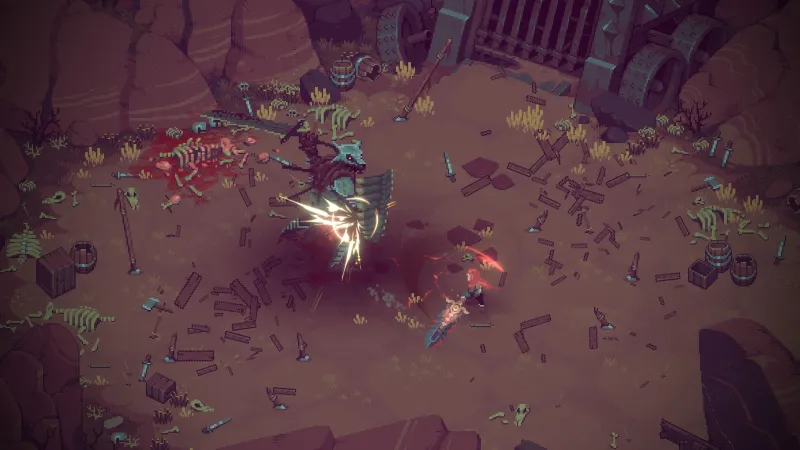
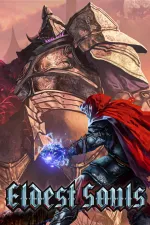
Let’s rip this band-aid off now: Eldest Souls is a Souls-like indie action game. Before you flee in terror screaming, “not another one of these!” you should know the game offers a nice twist by stripping away fodder enemies and shortcut-driven exploration to focus squarely on elaborate, tough-as-nails boss battles. Furthermore, Eldest Souls’ combat and progression offer smart ideas that make its challenge not only bearable but strategically gratifying. Yes, the game sports some of the sub-genre’s familiar trappings, but it succeeds in putting the “rush” in “boss rush.” 

You are a lone warrior brandishing a huge sword with a straightforward task: infiltrate a citadel imprisoning ancient gods who destroyed the world and kill every one of them. That's it. Scattered notes and the occasional NPC offer additional, sometimes exciting context for this world gone awry, but I was more concerned with getting my sword dirty than mulling over the how’s and why’s of it all. 

Eldest Souls wears its FromSoftware inspirations on its sleeve but is thankfully not as harsh. For one, you’re not collecting currency, so you don’t lose anything on dying. Stamina only dictates how often you can dodge, meaning you can swing your sword all day without consequence. Armed with a heavy broadsword, your basic attacks are deliberately slow, to the point of feeling slightly unresponsive. It’s not a deal-breaker, but it could stand to feel tighter, and it took me a while to get used to combat. 

My favorite aspect of Eldest Souls is that you don’t collect health pickups. Instead, you regain health by landing charged sword strikes. This system does an excellent job of encouraging and rewarding aggression and kept my morale from plummeting whenever I got stomped. Lose 90 percent of your health during the opening seconds of a bout? A few hard hits can patch you up as if nothing happened. I love how this mechanic emboldens me to keep bringing the fight no matter how bleak things look and led to some incredible come-from-behind victories. 

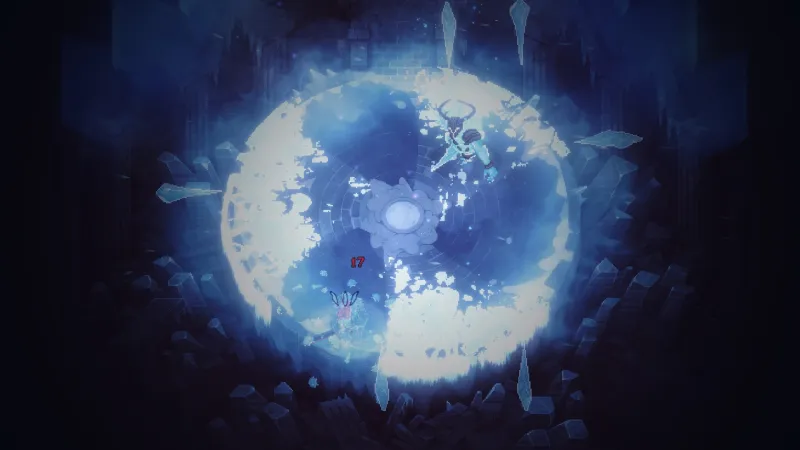
The Old Gods offer an entertaining and supremely challenging gauntlet of battles that pushed me to use every skill. Each boss is fun, even those who took a dozen attempts or so to topple. Favorites include a gravity-controlling mage and a deer god who’s much more than meets the eye. Even the final big bad had me grinning with excitement as I cut through its seemingly bottomless well of offense. Enemies are multiple-trick ponies that lob screen-filling traps, bullet-hell style projectiles, and often shift tactics or take on new forms mid-fight. Surviving their assaults can be infuriating, and I saw the Game Over screen hundreds of times. Sometimes the sheer number of attacks to look out for can feel maddening, but I always knew where I went wrong and ultimately succeeded by studying attack patterns while properly managing stamina. Instant respawns also kept me engaged, as did the option to try my luck against other foes as multiple are available to challenge at a time.

Winning the day requires a mastery of Eldest Souls’ three combat styles: Windslash, Berserk, and Counter. In layman’s terms, that’s Speed, Offense, and Defense. You can only equip one class at a time, and each has a separate skill tree of abilities and buffs, but you can switch by respec-ing skill points whenever you want at no cost. Whether I was spawning homing projectiles using Windslash or unleashing devastating parry attacks under the Counter tree, I found each class entertaining in its own way. As someone who rarely respecs in a game, Eldest Souls pushed me, with great success, to change my tactics whenever I hit a wall. Eldest Souls isn’t about figuring out which class a boss is weakest against, ala rock-paper-scissors, but rather learning which approach works best for your play style. Ability granting shards earned from bosses provide additional customization options to the deceptively deep character building.  

Between god-slaying you engage in light exploration, converse with characters such as an omnipresent bard, or oddities like a talking frozen skull. These characters usually ask you to bring them an artifact, so exploring thoroughly to find well-hidden items is important. You can completely ignore these fetch quests as they have no bearing on the critical path, but you can earn perks such as increased movement speed. It’s nothing fancy, but it does a fine job filling out the adventure without feeling like needless padding. 

Weirdly, the more Eldest Souls handed me my butt on a bloodstained platter, the more it grew on me. Hitting walls opened my eyes to the smart nuances in combat and made each mammoth confrontation even more exciting. Once the game clicked, I gleefully charged into the action, excited to add another monstrous head to my proverbial wall. A New Game + mode ups the ante on these titans and keeps you on your toes. Eldest Souls is a no-brainer if you already enjoy punishing games of this ilk, but the forgiving health system and honed-in challenge may entice newcomers to brave its dangers.  

Score: 8.25

Summary: This challenging boss rush can be maddening but its rewarding combat makes it worth the struggle.

Concept: Topple almighty gods amid a ruined world in this Souls-like boss rush

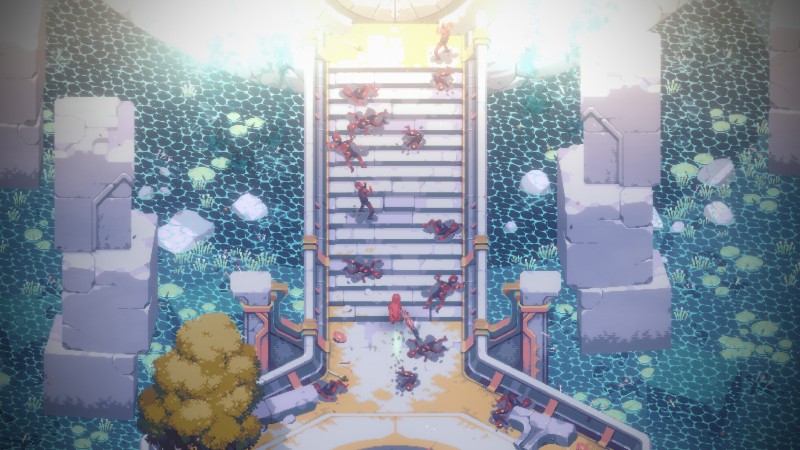
Graphics: Every area is rich with detail and sells the idea of a once-beautiful land in turmoil. Some bosses sport cool designs though a few lack imagination (for example, one is just two floating orbs)

Sound: The battle soundtrack is appropriately grandiose, which is contrasted by the somber ambiance heard roaming the overworld

Playability: Swinging your sword feels purposeful and deliberate but lacks tightness. Still, combat is a tense, entertaining dance of dodging and landing charged attacks to regain health

Entertainment: Eldest Souls’ punishing difficulty may turn off some, but this entertaining and rewarding combat system made me look forward to every titanic face-off

Replay: Moderate

Click to Purchase

Wednesday, August 4, 2021

Cris Tales Review – In A Time Loop

Cris Tales

Publisher: Modus Games
Developer: Dreams Uncorporated, Syck
Rating: Teen
Reviewed on: PC
Also on: PlayStation 5, PlayStation 4, Xbox One, Switch, Stadia

Many RPGs dabble in time travel and ever-shifting destinies, but the idea that no future is guaranteed is Cris Tales' thesis statement. When a young girl named Crisbell learns to harness the power of mystical time crystals, the player reaps the benefits through innovative mechanics both within the turn-based combat and the environmental exploration. Unfortunately, while these unique mechanics evolve throughout the adventure, they stagnate before the story concludes.

Cris Tales wastes no time showing its strengths; the downright gorgeous, hand-drawn aesthetic delivers surface delights, while terrific turn-based combat mechanics offer thrills that are more than skin deep. Fighting droves of monsters and minions is simple due to easy-to-understand combat menus, while a wide array of combat abilities lets you tackle encounters in various ways. Cris Tales adds a timing mechanic to keep battles interesting; pressing a button at the right time during your attack lands a critical hit while doing the same for an incoming enemy attack lets you parry to minimize damage and status ailments. This active approach injects excitement, though it requires that you memorize the animations of each enemy type. Even then, the timing sometimes doesn't feel aligned with the on-screen action.

Click here to watch embedded media

Your party members bring a diverse set of powers to aid you in battle. I always felt competent and creatively enabled in combat, from Willhelm's collection of offensive and defensive vegetation to Cristopher's effective elemental magic or Zas' fun roulette abilities. However, the main attraction is Crisbell's suite of time-crystal powers. Using her ability to shift parts of the battlefield forward or backward in time allows you to get inventive with your approach to fights. In one encounter, I used her powers to revert two vicious beasts to younger, less-powerful versions of themselves. I also poisoned the enemies with Willhelm before accelerating time, causing the poison to hit them all at once. In these sequences, the combat of Cris Tales truly shines; I felt powerful as I masterfully wove Crisbell's time powers together with the rest of the party's abilities. However, the more I played, the more I felt stuck in a time loop.

As you travel through each dungeon in Cris Tales, you repeat many of the same battles. Fighting through random encounters with the same subset of enemies is nothing new to the genre, but the repetitive fights encouraged me to take the most efficient route possible despite the awesome powers at my fingertips. Since this strategy prevailed in the random encounters, I hoped boss battles would encourage more time manipulation, but that's also rare. While some bosses feature different forms depending on how you manipulate their time, the most potent foes offer no incentive to play with these unique tools. Rather than serving as a culmination of everything you've learned, Cris Tales' later bosses ask you to ignore the battle system's most distinctive mechanics by rendering them ineffective.

I also liked using the time powers to solve simple puzzles in dungeons, like turning a pillar into rubble to get through a blocked path, then restoring the pillar so I could bridge the gap above. Sadly, these mechanics never progress beyond a rarely used gimmick. The dungeons also lean towards long, mundane pathways seemingly designed to trigger random encounters on your way to an isolated treasure chest instead of enticing exploration.

Click image thumbnails to view larger version


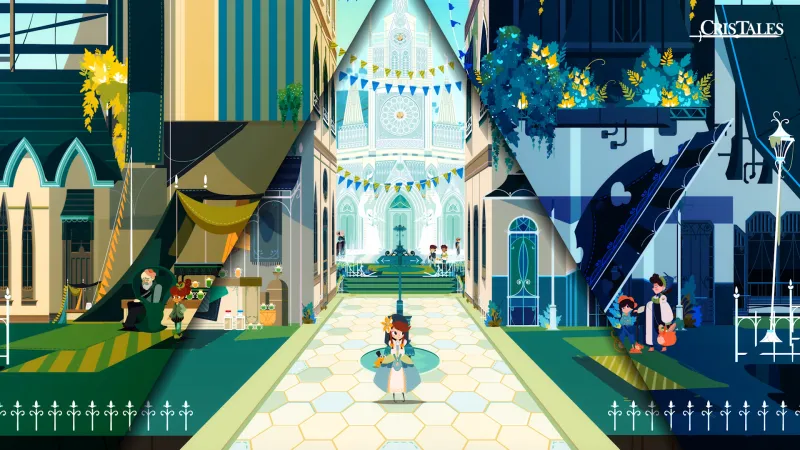
The time-shift systems carry into the towns, as you can see every destination's past, present, and future. I found it rewarding to see my actions and completed sidequests affect people or locations in real-time; folding these consequences into an already endearing and enthralling story (albeit one brimming with whiplash-inducing twists and turns) made me more excited to engage with the optional content.

Sadly, a lack of labels on both people and places hinders world exploration. For example, if one sidequest tells me to talk to a specific person and I can't remember who that person is, I must talk to each character, so their name pops on the screen with their dialogue. Similarly, towns in the hub world are frustratingly unlabeled, meaning you need to keep track of each area's name and location. These are minor inconveniences in the grand scheme but were particularly annoying due to many sidequests that require you to talk to several specific people. This problem came to a head in the endgame, which tasked me with retrieving people from each town, but with more than 30 hours of gameplay between my interactions with some townspeople, I had no idea who some of the characters were going off just their names.

Despite these issues, RPG fans still have an enjoyable and often delightful adventure to play. However, with myriad frustrations, repetitive action, and mechanics that don't live up to their potential, Cris Tales falls short of the greatness for which it seemed destined.

Score: 7.75

Summary: Despite its shortcomings and frustrations, Cris Tales is an enjoyable adventure for RPG fans to take.

Concept: Revisit the well-established turn-based RPG formula, but with the added twist of being able to transport parts of the world forward or backward in time

Graphics: The star of the show, Cris Tales' unique hand-drawn graphics are undeniably gorgeous

Sound: A strong soundtrack complements the solid voice acting

Playability: Core time-travel concepts are novel at first, but they fail to evolve in meaningful ways and eventually give way to monotonous combat and exploration

Entertainment: Cris Tales is a solid RPG dragged down by a creative gimmick that never realizes its true potential

Replay: Moderate

Click to Purchase