This is default featured slide 1 title

Go to Blogger edit html and find these sentences.Now replace these sentences with your own descriptions.This theme is Bloggerized by Lasantha Bandara - Premiumbloggertemplates.com.

This is default featured slide 2 title

Go to Blogger edit html and find these sentences.Now replace these sentences with your own descriptions.This theme is Bloggerized by Lasantha Bandara - Premiumbloggertemplates.com.

This is default featured slide 3 title

Go to Blogger edit html and find these sentences.Now replace these sentences with your own descriptions.This theme is Bloggerized by Lasantha Bandara - Premiumbloggertemplates.com.

This is default featured slide 4 title

Go to Blogger edit html and find these sentences.Now replace these sentences with your own descriptions.This theme is Bloggerized by Lasantha Bandara - Premiumbloggertemplates.com.

This is default featured slide 5 title

Go to Blogger edit html and find these sentences.Now replace these sentences with your own descriptions.This theme is Bloggerized by Lasantha Bandara - Premiumbloggertemplates.com.

Monday, March 21, 2022

GhostWire: Tokyo Review - Graveyard of Horror

Click here to watch embedded media

Reviewed on: PlayStation 5
Also on: PC
Publisher: Bethesda Softworks
Developer: Tango Gameworks
Rating: Teen

GhostWire: Tokyo has a completely dead world, empty of any other human beings or people to talk to. It also has rote and repetitive combat with a bland and uninspired story. And yet, I love it more than I like most games, even if I think a lot of people won't. It might take a bit to explain why, but it all starts with GhostWire's best feature: its cold, lifeless map. 

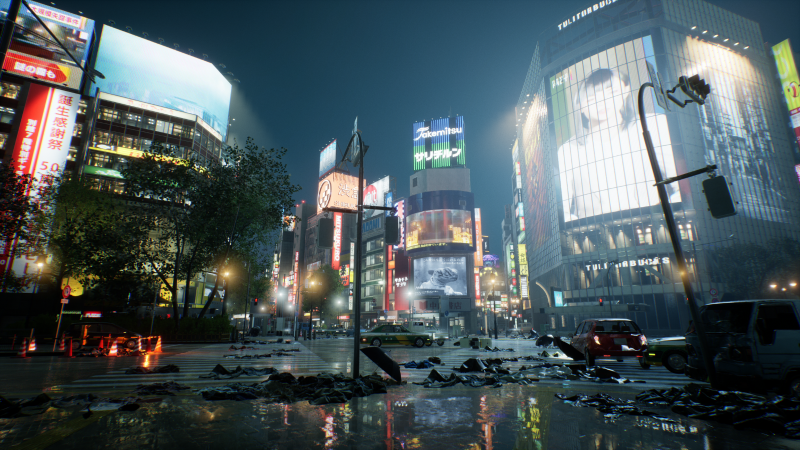
Early in the game, a supernatural force causes everyone roaming around the Shibuya Ward of Tokyo, Japan, to vanish. A mysterious man flashes on the many LED screens around Shibuya Scramble – the famously busy real-world intersection where the game also begins – spouting some nonsense about saving people's souls and so on. The long and short of it is: that guy has stolen the souls of everyone around you, except yours. 

You assume the role of Akito, who is spared from death when possessed by a spirit named KK. For reasons never abundantly clear, KK being in your body also means you have elemental powers. And wouldn't you know it? Spooky ghosts and monsters are now roaming Tokyo's streets without a care in the world. KK needs Akito's body to save the world from this maniac terrorizing Tokyo. Akito just wants to save his sister. If you can put your differences aside, you might just be able to do both. 

It's a bland story that never does anything unexpected and never reaches beyond just okay. I did enjoy Akito and KK's banter, but beyond that, I never found myself all that invested in their arcs. There are a small number of side characters throughout GhostWire – both friend and foe – but none get much screentime or development beyond whatever gameplay purpose they're serving in the given moment, be that a boss fight, new objective, mechanic, so on, and so forth. 

Click here to watch embedded media

What the story does, however, is give narrative justification for why Shibuya is empty (save for those spooky ghosts). And I think this is one of the more interesting parts of GhostWire; its open-world take on Shibuya is a fantastic recreation of architectural density – minus the people. Not only are buildings tightly packed together, but they feel massive in the way real skyscrapers do. Thanks in no small part to GhostWire being in first-person, this is immediately apparent. I loved craning my neck up at the buildings around me, feeling the game's sense of space and scale. That scale extends far outward, too, as it captures Tokyo's urban sprawl; crossing the map takes time, though I rarely felt bored walking around like a virtual tourist. 

GhostWire is obsessed with the idea of urban isolation, that even in a city where millions of people live on top of each other, you can feel alone. GhostWire achieves this feeling by completely taking people away. There's an eerie quality to walking around a city without its population, knowing there's no one to talk to beyond yourself and the (literal, in this case) voice in your head. More often than not, I found myself wishing there were people – or even just one friendly person – I could find on GhostWire's streets. Not because I was ever bored walking through an empty world, but rather its sense of isolation and loneliness was incredibly effective and haunting. 

And I genuinely mean haunting. GhostWire takes every chance it has to sell its spiritual apocalypse. Occasionally, the game will mess with you. Walking around, I'd see the painted lines on the street waving in the wind as if they were thin pieces of paper. Or I'd turn a corner and realize that, in just maybe one alley or one small city block, the rainfall was now blood, soaking the surrounding buildings and street in a dark, sludgy red. More dramatically, at key story elements, the world breaks around you. In fantastic set-piece moments, levels twist, warp, and change seamlessly before your eyes, as if M.C. Escher has taken over as art director. It's endlessly impressive and fun to look at, and I loved using photo mode to capture the bizarreness surrounding me. 

Recalling classic rapture imagery, personal belongings litter the map exactly where they were left – you can't take your purse or cellphone with you to the afterlife. Most strikingly, clothes are everywhere. Especially in high-population areas, there are often vast seas of garments littering the floor where people vanished. It's imagery like this that hammers home not just the scale of the game's rapture but how terrifying something like this would be. Add that the city is still functioning – lights are on, speaker systems play, you can go into the subway or inside convenient stores – and GhostWire has a world not hampered by its lack of things to do but strengthened by its commitment to being desolate. 

Desolate except for those spooky creatures, of course. GhostWire's antagonist is fusing the worlds of the living and the dead. This sets the stage for most of its gameplay and combat. 

Bringing together this world with the next leaves Shibuya overrun with spirits. The vast majority of GhostWire is running from point A to point B, fighting a variety of hostile yōkai littering the streets on the way, getting to your destination, and then fighting some more. There's a solid weight and crunch to combat that's satisfying from an audio and visual perspective. All Akito's elemental powers have their unique advantages, too. I enjoyed swapping between my fire attack, which casts a high-damage explosion, and my water attack, which sends out a wide arc that hits multiple enemies at once. Other fun powers, like a wind attack with a high rate of fire, magical bow-and-arrows, and talismans that freeze enemies, among others, are all fun to experiment with. And using the ethereal weave – which is basically a magic string – to rip out enemy cores always looked great. 

Even though it doesn't have guns, GhostWire effectively plays like a first-person shooter. But not a very good one. Aiming is often clunky and imprecise, and I found myself missing more attacks than not. Encounter design also rarely changes from: there's a handful of enemies surrounding this point of interest, kill them, move on. It's not necessarily bad insofar as it gets the job done, but combat quickly becomes repetitive. The game's handful of bosses don't fare any better, which often feel awkward and sluggish to fight. 

Not every spirit is out to kill you, though. When you're not blasting your way through Shibuya, you're rounding up spirits trapped between the two worlds. There are over 240,000 lost souls you need to help usher back into the mortal coil, which means spending a ton of time walking around collecting – which boils down to holding a button, or very rarely, solving a small puzzle – and depositing at various payphones throughout the map. Luckily, you pick up spirits in mass, so you don't have to individually collect all 240,000, but it's still a tedious side-objective. 

Click here to view embedded media


But I don't find myself coming down too hard on the game's core loops. On the one hand, it is a repetitive, fairly bland take on the tired Far Cry formula. On the other, on top of loving GhostWire's world, its yōkai designs stand in a league of their own – it has some of my favorite enemy designs in years. Mixing traditional Japanese folklore with its contemporary setting, looking at the terrifying enemies never got old. My favorites include the Lamentation and Shiromuku, whose long black hair is reminiscent of classic Japanese horror film characters Sadako (Ring) and Asami Yamazaki (Audition), as well as the various takes on Kuchisake-onna, the slit-mouthed woman, who borrows heavily from her design in 2007's Carved. For a horror fan, especially one who grew up watching Japanese horror movies, I couldn't help but nerd out on all the various creature designs, no matter how many times I fought them. 

It also helps that GhostWire is really short. I completed the campaign in about 14 hours, though I've spent a few extra afterward cleaning up side stuff. Bland as a lot of its gameplay and story may be, GhostWire never wastes your time. It gets in and out long before anything gets too old, letting you enjoy everything you like about the game without wearing you down with things it does poorly.

Which makes GhostWire a strange game to review – at least within the often-restrictive confines of a scoring system. The things I like about GhostWire, I really like. I'd go so far as to say that some elements – its world, enemy design, etc. – are among my favorites in a game in years. That said, there are plenty of elements, such as story and gameplay, where GhostWire is hardly up to snuff. 

I fully expect some people won't be smitten with the game the way I am, and I think it's completely understandable if you don't want to forgive the game for that. But if GhostWire connects with you, I think it'll really connect with you. It's weird and unique, and I think it's great to see this kind of game get this kind of budget, put it all on the table, and use that money to do some baffling and great art. And for that alone, I can't help but love GhostWire.
Score: 8

About Game Informer's review system

Purchase

Wednesday, March 16, 2022

Tunic Review – A Dyed-In-The-Wool Treasure

Reviewed on: PC
Also on: Xbox One
Publisher: Finji
Developer: Tunic Team
Rating: Everyone 10+

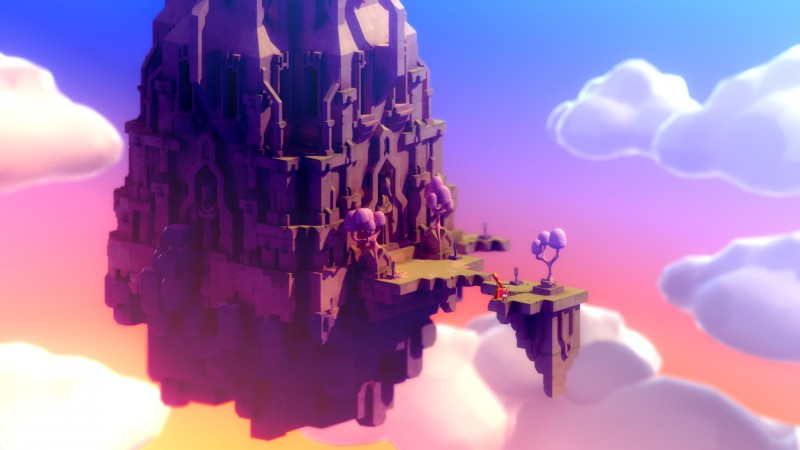
Tunic brilliantly captures the feeling of that special childhood title that made you fall in love with video games. Using a virtual simulation of an old-school guidebook, the game masterfully balances telling players almost nothing with giving them all the information they need. The result is a game brimming with genuine, triumphant discovery.

With its every pixel stuffed with reverence for gaming as a medium, Tunic revels in its historically inspired design. Players steeped in the hobby’s traditions will find following their instincts richly rewarding as they quest through its gorgeous world. Impressively, Tunic also melds the charm of the past with the sensibility of modern titles. As an isometric action/adventure, Tunic has a heaping helping of early Zelda games with generous handfuls of the Souls titles thrown in for good measure. It’s a winning combination.

Click here to watch embedded media

The real-time combat had me tackling foes by watching for offensive openings while keeping a careful eye on my stamina. Every swing, dodge, or block took a chunk of the bar. Mercifully, low stamina never kept me from attacking, but I did take more damage when the bar ran out. The distinctly relaxing music introduces an intriguing contrast to the tough battles, and the ‘Chill Beats To Fight To’ vibes take the sting out of being viciously cut down. As does the world’s simple-but-beautiful visual aesthetic. Dying meant dropping a portion of the hard-earned currency I’d won from my victories. The nice thing about Tunic, though, is that you never lose everything. So, you can run directly back to the spot you died to regain the contents of your wallet, or you can spend what you have left on items to give you an edge.

For those turned off by this kind of gameplay, Tunic offers players of all kinds the chance to enjoy its combat system, as the accessibility options include a no-fail mode and the ability to turn off stamina restrictions. The Souls-like combat is intense, but the challenge feels satisfying rather than punishing – though a few later bosses definitely gave me trouble. Each boss has its own feel, with different attack patterns to study, but most play out similarly. An imposing challenger does its best to take you down in a closed-off battlefield; that means no running away from the conflict.

Tunic’s fighting is great, but discovery and exploration might be its most impressive elements. Your adventure is linear, but its myriad paths contain branches that split off into more branches and then more still. No matter which direction I went in, the destination was usually noteworthy, with some paths unexpectedly leading me to new objectives or undiscovered, late-game areas. It made the world feel boundless, which is a commendable feat for a game made up of strictly defined pathways.  

Every route was also packed with things to uncover, and there were an unbelievable number of treasure chests. Many of these were seemingly inaccessible until I noticed an inconspicuously hidden passage or used some clever combination of items to get where I needed. Without resorting to busywork puzzles, Tunic constantly compelled me to feel proud of my puzzle-solving skills. In an amazing display of unintrusive design, the sense of discovery didn’t stop once I’d collected my prize.

Some things – like the sword or the very Zelda-esque key items that opened new zones or allowed me to get past obstacles – were self-explanatory. However, others, which I won’t spoil, were complete mysteries. One of my favorite moments from the game involved a curiously mundane object that didn’t seem to do anything. Later in my journey, a wild idea popped into my head on what it might be for. Thinking to myself there was no way I was right, I tested my theory and was greeted by surprising success. I audibly celebrated my accomplishment, along with the developers’ skill in designing a wonderful ‘ah-ha!’ moment.

I wasn’t left entirely without guidance, however. Tunic’s gameplay is inextricably linked to collecting the pages of an instruction booklet scattered throughout the world. Despite being predominately filled with unreadable glyphs, the nostalgia-inspiring manual somehow contained all the information I ever needed to know about Tunic – if I paid close attention. One page might demonstrate combat mechanics, while another serves as a map, and still another could give a veiled look at the game’s narrative. As I uncovered more pages, I discovered there was actually an entire section dedicated to the story. But the snatches of largely incomprehensible text didn’t tell the whole tale. Despite its lack of transparency, Tunic still paints a compelling narrative picture that gave me a sense of what was happening but also left a lot of details up to my interpretation, which I enjoyed.

Looking closely at the manual, I quickly realized there were copious, hand-written pearls of wisdom scribbled in the margins. This gave me the sense that I had received Tunic – along with its booklet – from an older sibling, a friend, or a second-hand store and had inadvertently gained access to secret knowledge. I studied the pamphlet’s official print as well as the helpful, if obscure, ink-scrawled hints meticulously, and the game constantly rewarded me for it. If I ever got stuck at any point in my quest, the answer was somewhere in the pages. I love when a game includes me, as the player, in its meta-narrative. With this conceit, Tunic invoked my youthful memories of inheriting games and mixed those real-world experiences into the gameplay, making my connection to the game deeper and more personal. 

While Tunic is an experience I would recommend to any player, the obscureness that makes it uniquely rewarding can also lead to genuine frustration. Mostly, the game is so well designed that it is easy, especially in the beginning, to find answers or check out a different avenue while puzzling something out. But when I got stuck near the end of the game, I couldn’t simply run down another path, and my progress slowed to a halt. However, this was a rare exception to the overall sparkling experience. And my frustration gave way to admiration when I discovered the easy-to-miss secret I’d been glossing over had been right there in the booklet the whole time. The developers’ attention to detail and the work poured into those collectible pages is remarkable.

I was constantly veering off from the main quest to track something down or look into a newly discovered path, and so it took me about 20 hours to roll credits. Despite that, I know there’s still a lot for me to do in the game, and I’m excited to go back in to find every secret and experience everything its aesthetically striking world has to offer. Tunic is a stunning achievement that manages to embody the best of nostalgia while being completely refreshing. It’s absolutely a must-play gem.

GI Must Play

Score: 9.75

About Game Informer's review system

Purchase

Monday, March 14, 2022

Stranger Of Paradise: Final Fantasy Origin Review

Reviewed on: PlayStation 5
Also on: PlayStation 4, Xbox One, PC
Publisher: Square Enix
Developer: Koei Tecmo
Rating: Mature

Even if you love Final Fantasy games, expect to feel like a stranger in a strange land when playing Stranger of Paradise: Final Fantasy Origin. This violent retelling of the original Final Fantasy game from 1987 largely sidesteps the series’ adventurous spirit and heartfelt mysticism to focus on muscle, attitude, and everything extreme. Square Enix labels this remake as a “hardcore action/RPG,” an apt description for a game that rarely relents in its aggression. When swords are drawn and giant beasts enter frenzied states, this edgy experiment shines, as the battlefield lights up with a flurry of combos and magics against awesome monsters that pose a real threat. When the swords are holstered and the characters need to converse or explore, Stranger of Paradise hits lows rarely seen in Final Fantasy's storied 35-year history.

Don’t be surprised if you let out your first audible groan within minutes of meeting protagonist Jack. Showing the emotional range of a brick, Jack is a blank slate of a lead, offering little in terms of backstory or personality, yet he amuses for all the wrong reasons given how frequently he talks about wanting to kill a dark being named Chaos. He growls this dark ambition to almost anyone who will listen, sometimes dropping f-bombs along the way because he’s that angry. The story clings for dear life to the silly Chaos thread, which offers a couple of interesting twists near the conclusion, but mostly falls flat and does little to build up the characters or world around them.

Jack eventually befriends a handful of like-minded individuals to journey with, but they are just as lifeless as he is, and the reasons they are together are flimsy at best. At one point, Jack meets Jed and Ash on a road, and after conversing about Chaos and crystals for just a few seconds, they agree to journey together and cement the occasion with a fist bump. The fist bump is as awful as it sounds, and is oddly notable, as you’ll see this gesture many times, each one as unintentionally comedic as the last. I didn't care for most of the story, but did enjoy where it ends. No, the final moments don't make the journey worthwhile, but at least it ends with a bang.

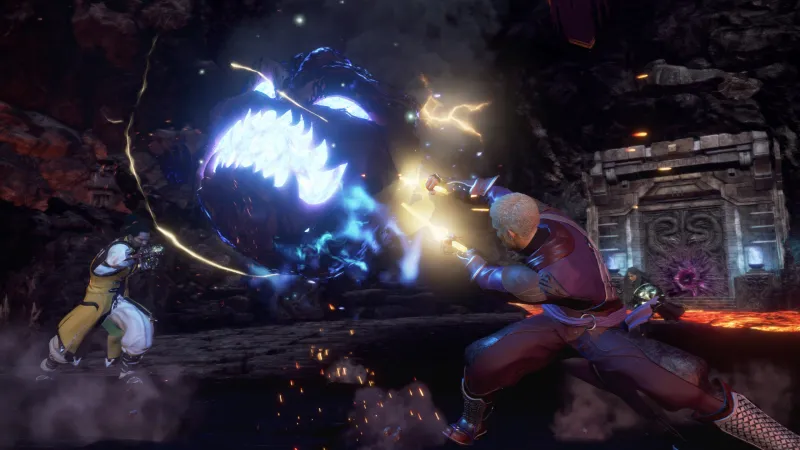
The hunt for Chaos unfolds within the land of Cornelia, a place lush with most of the fantasy tropes this series is known for. Developer Team Ninja does an excellent job of changing up the locales frequently within its level-based progression – throwing the party into lava caverns, icy mountains, and glowing forests filled with wild beasts. Most of these places are confusing in design, sending Jack and company down mazelike paths, some featuring puzzle qualities that require backtracking to solve. Without a map, expect to get lost periodically. In an odd twist, the party can dart through swarms of enemies uncontested, meaning you can cover ground quickly and find your bearings again. You can also run from the start of a level to the concluding boss without confronting a single foe – a design flaw I exploited to speed up exploration in some of the more confusing levels.

Click here to watch embedded media

It’s not that I didn’t want to engage in combat. As messy as Stranger of Paradise is in its story and world, it fully embraces the rage of a warrior to deliver an exceptional combat experience. The nicely implemented melee combat and long-range magic sizzle with excitement, and Jack can switch between them on the fly. Enemy movements and unblockable attacks are easy to read, making all fights feel fair and a true test of skill. Even the two A.I. companions who join you are competent and rack up kill counts of their own, even against bosses if you need to keep your distance. Some bosses are incredibly challenging, and your allies may not be enough of a help, but you can always lower the difficulty for this one fight at any save point – another nice touch.

The combat mechanics are robust, allowing for Jack to bombard the enemy with abilities at a liberal pace. The evasive move works well, as does the soul shield counter that allows Jack to bank magic and send long-range attacks hurling back at his attacker – the latter is quite ingenious, yet is sometimes difficult to use given how frenzied battles can be. When foes are giving you fits, saving up magic to activate devastating Lightbringer attacks can turn the tide. Best of all, when an adversary’s break gauge depletes, you can execute them immediately with a stylish finishing move that even delivers splash damage to any other enemy nearby.

Jack lives up to his name as a jack of all trades on the battlefield. Rather than focusing on just one job, Stranger of Paradise encourages the player to use over a dozen of them, switching to whichever style best fits the situation at hand. Each class is fully featured and fun to use. I enjoyed being able to morph in the blink of an eye from a samurai with precise sword strikes to a black mage that carelessly rains down death from afar. Figuring out which jobs work best with each other is part of the fun and reason to experiment often.

Applying points to skill trees allows each job to grow more potent in the way the player wants. Specific armor pairings also deliver worthwhile statistical bumps. Each class can reach a master rank at level 30 and offer a variety of nice customizations, like determining which special attacks trigger at specific points on combo chains. Again, the combat absolutely sizzles in Stranger of Paradise and gives you a true sense of ownership over it.

Almost every defeated enemy drops a weapon or armor, and you quickly learn that you must pace how often you dive into the menus to tinker with each character’s loadout, as you could spend just as much time in menus as combat. The weapons offer almost every kind of attribute bump you would expect, and armors deliver cosmetic changes galore. The "cool" factor of the gear is tied to their levels, meaning at level five, you are wearing leather, and at level 105, you glisten in an awesome dragon-scale suit.

Having so many different options at your fingertips – from the gear to jobs – is where Stranger of Paradise shines the brightest and delivers excitement. These thrills extend to two friends in online cooperative play, but only if they keep pace with your combat level. If you aren’t in the same level range, you must play at the lowest player’s level, which can be a bust if they are just starting and you are in the mid- or endgame.

Click here to watch embedded media

Stranger of Paradise is the strangest Final Fantasy game yet, bounding wildly between awful and fantastic. If you can tolerate Jack (and that’s a big ask), the excellently crafted combat is worth a look. You may be coming to this game for the story and Final Fantasy experience, but it’s all about combat and little else.

Score: 7

About Game Informer's review system

Purchase