This is default featured slide 1 title

Go to Blogger edit html and find these sentences.Now replace these sentences with your own descriptions.This theme is Bloggerized by Lasantha Bandara - Premiumbloggertemplates.com.

This is default featured slide 2 title

Go to Blogger edit html and find these sentences.Now replace these sentences with your own descriptions.This theme is Bloggerized by Lasantha Bandara - Premiumbloggertemplates.com.

This is default featured slide 3 title

Go to Blogger edit html and find these sentences.Now replace these sentences with your own descriptions.This theme is Bloggerized by Lasantha Bandara - Premiumbloggertemplates.com.

This is default featured slide 4 title

Go to Blogger edit html and find these sentences.Now replace these sentences with your own descriptions.This theme is Bloggerized by Lasantha Bandara - Premiumbloggertemplates.com.

This is default featured slide 5 title

Go to Blogger edit html and find these sentences.Now replace these sentences with your own descriptions.This theme is Bloggerized by Lasantha Bandara - Premiumbloggertemplates.com.

Friday, April 14, 2023

Minecraft Legends Review - A Strategic Retreat

Minecraft Legends

Reviewed on: Xbox Series X/S
Platform: PlayStation 5, Xbox Series X/S, PlayStation 4, Xbox One, Switch, PC
Publisher: Xbox Game Studios
Developer: Mojang
Rating: Everyone 10+

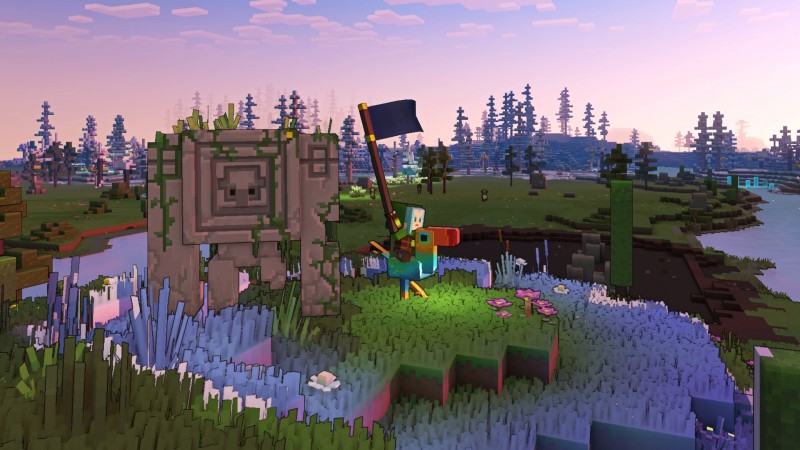
Mojang Studios has returned to the crafting table in an attempt to take Minecraft in a bold new direction. Minecraft Legends is an open-world real-time strategy game where you gather resources, build defenses, and summon adorable mercenaries to protect the sanctity of the realm. Instead of the birds-eye perspective often featured in strategy games, Legends opts for a character-focused view, with your hero roaming the landscape on dynamic mounts, sword in hand, using resources and armies to evict factions of evil Piglins, each with combat quirks to overcome. A compelling concept in theory, but this unique take on an iconic franchise can often feel at odds with itself. Minecraft Legends feels caught between the expected complexity of strategy games and the franchise’s approachable brand.

The first few hours of gameplay felt like an awkward first date with someone who is actually really interesting. As I galloped around the gorgeous environments, I was constantly interrupted by the game’s advisors trying to shoehorn me into specific tasks, which took away some of the shine from Legends’ immediately intriguing world. It felt like a series of false starts, but after repeating the same gameplay loop and enduring an epic tutorial phase, Legends finally lets go of your hand, and this is where the fun begins.
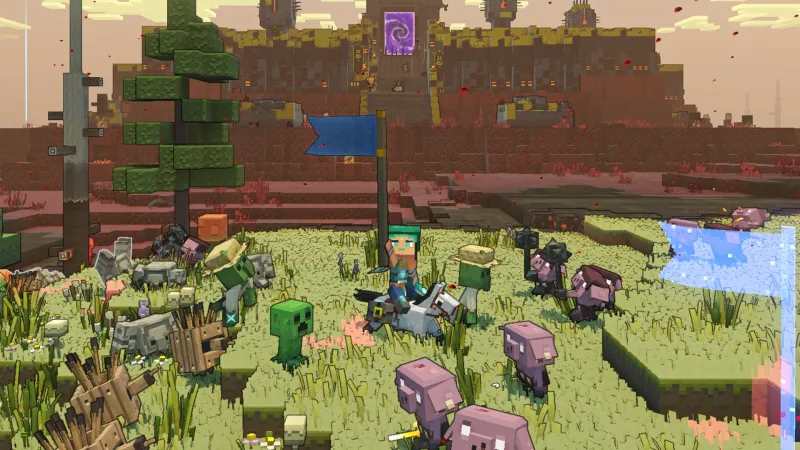
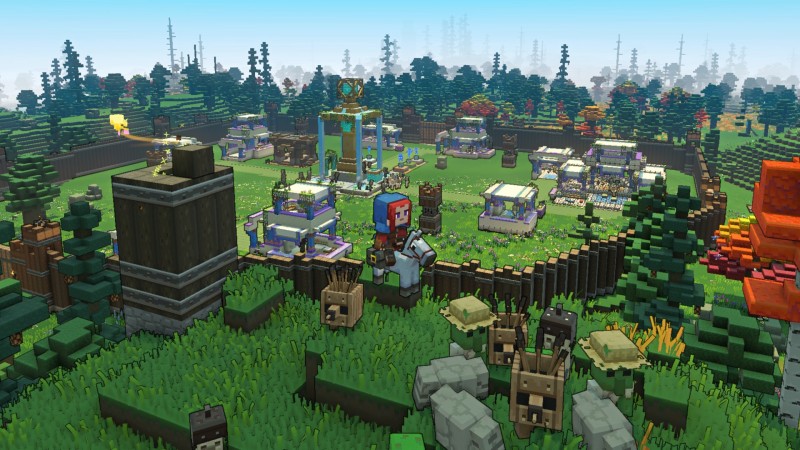
 

Legends’ reasonably sized map is full of iconic Minecraft imagery. From packs of wolves wandering across the plains to turtles splashing in ponds, the overworld feels organic and welcoming. Ambient patches of landscape like the aptly named Bouncecaps invited me to think vertically about exploration as they sent my hero flying into the sky. I felt encouraged to test the limits of fall damage in search of untouched areas, making for some unexpected finds and overt slapstick failures. 

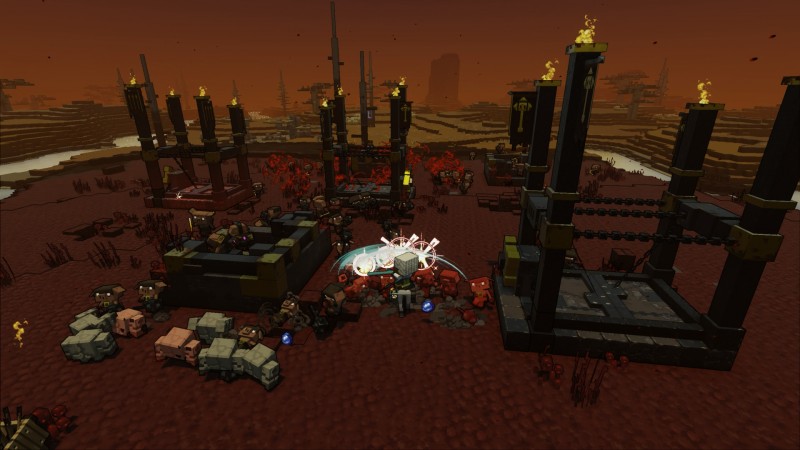
Across the realm, you’ll take down Piglin strongholds with combinations of deadly mobs and defend helpless villages by building walls and towers, all while maintaining your captured bases from random raids. Various defensive and offensive scenarios pushed me to evolve my tactics and choose my upgrades wisely at the Well of Fate, the hero’s home base. The game forces you to choose between having extra mobs on the battlefield, more options for structures, or additional resources, so you fine-tune your play style as you progress.

Traditional Minecraft mobs have had a charming makeover in Legends. Where a Creeper in the wild may have previously sent chills down your spine, here, they are puppy-like underdogs with explosive tempers you can use at your will. This twist also applies to Zombies and Skeletons: earn their trust by defending their homes from Piglin attacks; they’ll aid you against the tyrannical enemies who have usurped their position as the conventional menaces of the domain. 

Minecraft Legends succeeds in engaging players to investigate its world by hiding special mobs and tools throughout its procedural landscape. Still, it can struggle to make you feel present and essential in the adventure, primarily due to the perspective shift. My hero was on the ground, manually summoning troops and fighting baddies, but it was my companion sprites, the Allays, that were getting all the upgrades, gathering resources, and building structures. You may yearn to get your hands dirtier in a world that feels so inviting and interactive.

This disconnect also followed me into battle where, instead of feeling like a captain who was storming castles to free the land, I would mostly watch my army whittle away at structures while wandering the outskirts alone. Minecraft Legends’ most absorbing moments come when you fight side by side with your mobs to destroy a Piglin portal, so it feels particularly deflating when the game forces you to replenish yourself outside of the action as your troops continue without you. However, I can see some benefit in these maverick systems, as Legends succeeds in twisting strategy game traditions in a way that welcomes players new to the genre.

Minecraft Legends battles to blend its open-world adventuring with the intricacies of real-time strategy, a war that sometimes detracts from the overall fun you can have. Even so, its gorgeous environments and clever world-building inspire familiar creativity that makes up for its growing pains. Where other strategy games feature more profound complexity, Minecraft Legends has heart, and it’s hard to resist its charm. Mojang’s first expedition into this genre occasionally holds your hand too tight. But when its grip loosens, there’s a vibrant world of combat challenges to discover, ultimately making it an enticing endeavor. 

Score: 7

About Game Informer's review system

Purchase


Wednesday, April 12, 2023

MLB The Show 23 Review - Loading The Bases

MLB The Show 23

Reviewed on: PlayStation 5
Platform: PlayStation 5, Xbox Series X/S, PlayStation 4, Xbox One, Switch
Publisher: PlayStation Studios
Developer: Sony Interactive Entertainment San Diego Studio
Rating: Everyone

Each year, developers of annualized sports franchises work to craft new experiences to try and avoid the community criticism that each successive release is "just a roster update." While real-life sports don’t evolve much year over year, developers still need to provide players with reasons to come back each time, whether that be gameplay improvements, enhanced modes, or better visuals. MLB The Show 23 does all of that while also exploring a unique avenue – history – to great effect.

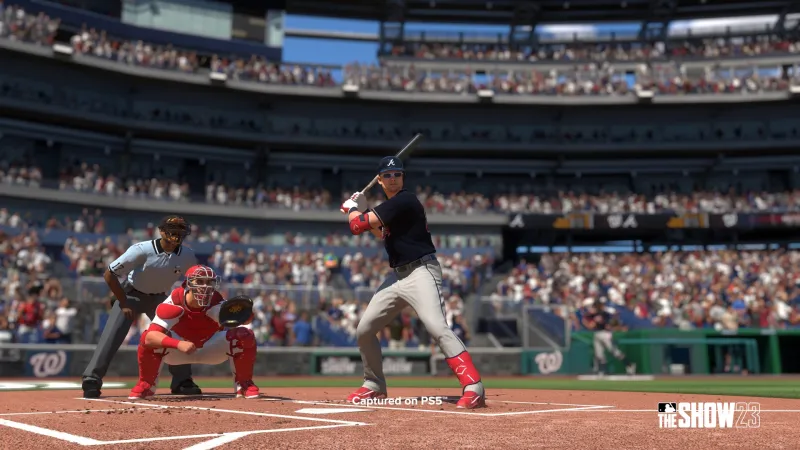
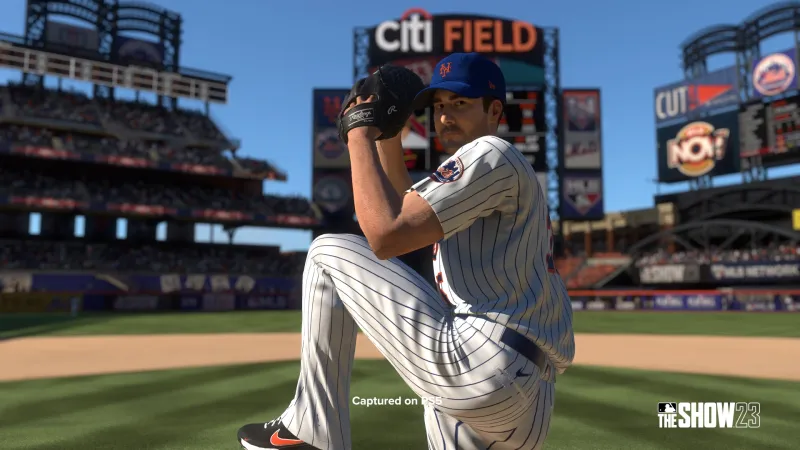
On the field, MLB The Show 23 plays as well as any entry to date. Whether stepping up to the plate at a critical moment with runners on, taking the mound in a tense bases-loaded situation, or simply chasing down a routine flyball, the gameplay is smooth and often gorgeous thanks to new animations in this year’s entry. Even the commentary, often one of the most challenging elements for sports games to nail, is top-notch.

On the gameplay side, new quirks further differentiate the superstars and role-players, and various improvements to fielding (like a tweaked throwing meter) make for more skill-based play. It may be anecdotal, but I also notice fewer home runs this year, which is perhaps a testament to how the Casual, Competitive, and Simulation styles were tweaked. Of course, if anything isn’t to your liking, you can change things around in the extensive settings list, with which I experimented to great lengths. The list of adjustable settings is daunting, but the Options Explorer that launches when you first fire up the game helps you get things close to ideal in an efficient manner.


Perhaps the centerpiece of this year’s new offerings is an excellent new Storylines mode highlighting The Negro Leagues. Featuring eight players, including Satchel Paige, Jackie Robinson, Rube Foster, and Buck O’Neil, these chapters offer documentary-style talking-head clips before giving you control of these icons from the era of racial segregation. I loved learning more about and playing as some of the greatest players and most influential figures in the history of baseball.

The bite-sized gameplay challenges are often simple enough to complete, but the reward of unlocking the next history lesson had me excited to see the last goal checked off my list. Too often, sports video games are fixated on the present and future of the sport, but MLB The Show 23 shows that looking back to the past is a rewarding avenue for developers to explore, especially when it’s about such an important but often-overlooked chapter in baseball’s history.

In past years, the player-lock mode Road to the Show, where you develop a created player over several years, has been my favorite mode. However, the maturation of March to October, which started as a story-driven single-season mode, has led to it taking that title. The mode has grown substantially since its introduction in 2019, now offering scouting, trade logic, and plenty more while still only having you play the crucial moments of each season. Franchise mode offers you much more flexibility, breadth, and depth, but March to October tailors the experience to not only your performance but your team’s starting point, giving you a more dynamic and efficient experience.

MLB The Show 23 offers so many different modes with which you can engage. From the card-collecting team-builder Diamond Dynasty to the history-rewriting Moments mode, you can step on the field from the angle of your choosing, with the level of commitment that matches how much time you have. You can even hone your skills in an improved practice mode where you can specify details down to the frequency of the pitch types thrown your way, or create your own stadium, now with more options than ever before.

The action of MLB The Show 23 is superb, but the occasional technical or logic hiccup breaks immersion on a semi-regular basis. From checked swings clearly crossing the plate and being called safe (and vice-versa) to fielders not covering bases in certain situations and the computer-controlled runners completely misunderstanding the tag-up rules, unnecessary frustration reared its ugly head every few games. Add in some of the nets in foul territory constantly phasing in and out of existence, and MLB The Show 23 would definitely benefit from a patch addressing these, even if the overall package is already great as is.

Real-life Major League Baseball continues to evolve in ways to encourage faster play in hopes of appealing to a broader audience, but MLB The Show 23 feels somehow ahead of the game. At the same time, the new Storylines mode shows the past is just as important as the future, providing players with the best of both worlds. Myriad options and modes allow you to engage with America’s Pastime precisely how you want, and in the process, MLB The Show 23 delivers one of the best baseball games in years.

GI Must Play

Score: 8.75

About Game Informer's review system

Purchase
Tuesday, April 11, 2023

EA Sports PGA Tour Review - A Frustrating Slice

EA Sports PGA Tour

Reviewed on: PlayStation 5
Platform: PlayStation 5, Xbox Series X/S, PC
Publisher: Electronic Arts
Developer: EA Tiburon
Rating: Everyone

EA returns to the PGA with an inconsistent, frustrating simulation, struggling with its identity. While gorgeous, with pro golf’s best interactive presentation, the on-the-course action delivers inconsistent results.

In licensing, EA wins, scoring the Masters and key courses like Pebble Beach. Presentation counts, like the Masters’ first day showing opening tee shots from Jack Nicklaus and others. Quiet commentary meaningfully discusses each hole during flybys. Gorgeous vistas line the courses, and every individually rendered blade of grass is visible, even on the fairway. Each hole is lined with realistic-looking spectators, but their lack of reaction when struck with a ball removes the immersion.

Prestige comes with a cost – this is a daunting golf sim. Fairways and greens seem stuck on their hardest/fastest setting. The analog stick swing functions logically, but results vary, with little feedback on what sent a tee shot slicing toward trees. Each stroke accounts for forward and backswing speed, length, loft, and wind. That’s true to the sport, as any one of those can cause a botched shot, yet EA’s PGA Tour doesn’t allow a sense of what’s going wrong at the moment.


With the ball airborne, a small window shows the analog stick’s motion, and any left/right deviation (no matter how small) means a drastic gaffe. This becomes more forgiving when leveling, however marginal the gain. Greens present a useless guide showing the best ball track but no indication of what that line represents to help aim. Even on easy, if the swing is a smidgen off in power or straightness, it misses, short putt or not.

Elements from EA’s retired Tiger Woods series remain. Notably returning is the chance to jam a button for power during the backswing and add spin as the ball goes skyward, a wholly unrealistic option. That’s the crisis facing EA Sports PGA Tour, trapped with the studio’s arcade-esque legacy while competing with golf-sim rival 2K Sports. 

Setting up a career (the only long-term single-player mode), the disappointing character creator limits your options. Only generic heads and an abysmally small line of clothes fill the menus, the latter widening via the in-game shop.

From there, it’s a matter of entering tournaments, playing majors, and leveling up. Earning XP happens quickly at first, but the final stages in each stat take way too long, and the currency accumulates just as slowly. Meanwhile, PGA Tour pesters players to spend between $5 to $50 on in-game cash for new shirts or a +3 club power boost to speed up this process. When combined with the slow progress, the pressure to spend feels overt.

Training challenges offer sponsorships and XP, but it’s clumsy and tedious. Each typically lasts for a few swings – say, a driving accuracy test – then back to a loading screen, then the menu.

Graphical beauty can occasionally create problems. Before a crucial Masters tee shot, a fan’s body blocked the swing meter. Tall grass does the same, even if it’s translucent. Power becomes a guess because the meter doesn’t show, making the already-brutal difficulty unfair.

Leveling allows additional swing types, like power drives, to ease the challenge. These fit EA’s brand, akin to Madden’s X-Factors, but like the backswing button mashing, they seem like misfits in a game true to golf. While some shot types make sense, it’s illogical that many of these need to be unlocked in the first place; imagine going to the PGA without basic skills.

EA Sports PGA Tour captures the intricate nuance of golfing. However, the systems struggle with what a user can reasonably decipher from a mere analog stick, leading to a frustrating experience. EA Sports PGA Tour is a game at odds with whether it wants to compete with rival 2K’s realism or veer closer to its own more arcade roots, and in the process, lands its first drive on this new round in the rough.

Score: 6

About Game Informer's review system

Purchase