This is default featured slide 1 title

Go to Blogger edit html and find these sentences.Now replace these sentences with your own descriptions.This theme is Bloggerized by Lasantha Bandara - Premiumbloggertemplates.com.

This is default featured slide 2 title

Go to Blogger edit html and find these sentences.Now replace these sentences with your own descriptions.This theme is Bloggerized by Lasantha Bandara - Premiumbloggertemplates.com.

This is default featured slide 3 title

Go to Blogger edit html and find these sentences.Now replace these sentences with your own descriptions.This theme is Bloggerized by Lasantha Bandara - Premiumbloggertemplates.com.

This is default featured slide 4 title

Go to Blogger edit html and find these sentences.Now replace these sentences with your own descriptions.This theme is Bloggerized by Lasantha Bandara - Premiumbloggertemplates.com.

This is default featured slide 5 title

Go to Blogger edit html and find these sentences.Now replace these sentences with your own descriptions.This theme is Bloggerized by Lasantha Bandara - Premiumbloggertemplates.com.

Tuesday, November 12, 2019

Disco Elysium Review – Living On The Edge And Loving It

Publisher: ZA/UM
Developer: ZA/UM
Rating: Not rated
Reviewed on: PC

When a detective wakes up surrounded by empty bottles in a trashed hotel room, crime fiction has trained us to fill in the blanks with all sorts of issues – substance abuse, egomania, heartbreak. Because Disco Elysium incorporates some of these common elements, it fooled me into thinking I was in familiar narrative territory. I was not. As the hours unfolded, this investigative RPG surprised and delighted me at almost every turn with its complex world, fantastic dialogue, and ability to convey a constant struggle with the warring facets of one’s own mind.

Both as a human and a detective, Disco Elysium’s leading man is a disaster – but deciding precisely what kind of disaster is the heart of this fascinating, story-driven murder mystery. Is he an alcoholic trash fire? A delusional prophet of the apocalypse? The answer emerges slowly as you search for clues in the fictional city of Revachol, making choices during conversation and exploration that give you a clearer picture of the miserable person you’ve become. Maybe you elect to refer to yourself as a “superstar cop” while sporting a pained grimace you cannot suppress. Maybe you break down crying while telling a young woman to wear a hat. Maybe you botch a sad karaoke song despite your best efforts. The sharp writing in exchanges like these made me laugh out loud, and the game does an amazing job remembering and referencing your previous deeds – even things that seem unimportant – which creates a sense of reactivity and consistency that few games can match.

Click here to watch embedded media

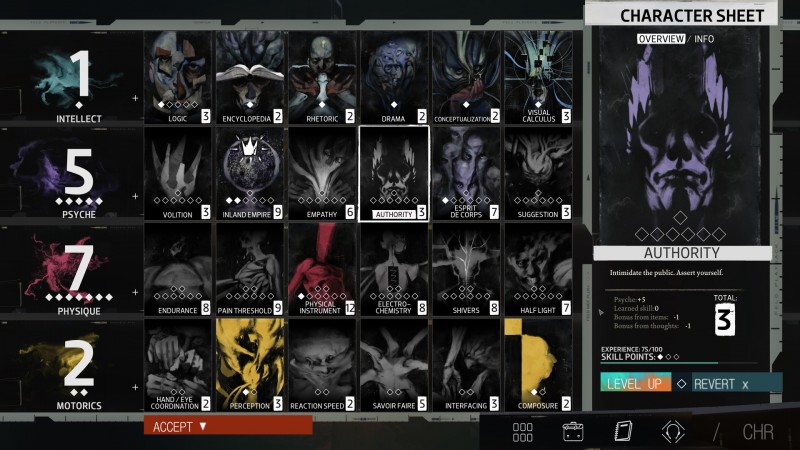
Even more impressive is how much nuance is communicated internally, through your character’s thoughts. This is made possible through Disco Elysium’s crowning achievement: 24 distinct personality aspects representing your mind and body, each of which may chime in at any time with dialogue exchanges that offer encouragement, provide guidance, or goad you into folly. Though they are a part of you, these aspects also feel like different characters vying for control, with different goals and manners of speaking; Physical Instrument is always eager for violence, Authority wants to assert dominance, and Drama always calls you “sire.” Depending on how you want to play, you may trust certain aspects’ interjections over others, and their frequent intrusions create the compelling sense that your character is always teetering on the brink of sanity.

Since Disco Elysium has no combat mechanics, your investigation’s successes and failures are determined through dice-roll checks tied to each personality aspect, with higher chances for passing if you’ve invested skill points in the appropriate area. The concept is neat, but it feels a little too arbitrary in practice. With 24 different available aspects and no way of knowing which ones might benefit you in the future, the process of spending your skill points is fuzzy at best. For instance, if you neglect Composure in the early hours, you will probably throw up when you first approach the victim’s corpse and be unable to proceed. You can attempt the check again after putting some points in Composure, but earning those points takes time, and you still aren’t guaranteed a success. So, even though the game seemingly embraces a “play how you want” philosophy, it also withholds important and excellent moments if you don’t invest points in specific ways – or repeatedly save and reload to brute-force certain checks – which is disappointing.

Click image thumbnails to view larger version


Even with some behind-the-curtain issues, the unique world in front of you in Disco Elysium feels magical. Though the sliver of Revachol you explore is small, its history feels as large as a sprawling epic fantasy. People tell you about wars long lost, paranormal phenomena, and deific figures. The attention to detail creates a fantastical setting that still feels grounded; a melancholy thread runs through it all, but the city is cold and desolate, and the people within it reflect that beautifully. I specifically need to praise Lt. Kim Kitsuragi, who is a great companion character and the perfect foil to the protagonist’s spiraling mess of impulses.

A few moments of frustration aren’t enough to dim the surreal glow of Disco Elysium. Trying to contain your glorious catastrophe of a “hero” can be simultaneously amusing and horrifying, and that’s before you even consider the events of the case surrounding him. I won’t spoil any of the major story beats, but the central mystery has immaculate pacing, with new layers and complications folding in at just the right moments. Plus, the payoff is satisfying and surprising. The team at developer ZA/UM only lets you spend a handful of in-game days as a part of Disco Elysium’s world, but now that the case is closed, I hope I can report for duty again in the future.

Score: 9

Summary: This investigative RPG surprises and delights with its complex world, fantastic dialogue, and ability to convey a constant struggle with the warring facets of one’s own mind.

Concept: You are an awful person, but a good detective. These two truths combine as you try to solve a grisly murder while wrestling with your own destructive tendencies

Graphics: The static environments have a stylish, painted look that sells the setting well. The character models are nothing special, but you usually only see them at a distance

Sound: While not every line of dialogue is voiced, you hear enough to get a good sense of the people and their dispositions. The music is atmospheric, but not exactly catchy

Playability: Straightforward point-and-click controls handle all of your movement and interactions. The menus can be overwhelming at first, but it all makes sense before long

Entertainment: The mystery has a satisfying payoff, but the bigger draw is navigating the main character’s competing thoughts and weighing what kind of person you want him to be

Replay: Moderately High

Click to Purchase

Thursday, November 7, 2019

Planet Zoo Review – Wearing Down Barriers

Publisher: Frontier Developments
Developer: Frontier Developments
Release:
Reviewed on: PC

A good simulation game has the power to make micromanagement exciting instead of laborious. Watching your empire grow and seeing the fruits of your decision-making is what drives these experiences, making the overwhelming feeling of pulling so many strings rewarding. Planet Zoo captures a lot of that appeal, trying to take its simulation elements in more meaningful and complex directions. Unfortunately, it spends far too much time on the tedium.

From the creators of Planet Coaster and billed as a spiritual successor to Zoo Tycoon, Planet Zoo doesn’t hesitate in throwing you to the lions. It’s a challenging simulation due to all the areas you must excel in, and being lucrative isn’t your only concern. Angry protesters run amok if you’re not giving your animals excellent care. Customers turn into vandals if they aren’t enjoying themselves. The animals always need something, and they are clever enough to escape if you don’t repair your barriers often enough. All of these factors force you to constantly balance the happiness of animals and people against your pocketbook. I enjoyed the challenge of this juggling act, even if the animals sometimes exhibit diva-like behavior with their high demands.

Since animals are the main attraction, they take up most of your resources. You must research different species and study the basic attributes and tendencies in an expansive encyclopedia. You need to pay attention to things like temperature and terrain type when building your exhibits, and regularly add new toys to keep your animals interested. Even adopting the best-fit animal available within a species can change things drastically. For instance, choosing the timber wolf with a higher fertility rate is in your best interest, even if the cost is high and sets you back from getting other animals to exhibit.

Your level of care has a huge ripple effect on your success, since high animal welfare means no protestors and a higher chance of procreation. I was impressed by the scope of the animals, from Komodo Dragons to Japanese Macaques, but learning about them quickly became like taking a boring open-book test. You must constantly reference the zoopedia to succeed, as research often unlocks and records new details, which allows you to improve animals’ welfare. The amount of detail and specificity for each species is impressive, but it’s presented in such an unappetizing way; spending the majority of your time with your head in a book isn’t exactly a fascinating way to learn about different animals in an interactive format. At the very least, Planet Zoo does touch on conservation and the importance of releasing animals into the wild to repopulate areas, giving you incentives, such as currency bonuses, for finally setting them free. 

Click image thumbnails to view larger version


Building my own zoo and managing the cash flow held the most allure. Zoo themes (like India and Africa) help you create cool designs, and I enjoyed the strategic elements, such as placing souvenir shops by popular exhibits and putting animals’ food trays near glass windows so guests get a better view. Training staff members, running marketing campaigns, and selecting pricing are also interesting things to consider. Planet Zoo certainly provides a challenge, and having so many different things to weigh kept me on my toes, but it also took a lot of experimentation to actually learn about all the elements. Planet Zoo doesn’t offer adequate guidance for its complexities, with a lot of important things not being explained well or at all. This is a shame because the game is packed with so many different areas and aspects to consider. I learned the hard way about the importance of exhibit size, using non-climbable fences for specific animals, and how animals fight for dominance and space if you don’t balance the male to female ratio accordingly.

Learning through failure and looking up topics in a glossary aren’t the only ways to master the complex mechanics, but it’s far more fun than the frustrating career mode. That path is basically a long tutorial through various zoo types to help teach the basics, but it’s awful to play through. On top of listening to bad dad jokes, you get a checklist of tedious tasks to complete, like increasing animal welfare to an extremely high percentage, placing objects and buildings in specific areas, and adopting a certain amount of different species. I started with the career mode to learn how to play the game, and it left a terrible first impression. The problem is you need to play some of it to have even the slightest idea of how to navigate the game; with several different systems and elements to consider, this is a huge issue. I couldn’t believe how much more fun Planet Zoo became when I stepped into other modes where I had the freedom to do things as I pleased, as there’s everything from economic challenges to just a sandbox to build the zoo of your dreams with no restrictions. 

While swapping to other modes mitigated some of my frustrations, it doesn’t alleviate the extremely menu-heavy interface. I always felt like I had to go through one more hoop than necessary to find information or take actions. For example, if I researched a new enrichment for my animals, I had to go back into the zoopedia to even see what it was, then back out and go into another menu to find said item and put it in the habitat. At times, I even wrote things on paper so I didn’t forget them as a way to avoid the hassle of going into extra menus. 

Planet Zoo put up a lot of obstacles to my enjoyment, but once I broke through the majority of them, I found that engaging loop of mastery and success that makes simulation games fun. I enjoyed trying to one-up my last creation and surpass my previous revenue and years in business. Unfortunately, Planet Zoo requires an unreasonable level of patience that creates a barrier around its best qualities.

Score: 7

Summary: Planet Zoo requires an unreasonable level of patience that creates a wall around its best qualities.

Concept: Construct and manage your own zoo, catering to your animals’ and customers’ needs while staying profitable

Graphics: The building and animal variety allows you to create majestic zoos, all with their own flair thanks to real-world inspirations

Sound: Sound effects and music add to the atmosphere, especially the noise of crowds, protesters, and distinct animal vocalizations

Playability: With its menu-heavy interface and poorly explained management tools, Planet Zoo is too obtuse for its own good, leaving it hard to recommend to anyone but hardcore simulation fans

Entertainment: Planet Zoo has a lot of ambition and depth, but it often comes at too high a cost

Replay: Moderate

Click to Purchase

Wednesday, November 6, 2019

Plants Vs. Zombies: Battle For Neighborville – Mindless Mayhem

Plants vs. Zombies: Battle for Neighborville

Publisher: Electronic Arts
Developer: PopCap Games
Release:
Rating: Everyone 10+
Reviewed on: Xbox One
Also on: PlayStation 4, PC

After the Plants vs. Zombies: Garden Warfare series gave players two games full of exciting heroes and intense battles across fun multiplayer modes, Plants vs. Zombies: Battle for Neighborville rebrands the series. However, despite the new name, make no mistake: This new entry carries forward the enjoyable multiplayer suite from those enjoyable Garden Warfare games while experimenting with PvE modes to mixed results.

Regardless of what mode you want to dive into, you can expect zany, over-the-top action from start to finish thanks to the roster of 20 playable heroes. Rockets whiz past you to annihilate your teammates, drone-style onions and zombie parrots provide air support, and sentient oak trees emerge from the ground. Thanks to a wide range of hero classes to choose from, from a basic foot soldier and a shotgunning healer to an agile mushroom ninja and a fire-breathing snapdragon, you can approach every situation how you want. Picking the right class and equipping perks (like health regeneration and the ability to move and dodge while reviving a teammate) to suit your playstyle is endlessly rewarding as you experiment to find the right loadout for your playstyle and characters.

Click here to watch embedded media

Learning the skills of the various plants and zombies is daunting at first, but simple controls and abilities make it a breeze to jump into any mode with little to no practice. While you have a plethora of options available from the start, the robust competitive multiplayer suite is the main attraction.  My favorite modes return from Garden Warfare 2, like Vanquish Confirmed, offense-versus-defense Turf Takeover, and control-point-based Suburbination. I also love the tense new Battle Arena, where two teams of four duke it out in an elimination mode. In addition to no respawns, when you choose a character at the start of each round, you are unable to choose that specific character again for the rest of the match. These restrictions lead to strategic team compositions and white-knuckled firefights you rarely encounter in other modes.

You can also dive into PvE options with the wave-based Ops mode and three open regions full of missions to complete and collectibles to gather. While laying out your defenses and protecting your point from the increasingly difficult waves of enemies in Ops is a blast, the PvE in the three open regions is hit-and-miss. While I liked some of the more straightforward missions and boss battles, others fall flat, delivering an uneven experience. This inconsistent enjoyment propelled me back toward the multiplayer suite on several occasions, as I worried about whether the next mission would be fun or frustrating.

The part I dislike most about the PvE regions is you can’t change characters mid-mission or without backing out to the hub, which is frustrating since certain heroes are not well-suited for all situations. This means that if you get to the end of a long, multi-part quest and find it unbalanced for the hero you chose, you have to go back to the hub and lose all progress on the quest, starting again with the hero better suited for the challenge. It’s an unnecessary headache that saps the fun from some missions.

Click image thumbnails to view larger version


No matter the mode you choose, you earn coins to spend on cosmetics and experience to level up your heroes. Experience points are used to level up and promote individual heroes to earn upgrades for their abilities. These upgrades are useful, like giving the Peashooter’s bullets a homing property, or increasing the rate of fire for the Foot Soldier zombie. I like the straightforward nature of the promotion mechanic and wish it carried into the cosmetic items, but unlocking those is more complicated and less engaging.

In-game currency is primarily used to purchase random pieces of cosmetic equipment from a giant capsule toy machine. The randomized nature of this method of unlocking is annoying, with the brief moment of excitement from seeing what you got usually giving way to disappointment. Because many of the items are underwhelming components or customizations for characters you don’t often use, the act of progressing through the cosmetics you want feels throttled. However, Battle for Neighborville also runs themed events that let you chart paths to specific customization components by spending prize bulbs you earn with experience – just don’t expect to earn the top prizes of an event without investing some serious playtime or saving up over multiple events. I like the idea of having multiple paths to earn customizations, but this convoluted method is unrewarding and unmotivating since there’s rarely a clear path to getting the exact piece you want. The team does have a soon-to-be implemented solution to this problem, but here’s the bad news: It’s a premium shop using real-world currency.

Those looking for zany multiplayer fun can find it here, but that also comes with an unnecessarily complicated economy and inconsistent PvE components. Plants vs. Zombies: Battle for Neighborville lets dedicated soldiers dive back into this long-running conflict, even if everyone else has moved on to other battles.

Score: 7.75

Summary: Battle for Neighborville delivers exciting competitive and cooperative multiplayer, but an overly complicated economy and inconsistent PvE elements take away from the experience.

Concept: Take sides in the seemingly endless conflict between plants and zombies in a third hero-based shooter

Graphics: A cute-but-unremarkable visual experience with bright colors, delightful animations, and unique character designs

Sound: Series mainstay tracks react to the action on the battlefield and amp up the action

Playability: While the prospect of learning the unique loadouts of 20 different heroes is daunting at first, the controls are easy to pick up for anyone who has played a shooter before

Entertainment: Despite strong competitive and cooperative multiplayer action, the PvE elements fall short of those marquee modes. The progression leads to more frustration than satisfaction

Replay: Moderately high

Click to Purchase