This is default featured slide 1 title

Go to Blogger edit html and find these sentences.Now replace these sentences with your own descriptions.This theme is Bloggerized by Lasantha Bandara - Premiumbloggertemplates.com.

This is default featured slide 2 title

Go to Blogger edit html and find these sentences.Now replace these sentences with your own descriptions.This theme is Bloggerized by Lasantha Bandara - Premiumbloggertemplates.com.

This is default featured slide 3 title

Go to Blogger edit html and find these sentences.Now replace these sentences with your own descriptions.This theme is Bloggerized by Lasantha Bandara - Premiumbloggertemplates.com.

This is default featured slide 4 title

Go to Blogger edit html and find these sentences.Now replace these sentences with your own descriptions.This theme is Bloggerized by Lasantha Bandara - Premiumbloggertemplates.com.

This is default featured slide 5 title

Go to Blogger edit html and find these sentences.Now replace these sentences with your own descriptions.This theme is Bloggerized by Lasantha Bandara - Premiumbloggertemplates.com.

Thursday, November 12, 2020

Sackboy: A Big Adventure Review – A Delightful Companion Piece

Publisher: PlayStation Studios
Developer: Sumo Digital
Reviewed on: PlayStation 5
Also on: PlayStation 4

Sackboy has proven to be a character who’s pretty much up for whatever, including his starring role in the LittleBigPlanet series, a kart-riding spin-off, and even an appearance as a fighter in PlayStation All-Stars Battle Royale. In Sackboy: A Big adventure, the character brings his blank-slate appeal to a 3D platformer. Sure, he’s been jumping, punching, and throwing his way across hand-crafted worlds since his inception, but almost always with an eye toward tutorializing user-creation tools. Freed of those responsibilities, Sackboy – and players – can simply kick back and enjoy the action in another family-friendly showcase.

When we meet up with Sackboy, he and his friends are having a swell time over in his hometown, Loom. That peace doesn’t last. Vex, a jester-like villain, has plans to build a chaos-reaping machine, and he enslaves the citizens of Craftworld to build it. Sackboy flees to a rocketship and makes his escape. As far as platform-game setups go, it’s fine, but let’s be honest: I would have been just as happy to explore a jungle-themed world or a string of retro space-age levels even without Vex or the existential stakes. The fact that he’s a pretty fun guy to hate when he pops up throughout the adventure is just gravy.

Click here to watch embedded media

Initially, I was concerned that my biggest obstacle would end up being Sackboy himself. Or, to be more specific, the peculiar way he gets around. As appealing as his design may be, his floaty jumps and overall movement in past games never clicked with me. Sumo Digital must have felt the same way, or at least realized that what worked in 2D gameplay wouldn’t necessarily be great in more expansive 3D levels. Sackboy has been tuned to be more responsive and precise, and controlling him is a joy. And it’s not just the simple movements. Throughout his trip, Sackboy gains temporary access to upgrades like hover boots, a boomerang, and a blaster. They’re all well implemented, and incorporating these new abilities in his suite of moves – which include rolling, punching, and grabbing – is intuitive and rewarding.

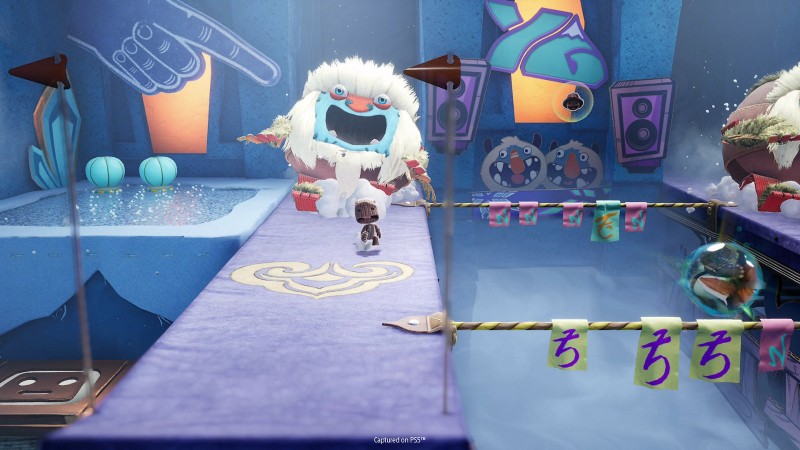
Sackboy travels across a fair bit of Craftworld in his pursuit of Vex, covering a lot of the types of places you’d expect to find in a platformer. You like undersea vistas? Idyllic outdoor countrysides? The classic themes are present, but they’re cleverly designed to upend expectations. Just about every level introduces a new gimmick like teleporters, rising (and swaying) tides, or gauntlets of spinning sponges that hurl you forward. I groaned when I first saw herding missions and motion-controlled platforms, but these clichés are less aggravating than I feared. In addition to having great platforming bones, levels are constructed in a variety of crafty bits familiar to LittleBigPlanet fans. They create functional and often breathtaking worlds to explore.

Click image thumbnails to view larger version


I wish I was as enthusiastic about the co-op. Up to four players can team up in couch co-op (Sumo says online co-op, including cross-gen support, is coming later this year), and Vex should incorporate this kind of chaos into his master plan. I’m all for sharing screen time with my friends and family, but I generally prefer platforming as a party of one. Sackboy: A Big Adventure didn’t change that preference. The screen doesn’t accommodate multiple characters at once, even with just two players, leading to an uncomfortable pulling sensation as I went to check out one corner of a level while my buddy tried to see another. And when you’re pulled together in battle, good luck distinguishing friend from foe – especially if you dress Sackboy up in some of the collectable outfits he can acquire. It can be fun to slap your partner or pick them up and toss them aside, but after a while I just wanted to make progress in peace. However, the side missions designed specifically with multiplayer in mind fare much better than the main levels. These require cooperation, such as having one player move and hold a platform into place so the others can progress, and they’re much more satisfying in co-op overall.

Sackboy: A Big Adventure is such a visually appealing title that it’s easy to ignore the audio, or to assume that it’s just an incidental part of the experience. That would be a huge mistake. The soundtrack is exceptional, with tunes that span the works of indie artists (several of which you may recognize from past LittleBigPlanet games) to some of the biggest names in music. When Sumo acquired some of those bigger songs, the team wasn’t content to loop them in the background; several levels are built around the music, where they don’t serve as accompaniment to the action but an equal partner of sorts. Platforms throb and enemies dance in time to the music, and I found myself syncopating my moves right along with it all. In a game filled with so many delightful moments, these were among the high points. As soon as a familiar baseline or beat kicked in at the start of a level, I eagerly looked forward to seeing how it would be worked into the level, and I was rarely disappointed. I’m dancing around the specifics here, because I really don’t want to rob anyone of the surprises in store. They’re that good.

I’ve always had a soft spot for Sackboy, and it’s great that the character has found a new home. As much as I’ve appreciated LittleBigPlanet’s tools in the past, I was always more interested in the playing part than creating or sharing. And with this release, I’m finally getting to take the loveable hero on a trip that plays as well as it looks. It doesn’t reinvent the genre, but Sackboy: A Big Adventure is a wonderful platformer that takes what’s come before, sprinkles in its trademark aesthetic, and shakes things up enough to feel fresh and exciting.

Score: 8

Summary: It doesn’t reinvent the genre, but Sackboy: A Big Adventure is a wonderful platformer that takes what’s come before, sprinkles in its trademark aesthetic, and shakes things up enough to feel fresh and exciting.

Concept: Give Sackboy a chance to star in his own 3D platformer without fussing around with content creation

Graphics: Materials pop on PlayStation 5, from shimmery satins to rusty old signs. Solid art design makes up for technical limitations on PS4

Sound: It’s a shame Sackboy doesn’t have ears, because his adventure is accompanied by a spectacular soundtrack that even gets directly incorporated into gameplay at times

Playability: Up to four players can team up, but I wouldn’t recommend it. Platforming is chaotic enough with just one friend, let alone three

Entertainment: Cleverly designed levels offer moderately tough challenges, but generous checkpoints and a genial atmosphere make it easy to keep coming back

Replay: Moderately high

Click to Purchase

Kingdom Hearts Melody of Memory Review – The Power Of Music

Publisher: Square Enix
Developer: Square Enix
Rating: Everyone 10+
Reviewed on: PlayStation 4
Also on: Xbox One, Switch

Since its 2002 debut, the Kingdom Hearts series has taken players on an unpredictable ride, containing everything from human replicas to time travel. One thing has remained constant, though: Stellar music. Whether it’s the poignant character themes or heart-pumping battle tracks, composer Yoko Shimomura has stayed at the top of her game, creating arrangements that have become core to the series’ identity. Rhythm game Melody of Memory is the ultimate tribute to this musical talent, offering a massive catalog of over 140 tracks to relive. The end result is proof that moving the spotlight onto this component wasn’t unwarranted. While not without its faults, Melody of Memory is a refreshing way to look back at Kingdom Hearts’ long journey thus far, and even gives fans just enough breadcrumbs to anticipate what’s next.

Melody of Memory has no shortage of songs, and I am impressed by how much content Square Enix has packed in. Expect classic tracks that have been integral to the series' identity (like “Destiny Islands” and “Hand in Hand”) alongside popular Disney standbys (like “Let It Go” and “Under the Sea”). Even theme songs like Utada Hikaru’s “Simple and Clean” and “Sanctuary” are available. A rhythm game is only as strong as its library, and Melody of Memory delivers in that department, providing a great tracklist that instantly transports you to certain moments in time. I can’t play “Lazy Afternoons” without thinking about Roxas’ summer vacation, or “Go for It!” without reliving all the crazy tournaments I took on at Olympus Coliseum. 

Don’t go into Melody of Memory expecting gameplay mirroring Square Enix’s popular Theatrhythm series. While there’s some inspiration and nods to its artstyle in the loading screens, Melody of Memory is a 3D experience that attempts to replicate Kingdom Hearts’ stylish action combat in a rhythm game shell. To execute attacks, you tap and hold buttons in time with the on-screen animations, chaining them for an even higher score. It sounds basic, but the addition of a jump button to hit airborne enemies or avoid incoming attacks adds more frenzy. You see your attacks connect in real time with the enemies on screen, which means the lanes are cluttered, sometimes making it hard to prepare ahead of time or see prompts. I liked the level of detail in the enemy design, especially having their aesthetic match up with the world’s, but a lot is always going on. 

Click image thumbnails to view larger version


The main mode, World Tour, is the best way to unlock the majority of the songs. As you complete certain objectives to unlock new worlds, Kairi narrates pivotal moments in each game, explaining the big takeaways from the first entry all the way up to Kingdom Hearts III’s recent Re Mind DLC. I was disappointed that Melody of Memory doesn’t have many new scenes until the very end, but as soon as I saw the final moments, I had a new excitement for the series. Similar to the end of Dream Drop Distance, the finale provides clues and context, and it also sets up where things are going in the future. It feels like a good reward for going down memory lane. 

The other bonus with World Tour is boss battles, which were my favorite part of the mode as they take a more traditional setup, clearing the onslaught of enemies on screen and challenging you with more holds and multiple button presses that determine the power of your hits and if you dodge incoming attacks. The small number of these boss battles is a big letdown, especially since they’ve always been a huge part of the series. Memory Dives function similarly, but instead of intense battle sequences, you tap to the beat over scenes from specific worlds, but the busy CGI can make it difficult to follow prompts. For some reason, all the Kingdom Hearts III levels are like this, which is disappointing, as it would have been cool to see battles play out with the newer Heartless designs. 

Even after completing the main World Tour mode (which took me around eight hours), I’m still unlocking songs, chasing hi-scores, and finding new ways to experience them through the couch co-op and online versus mode. The only drawback with co-op is both players need to select the same skill level, so if your partner isn’t at the same level, one of you is left wanting. 

For those concerned about difficulty, not only is Melody of Memory one of the easier rhythm games I’ve played, but it also has plenty of options to tailor the experience to your skill level. In fact, if there’s anything to knock at it, it may be that more advanced players may not find much of a challenge, even in Proud mode. For those players, there is an online versus mode to face off against the best players, and it also adds extra challenges, like allowing you and other players to use tricks that vanish enemies or put fake prompts on your opponent’s screen that they must ignore. 

I didn’t realize how much Kingdom Hearts’ soundtrack has impacted me until I played Melody of Memory. As a fan of the series, I’ve always praised the score, but something about actually going back through various tracks and tapping to the beats on familiar backdrops showcased just how powerful these songs have been. Melody of Memory delivers great music and tons of unlockables to keep you listening. 

Score: 8

Summary: While not without its faults, Melody of Memory is a refreshing way to look back at Kingdom Hearts’ long journey thus far.

Concept: Tap along to iconic Kingdom Hearts tunes while revisiting the series’ biggest twists and turns

Graphics: Square Enix put a lot of detail into replicating the enemy design associated with each world, and the 3D graphics look right at home

Sound: Composer Yoko Shimomura’s talents are on fully display here, with a massive tracklist that captures everything from intense battles to heart-wrenching moments

Playability: Multiple difficulties and additional ways to alter the control scheme to only use one button or add extra inputs makes for an approachable rhythm game at all skill levels

Entertainment: Melody of Memory provides a fun and energizing way to celebrate the franchise’s fantastic music and greatest moments

Replay: Moderately High

Click to Purchase

Tuesday, November 10, 2020

The Pathless Review – A Liberating And Spirited Adventure

Publisher: Annapurna Interactive
Developer: Giant Squid
Reviewed on: PlayStation 5
Also on: PlayStation 4, PC, iOS

The first shot in The Pathless is of a sprawling sea, a visual nod to developer Giant Squid’s previous work on the ocean adventure game Abzû. That title was peaceful and serene, whereas The Pathless acts as a counterpoint, inviting you into a dark world consumed by fire and brimstone. Giant Squid handles the tonal shift well, creating a better game that embraces a true sense of discovery, while being every bit as gorgeous as its underwater predecessor.

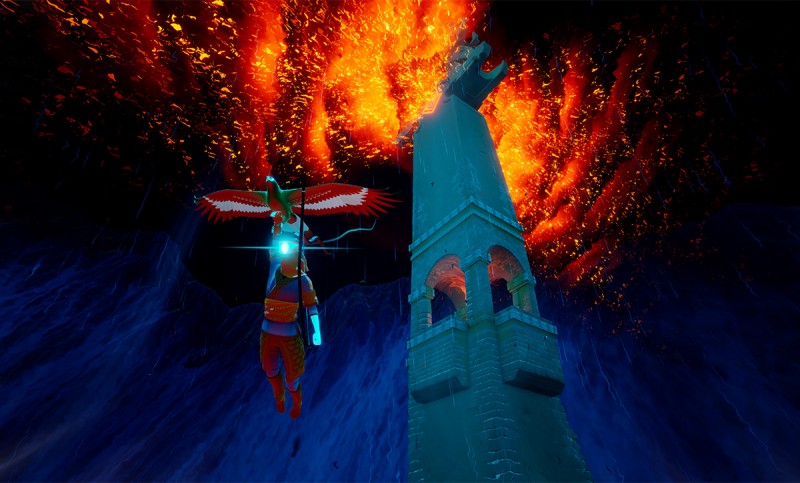
This adventure into a dangerous land is seen through the eyes of a character known only as “The Hunter,” a gifted archer who becomes the unlikely ally of a mystical eagle capable of lifting her high into the air. The Hunter is focused on one task: ridding the world of a curse created by a being known as Godslayer. For generations, Hunters have attempted this feat, but none have succeeded. You find these past Hunters’ skeletal remains littered along the sprawling open-world areas, showing just how close they came – a great visual-narrative technique that guides you to more perilous places. The world’s lore is uncovered through reading tomes, but Giant Squid also frames dramatic moments in beautifully animated cutscenes that scream of The Legend of Zelda’s recent stylization. The Godslayer gets plenty of screen time to reveal why he’s a formidable threat.

The Hunter’s sole weapon is a bow, and despite what you may think, it is rarely used for combat. Its primary focus is locomotion. Using an ingenious lock-and-shoot system, every arrow that hits an environment-based talisman gives the Hunter a burst of speed. You don’t have to worry about lining up these shots, the lock-on system does that, even if the talisman is off screen. You just have to time the shots, which ends up creating rhythmic gameplay. As arrows hit the mark, the Hunter bounds across the terrain in quick jolts. This style of movement is odd, but it’s handled remarkably well in execution and ends up being a blast to use. It later evolves for flight purposes, allowing the Hunter to soar up the side of mountains. The tightening of the DualSense’s adaptive triggers is cool, helping with timing just through the feel the controller gives off.

Holding true to The Pathless name, you won’t find a bread-crumb trail to follow, a map to look at, or even a defined order to any of the objectives. Giant Squid created a freeing open-world design aided by clear visual lines that almost always hold a point of interest no matter what direction you face. As the terrain becomes more vertically challenging, the Hunter relies on a magical technique, almost like a submarine’s sonar, which illuminates something of note in a red hue for a second. The exploration is enthralling, and I never once felt like I was lost or in need of some kind of assistance. I just ran to areas that looked important and my assumption was almost always right.

Most of the notable places are ancient ruins or dilapidated structures that hold an item called the Lightstone, which the Hunter must return to towers to cleanse the area of the curse. The Lightstones are always locked away behind an energy field. To free them, the Hunter must use the bow to solve environmental puzzles, sometimes shooting arrows through flames at specific angles to ignite pyres, and other times lining up a trick shot to thread three rings at once. These puzzles are well thought-out; a few stumped me for a bit, but their diminutive size doesn’t overwhelm and there are only so many approaches you can try. In general, the puzzles are fun to solve and a nice change of pace, since the game largely hangs its hat on environmental navigation. My biggest complaint about The Pathless is the repetitive structure of each world. Find the Lightstones. Light the towers. Repeat. Repeat. Repeat.

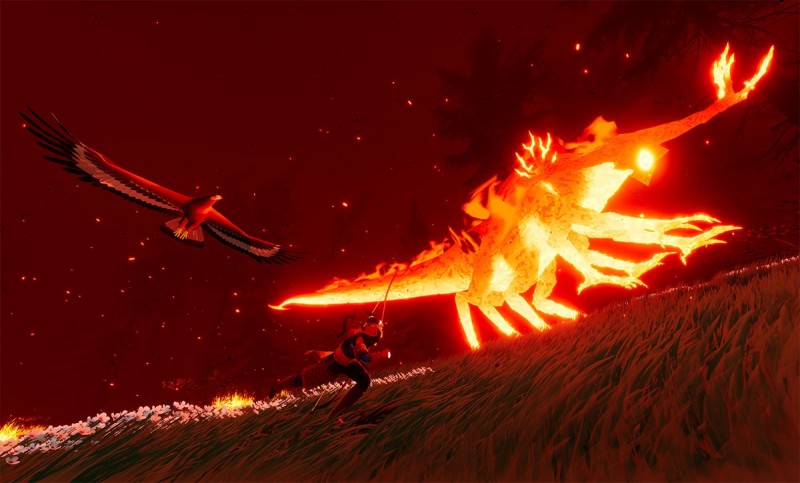
The Hunter is often airborne, gliding with her eagle over vast spaces, allowing the player to soak in the beauty of the world. Periodically, though, an angry beast whips across the terrain, engulfing it in flames. When this happens, the player simply must sneak by it. These stealth sequences are overused, but are mercifully easy. When all of the towers in an area are lit, this foe transforms into a formidable boss, showcasing how intense and challenging The Pathless can be.

Click here to watch embedded media

These big fights begin with a chase sequence, where the Hunter leaps over fire, glides past fireballs, and uses talismans to keep up and hopefully get close enough to land a shot on one of the beast’s weak spots. The Hunter then confronts it in an arena battle that requires her to time her jumps and roll-dodge area blasts. Each of the handful of worlds’ bosses are distinct and nicely designed. I loved taking them all on.

The Pathless is a wonderfully different game that makes you feel like you have ownership over the entire experience and are not being led along by a pre-scripted playbook. It’s one of those adventures that will stick with you long after you play it.

Score: 8

Summary: The Pathless is a wonderfully different game that makes you feel like you have ownership over the entire experience and are not being led along by a pre-scripted playbook.

Concept: Open-world exploration and puzzle-solving unite in this unique and beautiful adventure

Graphics: It looks like a cartoon come to life, with smooth animations and colors that pop

Sound: One of the best soundtracks of the year that shifts from menacing orchestration to a lone fiddle

Playability: The freedom of exploration is liberating, the controls are easy to pick up and master, and the puzzles are nicely designed

Entertainment: Clocking in at roughly seven hours, don’t be surprised if you complete it in one or two sessions. It’s a hard game to put down

Replay: Moderately High

Click to Purchase