This is default featured slide 1 title

Go to Blogger edit html and find these sentences.Now replace these sentences with your own descriptions.This theme is Bloggerized by Lasantha Bandara - Premiumbloggertemplates.com.

This is default featured slide 2 title

Go to Blogger edit html and find these sentences.Now replace these sentences with your own descriptions.This theme is Bloggerized by Lasantha Bandara - Premiumbloggertemplates.com.

This is default featured slide 3 title

Go to Blogger edit html and find these sentences.Now replace these sentences with your own descriptions.This theme is Bloggerized by Lasantha Bandara - Premiumbloggertemplates.com.

This is default featured slide 4 title

Go to Blogger edit html and find these sentences.Now replace these sentences with your own descriptions.This theme is Bloggerized by Lasantha Bandara - Premiumbloggertemplates.com.

This is default featured slide 5 title

Go to Blogger edit html and find these sentences.Now replace these sentences with your own descriptions.This theme is Bloggerized by Lasantha Bandara - Premiumbloggertemplates.com.

Tuesday, June 14, 2022

Industria Review – A Not So Well-Oiled Machine

Industria Review

Reviewed on: Xbox Series X/S
Platform: PlayStation 5, Xbox Series X/S, PC
Publisher: Headup
Developer: Bleakmill

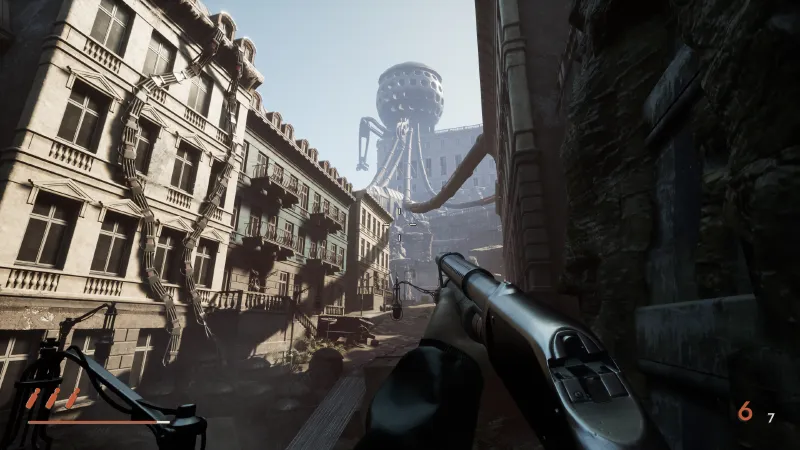
Industria’s inspirations are clear from the jump: Half-Life 2, David Lynch movies, and more. It’s something the six-person team at Bleakmill has mentioned when discussing Industria online that had me excited. You play as Nora, a worker for the East Berlin-based company Atlas, just before the end of the Cold War. Your lover disappears, and you set off to find him, only to wind up in a parallel dimension where machines have taken over what used to be home. Sadly, the four hours following this mysterious and intriguing start fail to live up to the opening’s potential. Bleakmill aimed high, and while I thought it might land at times, I was left dissatisfied and wishing there was more meat on the bone by the time credits rolled.

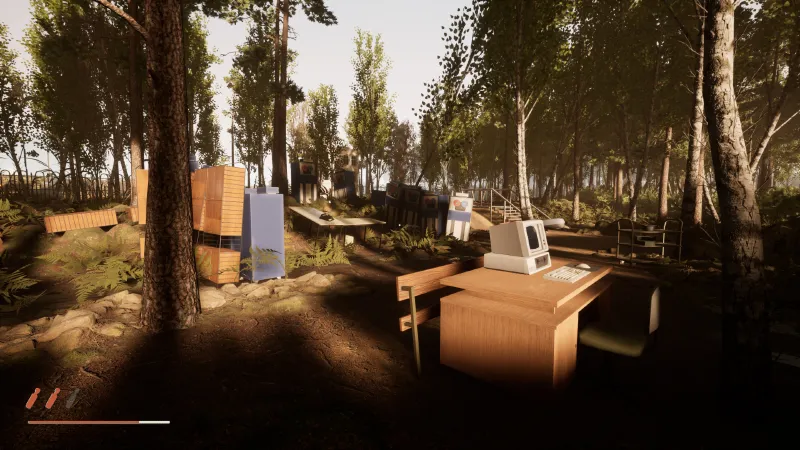
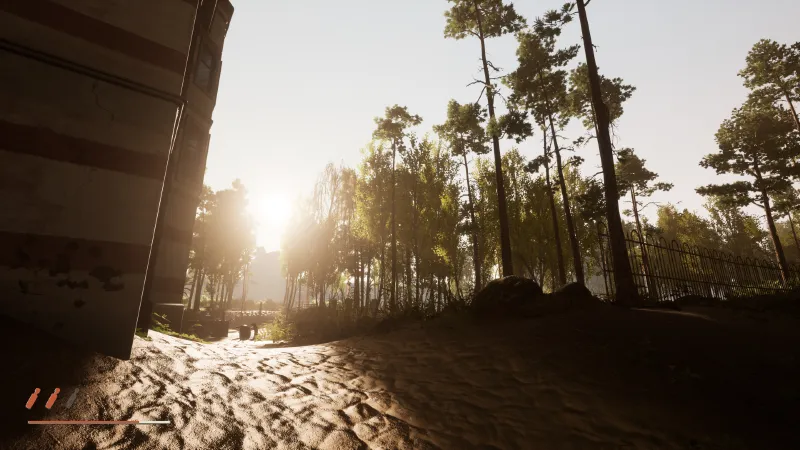
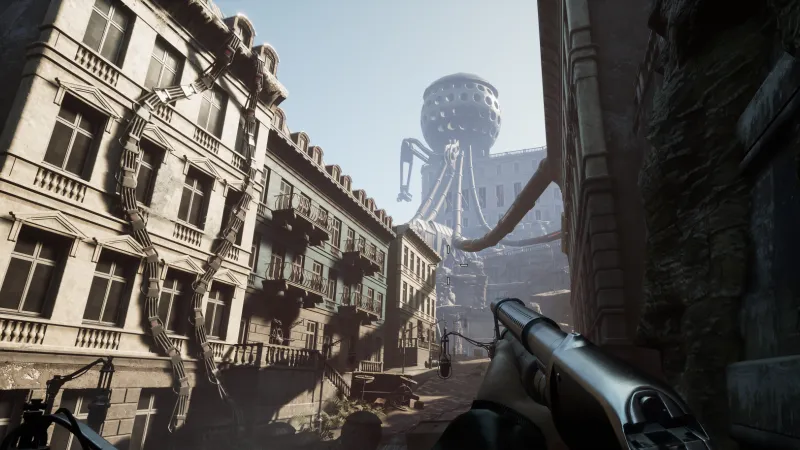
However, one aspect that kept me satisfied from start to finish was everything you experience in Industria without touching a controller. Thanks to a world wholly overtaken by machines, its atmosphere is oppressive and haunting. The score matches, presenting strange choral melodies that play wonderfully into the game’s ambiance. Even its visuals, which sometimes show cracks like when viewing vistas on the horizon, sold the game well. I just wish Industria’s gameplay and storytelling matched. 
Immediately, controlling Nora feels wonky. You cannot move diagonally on the left stick, a minute but affecting lack of input, and the game feels decidedly less fluid as a result. That Industria is a first-person shooter further highlights this problem because, above all else, I wanted to feel fast and in control when fighting enemies. Of course, I didn’t. 

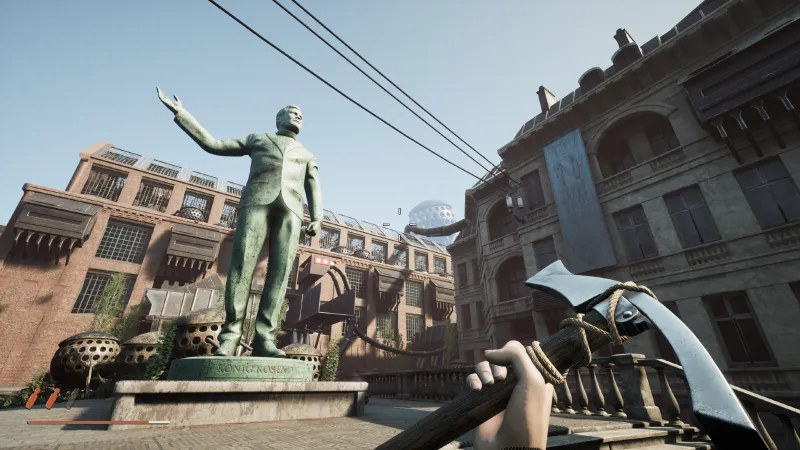
The opening stages feature a distinct lack of guns, forcing me to rely on an ax to attack enemies and solve environmental puzzles. I was excited about how these puzzles might evolve, but oddly, save for a couple, the rest of the game reuses the same few. I encountered these puzzles while attempting to complete objectives that are almost exclusively something along the lines of, “Go here, interact with this, and progress forward.” It got boring quickly. 

Bleakmill created a handful of different machines to fight while completing these objectives, and I liked the variations between them as they kept me on my toes. A small circular bot sprinted toward me before self-exploding. Another fought like a human with a gun, and another charged at me wildly, swinging its arms to attack. These firefights were often tense, and because Industria isn’t keen to toss out ammo in abundance, I was often on the run, scrounging through drawers and cabinets to find more bullets. I had a good time in these firefights, but I wish the actual scenarios were further polished to feel as varied as the robots I was shooting. 
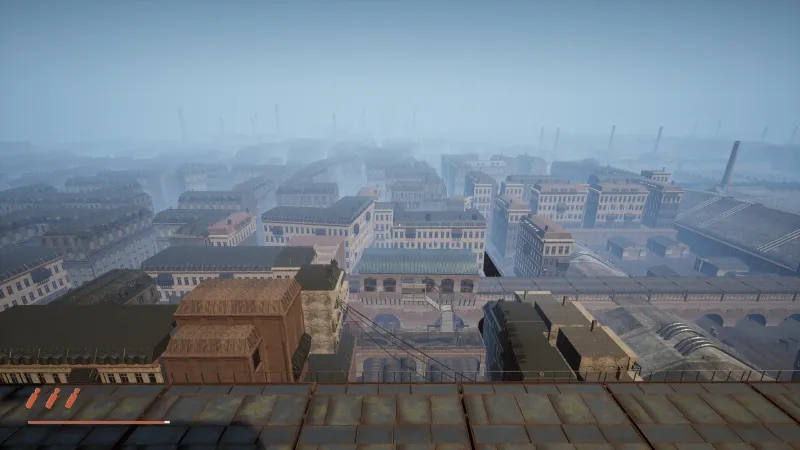
 

For the first hour, the central narrative mystery is intriguing enough for me to look past the relatively simple and dull “go here” objectives. There is even a mid-game twist I liked a lot. But as I reached the game’s final moments, I lacked the storytelling clarity I had hoped to achieve. One moment, I’m fighting a ton of robots in what might be the final combat scenario of the game. Then, I’m saying goodbye to a friend at breakneck speed before heading to an entirely new setting. Here, Bleakmill gave the narrative moment that everything was leading up to, and it missed the mark. Sure, it explained some character motives and solved Industria’s question from the opening scenes, but it wasn’t satisfying. It was too rushed to make sense, ending as fast as it began and not justifying my investment to that point. 

While Industria’s atmosphere certainly nailed what it was going for, the monotonous gameplay and rushed story left me dissatisfied. Still, I loved the ambiance and backdrop, and I wouldn’t mind if Bleakmill took another crack at it – the rest of this world just needs a few more cogs added to its machine.
Score: 6

About Game Informer's review system

Purchase

Monday, June 13, 2022

Diablo Immortal Review – The Price Of Playing With The Devil

Reviewed on: iOS
Platform: PC, iOS
Publisher: Blizzard Entertainment
Developer: Blizzard Entertainment, Netease

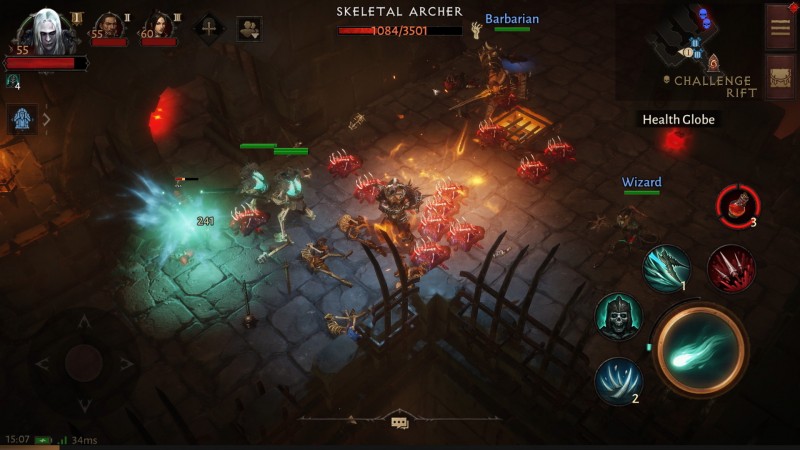
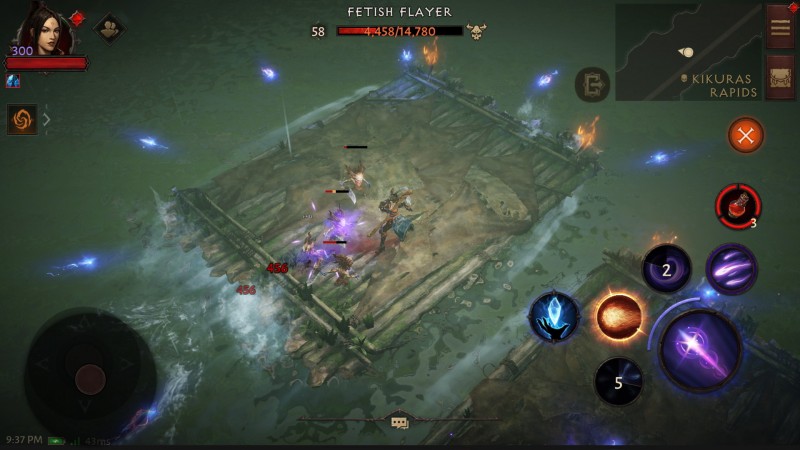
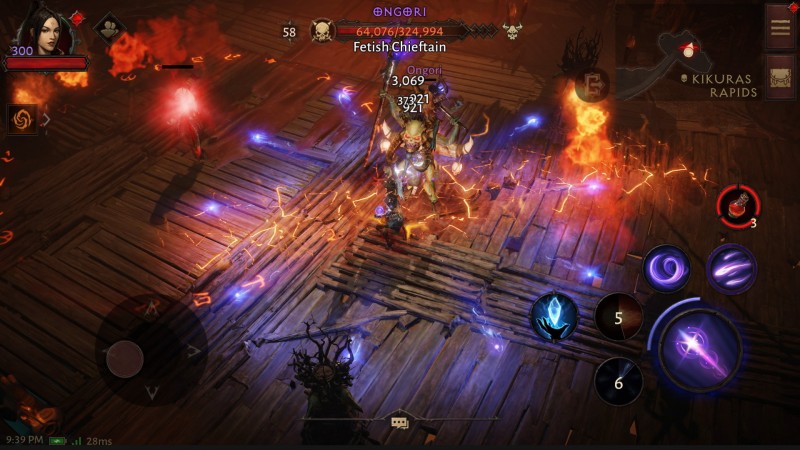
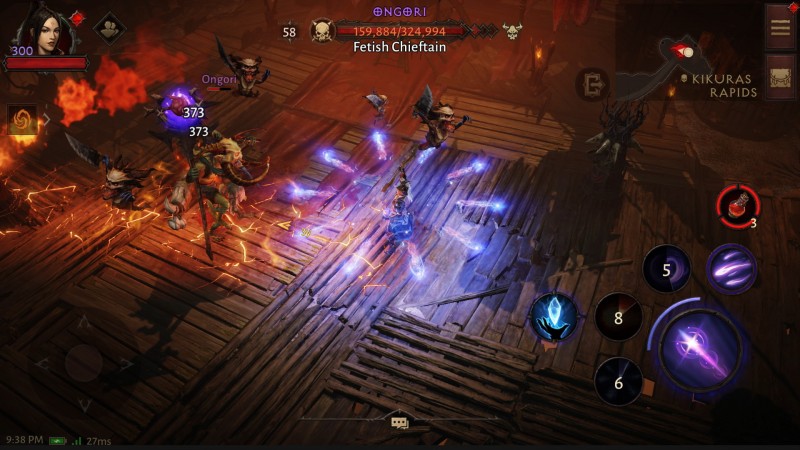
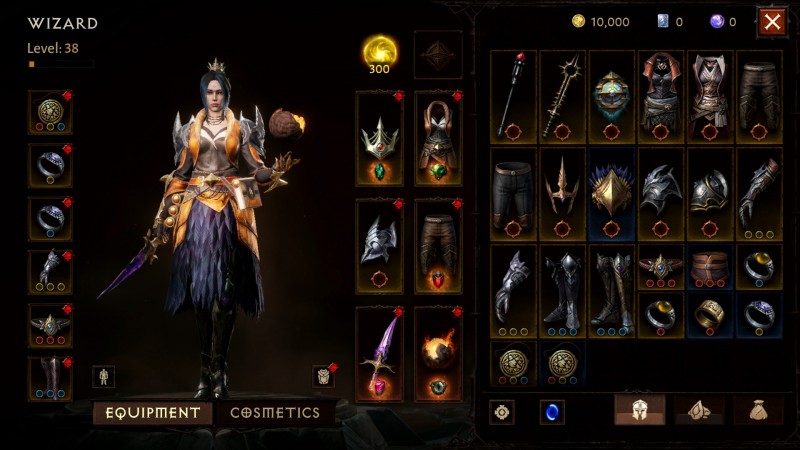
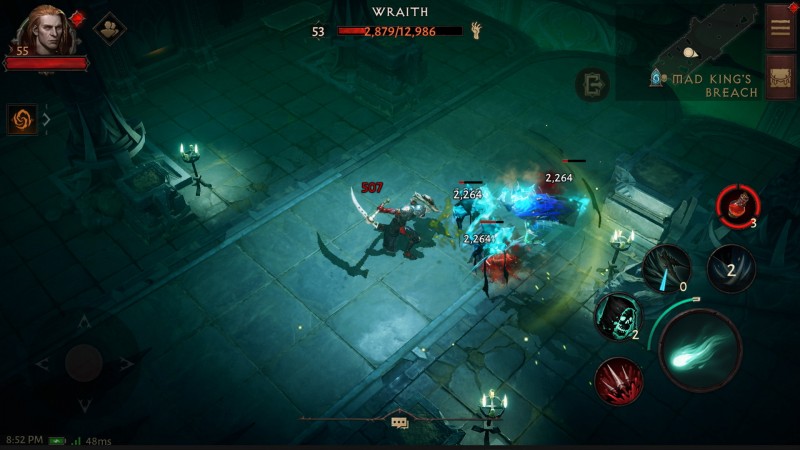
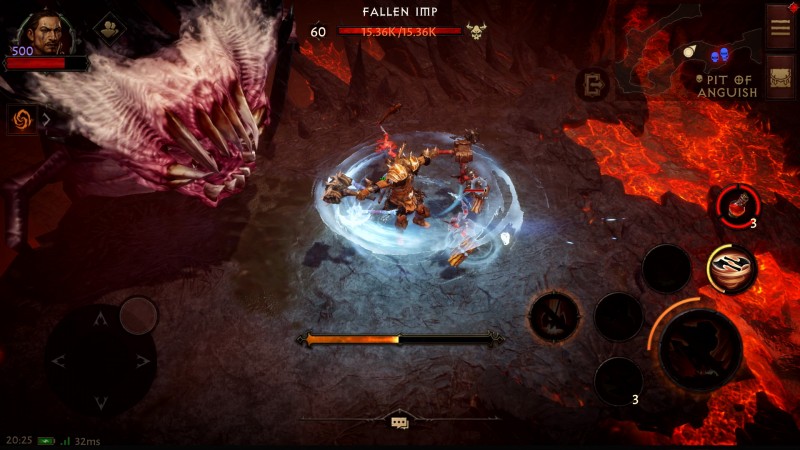
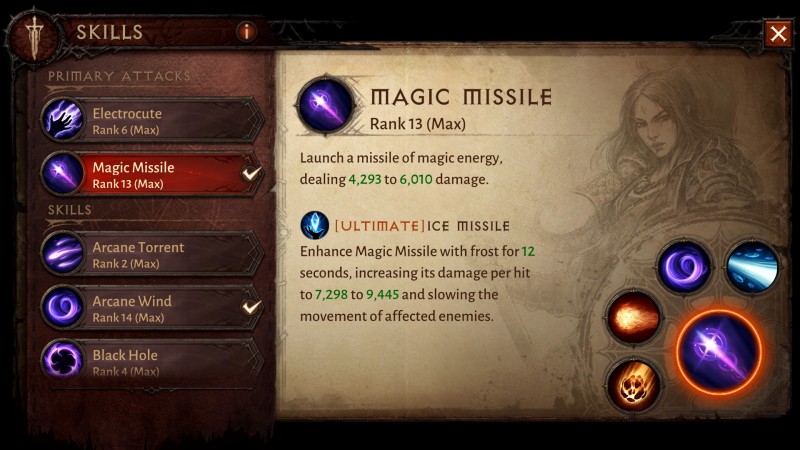
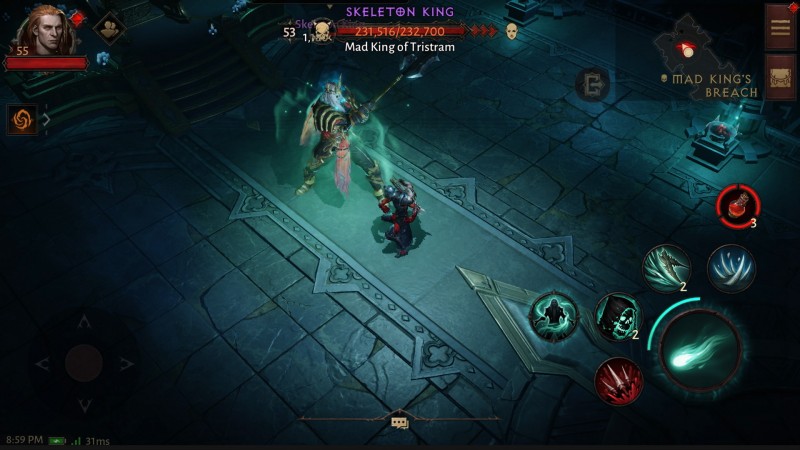
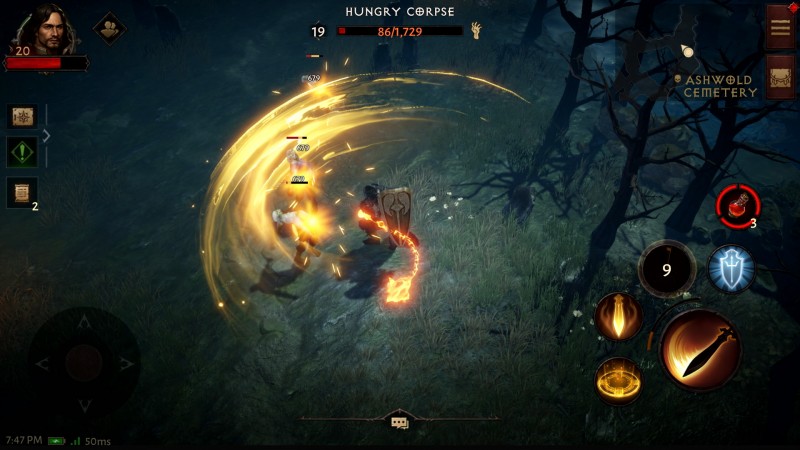
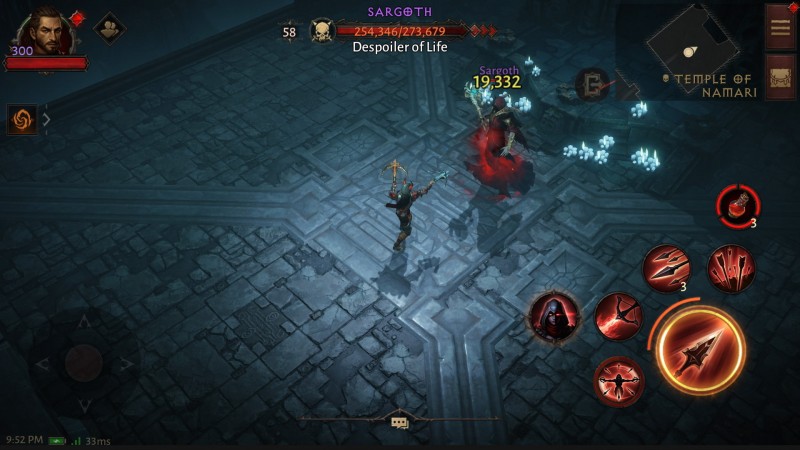
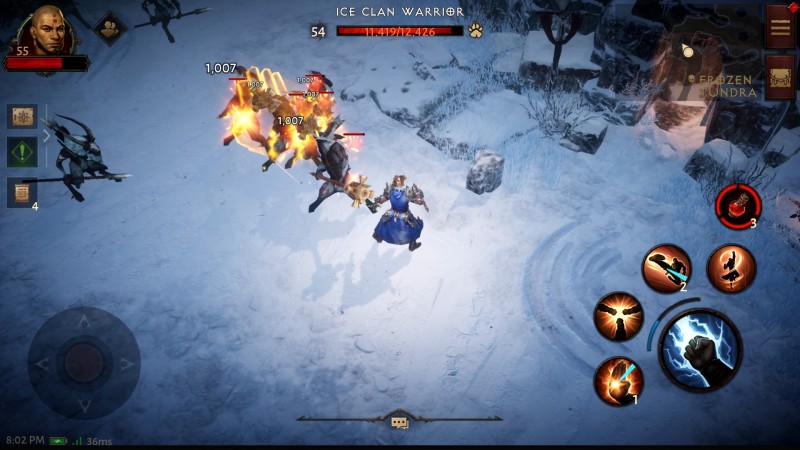
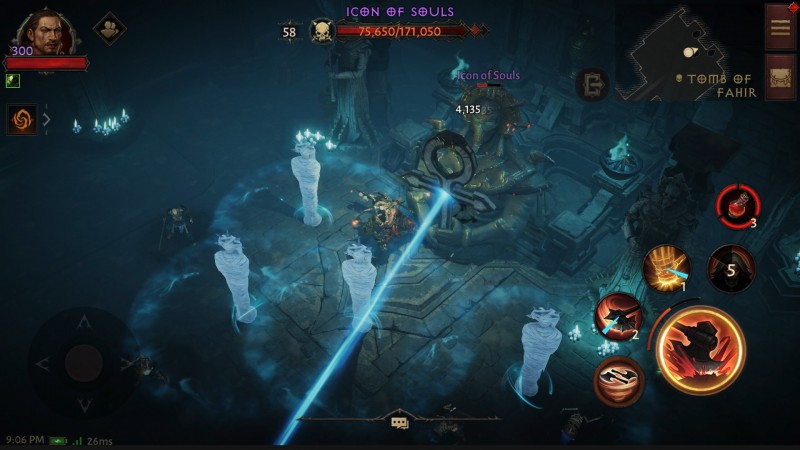
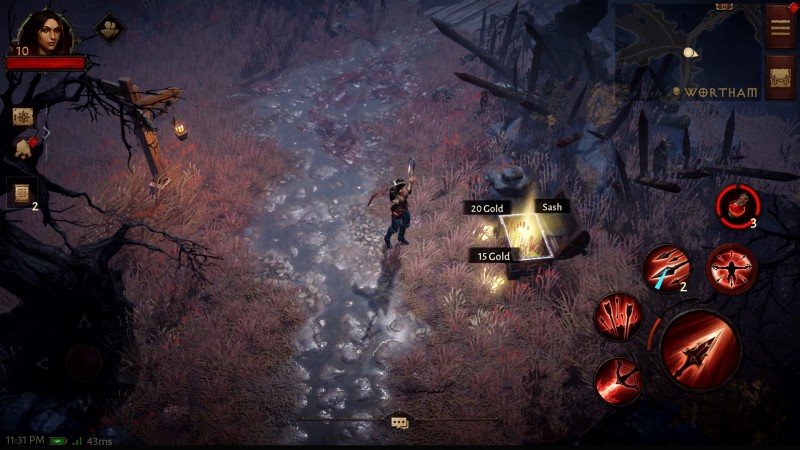
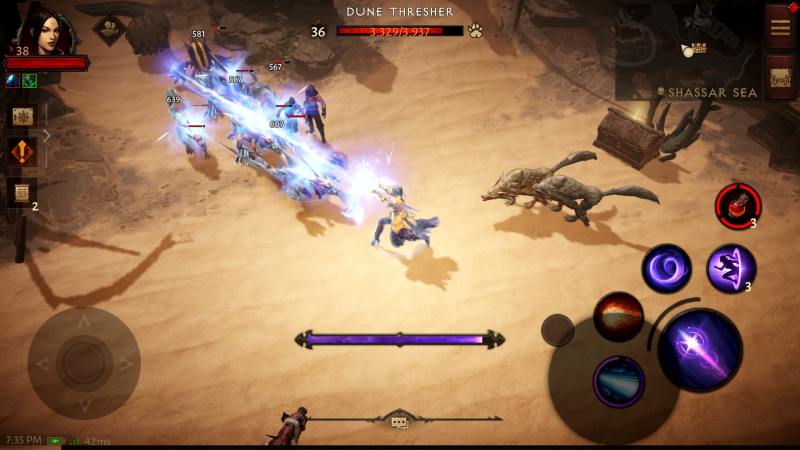
My fingers would ache for hours after playing Diablo Immortal; my hands haven’t spent this much time curled around my phone this way in years. Despite the pain my aging hands suffered during my first few days with Immortal, it was worth it for the fun I had. The series’ core action/RPG smash and loot gameplay makes the transition wonderfully to mobile thanks to responsive controls designed for portable play and adherence to the sights and sounds of the franchise. With this mobile facelift comes a free-to-play model most can avoid spending money on, but some specific parts of its monetization model blemish this game. This is disappointing, as the game offers an otherwise strong experience.

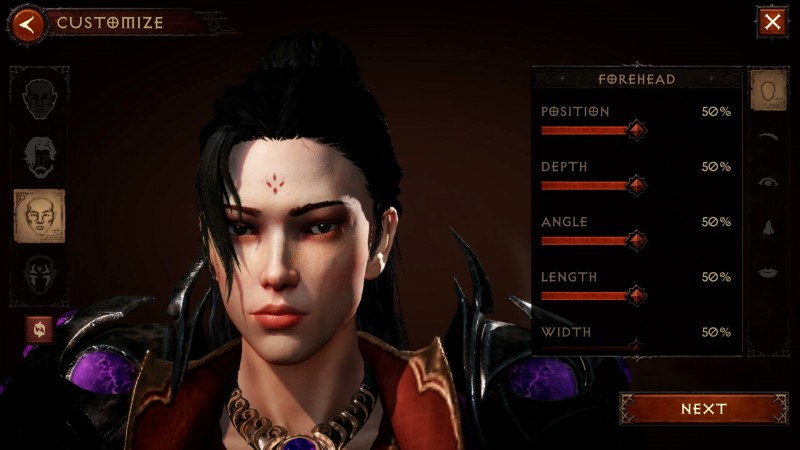
Immortal feels like a modern Diablo game thematically and aesthetically, and it often reminds me of a great mobile version of Diablo 3. Choosing between the six available classes – Barbarian, Wizard, Demon Hunter, Necromancer, Crusader, or Monk – you soon search for the shards of the shattered Worldstone, a vital relic from previous games. Despite Immortal taking place in the 20 years between the events of Diablo 2 and Diablo 3, the narrative is surprisingly ripe with gripping lore. A demon named Skarn aims to fill the power vacuum left after Diablo and Baal fell, causing more chaos for the never-peaceful plane of Sanctuary. Classic characters like Deckard Caine return, while new faces such as Jin and Rayek expand the established Diablo narrative in ways I appreciate.

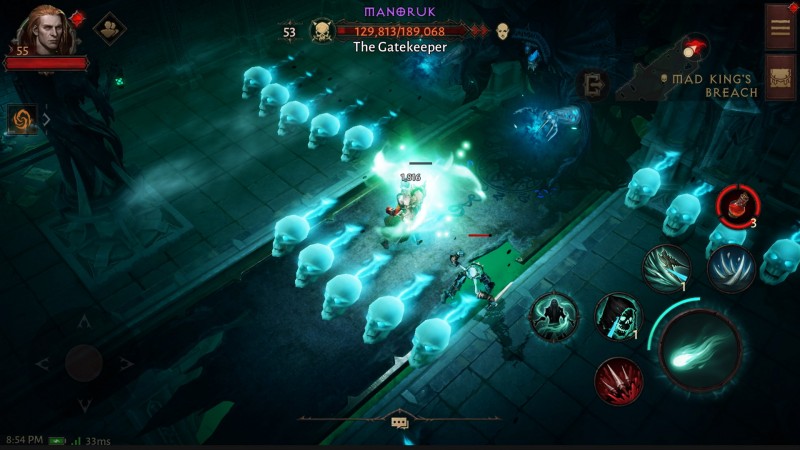
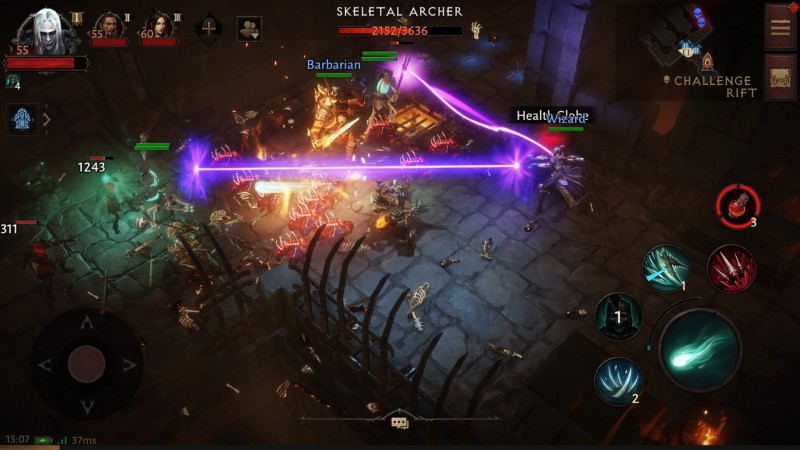
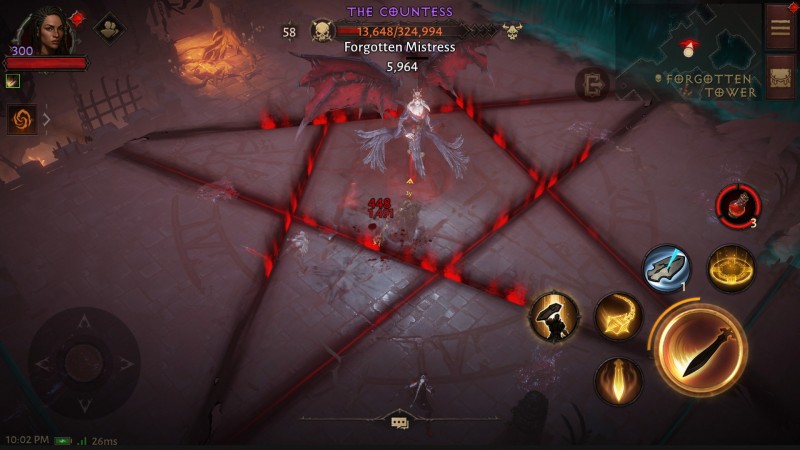
Playing Diablo Immortal is a treat; the intuitive and responsive touch controls are some of the best I’ve used in a mobile game, save for some minor hiccups. Skills can be performed by touching the vicinity of a virtual button and aiming with the swipe of my thumb. Launching a fireball or dashing your character into a demonic horde this way feels great. Still, there is room for improvement in hit detection for some ranged attacks that miss when they appear on target, causing some frustrating moments in the heat of battle.

Adventuring around the zones of Sanctuary reveal other players duking it out with monsters, accentuating that Immortal is an MMO by nature. While this design choice sacrifices the world map’s traditional random generation, I grew fond of how alive each zone feels with real people populating the area. Immortal features plenty of ways to group up with others. That includes 8-player Warbands for tight-knit squads alongside larger 100-player Clans that can show their allegiance to the PvP factions known as the Immortals and Shadows. I love getting a group together to run a bespoke four-player dungeon or even team up with someone on the fly to clear out the area’s bounties and knock off a few quests on the Battle Pass.


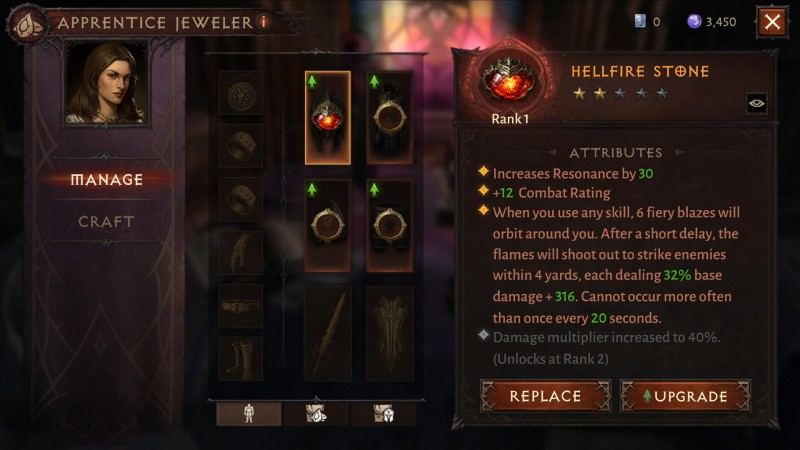
As a free-to-play game, Diablo Immortal has a handful of monetization options. In my experience, you can play just about every aspect of the game without paying a dime, and I appreciate that being the case. A premium battle pass (paired with a free reward track) and cosmetics for sale in the shop are among the less intrusive expenditures, implemented in a way that doesn’t feel exploitative. What is concerning, however, is certain items are extremely limited for free-to-play players but available for a real-money fee. These crests provide legendary gems with variable star ranks and stats that benefit endgame progression greatly. Not only is this special crest extremely hard to get for the non-paying players, but the odds of a high-quality gem dropping even when you’re spending plenty of cash makes this part of the free-to-play system disgusting. Considering how I’m delighted with most other aspects of Diablo Immortal, the monetization systems currently in place are deeply disappointing and truly sully what is otherwise a great experience.

I was looking for a substantial Diablo experience to play on my phone with Immortal, and it often reaches that bar. While I don’t see myself going deep into the endgame unless Blizzard resolves the issues with legendary gems, I still plan to spend hours in Diablo Immortal, leveling a character in every class and playing until my hands ache.

GI Must Play

Score: 8.5

About Game Informer's review system

Purchase

Wednesday, June 8, 2022

Mario Strikers: Battle League Review - Just Off The Post

Reviewed on: Switch
Platform: Switch
Publisher: Nintendo
Developer: Nintendo
Rating: Everyone 10+

Soccer is considered by many the world's most beautiful game. There's an elegance to the way players pass, score, and celebrate during their time on the pitch. While Mario Strikers: Battle League may share foundational DNA with its real-world inspiration, it focuses more on brutality over beauty. 

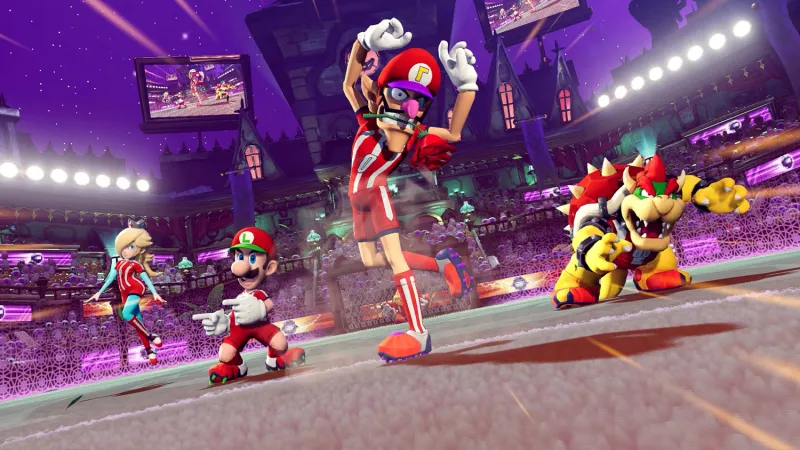
The setup for Battle League is simple: Players choose from the familiar suite of Mario, Luigi, and the rest of the Mushroom Kingdom, assembling teams of four controllable characters and an A.I. goalie. From there, you descend into customizable arenas in front of rowdy fans and duke it out for soccer supremacy.

At times, Battle League feels more aligned with a fighting game than soccer. There are no rules; pulverize the enemy whenever you can. Kick them into electric fences. Shoot shells and banana peels at them. Utilize whatever brutal tactics you see fit. As a competitive person, I found the chaotic gameplay enthralling, and I loved learning the ins and outs of characters from match to match.

While the game doesn't shy away from being a brutal bloodsport, Mario Strikers also rewards you for using these mechanics with tact and strategy; every move on the pitch has consequences. Tackling is a powerful way to disrupt the enemy team and secure the ball but also results in opponents getting a chance to nab an item from the crowd. If you miss a tackle and the opposing player dodges at the right time, they get a speed boost and increase their chance of scoring. The amount of strategy in Mario Strikers surprised me but also kept me engaged as I learned the best ways to score a goal and reign victorious.

Mario Strikers: Battle League

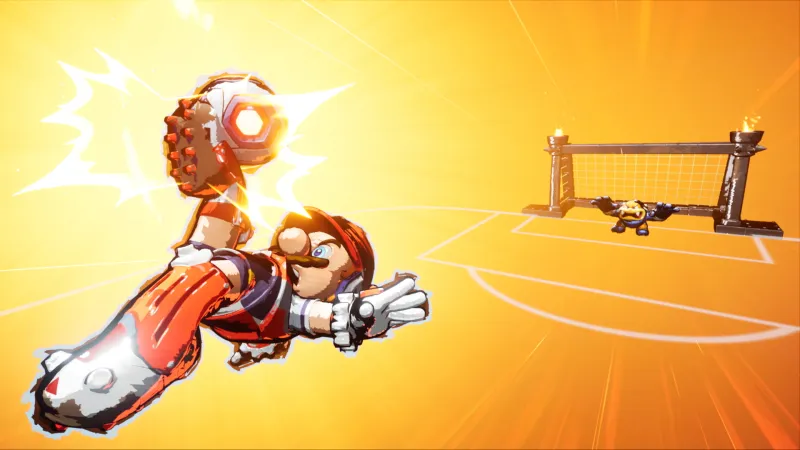
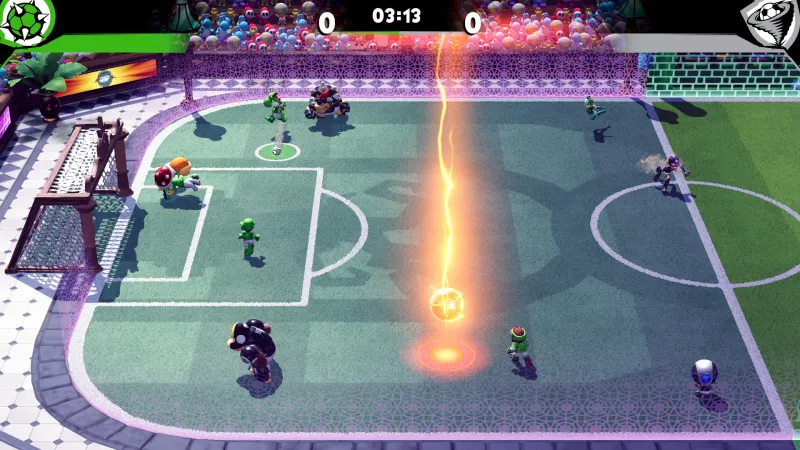
Nothing epitomizes that strategic dance better than Hyper Strikes. These stylish two-point shots are earned through on-field orbs and can blast past your opponent's goalie if your timing is right. There's a risk, though, as mistiming the sequence allows opposing goalies to block your shot, or worse, opens you to tackles and breakaway chances from the enemy team. While the scenes are flashy and fun at first, I found myself wishing I could skip them and return to the game at hand. Nevertheless, these moments are exhilarating, leading to pure elation or crushing defeat in the blink of an eye.

While strategy on the pitch is essential, team composition in the pregame is almost as important, and each of Nintendo's iconic characters have specific areas where they excel. Bowser may be slow, but he's an expert shot. Donkey Kong is adept at strength and knocking people off the ball. Toad speeds down the field in no time. Especially on a greater difficulty, keeping a balanced team is imperative when countering what the opposing squad throws at you. There were plenty of times I got burned for loading up on shooters who struggle with passing, and I paid for it when the opponents intercepted the ball and scored. This need for balance forced experimentation with characters I wouldn't normally pick and gave meaning to my casual matches as I learned who best fit my play style.

Mario Strikers: Battle League

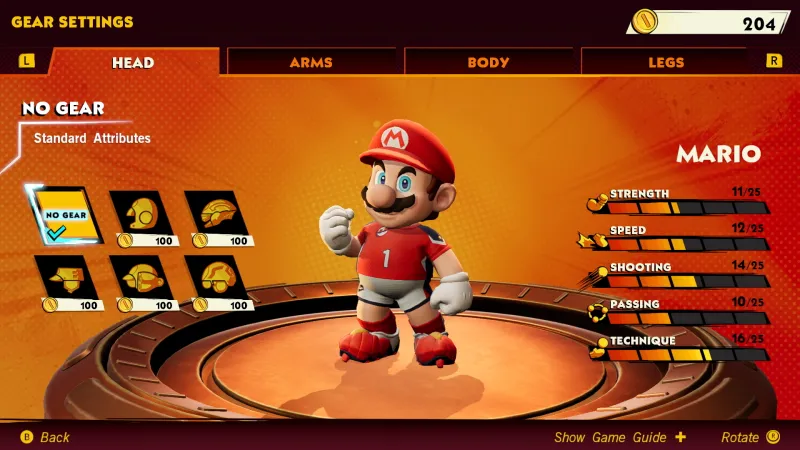
Once you find a team comp you enjoy, utilizing gear and boosting its best attributes is essential. Coins earned from matches can be spent on equipment, affecting how each character controls. These stat boosts come at a cost, though, as each buff to one category brings down another. At first, I largely ignored the gear system, but the steeper the challenge got, the happier I was having boosts in passing and shooting as I delved further into Battle League's different modes.

Those modes are where Mario Strikers loses a bit of its luster – save for one exception. The single-player experience comes from Quick Battle solo sessions and Cup Battles. The former is your standard match, whereas the latter is a tournament where players move up a bracket and vie for trophies and larger sums of coins. Cup Battles were more enjoyable than the standard Quick Battle, given I knew I was working towards more rewards. The problem is, outside of the slight difficulty scaling and teams being tailored around a specific attribute, Cup Battles aren't all that different from standard matches. Sure, they were enjoyable, but I found they were helping me learn the game more than posing a considerable challenge – aside from the occasional competitive championship round.

Mario Strikers: Battle League

While other modes offer plenty of fun, the real highlight is Strikers Club. This new mode allows you to bring in your unique character and form a soccer league with friends and the community. As the club owner, You can explore many features, such as naming your own league, creating your own jerseys, and even designing the field. Some of these customization options only unlock by spending tokens earned from matches in Strikers Club, which comes as a small disappointment to those looking only to explore single-player modes. Still, I relished the heightened sense of competition I felt playing online, and I'm excited to keep building my club and experience a full season alongside a group of friends as time goes on.

For those looking for more of a challenge, there's a hard difficulty in Quick Battle. But it's not for the faint of heart. Computer players are smothering and will make you pay at almost any moment if you happen to turn the ball over or miss a tackle. I welcomed the extra difficulty since I could waltz through previous Cup Battles, but it exposed some of the game's more frustrating A.I. 

At times, my goalie looked like Tim Howard in his prime, blocking everything near him without breaking a sweat. Other times, they would let in the weakest shot from one of the corners and cause me to erupt in anger. The same can be said of computer teammates, who generally did a good job getting into position to score and defend, but then let a ball daintily bounce off them, allowing the other team to score with ease. I make plenty of mistakes that cost me dearly during a match, but nothing was more frustrating than when I was doing my best Messi impression, only for one of my A.I. teammates to cost me a game. 

Mario Strikers: Battle League may not be the ultimate version of the world's most popular sport, but its strategic matches, fun online modes, and energetic animations make for an enjoyable experience. While the single-player crowd may find the game a bit lacking, Nintendo's return to the pitch is bound to create the same triumphant highs, and friendship-ending lows the company's suite of other party titles is known for.

Score: 7.5

About Game Informer's review system

Purchase