This is default featured slide 1 title

Go to Blogger edit html and find these sentences.Now replace these sentences with your own descriptions.This theme is Bloggerized by Lasantha Bandara - Premiumbloggertemplates.com.

This is default featured slide 2 title

Go to Blogger edit html and find these sentences.Now replace these sentences with your own descriptions.This theme is Bloggerized by Lasantha Bandara - Premiumbloggertemplates.com.

This is default featured slide 3 title

Go to Blogger edit html and find these sentences.Now replace these sentences with your own descriptions.This theme is Bloggerized by Lasantha Bandara - Premiumbloggertemplates.com.

This is default featured slide 4 title

Go to Blogger edit html and find these sentences.Now replace these sentences with your own descriptions.This theme is Bloggerized by Lasantha Bandara - Premiumbloggertemplates.com.

This is default featured slide 5 title

Go to Blogger edit html and find these sentences.Now replace these sentences with your own descriptions.This theme is Bloggerized by Lasantha Bandara - Premiumbloggertemplates.com.

Thursday, July 11, 2024

Anger Foot Review – An Adrenaline-Packed Foot Race

Anger Foot review

Reviewed on: PC
Platform: PC
Publisher: Devolver Digital
Developer: Free Lives

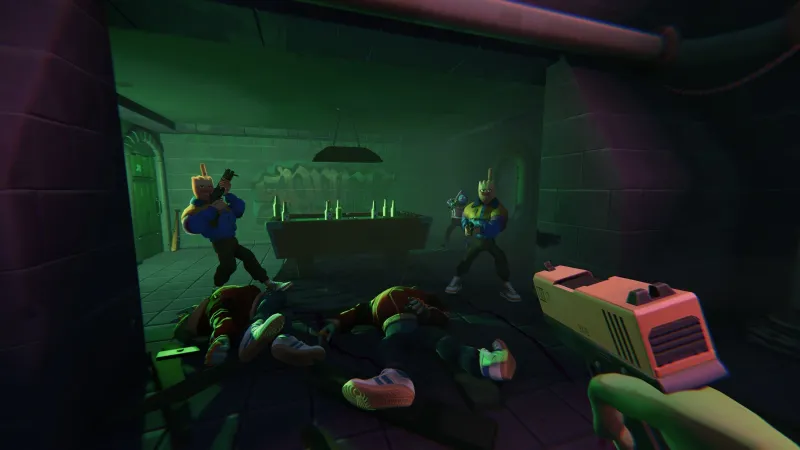
Anger Foot exemplifies a simple idea executed to the ninth degree. As a furious sneakerhead possessing seemingly the deadliest legs in the world, you must retrieve your prized collection of stolen footwear by kicking everything in sight. The bombast accompanying this wacky premise – fast-paced, split-second action, satisfying gunplay, and delectable destructibility – turns Anger Foot from a one-kick pony into one of the year’s most exciting, challenging, and tough-to-put-down adrenaline rushes.

Taking place on the seedy streets of Crime City, where crime is not only encouraged but is a way of life, you’ll plow through four gangs and their leaders across dozens of levels to retrieve your pilfered sneakers. Initially, your bare foot is your best and only weapon, as kicking sends the litany of armed goons flying, showcasing the satisfying (and, sometimes, hilariously broken) ragdoll physics. This first-person action game's frantic yet thoughtful pace is delightfully reminiscent of Hotline Miami and Doom. At best, you can complete the small, densely packed stages in under a minute, and success means quickly and strategically taking out deviously placed foes before they can off you. 

Since only one or two hits kill players, fast reaction timing and, for better or worse, trial-and-error win the day. Levels can border on being labyrinthine with enemies hiding in blind spots or lurking behind doors, and you won’t discover their presence until their bullet enters your skull. Some deaths feel cheap due to sometimes questionable enemy placement that makes taking damage seem unavoidable in spots. Other times, you're a victim of physics; a grenade that misses the first time may bounce off something and unexpectedly land at your feet the second time. Dying means starting the stage anew, and while that stings after a good run, instant respawns hasten the process of repeatedly running through levels and absorbing their layouts. 

Kicking foes feels great, but Anger Foot also encourages strategic use of the environment and your opponents, such as kicking doors into distant targets or sending exploding enemies careening into their allies. Wielding firearms, such as handguns and shotguns, plus more exotic fare like crossbows that impale multiple foes and flamethrowers, adds a complementary ranged aspect to the melee-focused action. Gunplay feels awesome, and you can even throw empty weapons to stun targets, providing perfect setups for a kick. I also enjoy how the various enemy types encourage me to change tactics on the fly, such as shield-bearing foes blocking gunfire or speedy, knife-wielding mice focusing on relentless swarming. The multi-stage boss fights are enjoyable (and absurd) but don’t compare to the thrill of blasting through the standard levels. 

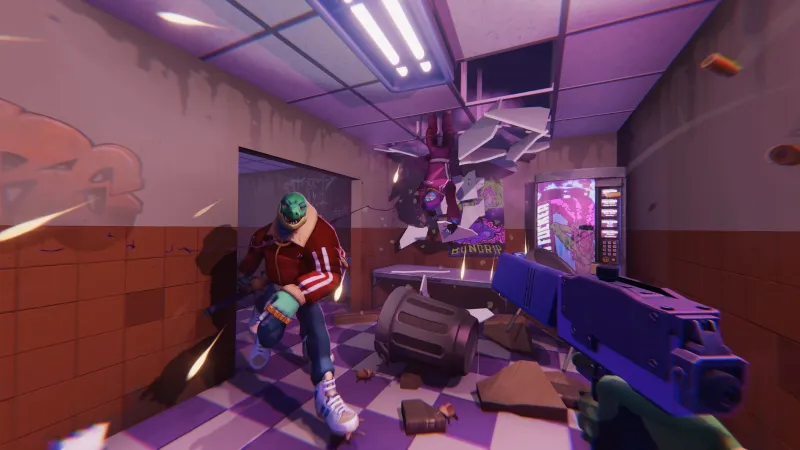
When Anger Foot is firing on all cylinders, which is often, it’s a gleefully chaotic execution of skill and resourcefulness. I love slipping into the flow state of running into rooms, rapidly taking out adversaries, grabbing their guns, lobbing depleted firearms to stun other targets, and kicking everything in sight. A mindless approach can work, but more often, it pays to have an ideal order of operations for eliminating threats and pinpointing every environmental advantage. Copius destructibility means encounters often devolve into a parade of exploding rubble, splintered wood, and shattered glass that leaves rooms looking like a tornado plowed through them. This element can be advantageous; why pick off goons perched atop scaffolding when shooting an explosive barrel sends the entire structure tumbling down? Though the framerate occasionally dips when the action overindulges in explosions and enemy mobs, it runs smooth as butter otherwise. 
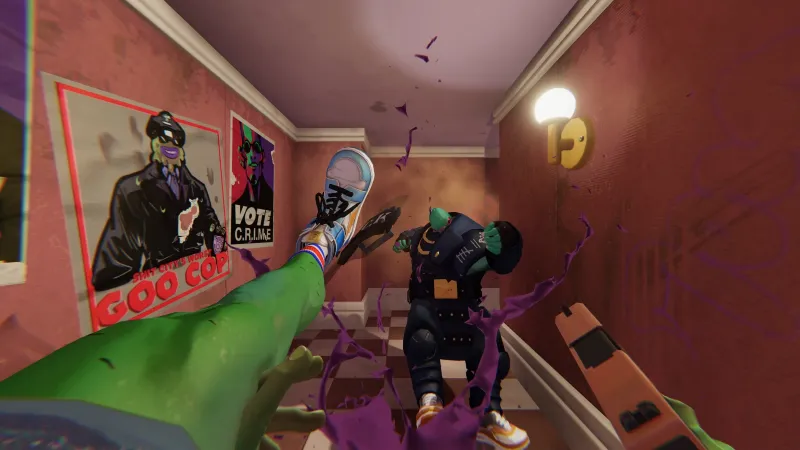
 

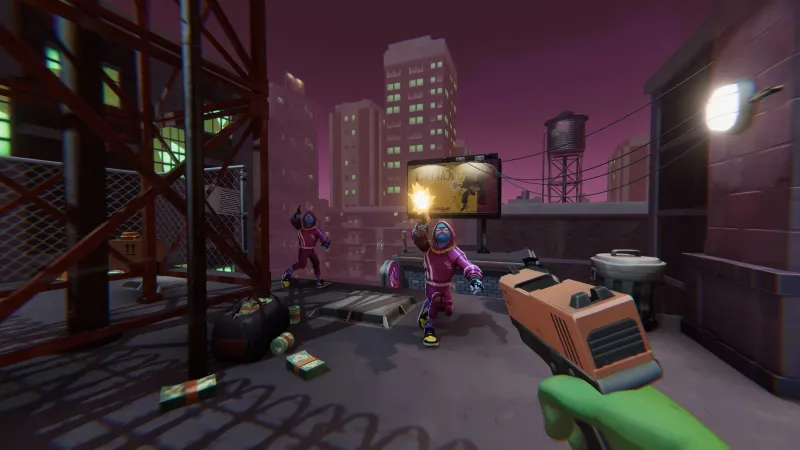
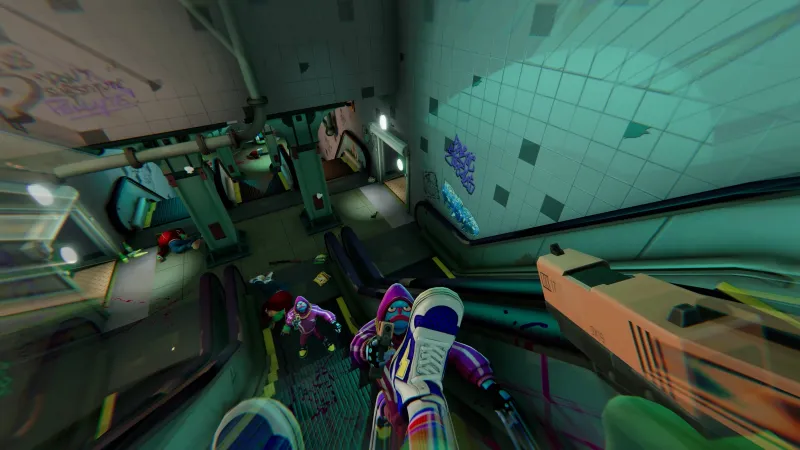
Anger Foot regularly introduces new ideas and mechanics to keep the gameplay and challenge fresh. Highlights include hopping across and dodging trains in a subway and kicking across rooftops while avoiding a sniper’s laser sight. I always looked forward to seeing what a level had in store and was often surprised and enthusiastic to tackle whatever obstacle developer Free Lives concocted. 

Completing stages and optional objectives, such as finishing it under a time limit or taking no damage, rewards up to three stars spent toward unlocking ability-granting sneakers. You can only wear one pair of these special shoes at a time, and they add fun wrinkles to the action. Some provide helpful perks, like a shoe that grants an extra life or one that causes doors to explode when kicked. Other shoes function like silly cheat codes, like a pair that reduces gravity, meaning everything, yourself included, floats. One useful shoe gives enemies comedically large heads, making them easier targets for headshots. Shoes can be potent game changers, providing a strong hook to replay stages and complete supplementary tasks to unlock them all. 

Defeat can be a bitter pill in Anger Foot, but I was amazed at how eager I remained to jump back in time after time. Firefights remained an exciting challenge even if I’d played it numerous times. Thwarting foes milliseconds before they pull the trigger, either by brute force or cleverly utilizing my surroundings, never ceased to feel cool. You should definitely walk a mile in these shoes.

GI Must Play

Score: 9

About Game Informer's review system

Purchase

Wednesday, June 26, 2024

Super Monkey Ball Banana Rumble Review - A Ripe Return

Super Monkey Ball Banana Rumble

Reviewed on: Switch
Platform: Switch
Publisher: Sega
Developer: Ryu Ga Gotoku Studios
Rating: Everyone

Outside of remasters and remakes, the Super Monkey Ball franchise has been dormant for a decade. At a certain point, it began feeling like AiAi and his crew of monkeys were relics of a bygone era and that Super Monkey Ball was little more than a nostalgic series that has no real place in the modern gaming landscape. Super Monkey Ball Banana Rumble disputes that assertion by delivering an experience that’s at once delightful, maddening, and rewarding, but above all else, fun.

At its best, Banana Rumble’s Adventure Mode delivers some of the top stages in Super Monkey Ball history. Particularly early on, I relished figuring out the optimal strategies to roll through the puzzle-like levels while achieving the three optional missions of collecting a set number of bananas, grabbing the golden banana, and finishing in a set time. Thanks to the new spin-dash move, I loved figuring out ways I could launch my character off ramps and lips to rocket through the goal or grab the golden banana.

The early stages best exemplify the series’ easy-to-learn, difficult-to-master hallmark. Blasting through stages in the first few worlds is intuitive and lighthearted thanks to improved physics and a better camera. Those levels are ripe for experimentation into the best ways to get through the level efficiently; on multiple occasions, I wondered if the developers intended for me to complete the stage in that manner or if I discovered some kind of secret. Those stages represent the Super Monkey Ball franchise at its absolute peak.

As you would expect, progression through Adventure Mode’s campaign brings increasingly difficult stages. Though I love trying to work my way through a difficult level, the restrictive nature of these more challenging obstacle courses often squashes my favorite aspect of this mode: experimentation. Instead of trying to find optimal paths and ways to sequence-break the levels, later stages in the game just had me fighting for survival as I desperately tried to make it to the goal.

The stages near the end of the 200-level campaign transcend Banana Rumble’s cute and colorful aesthetic to deliver pulse-pounding challenges that had me gripping my controller as tightly as I could while my character careened around corners and tempted fate with death-defying jumps. I largely enjoyed these levels, though they sometimes shined a light on the limitations of even the improved physics system, and the busier the stages got, the more noticeable the performance dips became.

If these stages ever feel too difficult, you can turn on Helper Functions, which add a ghost guide, arrows demonstrating the best path, a rewind function, and a mid-stage checkpoint. Though I used them extremely sparingly, if I ever turned them on, they immediately proved invaluable in getting past the roadblock I was stuck on.

Adventure Mode can be played with up to 4 players in co-op, but the real multiplayer experience allows for up to 16 players to compete in various party-style minigames. Players can compete in drawn-out races where rubber-banding comes not through the A.I.’s ability but rather the course being more challenging the further towards the front you are. I loved this twist on the tried-and-true formula, particularly with the various power-ups injecting extra chaos into the mix.


Meanwhile, Ba-Boom provides a fun survival-based tag variation, and Goal Rush challenges your precision and mettle as you roll down a hill, activating gates in a high-risk, high-reward blitz. The other two Battle Modes, Banana Hunt and Robot Smash, have you collecting bananas on an open map and launching into robots to deal as much damage as possible, respectively. Banana Hunt and Robot Smash were my least favorite of the bunch, but they still serve as fun side activities to Adventure Mode’s main course.

Super Monkey Ball Banana Rumble aptly demonstrates that the franchise still has something to offer in 2024 beyond nostalgia. With an eclectic mix of platforming levels and party games, Banana Rumble holds little back, offering a robust package that effectively announces the series’ true return.

Score: 8

About Game Informer's review system

Purchase

Tuesday, June 25, 2024

Still Wakes the Deep Review - I Sea Dead People

Still Wakes the Deep

Reviewed on: PC
Platform: PlayStation 5, Xbox Series X/S, PC
Publisher: Secret Mode
Developer: The Chinese Room
Rating: Mature

There’s something quite special about Still Wakes the Deep. A horror game, quintessentially Scottish through and through, with an atmosphere so tense you could hear your heart pounding as you explore areas, has the right ingredients to make for a memorable experience. Additionally, it’s made by The Chinese Room, the studio behind multi-awarded titles such as Dear Esther, Everybody’s Gone to the Rapture, and Amnesia: A Machine for Pigs. And yet despite these advantages, it still falters when it comes to the fundamental facets.

Still Wakes the Deeps puts you in the shoes of Cameron “Caz” McLeary, an engineer working aboard the Beira D oil rig, which is located somewhere in the North Sea. Caz, who’s having domestic troubles, will soon experience much worse, as what was initially thought of as a machinery malfunction leads to something darker and deadlier. His fellow workers all know that something has gone wrong, but when you’re stuck in the middle of nowhere, you don’t really know if help will ever arrive. What follows is a tightly woven, dread-inducing romp where you’re not entirely sure if anyone will survive the night. Think of it as The Thing meets Amazon’s The Rig – just replace the glowing spore pods with actual monsters, and you’re on the right track.

Right from the onset, Still Wakes the Deep immerses you in its setting thanks to a talented voice cast composed of Scottish actors. To be clear, I’m Filipino and I know next to nothing about Scotland, save for the fact that figures like William Wallace and WWE’s Drew McIntyre are from thereabouts. Despite this, I was hooked, especially when characters started churning out regional slang after slang, some in the Glaswegian dialect.

Granted, I did have a hard time understanding the thick accents and certain terms; for instance, I wondered who “Leckie” was, only to realize that it’s another word for electricity. However, this just proves the studio’s dedication to offering an authentic experience, and I appreciated having a little glimpse at a culture and dialect I’m not familiar with.

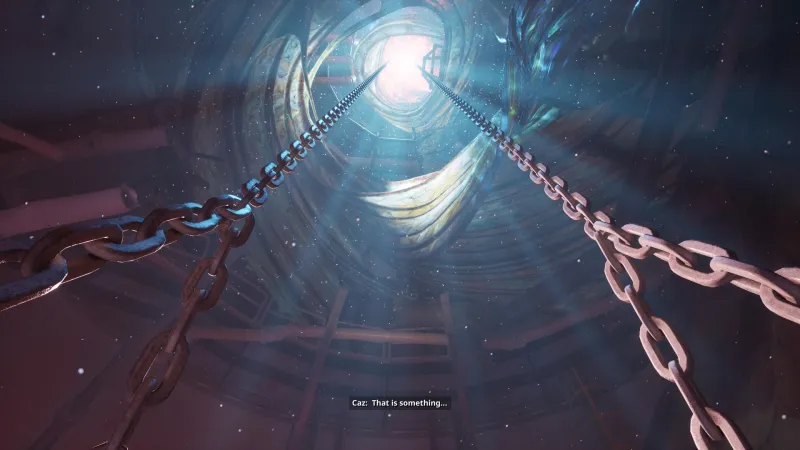
Likewise, I found the layout of the oil platform nothing short of fascinating. Yes, the facility consists of small rooms, narrow hallways, and large decks, and I mostly revisited the same areas during my playthrough. However, a certain creative flair arose when I realized how each area looked and felt different due to the events that transpired as I progressed. For instance, corridors accessible beforehand might be flooded down the line, and open doors might become barred later, covered in a mysterious pustulent growth. Interconnectivity also comes into play, especially with facility maps that point to my location as I reach new sections.

Moreover, the game has its fair share of context-sensitive interactions, such as using fire extinguishers, unscrewing ventilation shaft covers, and removing latches off contraptions. There are also several platforming sections, where you jump or shimmy across gaps or climb on ladders, with quick-time event button presses to prevent you from falling. And, yes, there are some parts where you have to swim to safety. All in all, these sections are simple, straightforward, and unchallenging to a fault, though they served as welcome respites from the core theme: body horror.

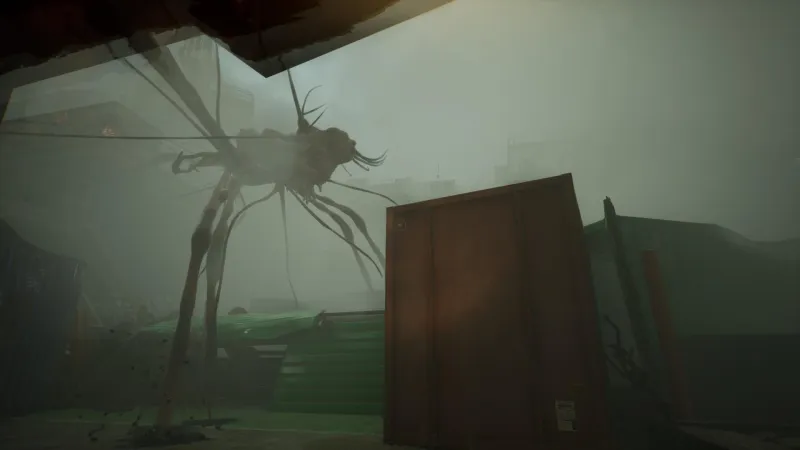
What drew me in within the first few hours of playing Still Wakes the Deep was the sense of foreboding. As mentioned earlier, the machinery malfunction on the oil rig leads to eldritch nightmares “waking from the deep.” At first, I could only see a few glimpses of what’s in store, like some red sinewy branch jutting out from the water or a vine-like object stretching across several corridors. Then, things got progressively darker, with the tense atmosphere building up thanks to spectacular shadow and lighting effects.


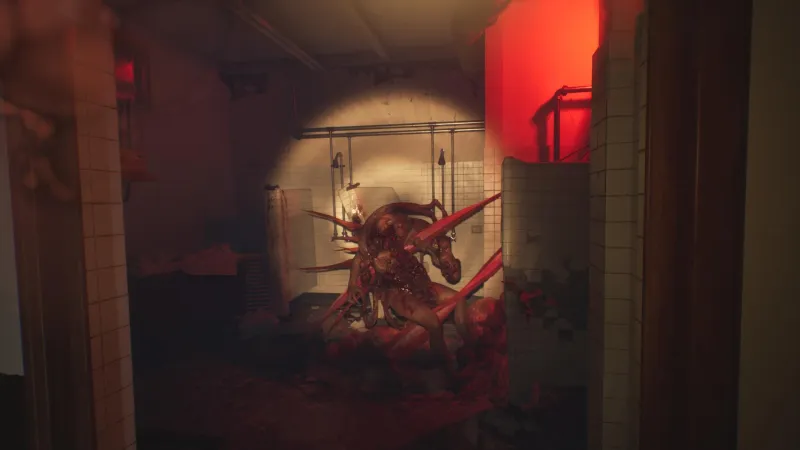
Shortly thereafter, I’d hear the pained moans of a worker begging for help and the bloodcurdling screeches of another who’s been driven mad. And then I’d see what had happened to them: words like macabre and grotesque are understatements when I saw people who’ve been smashed into fleshy blobs, faces frozen in a death scream. They have multiple limbs, clickety-clacking as they move about, all while calling out Caz’s name. One of them is actually just a big head with little arms who chases Caz all over the facility. The creature designs, as well as people who are in the throes of mutation, are gross, vile, and downright impressive to boot.

Sadly, Still Wakes the Deep botches the “survival” in “survival horror.” The single most surprising part of the game is that all these eldritch creatures, no matter how scary they look, are dumber than a bag of rocks.

Since there’s no combat or weapons, I primarily relied on stealthily making my way through rooms crawling with enemies, sometimes throwing bottles to create a distraction. If a monster so much as spotted me, all I had to do was hide underneath a desk, walkway, or pantry, and they’d be none the wiser. Those long limbs they have? They just clickety-clack; they don’t clickety-grab. Those sharp serrated teeth and gaping mouths? They won’t bite you if there’s a structure above your head. They’d see you, and then they’d forget about you after a few seconds, or they’d simply wiggle in front of you. 

Outside of chase sequences, which were few and far between, there was very little to excite me upon encountering these monsters once I realized the A.I.’s limitations. Coincidentally, blurry and spotted outlines do appear on the edges of your screen when staring at these entities and their otherworldly goop, though there are no other effects; it walks up to the line of including debilitating “sanity” mechanics, but since they aren’t actually present, it felt more like a tease.

Still Wakes the Deep is a relatively short game (I completed the campaign in under five hours). The story is strictly linear, akin to some of The Chinese Room’s other games, with no collectibles or secrets. While it’s true that the game builds on the setting, atmosphere, tension, and body horror, it flubs the most crucial aspect: the moments when you actually face the creatures. It’s like if The Thing was “from another world,” but it’s revealed to be E.T. due to how harmless it is. In the end, this romp through an infested oil rig might look slick, but it spills over and slips when it matters most.

Score: 7

About Game Informer's review system

Purchase